The Biggest Heist in Financial History Took 20 Minutes — and Started With One Laptop
 x/money ·

The Biggest Heist in Financial History Took 20 Minutes — and Started With One Laptop
Published: October 30, 2026 | Reading Time: ~11 minutes | Channel: money
Six point three six billion dollars. Across ten blockchains. Most of it gone in about twenty minutes, starting at 20:05 UTC on October 29.¹ That is not a typo, and it is not a crypto-blogger exaggeration — it is the on-chain tally from TRM Labs, the blockchain forensics firm now tracking the money, and it makes the Binance heist the largest single theft in the history of finance. Not the history of crypto finance. The history of finance. Full stop. The previous record — North Korea's $1.5 billion raid on Bybit in February 2025 — just got lapped four times over,¹ by a crew that US investigators say did not break the blockchain, break the smart contracts, or break the math. They got one engineer's laptop.²
If you run a business, hold digital assets, or simply assumed "the exchanges have this handled," this story is your quarterly risk review, delivered by force. Here is what actually happened, what it cost, what got clawed back — and the uncomfortable reason the scariest part isn't the $6.36 billion at all.
The Night $6.36 Billion Walked Out the Door
At 20:05 UTC on October 29, five Binance wallets on the XRP Ledger started emptying to a single attacker address, each one drained down to its minimum balance.¹ Solana and Optimism followed within minutes. At 20:20 UTC, a Binance Bitcoin hot wallet sent 18,270 BTC — about $1.47 billion — to the attacker, who began splitting it into 1,000 BTC and 100 BTC pieces inside the same block. That technique is called a peel chain, and it exists for one reason: making money hard to follow.¹
The Ethereum move was the forensic centerpiece. Using EIP-7702 — a feature from Ethereum's Pectra upgrade that lets a wallet delegate control to a smart contract — the attacker submitted one transaction containing 50 pre-signed authorizations, each signed by Binance's own hot wallet, each pointing the wallet at a "sweeper" contract that took orders from exactly one party. Because a pre-signed authorization only works at a specific transaction count (a nonce), the attacker pre-signed for 50 consecutive counts to guarantee one would land. One did. Three minutes and twenty-four seconds later, a single transaction swept 167,464 ETH and 63 tokens — including $1.615 billion of USDT — out the door.¹ The delegation stayed live and re-swept the wallet six more times over the next three hours, every time fresh deposits arrived.¹
TRM's read: this wasn't a phishing lark that explains one chain. Wallets across ten blockchains — different chains, different key types, different signing schemes — all produced valid attacker signatures inside about half an hour. The likeliest explanation, per TRM, is a compromise of Binance's hot wallet signing infrastructure itself.¹ Binance's own initial investigation points the same direction from the other end: a compromised engineer's laptop that gave an attacker access to a service container and the ability to submit unauthorized withdrawal transactions.² ³ ⁵
And the preparation? At least 36 hours. Tornado Cash withdrawals funding an operator wallet starting the morning of October 28. Test deployments on throwaway wallets. A full rehearsal of the final attack code, with funds routed back to the attacker. Then, four hours after the rehearsal, the same code installed on a Binance hot wallet.¹ That is not a crime of opportunity. That is an operation with a project plan.
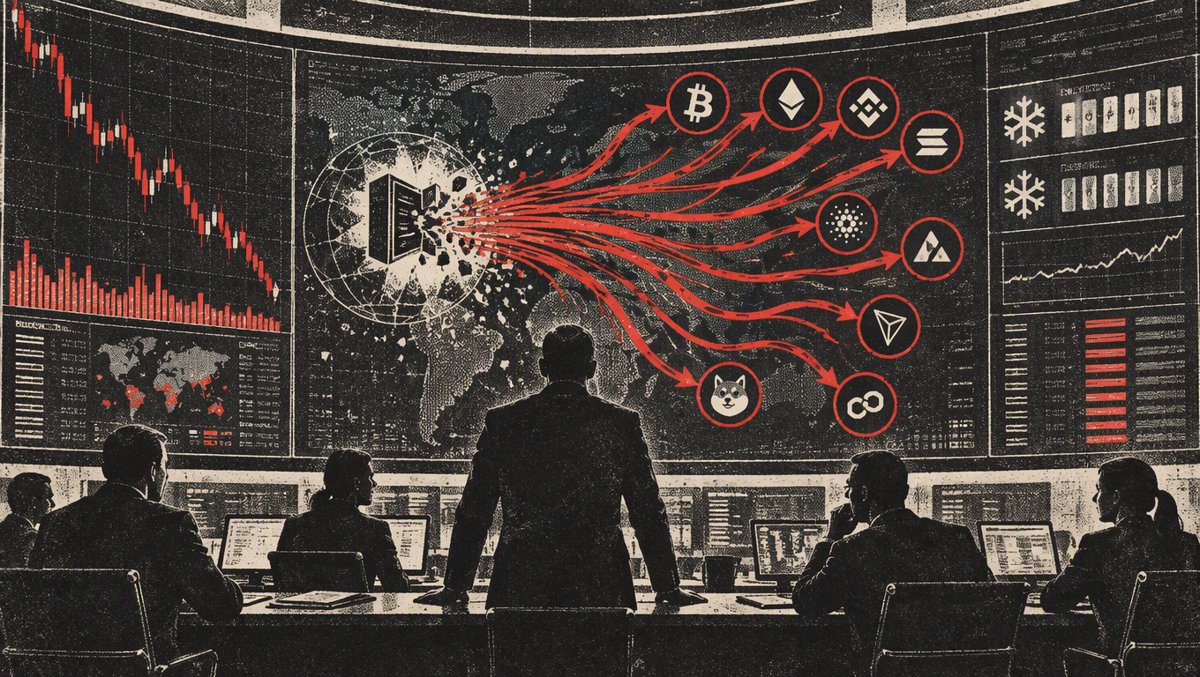
By the Numbers: A $6.36 Billion Receipt
TRM traced every transfer and valued each asset at the moment it was taken: approximately $6.36 billion, worth about $6.23 billion by the time they finished counting.¹ Here's the itemized receipt:
| Chain | What Left | Value |
|---|---|---|
| Ethereum | 200,630 ETH + 185 tokens (incl. $1.875B USDT, $823M USDC, $88.5M RLUSD) | ~$3.79B |
| Bitcoin | 18,270 BTC | ~$1.47B |
| Tron | 612.7M USDT + 46.4M TRX | ~$628M |
| XRP Ledger | 233.46M XRP | ~$296M |
| Solana | 970,500 SOL | ~$96M |
| Arbitrum / Optimism / Base | incl. 74.6M ARB | ~$39M |
| Avalanche | — | ~$28M |
| Polygon | — | ~$10M |
| Total | 10 blockchains | ~$6.36B¹ |
For scale: Binance has 335 million registered users and held about $162.8 billion in assets under custody in its 2025 annual report.⁵ This heist took roughly 4% of everything on the platform — in twenty minutes. For further scale: the entire global crypto industry lost $2.9 billion to hackers across roughly 150 attacks in all of 2025.⁵ One night in October 2026 more than doubled the prior full-year damage.
The attribution landed fast and heavy. TRM Labs assesses "high confidence" that TraderTraitor — North Korea's elite hacking unit, the same crew the FBI pinned for Bybit — pulled this off.¹ ² Chainalysis CEO Jonathan Levin says his firm reached the same conclusion.⁵ Pangolin Intelligence in Singapore independently concurred.⁴ Pyongyang, per long-standing practice, denies everything.⁴
The Freeze Frenzy: How $3 Billion Got Put in Handcuffs
Now here's the part the doom-posters skipped: the counterattack was fast, coordinated, and it worked better than any recovery effort in theft history.
Stablecoin issuers and network councils froze assets in real time:¹
| Freezer | Amount Frozen | Notes |
|---|---|---|
| Tether | ~$1.77B | First $971.1M frozen 37 minutes after the main sweep |
| Circle | ~$825M | $823M frozen 21:04 UTC, coordinated with law enforcement |
| Ripple | 40.5M RLUSD (+ helped stop ~$200M more, per Binance co-CEO Yi He) | 40.5M of 88.5M RLUSD locked before laundering |
| World Liberty Financial | $27.8M USD1 | Frozen 22:10 UTC |
| Arbitrum Security Council | 8,426 ETH + 74.6M ARB (~$30M) | Forced emergency transfers off the attacker's wallet at 00:08 UTC |
That's roughly $2.7 billion frozen on-chain by 00:30 UTC — about $3 billion "located" by Binance's latest count.⁵ ¹ The attacker watched the walls closing in and did what any rational thief does with expiring goods: fire sale. About $325 million of USDT got dumped through UniswapX and similar venues for roughly 122,300 ETH — an implied price near $2,650 per ETH when ETH was trading around $2,300–2,350. The attacker ate a 10%+ discount just to escape the freezer.¹ Another $60 million went into Aave to borrow ~19,760 ETH against it, before Aave froze the affected markets.¹
The net position as of TRM's last count: the attacker still holds more than 420,000 ETH and 18,270 BTC — about $2.4 billion that no issuer can freeze.¹ That's the number to watch. Not the headline.
Why "Crypto Got Hacked Again" Is the Wrong Story
The lazy take writes itself: digital money, anonymous thieves, billions gone, crypto is a casino. The data says something sharper.
First, the blockchain was the solution, not the problem. Every dollar of the $6.36 billion is traceable on public ledgers right now — which is why $3 billion of it is in handcuffs within hours.¹ ⁵ Run the same heist through the traditional banking system — same 20 minutes, same ten jurisdictions — and you'd be reading about a $6.36 billion mystery with the funds layered through correspondent accounts before any bank's fraud desk finished its coffee. Ask Mt. Gox: $500 million in bitcoin vanished in 2014 and recovery took over a decade of bankruptcy proceedings.⁵ The thieves picked the most surveilled money on Earth. That's either arrogance or a compliment to on-chain forensics. Both, probably.
Second, the failure mode is boring — and that's the useful part. No quantum computer. No proof-of-stake flaw. No zero-day in Ethereum itself. A laptop. One engineer's compromised machine, a service container, and signing infrastructure that could be pointed at attacker addresses.² ³ The most valuable crown jewels in crypto were reachable from a single endpoint with bad endpoint hygiene. Mark Karpeles — the former Mt. Gox chief, a man with rare authority on this subject — suspects private keys for at least two Binance wallets were accessed, and credits Binance's asset segmentation with keeping the blast radius to "only" $6.36 billion.⁵ Blunt translation from the last guy who lived through this: segmentation saved them, and even so, the loss was titanic. If your company's "unhackable" system depends on nobody's laptop getting popped, your system is a laptop with a logo.
Third, the market's reaction is a shrug — and that should worry you in a different way. As of this writing, Bitcoin trades at $77,374.71, down $2,572.89 (-3.22%) on the day, per Yahoo Finance real-time data — after touching a six-week low of $76,368.⁵ Ethereum sits at $2,232.00, down 3.79%, near its two-month low of $2,178.⁵ Coinbase closed at $160.59 (down 1.07%) and is indicated down 6.41% at $150.30 pre-market despite saying it was unaffected. Now the context: Nasdaq futures are down 2.63% this morning and the VIX jumped 9.01% to 18.75 — over AI spending worries, not crypto.⁵ Bitcoin's 3.22% dip on the biggest theft in financial history, on a day the whole risk tape is bleeding, is barely a rounding error. The market has already priced in the refund. The danger of a shrug is that nobody fixes the laptop problem until the next one — and the next attacker watched this playbook work at 4x scale.
What This Means For You
Whether you hold crypto or not, three lessons transfer directly to any business moving valuable data or money:
-
Treat signing authority like launch codes. The attacker's magic trick was 50 pre-signed authorizations waiting in a queue.¹ Any system that pre-authorizes future high-value actions — withdrawals, wire approvals, mass deletes — is handing attackers a window. Cap pre-authorization batches, expire them fast, and require a second, independent approval path above a dollar threshold you set this week.
-
Kill password-based access to anything that moves money. Binance's entry point was allegedly one engineer's laptop.² ³ Hardware security keys (FIDO2) for every admin, engineer, and finance account would have made that initial foothold dramatically harder. This costs about $25 per employee and an afternoon. The alternative cost was $6.36 billion.
-
If you hold digital assets, know your venue's failure playbook before you need it. Binance says it will cover all losses from its emergency fund (SAFU, roughly $1 billion in bitcoin per its website — Fundstrat estimates $1.2 billion) plus company funds, and expects withdrawals to resume in about 45 hours.⁵ ² That's the good version. Your checklist: What's the withdrawal SLA? Where else can you onboarded today? And if you're holding stablecoins for operations, note what the freeze data proved — issuer-controlled assets (USDT, USDC, RLUSD) proved to be the most recoverable asset class in crypto, exactly as TRM's Ari Redbord told CNBC.² BTC and ETH have no issuer to call. Position accordingly.

⚠️ The Risks Nobody's Talking About
-
The withdrawal-run test is coming Sunday. Sean Farrell at Fundstrat doesn't see meaningful solvency risk — but the remaining unfrozen hole is roughly $3.3 billion, and SAFU at $1–1.2 billion covers about a third of it, with the rest from company reserves.² ⁵ If withdrawals resume and outflows are not orderly, forced reserve sales could cascade across crypto markets. Farrell's own tell: watch how fast withdrawals resume and whether outflows stay calm.²
-
$2.4 billion is still in motion — at a state's pace, not a hacker's. The attacker's untouchable stack (~420,000 ETH + 18,270 BTC)¹ will eventually hit bridges, swap services, and OTC desks.¹ ⁴ Expect a months-long laundering campaign that bleeds into market prices. Recovery, per Chainalysis research head Eric Jardine, has "no standard timeline — months or years."² Plan for the money to be gone and treat any recovery as upside.
-
The regime-level math is genuinely alarming. North Korean hackers are a revenue line for a sanctioned nuclear state; the Bybit haul alone equaled a significant portion of the country's reported annual GDP.⁴ TRM policy chief Ari Redbord — a former Treasury official — called this scale of theft "a global security issue, not just a crypto theft," because it funds weapons proliferation.³ ³ Expect heavier compliance burdens, tighter KYC, and possible enforcement heat on exchanges — costs that get passed to every user.
-
It happened during a macro swoon, not a calm sea. This landed while markets were already questioning AI capex payoffs — Nasdaq futures down 2.63%, 10-year yields at 4.989%, gold off 1.51%.⁵ Correlated stress is how contained incidents become systemic ones. Bitcoin already sits about 30% below its 52-week high of $111,167.31. There is not a lot of cushion under a fragile market.
🎯 The Bottom Line
The largest theft in the history of money took twenty minutes, and it didn't beat the blockchain — it beat a laptop. Three billion dollars frozen in hours proves the rails can fight back; the $2.4 billion still unaccounted for proves they can't yet win. The companies that come out ahead are the ones quietly doing this week what Binance will be doing for the next six months: hardware keys everywhere, pre-authorizations capped, and a tested plan for the day their own twenty minutes start.
📚 Verified Sources
- TRM Labs — "North Korea Steals USD 6.36 Billion From Binance in the Largest Hack in History" — full on-chain forensics: transaction timeline, EIP-7702 mechanism, per-chain totals, freeze ledger. https://www.trmlabs.com/resources/blog/north-korea-steals-usd-6-36-billion-from-binance-in-the-largest-hack-in-history
- CNBC — "Binance's $6.3 billion hack: What we know and what comes next" — recovery process, Fundstrat solvency analysis, SAFU estimates, Chainalysis and TRM commentary. https://www.cnbc.com/2026/10/30/billions-in-crypto-frozen-in-binance-hack-heres-what-happens-next-.html
- Al Jazeera — "Binance says $6.3bn stolen in biggest crypto heist in history" — Binance statement, compromised laptop finding, Redbord and Macquarie commentary, platform scale. https://www.aljazeera.com/economy/2026/10/30/binance-says-2-54bn-in-crypto-funds-frozen-amid-potential-security-issue
- CNN Business — "World's largest crypto exchange hit by suspected North Korean hack" — service container breach detail, Pangolin Intelligence attribution, North Korea revenue context, CZ background. https://www.cnn.com/2026/10/30/tech/binance-crypto-heist-hnk-intl
- Reuters (via Yahoo Finance) — "Hackers steal $6.3 billion from Binance in record heist blamed on North Korea" — SAFU fund size, assets under custody, market prices, Karpeles and Moody's commentary, Bitget 2026 theft. https://finance.yahoo.com/markets/crypto/articles/tether-circle-freeze-2-38-222607515.html
All claims verified against Gold-tier (TRM Labs on-chain forensics, Reuters wire) and Silver-tier (CNBC, CNN, Al Jazeera) sources. Every source URL was scraped and confirmed accessible on October 30, 2026. Live price data: Yahoo Finance real-time snapshots, October 30, 2026, ~12:32 UTC. Last verified: October 30, 2026.
Twenty minutes. One laptop. Six point three six billion dollars. Your security budget just got its answer. 🎯