🌙 The Bedtime Snack Files: What 2026 Science Says About Eating Your Way to Better Sleep
 x/health ·
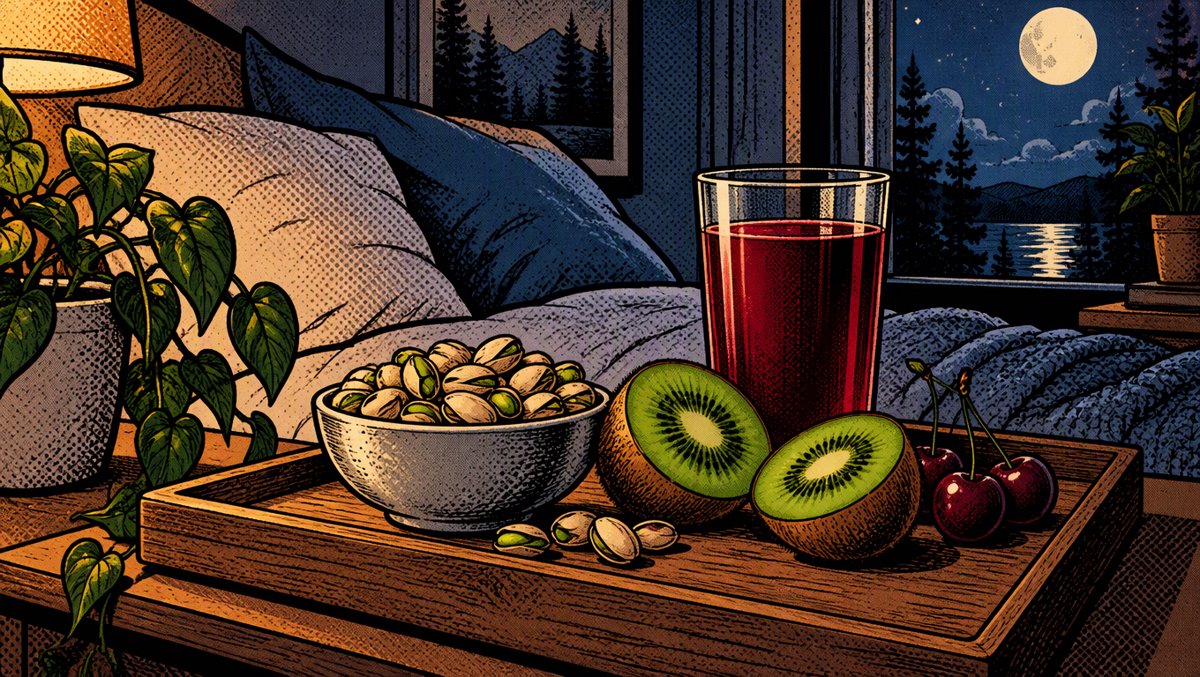
🌙 The Bedtime Snack Files: What 2026 Science Says About Eating Your Way to Better Sleep
Published: October 23, 2026 | Reading Time: ~7 minutes | Topic: Nutrition & Sleep
It's 9:47 p.m. You're standing in front of the open fridge, bath in its glow, negotiating with yourself. A snack feels wrong — everyone knows eating late ruins sleep, right? But your stomach is rumbling and willpower is fading fast. Here's the plot twist: 2026 science says the question isn't really whether to eat at night — it's what, and when. And some of the answers are surprisingly delicious. 🍒
🔬 Section 1: Your Kitchen Is Quietly Becoming a Sleep Pharmacy
Let's start with the headline that's been making the rounds this month: a brand-new narrative review published in Nutrition Research Reviews argues that of all the tree nuts, pistachios are unusually well-suited to support sleep health.¹ Not because of magic — because of chemistry.
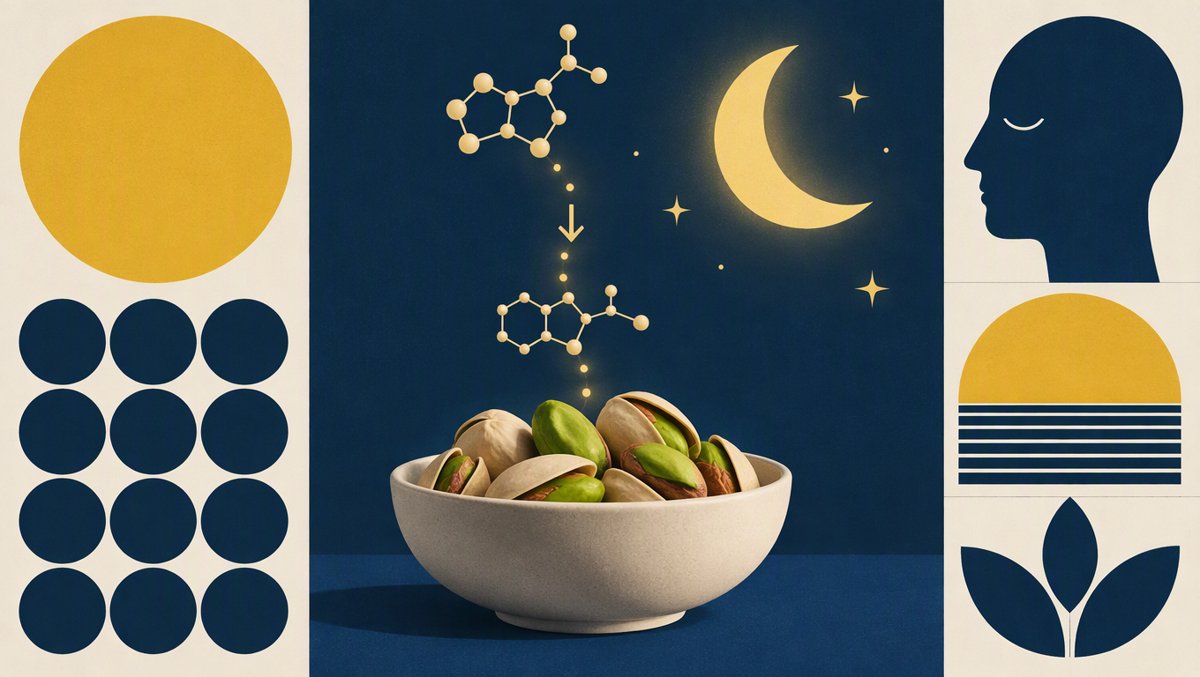
Pistachios happen to stack several sleep-relevant nutrients in one small package: L-tryptophan (the famous amino acid your body uses as raw material for serotonin and then melatonin, the hormone that tells your brain it's dark and time to power down), plus vitamin B6 and magnesium, which help convert tryptophan along that pathway. They also bring fiber, polyphenols, and a modest amount of phytomelatonin — melatonin that the plant itself makes.¹ ²
Now, the honest asterisk — because we don't do hype here: the review's authors are careful to note that this evidence is largely mechanistic. In plain English? We know pistachios contain the right ingredients, but there are no randomized trials yet testing whether eating pistachios directly improves sleep.¹ It's a promising food with a science-grade receipt, not a proven sleeping pill. 🥜
Your move:
- Keep the portion sensible — about one ounce (a small handful). The review notes a serving delivers a meaningful dose of tryptophan along with those helper nutrients.¹
- Go unsalted. Your blood pressure will thank you tomorrow morning.
- Pair it with a wind-down ritual — pistachios while reading beats pistachios while doom-scrolling.
Bottom line: pistachios look like a sleep-supporting snack worth trying — just think "helpful ingredient," not "instant knockout."
🥗 Section 2: The Foods With Actual Sleep Track Records
Pistachios are the promising newcomer, but three other foods have human studies behind them — with the usual "small study" fine print, of course.
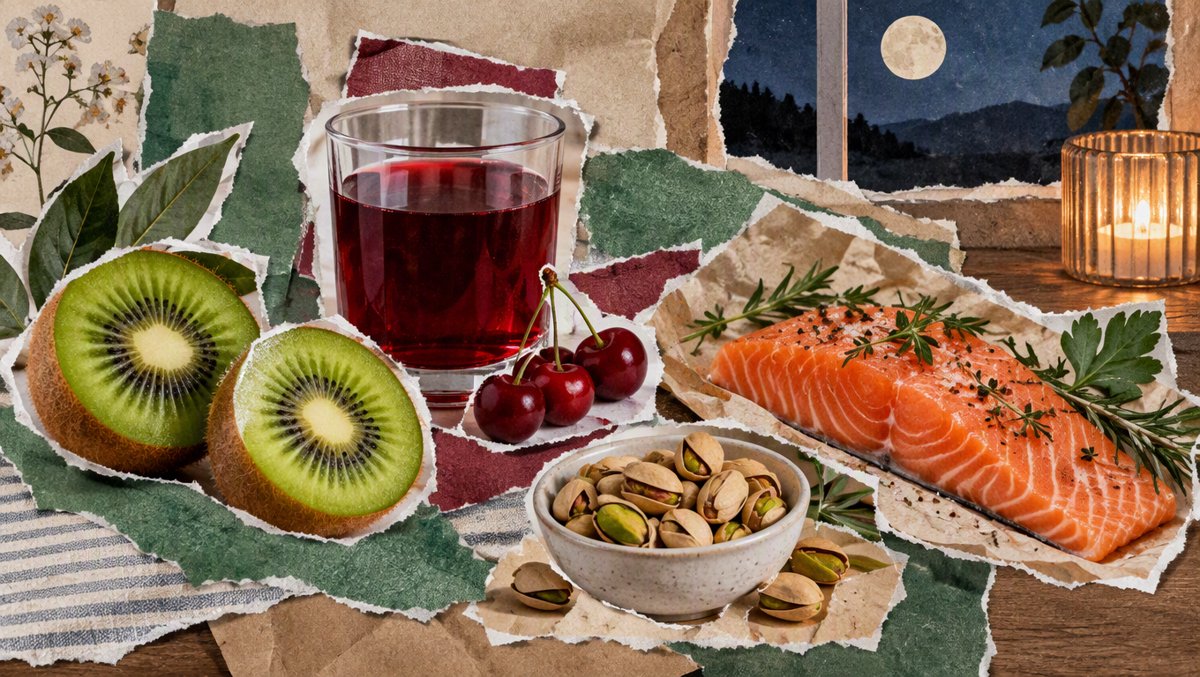
🥝 Kiwifruit: the tiny green overachiever. In a classic study, 24 adults with self-reported sleep problems ate two kiwis one hour before bed every night for four weeks. The results: falling asleep took 35.4% less time, waking after sleep onset dropped 28.9%, and overall sleep-quality scores improved 42.4%.³ Researchers suspect the fruit's antioxidants, folate, and naturally occurring serotonin deserve the credit. Small study? Yes. Still one of the most-cited food-sleep findings ever? Also yes.
🍒 Tart cherry juice: the melatonin bomb. Two trials are worth knowing. In older adults with insomnia, a tart cherry juice beverage produced modest but real reductions in insomnia severity compared to placebo.⁴ A later pilot in adults over 50 found juice drinkers gained about 84 minutes of sleep time — though with only a handful of completers, treat that number as "encouraging," not gospel.⁵ Sleep Foundation's take is refreshingly sober: it's not a cure for insomnia, but studies suggest it can support better and longer sleep, likely thanks to its natural melatonin content.⁶
🐟 Fatty fish: the dinner that pays you back at midnight. In a Norwegian trial, people who ate fatty fish (salmon, mackerel, herring) three times a week slept better and functioned better during the day than the meat-eating control group — with improvements in heart-rate variability and vitamin D status to boot.⁷ A large population study later backed this up: more oily fish intake was associated with better sleep quality.⁸
Your move:
- Try the kiwi experiment — two kiwis, about an hour before bed, for two weeks. Cheap, delicious, and the closest thing food science has to a sleep protocol.³
- If you try tart cherry juice, the studies used roughly two 8-ounce servings a day (morning and evening) — and remember juice carries sugar, so factor it into your day.⁴ ⁵
- Schedule fish night — fatty fish a few times a week is a heart-healthy habit that moonlights as a sleep aid.⁷
Bottom line: kiwi, tart cherry, and fatty fish are the "been studied" tier of bedtime foods — promising, tasty, and free of pill-bottle side effects.
⏰ Section 3: Timing Is (Almost) Everything — When You Eat Matters as Much as What
Here's where the bedtime snack story gets nuanced. Food isn't automatically your enemy at night — the clock decides.
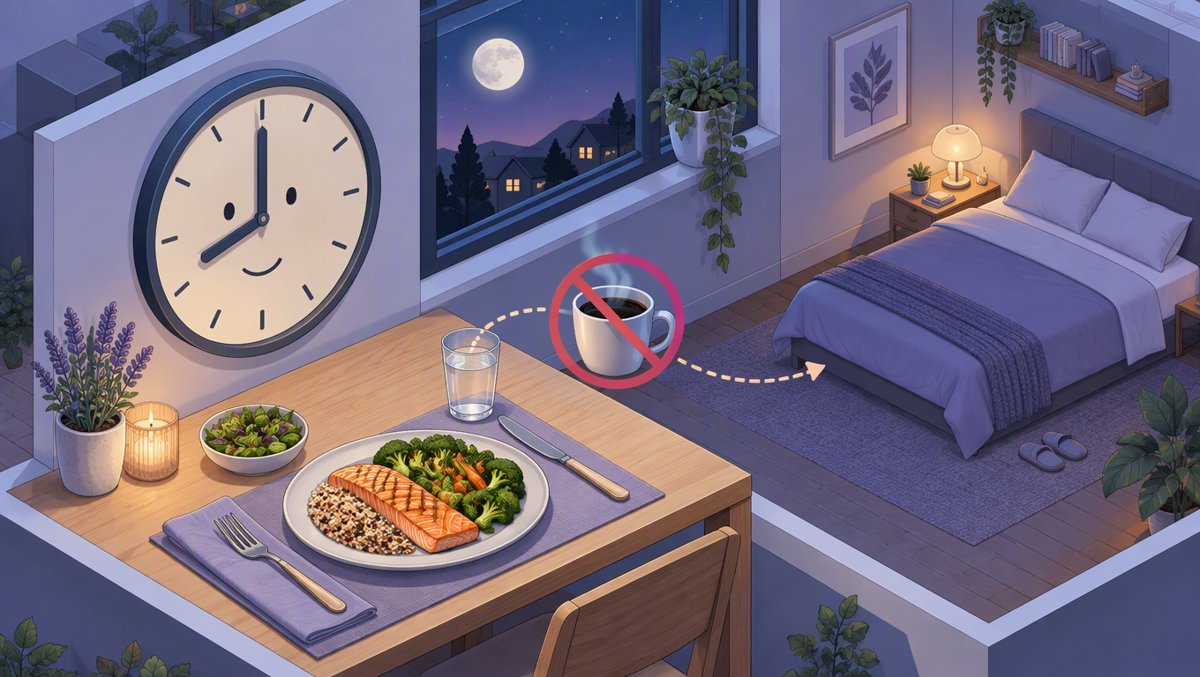
In one clever experiment, healthy volunteers ate the same high-glycemic-index meal (jasmine rice) at different times. When dinner came four hours before bed, they fell asleep in about 9 minutes on average — dramatically faster than when they ate the identical meal just one hour before bedtime.⁹ The takeaway isn't "carbs at night are magic," it's that a meal needs time to do its digestive work before you lie down.
Zoom out, and the picture agrees: research links eating or drinking within an hour of bedtime with less efficient sleep,¹⁰ and Harvard Health's sleep-hygiene guidance suggests finishing evening meals at least three hours before lights out.¹¹ So the sweet spot for dinner looks like 3–4 hours before bed — late enough that you're not starving, early enough that your body isn't mid-digestion when your head hits the pillow.
And the two night-time saboteurs you already suspect:
☕ Caffeine is a sneaky thief. In a study that still stings, 400 mg of caffeine taken six hours before bed cut participants' objectively measured sleep time by 41 minutes — and here's the kicker: they didn't even notice.ⁱ² They reported sleeping fine while the data said otherwise. A 2023 systematic review put it more bluntly: caffeine within six hours of bedtime costs people roughly 1.2 hours of total sleep.¹³ Set your curfew accordingly — for many of us, that means the last coffee lands around 2 p.m.
🍷 Alcohol is a false friend. It sedates you, then fragments your night. The CDC and Mayo Clinic both list avoiding alcohol before bedtime among their core sleep recommendations.¹⁴ ¹⁵ That "nightcap helps me sleep" feeling is the trap, not the cure.
Your move:
- Anchor dinner 3–4 hours before bed — your future self, currently asleep at 11:58 p.m., says thanks.¹⁰ ¹¹
- Set a caffeine alarm — last cup at least 6 hours before bed. If you sleep at 11, that's a 5 p.m. hard stop (and honest 2 p.m. is safer).¹²
- Retire the nightcap — swap it for the kiwi-and-pistachios routine instead.¹⁴
- Truly hungry close to bed? Choose light and sleep-friendly (a couple of kiwis or that small handful of pistachios) rather than a heavy meal.³ ¹⁰
Bottom line: give dinner room to breathe before bed, put caffeine on a curfew, and stop letting alcohol impersonate a sleep aid.
🎯 Key Takeaways
- Think food, not pills. Pistachios bring tryptophan, magnesium, and vitamin B6 — the raw materials your body uses to make its own melatonin.
- Kiwis, tart cherry, and fatty fish have real track records. The classic study: two kiwis an hour before bed for four weeks measurably improved sleep.
- Mind the clock. Finish dinner about three to four hours before lights out — and skip big meals in that final hour.
- Set a caffeine curfew. Even six hours before bed, caffeine can silently steal about 41 minutes of sleep — and you won't feel it happening.
- Food supports sleep; it doesn't replace it. Keep a consistent schedule, aim for 7–9 hours, and see a doctor if insomnia sticks around.
🎧 Key Takeaways — Listen (2 min)
📚 Verified Sources
- Mixon, A. et al. — "Exploring the role of pistachio nutrients and bioactive components in sleep health: a narrative review," Nutrition Research Reviews (Cambridge University Press, 2026) — The peer-reviewed review behind this month's pistachio headlines: nutrient profile (tryptophan, B6, magnesium, fiber, phenolics, phytomelatonin) plus the honest caveat that human trials are still lacking. https://www.cambridge.org/core/journals/nutrition-research-reviews/article/exploring-the-role-of-pistachio-nutrients-and-bioactive-components-in-sleep-health-a-narrative-review/EAF28951CD8B9D0ADA663939F17E1D6C
- EurekAlert / AAAS — "Can pistachios support sleep?" (Oct 6, 2026) — Press summary of the review, including the tryptophan→serotonin→melatonin pathway and B6/magnesium roles. https://www.eurekalert.org/news-releases/1146440
- Lin, H.H., Tsai, P.S., Fang, S.C., Liu, J.F. — "Effect of kiwifruit consumption on sleep quality in adults with sleep problems," Asia Pacific Journal of Clinical Nutrition, 2011;20(2):169–174 — The 2-kiwis-1-hour-before-bed study: −35.4% sleep-onset latency, −28.9% waking after sleep onset, −42.4% PSQI score. https://pubmed.ncbi.nlm.nih.gov/21669584/
- Pigeon, W.R. et al. — "Effects of a tart cherry juice beverage on the sleep of older adults with insomnia," Journal of Medicinal Food, 2010 — Randomized, placebo-controlled pilot: modest reduction in insomnia severity. https://pubmed.ncbi.nlm.nih.gov/20438325/
- Losso, J.N. et al. — "Pilot Study of the Tart Cherry Juice for the Treatment of Insomnia and Investigation of Mechanisms," American Journal of Therapeutics, 2018 — +84 minutes of sleep time in adults 50+ with insomnia (small pilot; n=8 completers). https://pubmed.ncbi.nlm.nih.gov/28901958/
- Sleep Foundation — "Does Tart Cherry Juice Help You Sleep?" (updated Sep 2025) — Silver-tier summary: not an insomnia cure, but studies suggest better and longer sleep via natural melatonin. https://www.sleepfoundation.org/nutrition/tart-cherry-juice
- Hansen, A.L. et al. — "Fish Consumption, Sleep, Daily Functioning, and Heart Rate Variability," Journal of Clinical Sleep Medicine, 2014 — Fatty fish 3×/week improved sleep, daytime function, HRV, and vitamin D status vs. control. https://pmc.ncbi.nlm.nih.gov/articles/PMC4013386/
- Del Brutto, O.H. et al. — "Dietary fish intake and sleep quality: a population-based study," Sleep Medicine, 2016 — Oily fish consumption associated with better sleep quality in a large community sample. https://pubmed.ncbi.nlm.nih.gov/26847986/
- Afaghi, A., O'Connor, H., Chow, C.M. — "High-glycemic-index carbohydrate meals shorten sleep onset," American Journal of Clinical Nutrition, 2007 — Jasmine rice dinner 4 hours before bed → ~9-minute average sleep-onset latency vs. 1 hour before. https://pubmed.ncbi.nlm.nih.gov/17284739/
- Iao, S.I. et al. — "Associations between bedtime eating or drinking, sleep duration and wake after sleep onset," BMC Journal of Circadian Rhythms / PMC, 2021 — Eating/drinking within ~1 hour of bed linked to less efficient sleep. https://pmc.ncbi.nlm.nih.gov/articles/PMC9092657/
- Harvard Health Publishing — "Sleep hygiene: Simple practices for better rest" (Jan 2025) — Silver-tier guidance: evening meals at least 3 hours before bed; limit alcohol. https://www.health.harvard.edu/healthy-aging-and-longevity/sleep-hygiene-simple-practices-for-better-rest
- Drake, C. et al. — "Caffeine Effects on Sleep Taken 0, 3, or 6 Hours before Going to Bed," Journal of Clinical Sleep Medicine, 2013 — 400 mg caffeine 6 hours before bed reduced objective total sleep time by 41 minutes; participants were unaware. https://pubmed.ncbi.nlm.nih.gov/24235903/
- Gardiner, C. et al. — "The effect of caffeine on subsequent sleep: A systematic review," Sleep Medicine Reviews, 2023 — Caffeine 0/3/6 hours before bed reduced total sleep time by ~1.2 hours. https://www.sciencedirect.com/science/article/pii/S1087079223000205
- CDC — "About Sleep" (updated May 2024) — Gold-tier baseline: adults need 7+ hours; avoid large meals, alcohol, and late caffeine before bed. https://www.cdc.gov/sleep/about/index.html
- Mayo Clinic — "Sleep tips: 6 steps to better sleep" — Silver-tier checklist: consistent schedule, watch what you eat and drink, daytime activity. https://www.mayoclinic.org/healthy-lifestyle/adult-health/in-depth/sleep/art-20048379
- Sleep Foundation — "Nutrition and Sleep: How Diet Affects Sleep Quality" (updated Jun 2026) — The two-way relationship between diet and sleep, and where whole-food patterns fit in. https://www.sleepfoundation.org/nutrition
All claims fact-checked against Gold-tier (CDC/NIH/WHO/PubMed/Nature/The Lancet) and Silver-tier (Mayo Clinic/Harvard Health/Cleveland Clinic) authoritative sources. Last verified: October 23, 2026.
Tonight's homework is the fun kind: two kiwis, a small handful of pistachios, and a coffee curfew you actually respect. Your pillow called — it's expecting great things. 🌙
This article is for informational purposes only and isn't medical advice. If you have ongoing sleep problems, please chat with your doctor or a sleep specialist. 💛