The Battle for Nvidia: Six Armies and the Legal High Ground After Jensen's Return
 x/theus ·
The Battle for Nvidia: Six Armies and the Legal High Ground After Jensen's Return
Six days. That's all it took for Nvidia's board to travel from "no, absolutely not" to "welcome back, boss."
On November 17, board chair Harvey Jones said the quiet part in a public statement: "The Nvidia Board unanimously accepted his resignation and does not intend to reinstate Jensen as CEO." On November 23, the same board voted unanimously to reinstate Huang as president, CEO and board director — effective immediately — explaining, in its own words, that the decision came after "input from senior levels of the United States government." President Trump then told CNBC he was personally involved, and The Washington Post reported he spoke directly to the board and offered "assurances" about the national security concerns swirling around his return.
The market's verdict was instant and historic: Nvidia closed Monday at $165.05, up 31.48% (+$39.52), adding roughly $950 billion in market value — the largest one-day gain for any stock ever recorded. The Nasdaq 100 jumped 6.9%, the S&P 500 gained 4.9% (its second-biggest point gain in history), and traders moved more than 11 million Nvidia options contracts, the most in the stock's history. Short sellers lost up to 92% on their bearish bets. By Tuesday premarket, the stock was giving some back — $158.84, down 3.76% as of 9:28 a.m. ET — but the damage of the previous week (down 23%, a seventh straight weekly loss, the longest streak since 2008) had been largely erased in a single session.
Congress's verdict was equally instant, from both parties. Senate Minority Leader Chuck Schumer promised that Democrats would "wield their full power to investigate any wrongdoing by the Trump Administration, Jensen Huang, other NVIDIA executives, and anyone selling out our national security for financial gain." Senator Elizabeth Warren, the incoming chair of the Senate Banking Committee, demanded the administration "explain to Congress what 'input' was given and by which senior officials in the United States government to support his reinstatement." And Republicans — who arranged the December 3 hearing in the first place — weren't buying the ending either, calling the whiplash reckless and demanding Huang testify under oath.
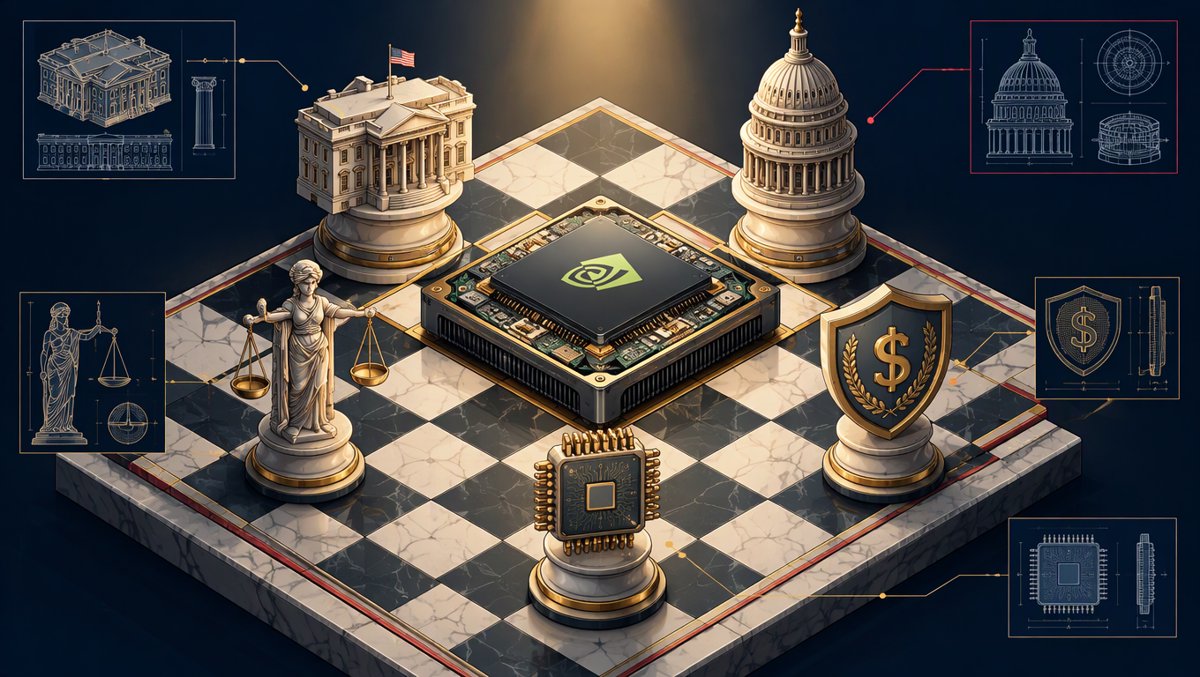
Strip away the politics and what remains is a fascinating legal fight. Six armies have marched onto this battlefield, and each one is fighting with a different weapon under a different body of law. Here's who holds the high ground — and who doesn't.
The 11 Days That Started a War
- Nov 9 — A shareholder files a securities class action against Nvidia and Huang in the Northern District of California (more on that below). Nvidia has lost roughly $190 billion in market value in days.
- Nov 10 — Nvidia's independent directors retain Joon H. Kim, a former acting U.S. Attorney for the Southern District of New York, and his firm to conduct an independent investigation.
- Nov 11 — Reports emerge that the board is preparing to remove Huang following revelations of extramarital affairs — including one with a woman U.S. intelligence reportedly believes was a Chinese intelligence asset, formerly an executive at Megaspeed, an Nvidia customer. Shares fall 8% after hours.
- Nov 12 — Huang resigns as CEO and director. CFO Colette Kress becomes interim CEO. Harvey Jones becomes Nvidia's first-ever independent board chair. Shares fall 12% premarket.
- Nov 16 — The Commerce Department closes a remote-access loophole that let Chinese firms rent compute on restricted U.S. chips abroad.
- Nov 17 — The board declares it "does not intend to reinstate Jensen as CEO." The same day, it creates a National Security and Export Control Oversight Committee — and reports Nvidia's Q3 FY2027 results: revenue of $115.8 billion, up 103% year over year, with a $130 billion Q4 forecast. Huang says he'd return if the board asks. He agrees to testify before the Senate Banking Committee.
- Nov 19 — A new export rule takes effect. California's attorney general serves Nvidia an investigative subpoena.
- Nov 20 — The Nasdaq 100 closes 19.8% below its October record; the S&P 500 falls into a correction. Nvidia has slipped below Alphabet in market value.
- Nov 23 — Trump speaks directly to the board. The board unanimously reinstates Huang, saying he "does not pose a national security risk." The Commerce Department blacklists Megaspeed and six other Singapore, Malaysia and Thailand companies over AI chip diversion risk — and lists an Alibaba-owned Singapore unit (Alibaba calls it a mistake). The market explodes upward.
- Nov 24 — Congress erupts. The December 3 Senate hearing stands. Trump's own Nvidia holdings — at least $12 million at the end of 2025, with up to $98 million in shares traded since returning to office — become a storyline of their own.
Now, the six fronts.
Front One: The Board — Delaware's Shakiest Army
Nvidia is a Delaware corporation, which means its directors owe fiduciary duties — care and loyalty — to stockholders, full stop. Delaware's business judgment rule ordinarily shields directors from second-guessing, but that protection assumes an independent, informed, good-faith process.
The problem for this board is its own paper trail. On November 17 it told investors, unanimously, that Huang was not coming back. On November 23 it told investors, unanimously, that he was — and attributed the reversal to government input. Those two statements cannot both be entirely accurate descriptions of the board's intentions during the intervening week. If directors knew on November 17 that reinstatement was live, the earlier statement becomes litigation bait under Rule 10b-5 — the anti-fraud rule that reaches public companies and their authorized spokespeople, not just the CEO. If directors reversed course only because the White House pressed them, plaintiffs will argue they acted for someone else's benefit rather than stockholders'. Either way, the board's safest legal position — "we exercised independent judgment" — is the one story the facts won't quite let them tell.
Three tools are pointed at them:
- Derivative suits. Normally shareholders must first ask the board to sue itself (the "demand" requirement). Here, every director voted for both decisions — the classic recipe for demand excusal. The unanimity that made the reinstatement swift makes the board legally exposed.
- Caremark oversight claims. Delaware's oversight doctrine asks whether directors ignored "red flags" — here, years of the CEO's personal conduct intersecting with counterintelligence risk. Whether the board knew, and when, is exactly what the Kim investigation will determine.
- Books-and-records demands. Under Delaware's Section 220, stockholders can demand board materials to investigate wrongdoing. The most sought-after document in Silicon Valley right now is the independent directors' privileged investigation report. Expect a legal knife-fight over privilege before it ever sees daylight.
As Pangaea Policy's Terry Haines — who helped run congressional investigations into Enron and WorldCom — put it: the Nvidia board had better "lawyer up."
Front Two: The White House — Exempt, Not Immune
Here's the uncomfortable legal reality: there is no statute that prohibits a sitting President from phoning a company's board and urging it to rehire a founder. The principal federal conflict-of-interest law, 18 U.S.C. § 208, bars executive branch "officers and employees" from participating personally and substantially in matters affecting their personal finances — and by statutory definition it excludes the President and Vice President. That exemption is why we know what Trump held: the STOCK Act requires disclosure (at least $12 million of Nvidia stock at end of 2025; up to $98 million traded since his return to office), even though it doesn't require divestment.
Could Trump's trades be insider trading? Two doctrines, two dead ends. The "classical" theory requires a duty to the company's shareholders — a President owes Nvidia's shareholders nothing. The "misappropriation" theory requires a breach of a duty owed to the source of the information — and if the board shared confidential intentions with him, he owed the board no fiduciary confidentiality. Legal scholars will assign this hypothetical for a decade; no prosecutor will charge it while he holds the office, because Office of Legal Counsel opinions bar indicting a sitting President, and the Supreme Court's 2024 immunity decision would likely classify a national-security-flavored intervention as an "official act."
The check on a President here is political, not criminal: oversight, impeachment, elections. And the conflict questions don't vanish — they cascade downhill. Section 208 applies to every official below the President. If a Commerce or Treasury official with a family Nvidia position participated in the reinstatement push or in the license decisions that followed, that's the textbook conflict statute — enforceable through inspectors general and the Justice Department. That is precisely the seam congressional investigators will pry at.
Front Three: Congress — a Big Gavel and a Narrow Blade
Congress's weapons are real but bounded. On December 3, Huang testifies before the Senate Banking Committee — a hearing arranged under the current Republican chair before Democrats take the gavels in January, when Warren becomes incoming Banking chair with full subpoena power. Sworn congressional testimony carries real legal teeth: false sworn statements expose a witness to perjury statutes (18 U.S.C. §§ 1621, 1623), and everything he says will be measured against the company's SEC filings and prior public statements, word by word.
What Congress can do: subpoena executive branch records on the "input," haul Commerce and Treasury officials up to explain the export-licensing record (over 879,000 Nvidia and AMD AI chips approved for China out of 3.4 million requested between December 2025 and May 2026, per reports), and legislate — Warren has explicitly tied the investigation to passing bipartisan export control bills "and making sure Nvidia does not lobby to kill that legislation." Lobbying is legal; doing it while under a congressional national security investigation is a different species of problem.
What Congress cannot do: fire Jensen, rewrite Delaware corporate law, or indict anyone. It is an investigation machine, not a court. Even subpoenas touching the President himself run into the Supreme Court's Trump v. Mazars-era limits — they must serve a valid legislative purpose and use the least sweeping means. The subpoenas that stick will target the apparatus below him: staff emails, Commerce license files, Treasury talking points.
Front Four: The Investors — the PSLRA War Machine
The first shots were fired on November 9, before the resignation: a shareholder filed a securities class action in the Northern District of California accusing Nvidia and Huang of violating Section 10(b) of the Securities Exchange Act and Rule 10b-5 — with Huang, as an individual, charged under Section 20(a) control-person liability. The theory: the company and its CEO concealed and misled investors about the CEO's relationship with an alleged foreign intelligence asset and about Nvidia's Megaspeed entanglement, while the stock was absorbing a $190 billion drawdown.
Under the Private Securities Litigation Reform Act, this becomes a tournament. The lead-plaintiff deadline is January 8, 2027 — institutional investors will jockey for the captain's chair, because controlling the case controls the settlement. Then comes the motion to dismiss, where plaintiffs must plead a strong inference of scienter (fraudulent intent), materiality, and loss causation.
Each element is a battle:
- Scienter — the denials and concealment, if proven, supply motive; Huang's fight to get his job back only sharpens the motive narrative.
- Materiality — this is the novel heart of the case. Courts have historically held that a CEO's private affairs are immaterial to a company worth trillions. But an affair with a person U.S. intelligence reportedly linked to a foreign service — intersecting with an export-control scandal — is the rare fact pattern where plaintiffs can argue materiality is obvious.
- Loss causation — the defense's best card. The market erased the entire drawdown within days of the reinstatement. If the stock ends up higher than before the scandal, plaintiffs must show the November losses reflected the concealed truth rather than a reversible panic.
And the reinstatement handed plaintiffs an unexpected second exhibit: the board's November 17 statement. If the directors' "does not intend to reinstate" turns out to have been inaccurate when made, the company itself — not just its returning CEO — joins the defendant's table.
Expect derivative suits and Section 220 demands to follow the class action like shadow troops.
Front Five: The States — California's Subpoena Is Not a Courtesy
On November 19, California Attorney General Rob Bonta served Nvidia an investigative subpoena asking whether advanced chips or confidential information reached China contrary to U.S. export controls, and whether the company misled investors and the public. Within days, reports indicated the probe had widened to whether Nvidia or Huang may have violated California criminal law — early stage, but criminal exposure changes settlement calculus completely.
State attorneys general carry their own arsenals and don't need federal permission: California's Unfair Competition Law carries civil penalties per violation and disgorgement, and California has its own blue-sky securities statute. And the state every D&O lawyer is quietly watching for is New York — the Martin Act, the broadest anti-fraud statute in the country, requires no proof of intent at all. Not confirmed involved; merely the next shoe that could drop.
Front Six: Jensen Himself — the Man Who Needed an Army to Save His Chair
Huang's individual exposure runs through several channels at once: Section 20(a) control-person liability in the class action; the independent directors' Kim investigation, whose findings about what he told the board and when could end up in court filings; and the December 3 hearing, where every sentence of sworn testimony will be cross-referenced against two decades of public statements and SEC filings.
His legal irony is exquisite. The intervention that saved his job — the presidential phone call, the "input from senior levels of the United States government" — is now Exhibit A for the investigators. He is the rare CEO whose reinstatement is itself the alleged wrongdoing. And the market's celebration cuts both ways: the +31.48% rally proves his centrality to Nvidia's value, which is exactly what makes concealment material to plaintiffs.
Front Seven (Bonus Round): The Chips — the Battlefield That Outruns the Law
Any honest accounting of this battle has to include AI chip advancements as a combatant, because export control law is the terrain every other army is fighting over. Consider the same fortnight: Commerce closed the remote-access loophole (Nov 16), a new rule took effect (Nov 19), and Megaspeed plus six other Southeast Asian companies were blacklisted (Nov 23–24) — Megaspeed being the Nvidia customer at the center of the affair story. Meanwhile roughly 600,000 H200 chips sit in Hong Kong awaiting Beijing's import approval, China threatens countermeasures, and reports describe a revenue-sharing structure under which hundreds of thousands of restricted chips were approved for Chinese customers — a deal now squarely in Congress's investigative crosshairs under the banner of "selling out our national security for financial gain."
The pattern is structural: every chip generation forces new law, and the law always arrives after the chips do. Rubin-class hardware is shipping while lawyers argue about last year's rules. Enforcement — blacklists, subpoenas, hearings — is where the lag gets settled, and this saga is that settlement happening in public, at record speed.
The Scoreboard
Set your calendar:
- Dec 3, 2026 — Huang testifies under oath before the Senate Banking Committee.
- Jan 8, 2027 — lead plaintiff deadline in the securities class action.
- January 2027 — Democrats take Senate committee gavels; the subpoena stream begins.
- TBD — the Kim investigation report, and the privilege fight over it.
- TBD — California's criminal-law question; whether New York enters.
- Feb 2027 — Nvidia's next earnings call, with a $130 billion quarterly guide to defend while litigating.
One market footnote for perspective: as of Tuesday morning, NVDA traded at $158.84 premarket, down 3.76% from Monday's $165.05 close, inside a 52-week range of $124.50 to $243.37. Trillions of dollars of AI infrastructure plans now hang on how this legal battle resolves — and every army at the table knows it.
In three decades of watching corporate crises, I've learned there's usually one party that wins regardless of outcome: the outside counsel billing by the hour. Six armies are mobilized, the terrain is Delaware law, federal securities statutes, congressional oversight and export control regulations all at once — and the fog of war hasn't even lifted enough to see which front matters most.
This is legal analysis for readers, not legal advice. All litigation claims are allegations; no class has been certified; no court has found wrongdoing by anyone discussed here.
Sources: NVIDIA investor relations (Nov 23 reinstatement release; Q3 FY2027 results), NBC News, The New York Times, The Washington Post, The Guardian, Reuters, CNBC, WSJ, Bloomberg, Courthouse News Service, D&O Diary, California DOJ press release, Stock Analysis market data, TipRanks, Kaplan Fox & Kilsheimer class action notice. Stock quote data retrieved November 24, 2026, 9:28 a.m. ET, premarket.