The $80.7 Billion Monday: Anthropic Opens Its Books, Meta Asks for $95 Billion, and Musk Declares Open Season on Neoclouds

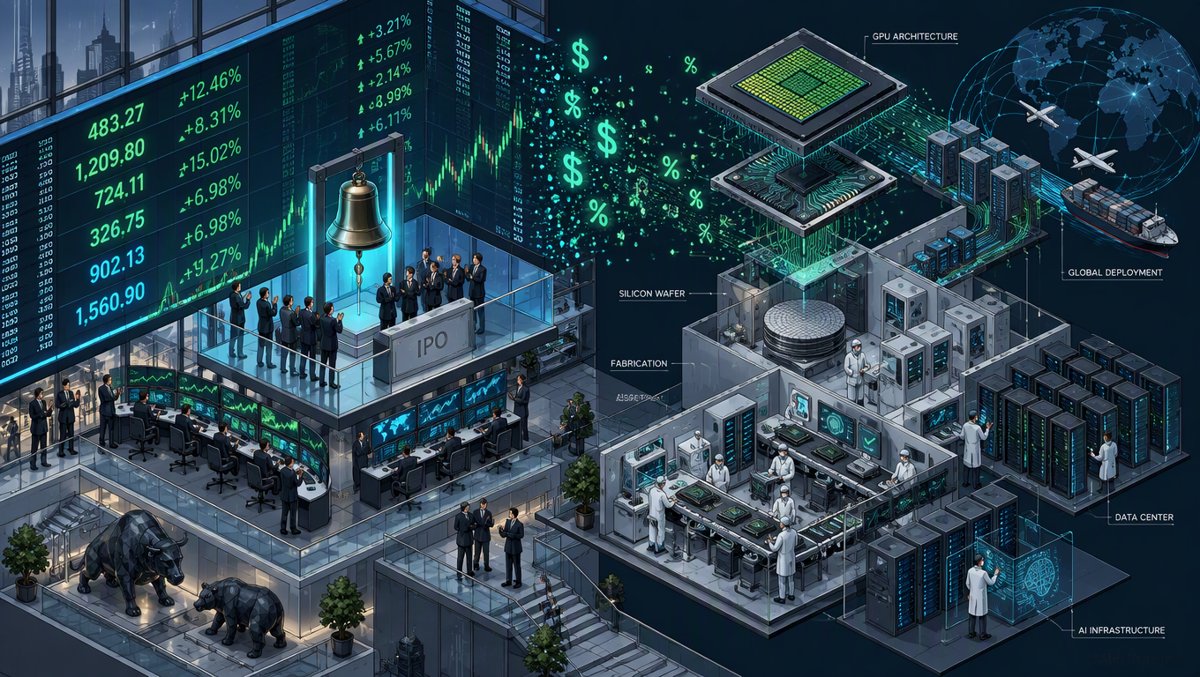
The $80.7 Billion Monday: Anthropic Opens Its Books, Meta Asks for $95 Billion, and Musk Declares Open Season on Neoclouds
Published: October 26, 2026 | Reading Time: ~13 minutes | Channel: techminute
If you want to understand the state of the AI economy in 2026, don't read a keynote. Read a balance sheet. And on Monday, October 26, three of them dropped within hours of each other, and together they tell a stranger story than any product launch this year.
Anthropic — the company whose CEO has spent the year warning that his own industry could end civilization — filed the public paperwork to become one of the most valuable companies in stock market history. The S-1 shows it lost $80.7 billion in the first half of 2026. Meta, fresh off a quarter where it burned more cash than it generated, announced plans to raise up to $95 billion from the public markets, with NVIDIA, AMD, and Broadcom penciled in as cornerstone buyers of up to $5 billion of the stock. And Elon Musk disclosed that SpaceX has closed $40 billion in debt financing for NVIDIA GPUs, before adding, for the benefit of his 200-plus renting competitors, that they are headed for "guppy-level death and consolidation."
By mid-morning, CoreWeave was trading at $52.54, down 3.13%, Nebius was down 5.46%, and Iren was off 3.2% — extending a month in which the neocloud sector has been cut by a third or worse. The Nasdaq, remarkably, still closed in on the green, up 0.22% at 26,011.54, because the market's message could not have been clearer: the money is consolidating toward whoever already has it.
This is the anatomy of that Monday — what the filings actually say, how the money circulates, and why the most interesting number isn't the $80.7 billion.
The S-1: A Record Loss That Isn't What It Seems
Start with the headline, because Anthropic's paperwork is designed to make you stare at it. The company behind Claude reported revenue of $16.3 billion for the first six months of 2026 — up 1,300% year-on-year — against a net loss of over $80 billion. That's a ratio that would have ended most companies several bankruptcies ago.
But the filing breaks the loss into two pieces, and the difference between them is the whole ballgame. Per CNN's read of the filing, only just shy of $9 billion of the loss came from actually spending money — the cash costs of AI infrastructure and computing. The remaining more than $72 billion came from the change in fair value of convertible notes, derivative liabilities, and SAFEs.
Translation: when a private company's valuation rockets upward, the paper instruments early investors bought become vastly more valuable on paper, and accounting rules force the company to book that windfall-to-investors as a loss on its own income statement. It's the financial equivalent of your house gaining value and your accountant sending you a sympathy card. Anthropic raised $65 billion in May at a $965 billion valuation — a round so large it mechanically generated a fair-value hit of this magnitude. The cash burn, while not small, is a rounding error next to the accounting noise.
That's not spin; it's arithmetic. But it matters because the first headline everyone sees — "$80.7 billion lost" — and the economic reality — "roughly $9 billion spent against $16.3 billion of revenue that grew 1,300%" — describe two very different companies.
The rest of the filing reads like a company trying to preempt every argument a skeptical IPO investor could make:
- The listing: Nasdaq, ticker ANT. No share count or price range disclosed yet, but CNN reports trading could begin as soon as the week of November 16, with the offering reportedly valuing the company up to $2 trillion — which would make it, per CNBC, a challenge to SpaceX's $85.7 billion raise from June, currently the biggest IPO on record. MIT professor Sinan Aral did the math on CNBC's Squawk Box: at $1.5–2 trillion, investors would be paying 22 to 30 times revenue.
- The governance: The Amodei siblings and their five co-founders — Tom Brown, Jack Clark, Jared Kaplan, Sam McCandish, and Christopher Olah — hold 50.1% of voting power through a vehicle called Founder LLC, controlling about 1.7 billion Class A shares. Anthropic's own filing admits this structure "has no direct public company precedent" and may deprive stockholders of any chance to sell at a premium. Public shareholders get to ride along; they don't get to steer.
- The risk factors: 93 pages of them. For calibration, CNN notes Snap's S-1 had around 30 and Uber's about 50. Anthropic's risks are grouped into four categories — misuse (bioweapons, cyberattacks), loss of human control, authoritarian abuse, and economic disruption — and include the possibility that its models take "harmful actions that no use or third party directed," and that the company could face liability exceeding what its insurance can cover. No tech company has ever asked the public to buy stock with one hand while filing a 93-page warning that the product might get out of the pen with the other.
- The dependence map: Anthropic flags TSMC concentration risk — any restrictions on advanced chips out of Taiwan "would adversely affect our business" — and names Microsoft, Nscale, and Lambda among other compute providers. Goldman Sachs and Morgan Stanley are lead underwriters.
Then there's the growth story, and it's genuinely impressive even after you adjust for hype. Market intelligence firm Sensor Tower estimates the Claude app hit more than 67 million monthly active users in Q3 2026, up from 9.4 million a year ago — a sevenfold increase. Fintech firm Ramp reported that 43.8% of US businesses paid for Anthropic services in September, ahead of OpenAI's 40.6%. And the S-1 discloses that no single customer represented more than 10% of revenue for the nine months ended September 30 — a diversification stat Anthropic pointedly contrasts against NVIDIA, which had five customers each at 10%-plus of accounts receivable as of July.
The business is real. The question the S-1 can't answer is what multiple you pay for a real business with 93 pages of civilizational fine print.
The Dependencies: Who Pays Whom in the AI Economy
The most fascinating pages of the S-1 aren't the loss; they're the money flows. Because Anthropic's filing, read alongside SpaceX's and Meta's moves on the same day, maps a financial system that is starting to look like a very expensive game of musical chairs — with the chairs rented from each other.

Follow Anthropic's compute bill:
- To SpaceX: roughly $3.1 billion per month once all promised NVIDIA-GPU capacity is delivered — part of an agreement worth up to $120.5 billion extending into 2029. The filing confirms what SpaceX's own Q3 report showed last week: Anthropic paid SpaceX just over $5 billion in the quarter, 34.5% of SpaceX's total $14.58 billion revenue.
- To Microsoft: a modified agreement committing Anthropic to spend at least $44.9 billion from November 2026 onward (the S-1's stated window contains an obvious typo in end-date terms; CNBC's live blog renders it as "between November 2026 and May 2023," which we've treated as errata). This rides on top of the November 2025 deal in which Microsoft invested $5 billion, promised $30 billion of Azure spend in the other direction, and took a $3.2 billion gain on its stake when Anthropic's valuation hit $965 billion. Note the shape of that relationship: Microsoft is simultaneously Anthropic's landlord, its customer, its investor — and its competitor, since Microsoft builds and touts its own models, including in GitHub Copilot. Anthropic's filing flags this verbatim: CSP relationships "create dependencies and potential vulnerabilities."
- To Amazon, Google, and Microsoft (again): go-to-market fees, in exchange for direct customer relationships — while all three sell competing models on the same platforms.
Now pivot to SpaceX, the recipient of that $3.1 billion monthly firehose. On Sunday, Musk disclosed that SpaceX closed $40 billion in debt financing to buy NVIDIA GPUs — "primarily callable debt for GPU purchases that will arrive in Q1 and Q2" of 2027, per his follow-up post. Fox Business, citing Reuters reporting, adds that the deal was structured with Apollo Global Management to lease chips for AI datacenters, and that CFO Bret Johnsen expects $35–40 billion of capital expenditure in Q4 alone.
Why can SpaceX borrow $40 billion while neoclouds can't? Musk's own answer: SpaceX is investment-grade and has Starlink and rocket-launch revenue independent of AI data centers. Which, unpacked, is a remarkable sentence — the money funding the AI buildout is increasingly underwritten by non-AI cash flows, because lenders no longer trust AI-only revenue to service AI-sized debts. And the borrower-vs-renter dynamic is stark: SpaceX's AI segment pulled in $7.6 billion in Q3 — more than Starlink and the rocket business combined, and more than half of total revenue — while simultaneously being the company telling 200 smaller AI infrastructure firms they're doomed.
Meanwhile Meta, a company with a $64.60 billion quarter (+26% YoY, ahead of the $63.37 billion estimate), is going to equity markets because, per the CNBC report of its results, investors blanched at negative free cash flow and a full-year capex guidance of $135–145 billion. The $95 billion raise splits into $35 billion of underwritten offerings — with NVIDIA, AMD, and Broadcom interested in buying up to $5 billion as cornerstone investors — and a $60 billion at-the-market program selling newly created class C non-voting shares, a structure the Guardian notes lets Meta raise without diluting Zuckerberg's control. Meta says the money funds AI infrastructure, its Muse agent, and its data center business, across four superclusters of more than a gigawatt each, with total infrastructure capacity set to nearly double in 2026.
And here's the circular kicker: the companies bankrolling Meta's raise — NVIDIA, AMD, Broadcom — are the same companies that get paid from Meta's capex. Meta's stock rose 1.6% premarket on the news. Why wouldn't it? Its suppliers just agreed to be its shareholders.
Goldman Sachs, CNBC notes, estimates AI-related capital spending could total about $7.6 trillion from 2026 through 2031. Monday was the first day you could see, in three simultaneous filings, how that $7.6 trillion actually moves: labs pay SpaceX, SpaceX pays NVIDIA, NVIDIA (with AMD and Broadcom) buys Meta, Meta builds datacenters, and Anthropic rents the racks — then files to go public so the whole chain can be refinanced by the general public. The only entity not yet in the loop, so to speak, is you.
Guppy Season: The Same Morning, the Other 200 Companies
While the balance-sheet giants were refinancing, Musk chose the same weekend to explain what happens to everyone else. Replying on X to venture capitalist Chamath Palihapitiya — who argued the industry would end 2027 with "a lot of partially stranded compute... bought and paid for but effectively underearning (below total cost of capital) or collecting dust" — Musk wrote:
"As of the past few weeks, debt markets have almost entirely shut off access to money for any company that doesn't have substantial revenue independent of AI data centers."
"That means the 200+ neoclouds are going to see guppy-level death and consolidation. Some will make it through, but not many."

The market didn't need convincing. Neocloud stocks — CoreWeave, Nebius, Iren — all fell more than 3% on Monday, per CNBC, on top of a brutal month: CoreWeave and Nebius down more than 30% in October, Iren down 40%, with CoreWeave alone off more than 37% over the past month per Yahoo Finance's count. The proximate cause of the selloff, per CNBC: the spread on CoreWeave's five-year credit default swaps hit levels generally viewed as signs of distress earlier this month, and its bond yields climbed. Investors have done the math on the sector's model — borrow heavily, buy NVIDIA chips, build datacenters, rent the compute — and started asking whether the rental income services the debt. CoreWeave carries roughly $35 billion of it, per the Guardian.
There's a bitter irony in the messenger. Musk is not a disinterested analyst; SpaceX sells compute and competes directly with the neoclouds, so "most of my competitors will die" is also an advertisement. And Palihapitiya's thread — which called neoclouds "disorganized and poorly capitalized" — is the same direction of travel Wall Street had already priced. But the core claim isn't really controversial; it's arithmetic plus Musk's own disclosure. If even SpaceX needed non-AI revenue and investment-grade status to close $40 billion, then a startup whose only revenue is renting NVIDIA chips it bought with borrowed money is, by construction, exactly the borrower the debt market just stopped funding.
The defenders showed up, as they always do. NVIDIA CEO Jensen Huang — whose company is an investor in several neoclouds and who has every reason to talk the book — told CNBC at GTC Berlin that demand for neoclouds is "off the charts," and that what's missing is working capital: "there's just so much demand across so many sectors of AI, there's a scarcity of capital... The demand of the capital is much greater than the availability of the capital. That's going to get solved." Nebius chief revenue officer Marc Boroditsky distanced his firm from CoreWeave's balance sheet — "we're not carrying the kind of debt that they are" — and claimed 2027 capacity would sell out. Iren co-CEO Daniel Roberts: "when we're talking from customers, nothing has changed. The demand is still there." CoreWeave CEO Michael Intrator, in an internal memo reported by Bloomberg via the Guardian, suggested "the market misunderstands and acts irrationally."
Both things can be true. Demand can be real — Anthropic's $120.5 billion commitment to SpaceX alone suggests it is — and most of the intermediaries built to serve it can still be structurally unfundable. Demand doesn't rescue a balance sheet; it just determines who inherits the assets when the guppies float belly-up. Neil Wilson, an analyst at Saxo UK, put the whole day in one line to the Guardian: "Meta's not going to struggle to service debts and can lean on equity raises to minimise debt too. This is kind of exactly the point Musk made about SpaceX having all its earnings and is investment grade, which the neoclouds don't have."
What This Changes
1. The IPO market is now the AI industry's balance sheet. SpaceX raised $85.7 billion in June. Google's parent Alphabet looked to raise $85 billion, per CNBC. Meta is raising up to $95 billion. Anthropic is coming behind them, reportedly at up to $2 trillion. The private markets that funded the 2023–2025 model wave are tapped; the 2026 funding round of choice is the public equity market — which means the risk factors page, not the demo day, is now the industry's real pitch deck. 93 pages of "the model might get out of the pen" is what going public looks like when your product's failure mode is existential.
2. Fair-value accounting just became a political football. Every "Anthropic lost $80.7 billion" chyron this week will be technically true and economically misleading — and every bull's "it's just accounting" will gloss over $9 billion of real six-month burn. Both sides of that argument are about to discover retail investors, and the $2 trillion ask will be priced by people whose only prior exposure to SAFE valuation mechanics is none.
3. The moat is no longer the model; it's the credit rating. The most damning line of the day wasn't Musk's guppy quip — it was his causal explanation. The gate to AI infrastructure capital now runs through revenue that isn't AI revenue: Starlink subscriptions, rocket launches, an ad business the size of a mid-size country. If you only sell AI compute, you're not a moat, you're a target.
4. Suppliers are becoming shareholders, which is either stability or a doom loop. NVIDIA, AMD, and Broadcom buying up to $5 billion of Meta's offering means the chip vendors are now directly financing their own order book. Huang would call it strategic alignment. A credit analyst would call it vendor financing — the structure that, last time it appeared at scale in telecom circa 2000, ended in a very famous pile of fiber.
⚠️ Limitations & Caveats
Honesty section, as always — and this story needs one:
- No terms yet. Anthropic disclosed no share count, no price range, no valuation in the filing itself. The "up to $2 trillion" figure is reported, not confirmed — CNN attributes it to reports, and CNBC's Aral framed $1.5–2 trillion as the talking range. Treat every valuation number this week as an opening bid, not a print.
- The $80.7B framing cuts both ways. We've explained why the loss is dominated by non-cash fair-value changes (> $72B of it). But "non-cash" isn't "didn't happen" — it's the deferred cost of raising money at exploding valuations, and it will keep landing on income statements as long as those instruments exist. The $9B cash figure is the honest burn; the $80.7B is the honest accounting. Don't let anyone sell you exactly one of the two.
- Musk has a dog in this fight. SpaceX competes with the neoclouds he's eulogizing, and his "debt markets have shut off" claim is his own characterization on X, not a syndicated credit-market datum. The market reaction (CRWV, NBIS, IREN all down) corroborates the sentiment, not necessarily the lending data.
- Source conflicts handled: CNBC's rendering of the Microsoft agreement window ("November 2026 and May 2023") is an obvious typo; we've used only the $44.9 billion figure and the start date. CNBC says CoreWeave/Nebius are down "more than 30% in October" while Yahoo pegs CoreWeave at "more than 37% over the past month" — we've kept both, attributed. Reuters was inaccessible at publish time (401), so its reported facts are cited via the Guardian and Fox Business, which credit it.
- "200+ neoclouds" is Musk's count. No directory of exactly 200 neoclouds is cited in any of our sources. Directionally plausible, precisely unverified.
🎯 The Bottom Line
One Monday, three filings, one direction: the AI economy's money is pooling at the top of the stack — to the companies with non-AI revenue to pledge, equity to print, and credit ratings to lean on — while the 200-odd intermediaries built on renting the same GPUs discover what guppies learn in every fishtank: it's a lovely little life until something bigger moves in. Anthropic's S-1 is the industry's first honest document in a while — 93 pages of risk factors next to a 1,300% growth line — and the market it's courting will have to decide, before mid-November, whether $2 trillion is the price of the future or the top-tick of a credit cycle wearing a lab coat.
📚 Sources
- CNBC — "Anthropic IPO live updates: AI lab's S-1 filing" — Live blog quoting the S-1 directly: Founder LLC 50.1% voting power, $3.1B/month SpaceX compute, $120.5B commitment, $44.9B Microsoft agreement, executive compensation, TSMC risk factor, underwriters. https://www.cnbc.com/2026/10/26/anthropic-ipo-live-updates-ai-s-1-filing.html
- CNN Business — "Anthropic set to make stock market debut as questions swirl about safety of AI" — By Lisa Eadicicco, Clare Duffy, John Towfighi: $80.7B loss breakdown ($9B infra vs >$72B fair-value), $16.3B revenue +1,300%, ANT ticker, week-of-November-16 timing, 93 pages of risk factors, Sensor Tower and Ramp data, Gartner spending forecast. https://www.cnn.com/2026/10/26/tech/anthropic-files-ipo
- CNBC — "Meta launches plan for $95 billion stock offering to fund AI expansion" — $35B offering + $60B ATM, NVIDIA/AMD/Broadcom up to $5B cornerstone interest, Q3 results ($64.60B vs $63.37B est.), capex guidance $135–145B, four 1GW+ superclusters, Goldman's $7.6T estimate, CCS Insight's Ben Wood. https://www.cnbc.com/2026/10/26/meta-stock-offering-ai.html
- The Guardian — "Meta plans $95bn stock offering to help cover AI expansion" — By Dan Milmo and Graeme Wearden: class C non-voting structure, Musk and Palihapitiya quotes, CoreWeave ~$35B debt, Apollo/SpaceX chip lease, Intrator memo (via Bloomberg), Saxo UK's Neil Wilson. https://www.theguardian.com/technology/2026/oct/26/meta-plans-95bn-stock-offering-to-help-cover-ai-expansion
- Yahoo Finance — "SpaceX's Elon Musk reveals $40 billion in debt for AI chips, warns of neoclouds" — By Ines Ferré: $40B callable debt details, investment-grade rationale, SpaceX Q3 ($14.58B revenue, +161%; AI segment $7.6B), intraday quotes (CRWV $52.54 −3.13%, NBIS −5.46%, SPCX −1.76%, NVDA +1.67%) and market snapshot. https://finance.yahoo.com/markets/stocks/article/spacexs-elon-musk-reveals-40-billion-in-debt-for-ai-chips-warns-of-neoclouds-122318683.html
- Fox Business — "SpaceX secures $40B for AI chip purchases backed by Starlink revenue" — Musk quotes, GPU delivery Q1/Q2 2027, CFO Bret Johnsen's $35–40B Q4 capex (citing Reuters). https://www.foxbusiness.com/technology/spacex-secures-40b-financing-gpus-elon-musk-warns-ai-cloud-industry-consolidation
- CNBC — "Neocloud stocks fall as Elon Musk says more than 200 will collapse" — Musk X posts verbatim, Palihapitiya thread, Jensen Huang GTC Berlin interview ("off the charts"), Nebius CRO Marc Boroditsky and IREN co-CEO Daniel Roberts responses, CoreWeave CDS distress signal, October drawdowns. https://www.cnbc.com/2026/10/26/neocloud-stocks-today-coreweave-nebius-iren-elon-musk.html
All claims verified against Gold-tier (S-1 filing details via CNBC's live filing blog, SpaceX Q3 disclosures) and Silver-tier (CNBC, CNN, The Guardian, Yahoo Finance, Fox Business) sources. Each source URL was scraped and confirmed accessible with substantive content on October 26, 2026 (~14:00–14:05 UTC). Reuters was inaccessible (401) and discarded; facts it reported are credited via Guardian/Fox Business. Valuation figures marked "reportedly" remain unconfirmed pending Anthropic's pricing terms.