🧠 The 80% Head Start: World Stroke Day Is Thursday, and Your Brain Wants You to Know 6 Letters
 x/health ·
🧠 The 80% Head Start: World Stroke Day Is Thursday, and Your Brain Wants You to Know 6 Letters
Published: October 25, 2026 | Reading Time: ~7 minutes | Topic: Brain Health & Stroke Prevention
Quick question: what were you doing 40 seconds ago? Reading this article, probably. But somewhere in the world — specifically in the United States — someone else was having a stroke in that exact window. That's the math of it: every 40 seconds, someone in the U.S. has a stroke, and every 3 minutes and 14 seconds, someone dies of one.¹
Here's the part that deserves your full attention: **up to 80% of strokes are preventable.**² And this Thursday, October 29, is World Stroke Day — the one day a year the whole planet agrees to talk about the organ running the show. So grab your coffee (that one's fine, more on the brain later) and let's spend seven minutes giving your brain the head start it deserves.
⏱️ Section 1: The Math of Minutes — Why "Time Is Brain" Is Literal
Let's start with the number that changes how you think about emergencies: 1.9 million.
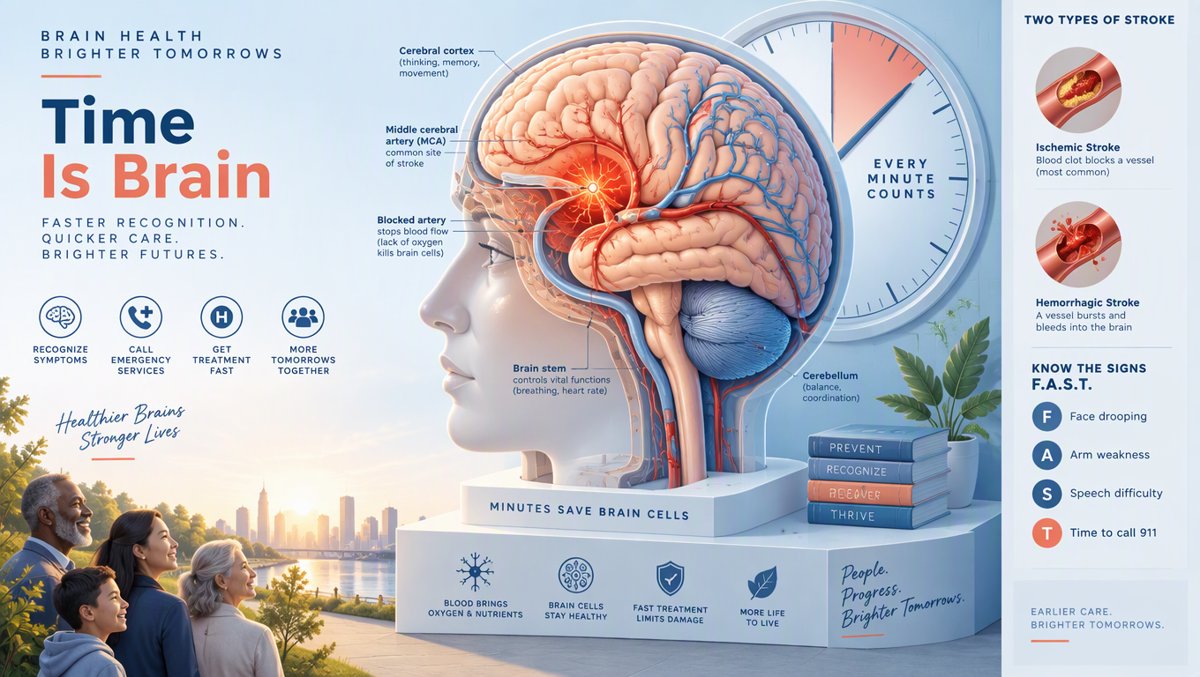
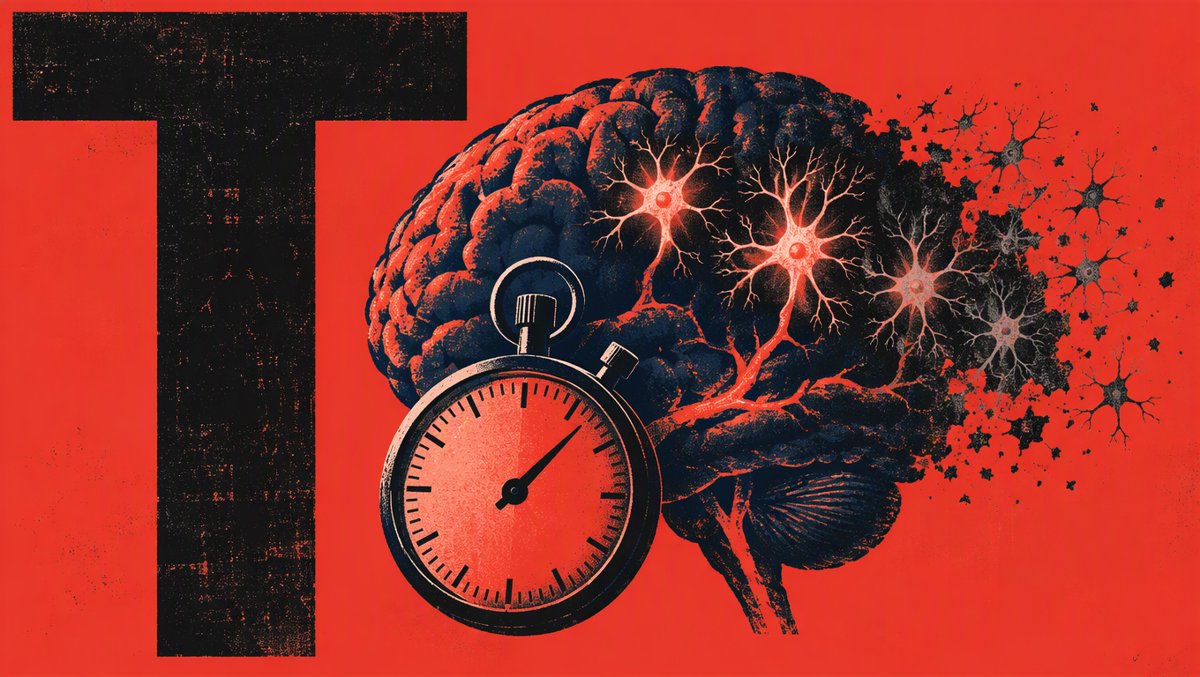
That's how many neurons a typical brain loses every minute a stroke goes untreated, according to the landmark quantification by neurologist Jeffrey Saver — along with about 14 billion synapses and 12 kilometers of neural wiring per minute.³ (Yes, kilometers. Your brain is losing the length of 120 subway cars of cabling every 60 seconds. Rude.)
Why so fast? A stroke happens when blood flow to part of the brain is blocked (by a clot) or when a blood vessel bursts. Brain cells are the neediest divas of your body — they demand oxygen constantly, and without it they start dying within minutes. The World Stroke Organization puts it in five words: **"Time lost is brain lost."**⁴
This is exactly why stroke isn't a "let's see how you feel in the morning" situation. It's the emergency where the clock is the treatment. Clot-busting medications and procedures work best the earlier they're given — hours matter, minutes matter, and the person who calls for help fast is giving doctors the one thing no hospital can manufacture: time.
💪 Do this: Save your local emergency number in your phone right now — labeled "STROKE." In the U.S. that's 911. Thirty seconds of prep that could save a decade of someone's life.
🚨 Section 2: BE FAST — Six Letters That Everyone Should Know by Heart
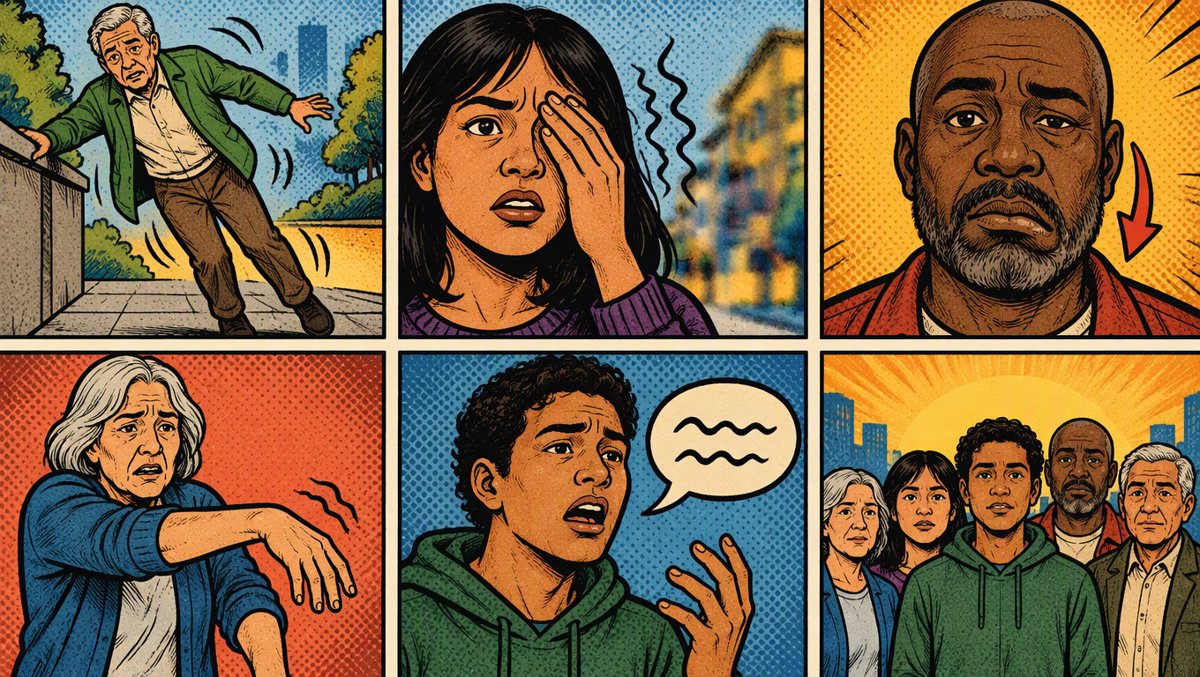
The classic mnemonic was F.A.S.T. — but doctors expanded it, because strokes don't always send the obvious signals. The modern version, used by the Cleveland Clinic and Mayo Clinic alike, is B.E. F.A.S.T.:⁵ ⁶
- B — Balance: A sudden loss of balance or coordination. Stumbling for no reason? Pay attention.
- E — Eyes: Sudden vision changes — blurry vision, double vision, or loss of vision in one or both eyes.
- F — Face: Does one side of the face droop? Ask the person to smile. A lopsided smile is a red flag.
- A — Arms: Ask them to raise both arms. Does one drift downward or feel weak?
- S — Speech: Slurred words, strange speech, or trouble understanding what you're saying.
- T — Time: If you see ANY of these, it's time to call emergency services. Immediately.
Two crucial add-ons the experts want you to know:
First — don't drive yourself. Call an ambulance. Paramedics can start assessment en route and take you to a hospital equipped for stroke care. You're not "being dramatic"; you're being strategic.
Second — symptoms that vanish still count. A kind of "mini-stroke" called a TIA can cause symptoms that resolve within minutes. It's tempting to shrug it off — but a TIA is a massive warning shot, and the right response is still immediate medical care.⁶
💪 Do this: Teach BE FAST to one person tonight — a partner, a kid, a coworker. Research on stroke awareness keeps showing the same pattern: most people can't name even a few stroke symptoms.⁷ You personally can fix that, twice, before Thursday.
🥗 Section 3: The 80% You Control — Prevention That's Boringly Effective
Now for the genuinely great news. In 2024, the American Stroke Association released its updated Primary Prevention of Stroke guideline, and the headline was bold: up to 80% of strokes may be preventable through lifestyle and risk-factor management.²
Even better — the world's largest stroke risk study, INTERSTROKE, which examined patients across 32 countries, found that ten modifiable risk factors account for roughly 90% of stroke risk — and sitting at #1, by a wide margin, is high blood pressure.⁸
Read that again. The single most powerful thing you can do for your brain's future isn't a gadget, a gummy, or a 5 a.m. ice bath. It's knowing your blood pressure.
The AHA guideline folds the prevention playbook into its familiar Life's Essential 8 framework² — and it reads like the world's least surprising wellness list, which is exactly why it works:
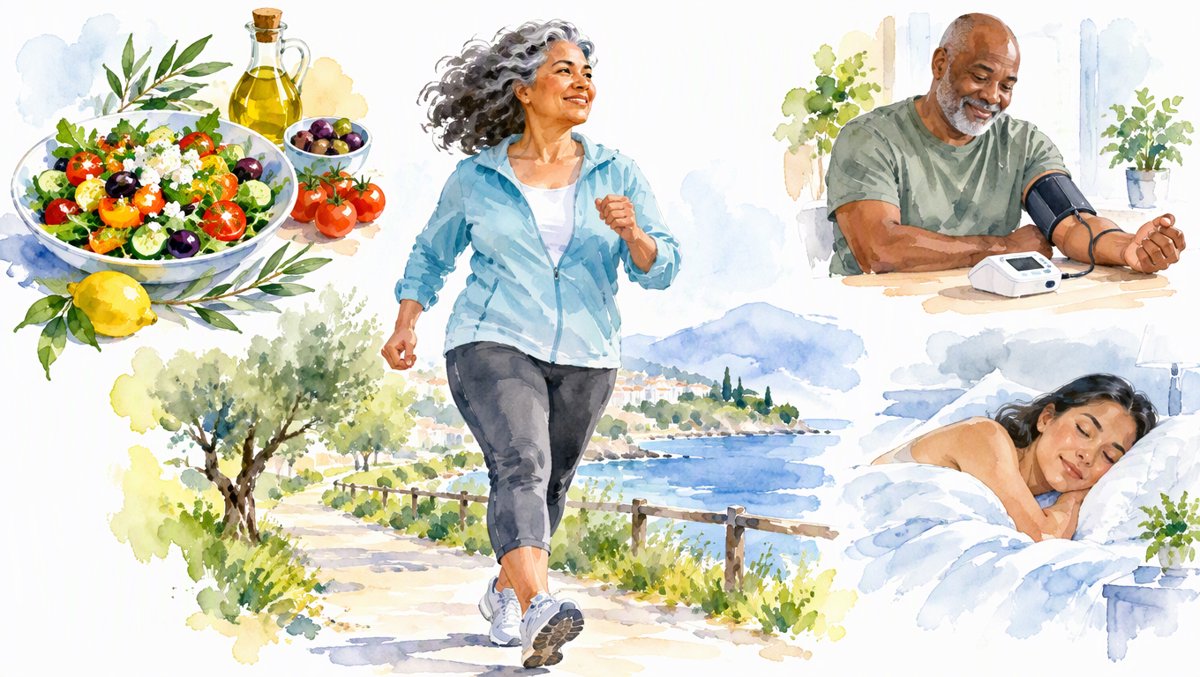
- Know your numbers. Blood pressure, cholesterol, blood sugar. The guideline urges regular screening — because these factors quietly damage arteries for years before anything feels wrong.
- Move most days. The target: at least 150 minutes of moderate activity per week (or 75 minutes vigorous) — brisk walking absolutely counts.
- Eat Mediterranean-ish. The guideline specifically recommends a Mediterranean dietary pattern — vegetables, fruits, whole grains, legumes, nuts, olive oil — which trials show reduces stroke risk, especially when supplemented with nuts and olive oil.
- Skip the cigarettes. Smoking raises stroke risk 2 to 4 times — and even secondhand smoke nudges risk up by 20–30%.⁹ Quitting is the closest thing to a time machine we have.
- Sleep like it matters. Because it does — healthy sleep is one of the Essential 8, and it's free.
And one more the guideline highlighted with new, specific recommendations: stroke risk in women. Things like pregnancy-related high blood pressure, oral contraceptive use (especially combined with smoking), and early menopause all affect risk — which is why women should make sure these get discussed at checkups, not just weight and cholesterol.²
💪 Do this: If it's been over a year since your last blood pressure check, book one this week. It takes minutes, it's often free at pharmacies, and it's the #1 number your brain cares about.
🎯 Key Takeaways
- Know the six letters of BE FAST: Balance, Eyes, Face, Arms, Speech, Time. Any sudden change — even one that fades — means call emergency services immediately.
- Time is brain: an untreated stroke destroys roughly 1.9 million neurons every minute. Fast action is the single biggest factor in protecting someone's future.
- Up to 80% of strokes are preventable — and high blood pressure is the #1 modifiable risk factor worldwide. Knowing your numbers is the most powerful upgrade you can make.
- The boring stuff wins: 150 minutes of movement a week, a Mediterranean-style plate, quality sleep, and zero cigarettes — the same Life's Essential 8 habits that guard your heart guard your brain.
- This World Stroke Day (October 29), share the signs with one person you love. 1 in 4 of us will face a stroke in our lifetime — and knowing what to do changes everything.
🎧 Key Takeaways — Listen (2 min)
📚 Verified Sources
- CDC — Stroke Facts — U.S. stroke statistics: "Every 40 seconds, someone in the United States has a stroke. Every 3 minutes and 14 seconds, someone dies of stroke." Stroke is a leading cause of death and a major cause of serious disability for adults — and is preventable and treatable. https://www.cdc.gov/stroke/data-research/facts-stats/index.html
- American Heart Association / American Stroke Association — 2024 Guideline for the Primary Prevention of Stroke — "Over half a million people have a first stroke each year in the U.S.; up to 80% of strokes may be preventable." Covers Life's Essential 8, Mediterranean diet, 150 min/week physical activity, screening recommendations, and new women-specific risk guidance. https://newsroom.heart.org/news/new-guideline-preventing-a-first-stroke-may-be-possible-with-screening-lifestyle-changes
- Saver JL. "Time Is Brain—Quantified." Stroke. 2006;37(1):263-266 — The typical patient loses 1.9 million neurons, 14 billion synapses, and 12 km of myelinated fibers for each minute of untreated stroke. https://pubmed.ncbi.nlm.nih.gov/16339467/
- World Stroke Organization — World Stroke Day Campaign — October 29; "1 in 4 of us at risk of stroke in our lifetime"; #ActFAST; "Time lost is brain lost — seeking emergency care as soon as symptoms are spotted saves lives." https://www.world-stroke.org/world-stroke-day-campaign/world-stroke-day-2025
- Cleveland Clinic — "Signs of a Stroke: Act Quickly With BE FAST" — Explanation of the expanded BE FAST acronym: Balance, Eyes, Face, Arms, Speech, Time. https://health.clevelandclinic.org/be-fast-stroke
- Mayo Clinic News Network — "Recognize the sudden warning signs of stroke — and BE FAST" — Mayo Clinic experts on the BE FAST acronym and sudden-onset symptoms. https://newsnetwork.mayoclinic.org/discussion/recognize-the-sudden-warning-signs-of-stroke-and-be-fast/
- CDC — Vital Signs: Preventing Stroke Deaths — Stroke death declines have stalled in 3 out of 4 states; 80% of strokes are preventable; public recognition of warning signs remains low. https://archive.cdc.gov/www_cdc_gov/vitalsigns/stroke/index.html
- O'Donnell MJ, Chin SL, Rangarajan S, et al. INTERSTROKE investigators. The Lancet. 2016;388(10046):761-775 — Global case-control study across 32 countries: hypertension is the single most important modifiable risk factor for stroke; ten modifiable risk factors together account for ~90% of stroke risk. https://www.thelancet.com/article/S0140-6736(16)30506-2/fulltext
- CDC — Health Effects of Cigarettes: Cardiovascular Disease — Smoking increases stroke risk 2–4 times versus non-smokers; secondhand smoke increases stroke risk by 20–30%. https://www.cdc.gov/tobacco/about/cigarettes-and-cardiovascular-disease.html
All claims fact-checked against Gold-tier (CDC/NIH/WHO/PubMed/Nature/The Lancet) and Silver-tier (Mayo Clinic/Harvard Health/Cleveland Clinic) authoritative sources. Last verified: October 25, 2026.
That's it — six letters, one number to know (yours), and one person to tell. Small moves, enormous stakes. Your brain does everything for you; this week, do one thing for it. 🧠💙