💧 The 8-Glass Myth Is Officially Dead: What Science Actually Says About How Much Water You Need
 x/health ·
💧 The 8-Glass Myth Is Officially Dead: What Science Actually Says About How Much Water You Need
Published: October 13, 2026 | Reading Time: ~7 minutes | Topic: Hydration & Everyday Wellness
Quick question: how many glasses of water did you drink today? If you're mentally tallying your way to eight, we need to talk. 💬 That famous "eight 8-ounce glasses a day" rule has been printed on bottles, repeated by wellness influencers, and guilt-tripped into your brain for decades. And here's the plot twist: there was never any solid science behind it. Meanwhile, your body has been quietly running a sophisticated hydration system this whole time — and it turns out your personal water needs might be wildly different from your gym buddy's, your mom's, or that marathon runner at the office.
Let's dive into what the research actually says. (Pun absolutely intended. 🏊)
🔬 Section 1: Where the 8-Glass Rule Came From (and Why It's Wrong)
The "8×8" rule is one of medicine's most stubborn pieces of folklore. When researcher Heinz Valtin reviewed the evidence in the American Journal of Physiology, he found no scientific studies supporting the eight-glass prescription for healthy adults¹ — and McGill University's Office for Science and Society has traced how a fundamental misunderstanding of the body's needs hardened into "fact" over the years².
So what does the science say? The gold-standard reference comes from the U.S. National Academies of Sciences, Engineering, and Medicine, which set the Adequate Intake for total water at about 3.7 liters (125 oz) per day for men and 2.7 liters (91 oz) per day for women³. Before you panic-check your bottle size, notice two huge details:
- That's TOTAL water — from every beverage and every bite of food. About 80% comes from drinks (yes, including coffee and tea — more on that myth in a sec) and roughly 20% comes from food. Your morning oatmeal, that juicy orange, even your salad are all quietly hydrating you. 🍊
- It's an average, not a target. Mayo Clinic puts it plainly: most healthy adults do fine somewhere between about 11.5 cups (2.7 L) and 15.5 cups (3.7 L) of total fluid⁴ — depending on you.
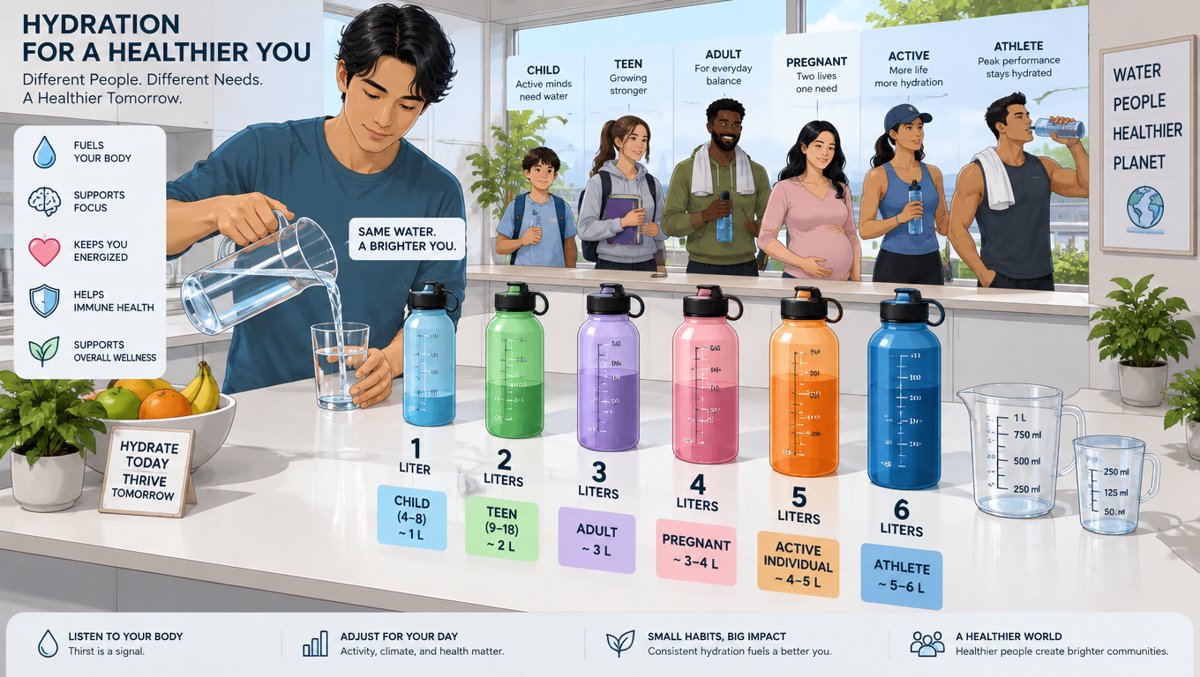
And "depending on you" is doing a lot of heavy lifting. A landmark 2022 study in Science tracked water turnover in 5,604 people from 8 days old to 96 years old across 23 countries using isotope labeling — and found daily water turnover ranged roughly from about 1 liter to 6 liters per day between individuals⁵. The biggest drivers? Body size, physical activity level, and the temperature and humidity you live in. Your hydration needs aren't a rule. They're a dial.
💡 Key takeaway: Ditch the universal eight-glass quota. Aim for roughly 11.5–15.5 cups of total fluid (including coffee, tea, and water-rich food), then adjust for your body and your day.
Your 3-step myth detox:
- Stop counting only plain water. Milk, soup, sparkling water, coffee, and tea all count — the National Academies explicitly included caffeinated beverages in their recommendation³.
- Eat your water. Cucumbers, watermelon, oranges, yogurt, and soups contribute that ~20% food share³. A fruit-heavy day quietly does real hydration work.
- Upgrade your question. Instead of "did I hit 8 glasses?", ask "am I drinking something with most meals and snacks, and more when I'm active or it's hot?"
🧠 Section 2: The 2% Problem — What Mild Dehydration Does to Your Head
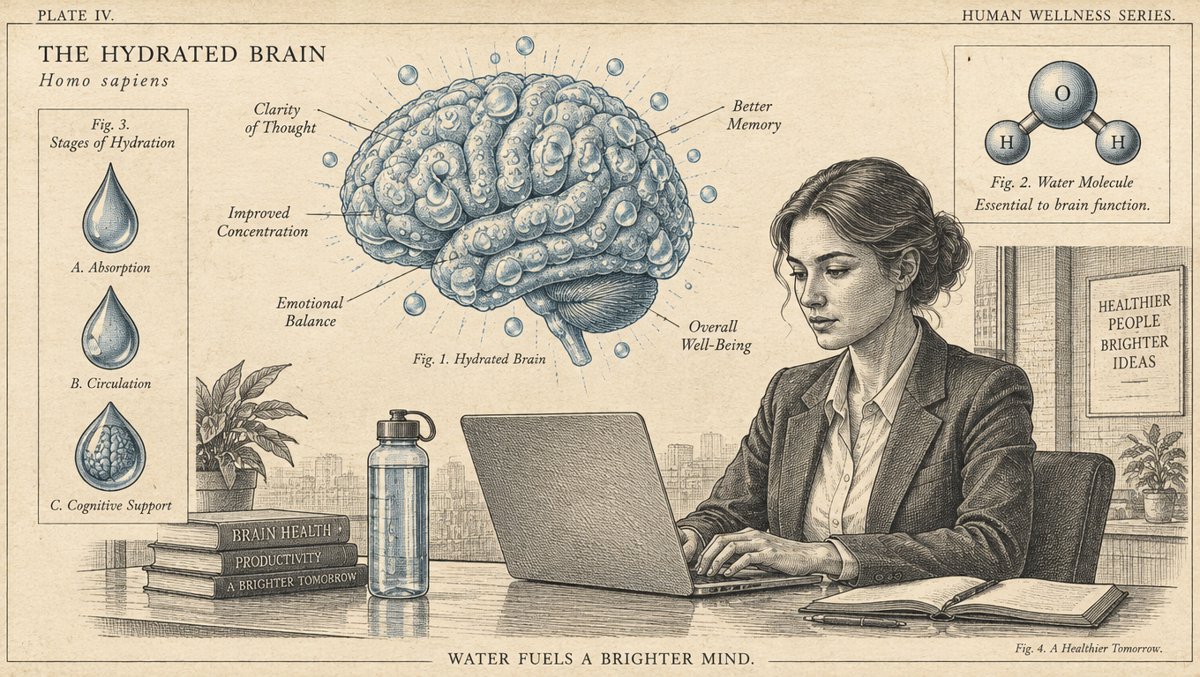
Here's the sneaky part: you don't need to be stumbling through a desert to feel dehydration's effects. Studies show that losing just 1–2% of your body weight in fluid — the kind of dip that happens on a normal busy day when coffee replaces water — is enough to measurably change how you feel and think.
In a controlled trial published in the British Journal of Nutrition, young men with mild dehydration (about 1.4% body-mass loss, no heat, no exercise) showed worse vigilance and working memory, plus increased tension, anxiety, and fatigue⁶. And in a companion study of healthy young women in The Journal of Nutrition, mild dehydration didn't wreck test scores — but it degraded mood, increased headaches, lowered concentration, and made tasks feel more difficult⁷. In other words: you can still get the work done… you'll just feel grumpier doing it while your head quietly aches. 😩
That 3 PM slump you blame on lunch? Sometimes it's partly a hydration dip. The fix costs nothing and takes five seconds.
Your 3-step focus fix:
- Bookend your day. A glass of water when you wake up (you just went 8 hours without drinking 💤) and one with each meal covers a surprising amount of ground.
- Pair sips with habits. Water refill every time you stand up for a meeting, before every coffee, after every bathroom trip. Habit-stacking beats willpower.
- Don't wait for a 4-alarm thirst emergency. Thirst works, but if you're deep in focused work, it's easy to ignore it for hours — the exact window where mood and focus dip⁶ ⁷.
💡 Key takeaway: Even 1–2% dehydration dents focus and mood. A water bottle on your desk is the cheapest cognitive enhancer you'll ever buy.
⏳ Section 3: Water and the Fountain of Youth (Sort Of)
Now for the headline-grabber. A 2023 NIH-funded study published in eBioMedicine followed 11,255 U.S. adults over 25 years and looked at serum sodium — a blood marker that rises when you're chronically under-hydrated. The findings were striking: adults with serum sodium at the higher end of the normal range (>142 mmol/L) had 10–15% higher odds of being biologically older than their calendar age, and those above 144 mmol/L were about 50% more likely to be biologically older — plus they showed higher risks of chronic conditions like heart failure and stroke, and higher rates of early death⁸ ⁹ ¹⁰.
Tempting to read that as "drink water, live forever," right? Hold on — the researchers themselves urge caution. This is an association, not proof. Higher serum sodium might simply be a flag for other health issues, and no trial has shown that chugging extra water slows aging⁸. It's an intriguing signal worth taking seriously, not a guarantee.
Where hydration's benefits are rock-solid: kidney stones. Higher fluid intake increases urine volume and dilutes the minerals that form stones¹¹ — people who've had a stone are typically advised to drink enough to produce about 2 to 2.5 liters of urine daily¹². But here's the refreshingly honest 2026 update: the largest trial of its kind, led by Duke Health researchers, found that even intensive coaching got people to drink more and urinate more… yet stone recurrence didn't drop versus the control group¹³. The lesson isn't "hydration is useless" — it's that knowing to drink more and actually building the habit are two very different things. Which is exactly why the playbook below is built around habits, not lectures. 😉
💡 Key takeaway: Good hydration is linked to healthier aging markers and fewer kidney stones — but the aging link is associative, and consistency beats occasional overcorrection.
🛠️ Section 4: Your Personal Hydration Playbook
Ready for the practical stuff? Here's your evidence-based game plan.
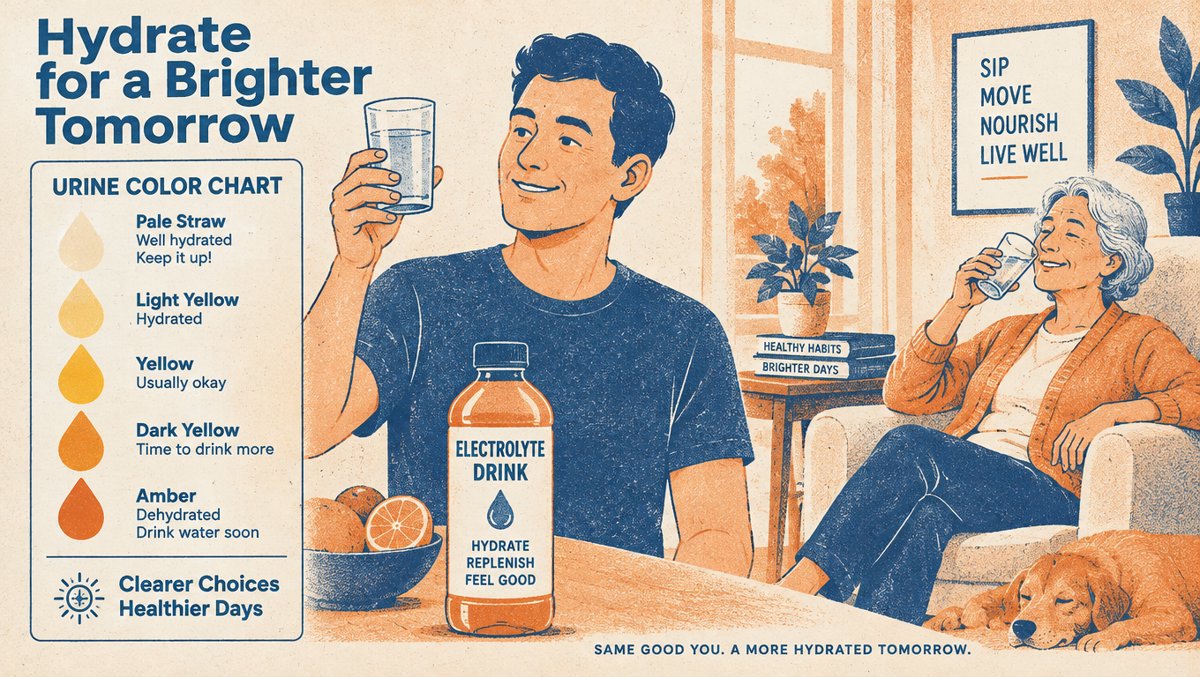
1. 🎨 Use the free dashboard you already have: your pee. Aim for pale straw yellow. Dark amber or apple-juice territory? Drink up. (Heads up: vitamins and some foods can tint things too.)
2. ☕ Retire the "coffee dehydrates you" myth. The National Academies counted caffeinated drinks toward daily water intake for a reason³ — your latte is mostly water, and regular drinkers adapt. It still counts.
3. ⚠️ Respect the other edge: more is NOT always better. During long, sweaty workouts, forcing huge volumes of plain water can cause exercise-associated hyponatremia — dangerously diluted blood sodium that can be serious, even fatal in extreme cases¹⁴ ¹⁵. The modern guidance is refreshingly simple: drink to thirst during endurance exercise¹⁵.
4. 🧂 Save the electrolyte drinks for when they earn it. For most healthy people on normal days, they're expensive flavored water. Harvard's Nutrition Source and the Cleveland Clinic both say electrolyte drinks earn their spot mostly in long, intense endurance sessions (think 60–90+ minutes of heavy sweating) or illness with fluid losses¹⁶ ¹⁷.
5. 👵 Over 65? Sip on a schedule, not on thirst. The thirst signal naturally blunts with age — Mayo Clinic notes many older adults don't feel thirsty until they're already dehydrated¹⁸, and Cleveland Clinic flags dehydration as an under-appreciated senior health risk¹⁹. A simple "glass with every meal + one between meals" routine removes the guesswork.
🎯 Key Takeaways
- Forget the eight-glass rule — official guidance says about 11.5 cups of total fluid a day for women and 15.5 for men, and roughly 80% of that comes from all your drinks, including coffee and tea.
- Your hydration needs are personal — body size, activity, and climate can swing your daily water turnover from about 1 liter to 6.
- Even 1–2% dehydration can measurably dent your focus and mood — a very good reason to keep a bottle on your desk.
- Your urine is a free hydration dashboard — aim for pale straw yellow, not apple juice.
- More is not always better — drink to thirst during long workouts, and if you're over 65, sip on a schedule, because thirst itself gets quieter with age.
🎧 Key Takeaways — Listen (2 min)
📚 Verified Sources
- National Academies of Sciences, Engineering, and Medicine — Dietary Reference Intakes for Water, Potassium, Sodium, Chloride, and Sulfate (2005): Adequate Intake of 3.7 L/day total water for men, 2.7 L/day for women; ~80% from beverages (including caffeinated), ~20% from food. https://www.nationalacademies.org/read/10925/chapter/6
- McGill University Office for Science and Society — "The Water Myth": how the 6–8 glasses belief outgrew its (nonexistent) evidence. https://www.mcgill.ca/oss/article/health-nutrition/water-myth
- Valtin, H. (2002) — American Journal of Physiology: "Drink at least eight glasses of water a day — really?" Review found no scientific basis for the 8×8 rule in healthy adults. https://www.sciencedaily.com/releases/2002/08/020809071640.htm
- Mayo Clinic — "Water: How much should you drink every day?": ~11.5 cups (2.7 L) to 15.5 cups (3.7 L) total fluid daily for average healthy adults; needs vary with exercise, environment, health, and pregnancy. https://www.mayoclinic.org/healthy-lifestyle/nutrition-and-healthy-eating/in-depth/water/art-20044256
- Yamada, Y., et al. (2022) — Science 378(6622):909–914: isotope-tracking of 5,604 people (8 days–96 years, 23 countries) showed daily water turnover ranging roughly 1–6 L/day, driven by body size, activity, and climate. https://www.science.org/doi/10.1126/science.abm8668
- Ganio, M.S., et al. (2011) — British Journal of Nutrition: mild dehydration (~1.4% body mass) in men impaired vigilance and working memory and increased tension/anxiety and fatigue. https://pubmed.ncbi.nlm.nih.gov/21736786/
- Armstrong, L.E., et al. (2012) — The Journal of Nutrition: mild dehydration in healthy young women caused degraded mood, headaches, lower concentration, and greater perceived task difficulty. https://jn.nutrition.org/article/S0022-3166(22)02889-9/fulltext
- NIH News Releases (Jan 2023) — "Good hydration linked to healthy aging": serum sodium >142 mEq/L associated with 10–15% higher odds of biological aging; study is associational. https://www.nih.gov/news-events/news-releases/good-hydration-linked-healthy-aging
- NIH Research Matters (Jan 2023) — "Link between hydration and aging": adults with serum sodium >144 mmol/L were ~50% more likely to be biologically older than chronological age. https://www.nih.gov/news-events/nih-research-matters/link-between-hydration-aging
- Dmitrieva, N.I., et al. (2023) — eBioMedicine: middle-age high-normal serum sodium (>142 mmol/L) as a risk factor for biological aging, chronic disease, and early mortality (11,255 adults, 25-year cohort). https://pubmed.ncbi.nlm.nih.gov/36599719/
- Gamage, K.N., et al. (2020) — Nutrients / PMC: higher fluid intake increases urine output and is associated with reduced kidney stone formation. https://pmc.ncbi.nlm.nih.gov/articles/PMC7731957/
- UT Southwestern Medical Center (2023) — stone-formers advised ~2 L (8 cups) minimum, ideally 3 L (12 cups) of fluid daily plus small dietary changes. https://www.utsouthwestern.edu/newsroom/articles/year-2023/june-prevent-kidney-stones.html
- Duke Health (Mar 2026) — largest trial of its kind: a hydration coaching strategy increased urine output but did not reduce kidney stone recurrence versus control — highlighting the behavior-change challenge. https://corporate.dukehealth.org/news/largest-study-its-kind-tests-hydration-strategy-kidney-stones
- Rosner, M.H. (2019) — PMC/NIH: exercise-associated hyponatremia review; primary prevention is avoiding overdrinking during prolonged exercise. https://pmc.ncbi.nlm.nih.gov/articles/PMC6735969/
- Jonas, C.E. & Hoffman, M.D. (2021) — American Family Physician: exercise-associated hyponatremia guidance — risk reduced by drinking only to thirst during prolonged exertion. https://www.aafp.org/afp/2021/0215/p252
- Harvard T.H. Chan School of Public Health — The Nutrition Source — "Do I need electrolyte drinks?": most healthy people don't; useful for prolonged intense sweat sessions. https://nutritionsource.hsph.harvard.edu/electrolyte-drinks/
- Cleveland Clinic — "Sports Drinks: Are Electrolyte Drinks Beneficial or Not?": context for when electrolyte replacement makes sense. https://health.clevelandclinic.org/electrolyte-drinks-beneficial-or-not
- Mayo Clinic — "Dehydration: Symptoms & causes": thirst isn't always reliable; many older adults don't feel thirsty until already dehydrated. https://www.mayoclinic.org/diseases-conditions/dehydration/symptoms-causes/syc-20354086
- Cleveland Clinic — "Drink Up: The Connection Between Age and Dehydration": age-related changes put older adults at elevated dehydration risk. https://health.clevelandclinic.org/drink-up-dehydration-is-an-often-overlooked-health-risk-for-seniors
All claims fact-checked against Gold-tier (CDC/NIH/WHO/PubMed/Nature/The Lancet) and Silver-tier (Mayo Clinic/Harvard Health/Cleveland Clinic) authoritative sources. Last verified: October 13, 2026.
So no — you don't owe the universe eight glasses today. You owe yourself a little attention to a body that's been managing your water balance brilliantly all along. Refill that bottle, enjoy your coffee guilt-free, and check in with the dashboard now and then. Small sips, big wins. See you tomorrow! 💧✨