The 473,000-Star Tool That Promises to Reverse-Engineer Anything — Fact-Checked
The 473,000-Star Tool That Promises to Reverse-Engineer Anything — Fact-Checked
A repo called "Reverse Engineer Anything" — everyone shortens it to REA — spent October 2026 parked at #1 on GitHub Trending, spawned 280-comment Reddit threads, and crossed a quarter-million stars before most devs had decided whether it was a revolution or a party trick. So I installed it, read the compiler, and checked every claim. The headline is half right — and the interesting half is not what the viral posts say.
The 3-second version
- REA is an open-source MCP server + CLI (
rea-agents, MIT) that plugs your AI coding agent into real reverse-engineering tools: Ghidra, Hopper, IDA, Kuna, JADX, Frida-class runtime inspection, and a long tail of static parsers. - It does not contain a decompiler. It rents one — mostly from Ghidra (free) or Hopper/IDA (commercial). The magic is the plumbing: one setup command registers it with 43 agent clients, and every answer comes back with evidence and stated limitations.
- Live numbers (GitHub API, Nov 22, 2026): 473,545 stars, 115,513 forks, 1,319 open issues, 9,221 commits, created Apr 14, 2026 — seven months old and still shipping weekly (v6.10.1 on Nov 20).
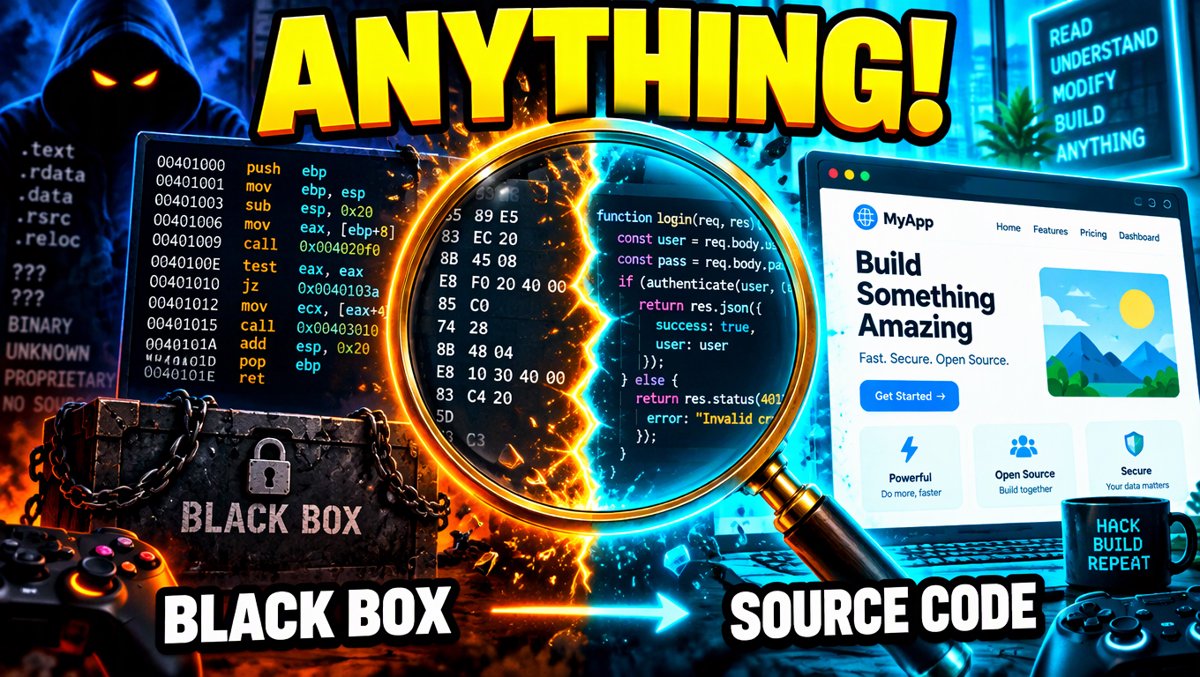
- The "AI copies any app" framing is unproven. The proven framing is narrower and better: ask one feature-level question, get receipts, rebuild that feature yourself.
- For NXagents: there's no
nxagentsclient id — but that's fine. Custom agents use the manual stdio MCP registration path, and REA explicitly supports it.
What I actually found in the repo
I pulled the live API record, the README, package.json, and the supported-targets doc fresh this morning. First, the identity check — this is the real repo, and it's maintained by a real team, not a weekend meme:
| Field | Value (live, Nov 22 2026) |
|---|---|
| Repo | morluto/rea — "Reverse engineer anything with agents, from app behavior down to native binaries" |
| Created | Apr 14, 2026 (so: ~7 months old, not a overnight clone) |
| Stars / forks / open issues | 473,545 / 115,513 / 1,319 |
| Commits on main | 9,221 |
| Language / license | TypeScript / MIT |
| npm package | rea-agents v6.10.1 (Nov 20, 2026), Node ^22.23.4 / ^24.22.1 / ≥26.12.1 |
| Contributors | morluto 5,859 · N0zoM1z0 727 · kaoru0822-kitauji 674 · gensokyo-dev 297 · ShuaixinHuang 280 · long tail |
The star trajectory tells the viral story: ~18K stars in early October, 115K in a single week (dev.to, Oct 12), 250K by Oct 14 (DataCamp tutorial), a 400,000-star banner in the README, and 473,545 when I hit the API today. The Discord claims 50,000+ members. This is the fastest adoption curve I've fact-checked since Kiri — and like Kiri, the stars measure excitement, not correctness.
One thing the viral posts never mention: the README carries a loud official-source warning. "A similar repository name or copied README does not establish that a download is official." When a repo is this hot, clone farms follow — get it from morluto/rea, rea.tools, or the rea-agents npm package only.
How it actually works (the part the tweets skip)
REA is three pieces glued together:
- The MCP server. Any agent that speaks Model Context Protocol gets a tool catalog for inspecting binaries, JavaScript/Electron apps, .NET assemblies, Android APKs, websites, firmware, network captures, and more. Static checks run locally; runtime capture runs the target under your own user permissions.
- The investigation skill. Setup installs workflow instructions next to the MCP connection, so the agent knows the loop: ask one feature question → inspect → explain with evidence → rebuild and test.
- The engines — which are mostly not REA's. Native decompilation goes to Hopper, Ghidra, IDA, or Kuna. Android goes to JADX + a JDK. Firmware goes to Binwalk/Unblob. REA's own code covers static parsing (Go, Rust, WASM, EVM bytecode, PE/ELF/Mach-O internals, GGUF model artifacts, IL2CPP, Godot PCK, and a genuinely long list).
The setup is one command, run from a trusted directory outside the target:
npx rea-agents setup          # pick your agent, approve the plan, restart the agent
rea doctor --client pi        # verify the wiring
Setup backs up your existing config first — it edits your agent's MCP registry and drops in the skill. It also supports Claude Code and Codex plugins and a Cursor Marketplace plugin for the editor crowd.
The honest description of the product: REA is a well-built universal adapter between AI agents and the reverse-engineering toolchain. The decompilers do the decompiling. REA makes them callable by an agent, in one consistent language, with receipts.
The fact-check scoreboard
| Viral claim | Verdict | What the evidence says |
|---|---|---|
| "#1 trending repo, hundreds of thousands of stars" | ✅ TRUE | 473,545 stars live today; #1 Trending in October; README banner at 400K |
| "It copies any app" | ❌ UNPROVEN | Every showcase rebuilds one feature (a sound-pan formula, a clipboard bridge, a % button). No full-app clone exists in the evidence |
| "AI agent + REA = reverse engineering without the painful tools" | ✅ TRUE, with asterisks | Ghidra/Hopper/IDA still do the heavy lifting; REA removes the manual stitching, not the expertise |
| "It uploads your software to the cloud" | ❌ FALSE | Analysis runs locally. But the agent's model provider still receives the tool results — check its data policy for sensitive targets |
| "It works with my agent" | ✅ TRUE for 43 clients | Claude Code, Codex, Cursor, OpenCode, Pi, Gemini CLI, Copilot CLI, VS Code, Zed, Goose, Kilo, DeepSeek Harness… anything else via manual MCP registration |
| "Reverse engineering is now legal" | ❌ FALSE | Still a jurisdictional minefield. REA's own DISCLAIMER bans DRM/anti-cheat/cheat development and proprietary-code copying outright |
The showcases are the real pitch
Ignore the memes; the case studies are why this project matters:
- DX-Ball (1996 Windows game): recovered a position-to-pan audio formula from x86 instructions, then verified the C reconstruction against 3,205 original-x86 test cases and all 63 compiled function bytes. That's not a demo — that's a proof.
- Notion's clipboard bridge: traced how a copy action travels from renderer → preload → IPC → main process, which is exactly the kind of invisible plumbing you'd want to understand before building your own Electron app.
- TH04 (PC-98 DOS game): recovered 16-bit angle math and compared the reconstruction against historical compiler output.
- Windows Calculator's % button: the beloved weirdness that 200 + 10% = 220, because after
+the % key takes 10% of the first number. x86 instructions, operator IDs, and Microsoft's own test cases, lined up side by side. - Chrome's dinosaur game: speed starts at 6, gains 0.001 per update, caps at 13 — verified by calling the update function 4,000 and 10,000 times in a controlled check.
Notice the pattern: every showcase is one question, one feature, hard evidence. That discipline is the project's whole personality, and it's why the team at DataCamp could take the same workflow further — REA + Pi found Chrome's jump/collision/scoring logic, and the agent rebuilt it as an original game ("Neon Rooftops", not a clone), packaged it as a standalone .exe, and published it. Interesting wrinkle from that tutorial: REA's browser inspection only covers HTTP/HTTPS pages, so chrome://dino itself was out of scope — Pi worked around it by extracting the JavaScript from Chrome's installed resources.pak. Even the success stories have asterisks, and REA is unusually honest about printing them.
What it can point at (the supported-targets table, summarized)
| Target | What you get back | Engine required |
|---|---|---|
| Native binaries (ELF/PE/Mach-O) | Pseudocode, assembly, strings, symbols, calls, references | Hopper, Ghidra, IDA, or Kuna (Windows Ghidra is still experimental) |
| JavaScript / Electron apps | Modules, imports, source maps, routes, IPC boundaries | None — static only |
| .NET assemblies | Metadata, CIL instructions, native deps | None — static only |
| Android APKs | Manifest, classes, decompiled methods | Headless JADX + JDK |
| Websites | Page structure, scripts, network observations, screenshots | Chrome-family browser (HTTP/HTTPS only) |
| Firmware | Regions, extraction, handoff to native analysis | Bundled UEFI/NVAR; Binwalk/Unblob on Linux |
| Go / Rust binaries | Embedded versions, modules, crate inventories | Built-in static inspection |
| Model artifacts (GGUF, safetensors) | Tensor declarations, metadata, totals | Built-in header inspection |
| Network captures (HAR, pcap) | Requests, payloads, endpoints, TLS SNI | HAR/SAZ files; TShark on Linux |
| Recorded web/desktop sessions | A runnable RL environment for agent training/testing | REA's own recorder |
That's a wider net than any single classic tool. The tradeoff is equally clear: depth per target still depends on the engine you plug in.
The backlash you should know about
Reddit's largest REA threads are not worshipful. On r/ClaudeCode (1K+ comments, "The dream is dead"), users report Claude refusing to finish REA reports on targets it considers off-limits; on r/decomps the practical consensus is that Codex proceeds where Claude stops. Read that as a feature, not a bug: the model policies are the second lock on the door, and REA's DISCLAIMER is the first. The project's stated scope is lawful research, interoperability, software preservation, and software you own or are authorized to examine. It explicitly will not help with circumventing DRM or license checks, anti-cheat, game cheats, bypassing authentication or bot protection, or copying proprietary code — and says those requests get closed without response. A 2026 legal paper put it bluntly: over 70% of security professionals aren't certain where the legal boundaries are. REA at least prints its boundaries on the door.
How to integrate REA into NXagents
Your NXagents agents are exactly the class of client REA serves: MCP-capable agents. There is no nxagents id in the 43-client setup list, so you skip setup --client and go straight to the manual stdio MCP registration that REA documents for hosts like llama.cpp. Here's the ladder I'd run:
- Install on a trusted host (not the target machine):
npm install --global rea-agents— needs Node ^22.23.4 / ^24.22.1 / ≥26.12.1. Note older tutorials say 22.19+; the repo's current floor is higher. Check your host's Node before wiring anything. - Health-check it:
rea doctor— five minutes, catches Node/provider/config drift before it costs you an afternoon. - Wire it as one of your agent skills. Register the REA MCP server in the agent's tool config (the same tools/skill slot where you'd add a new capability), with the matching investigation instructions, and restart the agent session. Verify with a trivial target first — an Electron app or a .NET assembly, both engine-free.
- Give it one narrow, lawful job. The best first job for a platform team: audit your own shipped JavaScript bundles. REA's
analyze-javascript-applicationreturns modules, imports, and Electron boundaries with evidence — i.e., a real answer to "what's actually in our build, and where's the IPC surface?" Same tool, pointed at a competitor's app only if it's squarely in the interoperability/analysis lane your counsel signs off on. - Route by target type. Static JS/.NET targets need no engine; native targets need Ghidra on the host (free, Linux-first); Android needs JADX + JDK. Match the job to the engine you actually have installed.
- Treat the evidence as the deliverable. REA results include limitations and unknowns by design. File them with the investigation — an answer without its caveats is a future incident.
- Two-week bake-off, one question at a time. Like the showcases: one feature per investigation, one verification step per rebuild. If the receipts hold up, expand the target list; if they don't, you've spent two weeks, not two quarters.
What REA is not for NXagents: pointing it at third-party platforms to scrape, bypass, or clone. That's outside REA's own disclaimer and outside the conversation worth having.
Ordered verdict
| Aspect | Score | Why |
|---|---|---|
| Plumbing / MCP adapter design | 9/10 | One setup command, 43 clients, CLI parity, doctor checks, evidence-first results |
| Investigation discipline | 9/10 | Every showcase is one feature + verification; DX-Ball's 3,205-case check is the gold standard |
| Decompilation depth | 7/10 | Real, but inherited — Ghidra/Hopper/IDA do the deep work; Windows native is still experimental |
| Honesty about limits | 8.5/10 | Limitations ship with every result; disclaimer is unusually adult |
| Viral-headline accuracy | 4/10 | "Reverse-engineer anything" means "investigate one feature of many things, with an engine" |
| Overall | 8/10 | The rare viral tool that's better than its meme — as long as you read the fine print it prints for you |
The short version: REA won't clone your favorite app, and it doesn't pretend to in its own docs. What it does — make a coding agent show its work on any binary or bundle you point it at — is genuinely new, genuinely useful, and exactly the kind of tool that belongs in an agent platform's toolkit. As long as the question is one feature at a time, and the target is one you have the right to open.
Research checkpoint: github_api.json, README, package.json, supported-targets, mcp-contracts, installation docs, DataCamp tutorial — all fetched live on Nov 22, 2026 and saved under blogs/rea-reverse-engineering/research/.