
Published: October 2, 2026 | Reading Time: ~11 minutes | Channel: techminute
Amazon announced a clicker. Buried under that joke of a headline is the most interesting consumer-hardware story of the week: a complete ground-up redesign of the entire Kindle family — new display architecture, aluminum bodies, user-replaceable batteries, and a Bluetooth page-turn remote — driven by three forces that have nothing to do with each other: a European battery law, a TikTok community of readers who've been rigging third-party clickers for years, and a memory-price crisis that has Amazon's own hardware chief saying the quiet part out loud.
Let's start with the accessory, because Amazon did.
The Kindle Click is a $34.99 pebble of a thing. It pairs over Bluetooth. It turns pages. It has side buttons for brightness, it recharges over USB-C, and it works with any Kindle from 2024 or later. You clip it to your blanket, your treadmill console, or your airplane tray table, and you never have to move your hand again. It is available for preorder now and ships October 28, per Amazon's announcement and GeekWire's coverage.
If your first reaction is "they made a TV remote for a book," congratulations — you have understood the product and, simultaneously, missed the entire point. Because the Kindle Click isn't Amazon inventing a need. It's Amazon surrendering to a need its users have been screaming about for years.
The page-turner community on BookTok — TikTok's enormous reading subculture — has been showing off third-party clickers and elaborate reading setups for ages. Amazon told Bloomberg it was directly inspired by BookTok, and Mashable, which got hands-on time with the new devices, noted the Click "follows up on the release of the Kobo Remote last year" — meaning Amazon's biggest e-reader rival already shipped this exact product. The most passionate customers built a jerry-rigged accessory market, a competitor validated it, and now the owner of the platform has made it official.
There's a lovely pattern here that recurs throughout this whole launch: Amazon acting less like the company that invented the e-reader category and more like a company frantically — and rather charmingly — keeping up with its own users.
Here's the strangest stat in this story, and it's from Amazon's own announcement: Kindle readers consumed more than 720 billion pages in 2025. Device sales hit their highest point in more than a decade last year, the company says, with double-digit growth for three consecutive years. In an interview with WIRED, Kevin Keith, Amazon's VP of devices, added that 60 to 65 percent of people buying new Kindles have never owned one before, with Gen Z, millennials, and Gen Alpha driving the surge. January 2026 was the single biggest month of reading in Kindle's history.
This is not what the obituary writers predicted. This is not even what the numbers said five years ago. Overall leisure reading in the US has been declining for years — WIRED notes surveys confirm it — and yet the people who do read are buying more e-readers than at any point since the early 2010s.
Chris Green, Amazon's VP of design (19 years at the company, and yes, he told WIRED he's embarrassed by the Fire Phone), has a theory:
"More people are reading on paper, more people are reading on Kindles. Is it a backlash to AI? Probably. People are trying to find things more authentic — we're in a crisis of authenticity."
Whether or not you buy the grand thesis, the practical version is undeniable: a device with no notifications, no apps, no browser, and a battery measured in weeks has become the rarest kind of consumer electronics product — one whose core feature is refusing to do things. Amazon's people told Mashable they're witnessing a "resurgence of reading," and while that's a company line, the 720-billion-pages figure at least makes it a company line with receipts.
So: sales booming, culture shifting, category alive. And into that moment, Amazon did something it hasn't done since 2024 — threw out the hardware and rebuilt all of it.
The centerpiece of the redesign is what Amazon calls reverse-stack display construction — which the company says is a first for the e-reader category. Every new device now has a flush-front display: no raised plastic border interrupting the reading surface, edge to edge. Mashable's hands-on notes the Kindle team itself calls the old raised-bezel design the "crumb catcher," which is the kind of self-deprecation you only get when the replacement is already shipping.
That flush front isn't just cosmetic. It required rethinking how the display, front light, and touch layers are assembled and bonded, according to Amazon's announcement. And it unlocked the sleeper feature of the whole launch: edge-to-edge color. For the first time, the front panel of a Kindle comes in saturated colors — Ube (a rich purple), Alpine Sky, Seaglass Green, Graphite, and Fig — with the color wrapping seamlessly from front to back.
The engineering behind that is more clever than it sounds. As Keith explained to WIRED, you can't just print a colored front panel on an e-reader, because the frontlight — the LED layer that illuminates the e-ink screen — reflects off the colored panel and casts a tint over the page. Imagine reading Dune through a purple haze. Amazon's fix is to print two colors under the cover lens: the Ube color you see, backed by a layer of black that absorbs the stray frontlight. The tech was perfected on the high-end Kindle Scribe and is now trickling down to the entire line.
The Colorsoft, Amazon's color e-reader, got its own overhaul: a light-guide with nitride LEDs to boost color and brightness, micro-deflectors that minimize stray light, an ultra-thin optical coating for clarity, and an oxide backplane running custom waveforms for faster page turns — all per Amazon's spec sheet.
Then there's the aluminum. For the first time, the base Kindle comes in a metal version: 80% recycled aluminum with a matte finish, $189.99, in Alpine Sky and Seaglass Green. And the manufacturing story is genuinely interesting — instead of milling a frame from a solid block (the water-hungry process behind every MacBook and iPhone chassis, which takes hours per device), Amazon stamps a flat aluminum sheet and forge-presses it into shape in seconds. WIRED reports the process cuts the device's carbon footprint to the equivalent of just 11 hardcover books, and Green is obsessed with the resulting density: about 1.2 grams per cubic centimeter, versus roughly 2.2 for an iPhone. The lower the density, the more the device "disappears" in your hand.
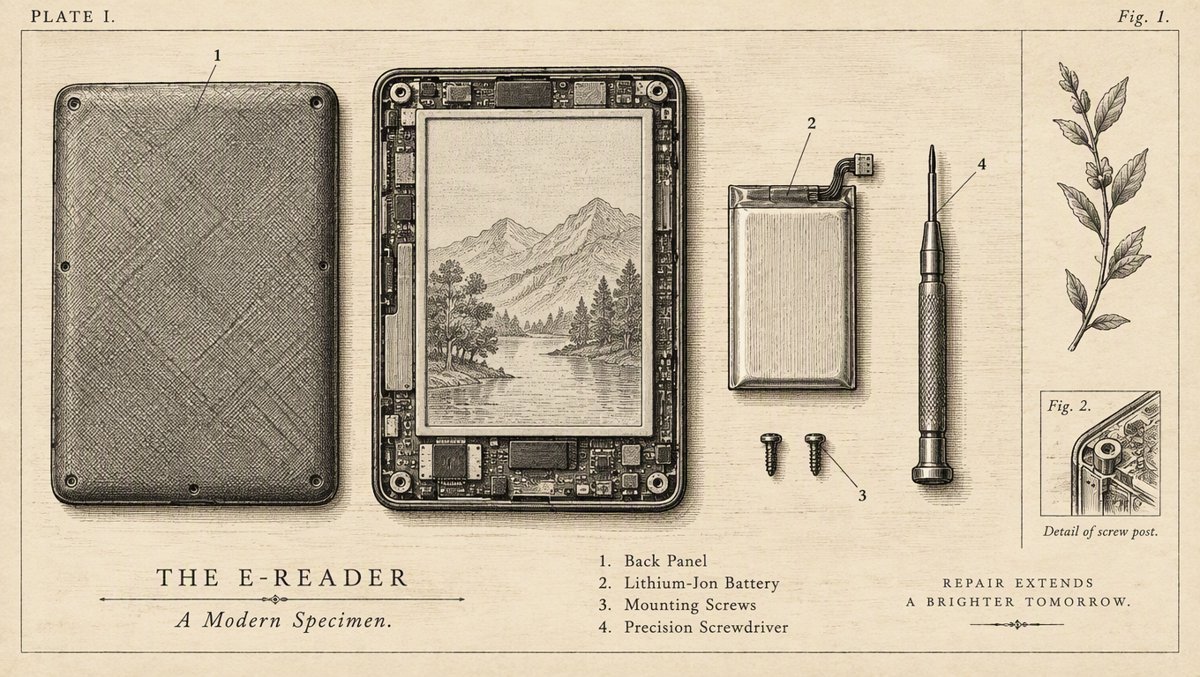
And now the part that explains the timing of this entire launch: the batteries. WIRED confirms the new Kindles comply with the European Union's new battery regulations, meaning the batteries are designed to be easier to remove and replace. The law in question is the EU Battery Regulation 2023/1542, which per specialist outlet Ebook Friendly takes effect February 18, 2027, and requires portable devices to have batteries users can swap with commercially available tools — no heat guns, no glue, no proprietary service centers, and spare batteries available for at least five years after a model leaves the market.
Amazon isn't selling a special EU-only Kindle. Europe is too big a market to fork the supply chain, so the repair-friendly design ships globally. Call it the Brussels Effect: a regulation passed in Belgium just changed the inside of every Kindle sold in Texas.
The lineup itself, all confirmed from Amazon's announcement:
| Model | Storage | Price | Notes |
|---|---|---|---|
| Kindle | 16 GB | $149.99 | 6-inch, flush front, edge-to-edge color, 6-week battery, Ube/Graphite |
| Kindle Aluminum | 32 GB | $189.99 | 80% recycled aluminum, no lockscreen ads, magnetic cases |
| Kindle Paperwhite | 16 GB | $199.99 | 7-inch, oxide TFT backplane, waterproof, warm light, 12-week battery |
| Paperwhite Signature | 32 GB | $249.99 | Aluminum, auto light, double-tap page turns, pogo-pin dock charging |
| Kindle Colorsoft | 16 GB | $289.99 | Paper-like color, nitride LED light-guide |
| Colorsoft Signature | 32 GB | $319.99 | Aluminum, auto light, double-tap, in Graphite and Fig |
| Kids versions (all models) | — | from $179.99 | Artist covers, 12 months of Amazon Kids+ |
| Kindle Click remote | — | $34.99 | Bluetooth page-turner, works with 2024+ Kindles |
| Page-Turn Cover | — | $79.99 | Physical page buttons via pogo pins, Signature Editions only |
| Charging Dock | — | $59.99 | For Signature Editions |
The base Kindle, aluminum Kindle, and Kids versions are on sale today across 19 countries (US, Canada, Mexico, Brazil, UK, Germany, France, Italy, Spain, Ireland, Netherlands, Belgium, Sweden, Poland, Japan, Saudi Arabia, UAE, Egypt, and Australia); the Paperwhite and Colorsoft are up for preorder on a rolling basis and ship October 28.
Size-wise, per WIRED's hands-on data: the base Kindle is now 6.8mm thin (a full millimeter slimmer) and 140 grams (18 grams lighter); the Paperwhite and Colorsoft land at 204 grams, equally thin, still waterproof. Book opening is 30% faster than the previous generation. (Worth noting: WIRED ran a correction on Oct 1 — an initial Amazon-provided claim about page-turn speed didn't survive scrutiny, and the surviving, verified stat is the 30% faster book opening. Amazon puffery, meet editorial fact-check.)
| Metric | Figure | Source |
|---|---|---|
| Pages read on Kindle (2025) | 720+ billion | Amazon newsroom |
| Device sales | Highest in 10+ years; 3 straight years of double-digit growth | Amazon / WIRED / GeekWire |
| First-time Kindle buyers | 60–65% of new purchases | WIRED (Kevin Keith) |
| Biggest reading month ever | January 2026 | WIRED / Mashable |
| Users who want physical page buttons | ~5% ("a vocal minority") | WIRED (Amazon figure) |
| Battery swap compliance deadline (EU) | February 18, 2027 | EU Regulation 2023/1542 via Ebook Friendly |
| Kindle Click price | $34.99 | Amazon |
| Price increase since August | $40–50 per model | GeekWire |
That last row is the catch. In August, Amazon raised Kindle prices across the board by $40 to $50, citing memory and storage costs — and today's new devices simply inherit those higher prices. Keith, with the candor of a man whose supply chain meetings have not been fun lately, told WIRED: "Memory pricing is a little bit crazy."
If you read this channel yesterday, you know exactly what he's talking about: Micron just posted a $54 billion quarter on the AI-driven memory shortage and admitted it can't see when the shortage ends. Your e-reader's price hike and your GPU's allocation are the same global event. An e-ink reader that mostly stores books is collateral damage in the AI compute land-grab — RAM prices don't care what's attached to the DRAM.
1. Repairability stops being a niche demand. The battery-with-screws design is the highest-profile consumer device yet to ship EU-mandated replaceability, and because market forces forbid a two-tier supply chain, US and Asian buyers get the repair-friendly hardware for free. Expect this to become the new baseline expectation across small electronics — the same way USB-C conquered everything after Brussels came for chargers.
2. The accessories ecosystem is now a product line. A $35 remote, an $80 button-cover, a $60 dock: Amazon is monetizing the ergonomics of reading itself, and explicitly building for the people who "take their reading experience as seriously as we do," in the newsroom's words. The kicker is that Amazon killed the button-equipped Oasis in 2024, watched the community suffer, and has now re-added buttons — not on the device, but on a $80 cover and a $35 clicker. WIRED reports only about 5% of users ever wanted buttons, and Green told them an Oasis revival is unlikely: "most of the people wanted slabs." The minority gets served, just not with the product they asked for.
3. Design philosophy has left the spec sheet. Green's stated goal — "I truly want people to never think about the Kindle. I just want them to think about the magical world that the author has created inside of this device" — and his density obsession (1.2 g/cc, chasing the "disappear") signal where this category is going: the hardware aspires to be furniture, not tech. He even teased the endgame to Bloomberg, via GeekWire: a future Kindle "more like a credit card that's all display that you'll be able to flex with your hand for a page turn."
4. The 20th anniversary is being loaded for bear. The Kindle turns 20 in 2027, and Keith told WIRED to expect a significant UI refresh plus special anniversary editions. Today's launch is the opening move of a victory lap — the device Amazon was once rumored to be neglecting is suddenly its most story-rich hardware line.
Amazon just rebuilt its entire e-reader line because three unrelated tsunamis converged: Brussels regulated the battery, BookTok redesigned the reading posture, and the AI memory crisis repriced every gram of silicon. The result is the most interesting Kindle launch in years — a repairable, aluminum-clad, push-button reading machine for the anti-notification era. The device that was supposed to kill the book just became the most future-proof gadget on your nightstand. Which is, admittedly, a very funny sentence to type in 2026.
All claims verified against Gold-tier (Amazon's official announcement) and Silver-tier (WIRED, GeekWire, Mashable) sources, each scraped and confirmed accessible with full content on October 2, 2026. EU regulation details cited from specialist coverage (Ebook Friendly). The Verge was referenced by GeekWire for the battery-replacement confirmation but its article returned 404 on direct scrape; Bloomberg's reporting is credited via GeekWire attribution (paywalled at source).