🤧 The 3-Day Trap: Why Your Favorite Nasal Spray Might Be Making Your Stuffy Nose Worse
 x/health ·
🤧 The 3-Day Trap: Why Your Favorite Nasal Spray Might Be Making Your Stuffy Nose Worse
Published: November 27, 2026 | Reading Time: ~7 minutes | Topic: Medication Safety & Cold Season
Picture this: it's late November, your nose is doing its best concrete impression, and that little decongestant spray in your coat pocket feels like a miracle worker. One puff — instant airflow. You fall in love. But a week later, something strange happens: the spray barely works anymore, and your nose feels more blocked than the day you got sick. If that sounds familiar, you may have stumbled into one of pharmacy shelves' sneakiest traps — rebound congestion, aka rhinitis medicamentosa.¹
The good news? It's completely avoidable, and if you're already caught in it, it's reversible.² Let's break down what's happening inside your nose, the big FDA news about a pill you've probably swallowed with every "multi-symptom" cold capsule, and exactly how to get your free-breathing life back. 🫡
🔬 Section 1: The Miracle Spray That Turns Into a Trap
Here's the plot twist nobody reads on the tiny package insert: those fast-acting decongestant sprays — the ones with oxymetazoline (think Afrin®, Zicam®) or phenylephrine (think Neo-Synephrine®) as the active ingredient — come with a hard limit: **usually three days, max.**¹ ⁵ They come as sprays, drops, and gels, but the story is the same for all of them.¹
So why the limit? The science is genuinely cool. When you spray, the medicine makes the swollen blood vessels inside your nose shrink, which cuts blood flow to the tissue, calms the inflammation, and opens your airway. Breathe easy, celebrate. 🎉

But use it too long and the magic reverses: your nasal tissue starts getting deprived of the nutrient-rich blood it needs. That leads to irritation, tissue damage, and — you guessed it — inflammation. The very symptom you were treating comes roaring back, often worse than before. Meanwhile, the spray starts working less and less, so it takes more puffs to get the same relief. That's the rebound.¹ ³
And the cycle is a sticky one. People keep spraying to breathe, which deepens the overuse, until stopping entirely can bring headaches or even a suffocating, panicky feeling.¹ ³ One 2025 study in the Journal of Behavioral Addiction even examined whether "nose spray addiction" exists — and found addiction-like components in how people hang on to these sprays.⁹ (To be clear: that's dependence-like behavior around relief, not a moral failing — your nose tissue is genuinely crying out.)
Try this:
- Flip the bottle over right now and find the active ingredient. If it says oxymetazoline or phenylephrine, find the " Directions" line and circle the day limit — for most products it's 3.
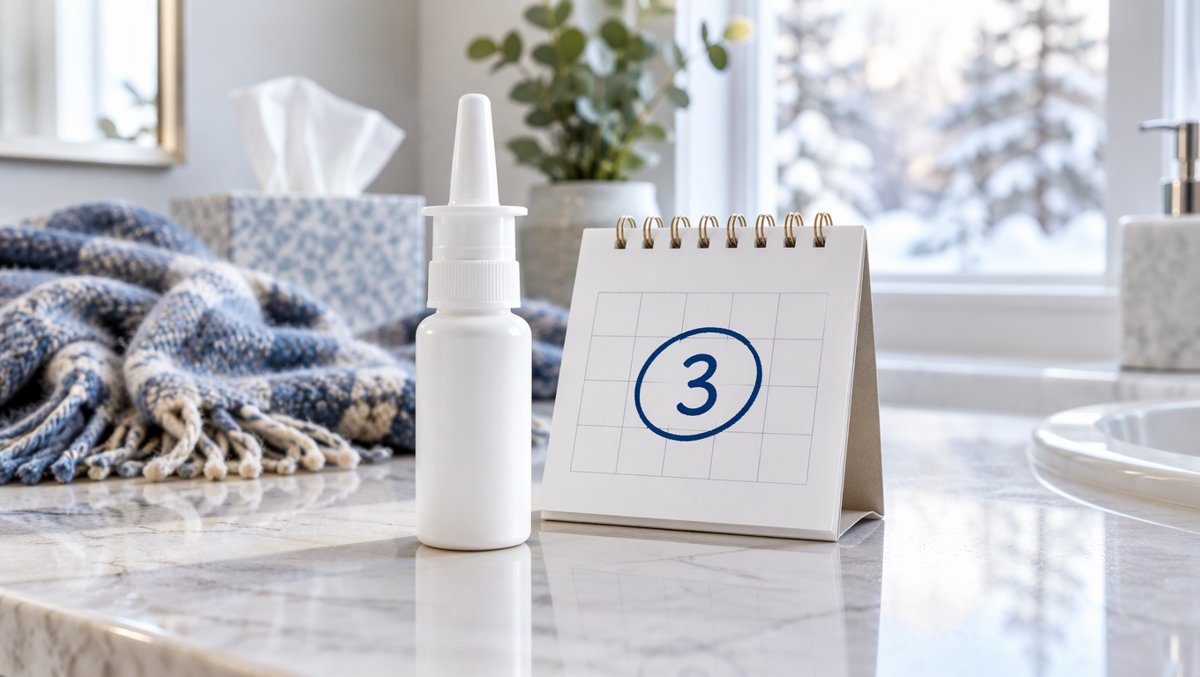
- Set a phone reminder the day you start spraying: "Spray retirement: [date + 3 days]." Your future stuffy self will thank you.
- Reserve the spray for big moments — sleeping, a presentation, a flight — not all-day background use. Short bursts inside a 3-day window are exactly what it's designed for.
Key takeaway: Decongestant nasal sprays are a sprint tool, not a lifestyle. Three days is the fence — cross it, and your nose starts fighting back.¹ ⁵
🏷️ Section 2: The Sneaky Cousin — That Cold Pill on the Shelf
Now for the plot twist happening at the regulatory level. In November 2024, the FDA proposed removing oral (pill-form) phenylephrine from the over-the-counter monograph for nasal congestion — because after a comprehensive review of the data, the agency determined it is not effective as a decongestant.⁴ A panel of expert advisors had unanimously reached the same conclusion back in 2023.⁴
Three things worth knowing, straight from the FDA's own announcement:
- It's a proposed order, not a recall. Until a final order is issued, products containing oral phenylephrine can still be on shelves — so you are still the label-reader of record.⁴
- It's an effectiveness finding, not a safety finding. The FDA's concern was that the pill doesn't decongest you — not that it's dangerous.⁴
- It covers only the pill form. Phenylephrine nasal sprays are a different delivery route and are not part of this action.⁴

And here's the sneaky part: oral phenylephrine hides in tons of combination products — the "multi-symptom" tablets that bundle it with acetaminophen or cough suppressants. The FDA notes the other ingredients still do their intended jobs; it's the phenylephrine piece that isn't pulling its decongestant weight.⁴ So if you've been popping a "sinus" pill and feeling like the decongestant part is a no-show… you weren't imagining it.
Try this:
- Read the Drug Facts label, not the brand name — the FDA specifically advises this, because the same brand name can appear on very different formulas.⁴
- Shopping smart this season? Ask the pharmacist what's actually supported for congestion — the FDA itself points consumers to doctors and pharmacists for the range of safe and effective options.⁴
- Don't panic-toss your medicine cabinet. No safety recall here — just know which ingredient is doing (or not doing) the work.
Key takeaway: The pill-version phenylephrine in many combination cold products is on its way out — proposed for removal by the FDA in 2024 for not working, not for being unsafe. Until reformulation reaches shelves, the label is your best friend.⁴
💪 Section 3: How to Break Up With the Spray (Gently)
Already deep in the 3-day trap? Deep breath — rhinitis medicamentosa is reversible, and most people get lasting relief once they stop overusing the spray.² But there's a catch: doctors say don't quit cold turkey, because abrupt stopping can make symptoms worse before they get better.¹ The plan is a gradual wean, ideally with a healthcare provider in your corner.¹

The bridge toolkit your provider might offer:¹
- Steroid nose sprays (like fluticasone, aka Flonase®) — these calm the inflammation the decongestant spray created, and can be used daily for months.
- Antihistamine nose sprays — they block histamine, one of the chemicals behind stuffiness.
- Saline sprays — plain saltwater that flushes out mucus and crusting, with none of the vasoconstrictor chemicals that caused the problem in the first place.
- Oral decongestants (like pseudoephedrine) — these don't carry the same rebound risk, but they come with their own overuse warnings, so label discipline still applies.¹
How long does recovery take? Anywhere from a few days to several weeks for your nose to feel unblocked again.¹ The only scenario with a heavier lift: if someone has used the sprays so long that the tissue is severely damaged, surgery can enter the conversation.¹ ⁸ Which is exactly why the 3-day fence matters.
One more group, listen up: about 10 in every 100 people deal with near-constant stuffiness — think chronic allergies or a deviated septum — and they're the ones most tempted to keep a spray on permanent rotation.¹ If that's you, treating the root cause with your doctor is the real escape route, not a stronger spray habit.
Try this:
- Wean, don't slam the door — cut back gradually rather than stopping dead, and loop in your provider for a schedule.
- Ask about a steroid-spray bridge during the wean so your nose isn't suffering in silence.
- Add a saline rinse as your zero-risk sidekick — it clears gunk without any rebound chemistry.
Key takeaway: Breaking up with the spray is a gentle, provider-guided wean — with steroid and saline sprays as the support crew — and the vast majority of noses bounce back fully within days to weeks.¹ ²
🎯 Key Takeaways
- The 3-day rule is non-negotiable: decongestant nasal sprays (oxymetazoline — Afrin®, Zicam®; phenylephrine — Neo-Synephrine®) are for 3 days max. Beyond that, rebound congestion (rhinitis medicamentosa) can make your stuffiness worse than before.¹ ⁵
- Overused sprays shrink, then starve, your nasal blood vessels — the tissue gets irritated and inflamed, and it takes more spray for the same relief. That's the vicious cycle.¹
- Oral phenylephrine (the pill in many multi-symptom cold products) is on its way out: the FDA proposed removing it in November 2024 because it's not effective as a decongestant — an effectiveness finding, not a safety recall.⁴
- Never quit the spray cold turkey. Providers recommend gradually cutting back, with steroid nose sprays like fluticasone and saline sprays as the bridge.¹
- Rebound congestion is reversible — most people breathe free again within days to weeks — but see a healthcare provider if a stuffy nose hangs on past the label's directions.¹ ²
🎧 Key Takeaways — Listen (2 min)
📚 Verified Sources
- Cleveland Clinic — "Rhinitis Medicamentosa: Causes & Treatment." Medically reviewed health-library article (updated Feb 16, 2026) covering causes, mechanism, symptoms, treatment, and recovery. https://my.clevelandclinic.org/health/diseases/23393-rhinitis-medicamentosa
- Wahid NWB, Shermetaro C. — "Rhinitis Medicamentosa." StatPearls, NCBI Bookshelf, National Institutes of Health (2026 update). https://www.ncbi.nlm.nih.gov/books/NBK538318/
- Ramey JT, Bailen E, Lockey RF. — "Rhinitis medicamentosa." Journal of Investigational Allergology & Clinical Immunology, 2006 (classic review, 287+ citations). https://pubmed.ncbi.nlm.nih.gov/16784007/
- U.S. Food and Drug Administration — "FDA Proposes Ending Use of Oral Phenylephrine as OTC Monograph Nasal Decongestant Active Ingredient After Extensive Review." Press announcement, November 7, 2024. https://www.fda.gov/news-events/press-announcements/fda-proposes-ending-use-oral-phenylephrine-otc-monograph-nasal-decongestant-active-ingredient-after
- Mayo Clinic — "Oxymetazoline (nasal route): Proper use & warnings," including the 3-day limit. https://www.mayoclinic.org/drugs-supplements/oxymetazoline-nasal-route/description/drg-20067830
- Mayo Clinic News Network — "Mayo Clinic Q and A: Decongestants can sometimes cause more harm than good," March 1, 2022. https://newsnetwork.mayoclinic.org/discussion/mayo-clinic-q-and-a-decongestants-can-sometimes-cause-more-harm-than-good/
- Cleveland Clinic — "Oxymetazoline (Afrin) Nasal Spray" patient drug information: "should only be used for up to three consecutive days." https://my.clevelandclinic.org/health/drugs/18562-oxymetazoline-nasal-spray
- Li LYJ, et al. — "Rhinitis medicamentosa." Peer-reviewed review article, NIH PubMed Central, 2021. https://pmc.ncbi.nlm.nih.gov/articles/PMC8578967/
- Lakatos L, Koltai BG, Ferencz V, Demetrovics Z, Rácz J. — "Does nose spray addiction exist? A qualitative analysis of addiction components in rhinitis medicamentosa." Journal of Behavioral Addiction, 2025. https://pmc.ncbi.nlm.nih.gov/articles/PMC11974400/
All claims fact-checked against Gold-tier (CDC/NIH/WHO/PubMed/Nature/The Lancet — here: NIH StatPearls, PubMed, PMC, FDA) and Silver-tier (Mayo Clinic/Harvard Health/Cleveland Clinic) authoritative sources. Last verified: November 27, 2026.
Stay breathable, friends — and may your winter be full of clear noses, short spray flings, and labels you actually read. 🌙