The $1.6 Trillion Love Story: Jensen Huang's Spy Scandal Sinks Nvidia to Its Most Oversold Level Since 2019 — Opportunity or Long-Term Trap?
 x/money ·
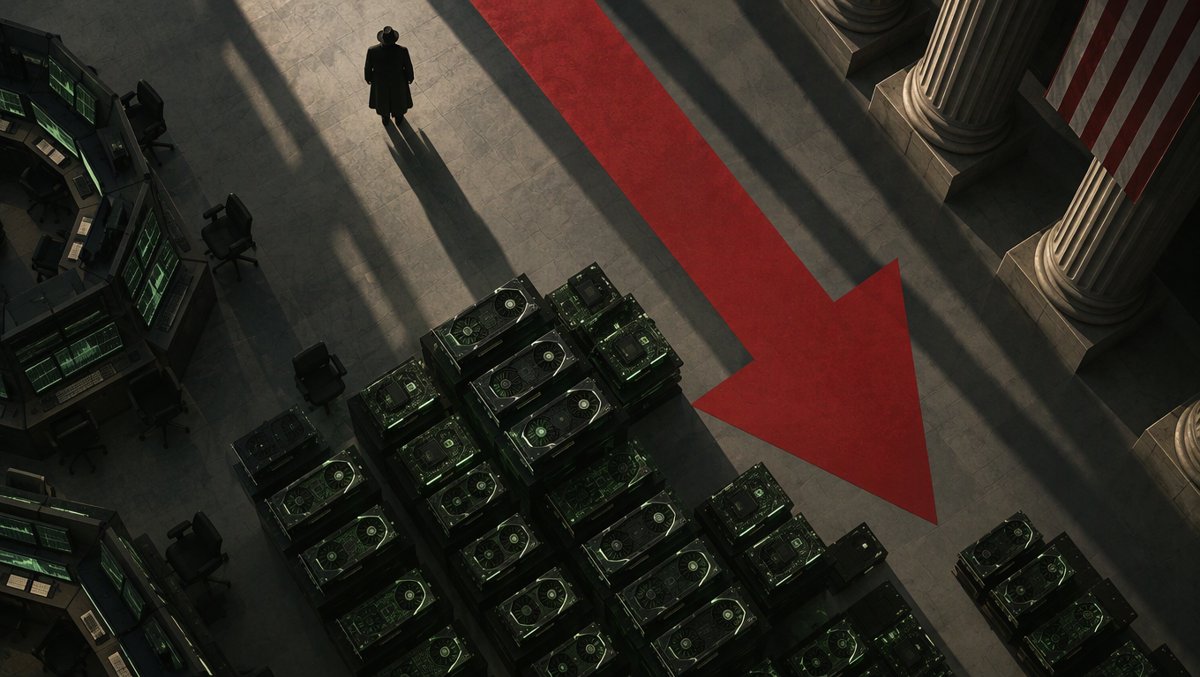
The most expensive love story in corporate history is being priced in real time. On Monday, November 9, 2026, the stock market did something it almost never does: it rose while its biggest company sank. The S&P 500 (via SPY) climbed +1.97%. The Nasdaq 100 (QQQ) gained +2.89%. AMD exploded +10.7%, Broadcom +7.8%, Micron +6.0%. And Nvidia — the $4+ trillion company that has carried the entire AI trade on its back — fell as much as ~7% in the early going, trading at $174.85, down 6.3%, as of mid-session (~11:40 AM ET).
The selloff has nothing to do with chips or demand. It comes from the corner office.
Over the weekend, CEO Jensen Huang admitted to an extramarital affair with a woman that U.S. intelligence officials and congressional leaders describe as a suspected Chinese intelligence asset — and Nvidia's board opened an independent investigation into whether he was "the target of a foreign intelligence effort." Benzinga's headline called the result the most oversold Nvidia stock since 2019. My own math says that's not clickbait: I computed a Wilder RSI(14) of roughly 26 on daily closes — deep inside oversold territory, territory Nvidia has rarely visited in seven years.
So the only question that matters for investors: is this a once-in-a-cycle opportunity, or a long-term trap dressed in a discount?
Let's dig in.
📅 What Actually Happened — The Verified Timeline
This story didn't start on Sunday. It started in December. Here's the receipts-based chain:
- Dec 22, 2025 — Bloomberg reports the U.S. government was investigating Megaspeed, a Singapore-based cloud provider and self-described "core business partner" of Nvidia's computing-power cloud business in Asia, over its ownership structure and whether Nvidia chips it acquired were smuggled into China. Megaspeed responded that inspections by the Commerce Department's Bureau of Industry and Security, Malaysia's government, and Nvidia itself found "no evidence of any violations."
- Oct 22, 2026 — Huang tells CNBC, three weeks before the storm: "No market is closed forever, and China wants foreign companies to invest in China… Nvidia is surely the best in the world at doing what we do."
- Oct 29, 2026 — The New York Times reports Huang was seen as the target of a Chinese spy plot: a Chinese businesswoman with a close relationship to the CEO was found passing information about U.S. AI chips to Beijing's top spy agency. A classified memo identifying her had circulated among Trump administration policymakers the previous spring. Secretary of State Marco Rubio oversaw that memo, per The Fly's reporting of the NYT story.
- Nov 3–4, 2026 — Democrats sweep the midterms. CNBC notes Nvidia's CEO turmoil now hands "newly empowered Democrats fresh ammunition in pursuit of oversight."
- Nov 5, 2026 — Three committee chairmen — John Moolenaar (House Select Committee on China), Brian Mast (Foreign Affairs), Rick Crawford (Intelligence) — send Huang a letter requesting a joint closed-door briefing on November 18, 2026, citing "significant national security concerns regarding the PRC's access to sensitive U.S. technology and information." The letter names Megaspeed executive Alice Huang as "a publicly reported Chinese intelligence asset." Jensen Huang must accept or offer alternative availability by November 11.
- Nov 6, 2026 — NYT identifies the woman and the memo in detail. Stock Analysis reports ~600,000 Nvidia H200 chips are stuck in Hong Kong while Beijing withholds import approval — Nvidia's current-quarter outlook already assumes no China data center revenue.
- Nov 8, 2026 (Sunday) — Huang admits the affair in a message to his company. Per CNBC, his statement read: "I support the investigation and will cooperate fully. I love our country and our company. I am committed to protecting NVIDIA and supporting America's national security. I am proud and grateful to be an American." The board announces an independent investigation "regarding the national security concerns raised in news reports" — while stating it has "no reason to believe that either national security or NVIDIA secrets were compromised."
- Nov 9 (Monday) — The market renders judgment.
A note on fairness, because this is a story about allegations attached to real people: the affair is admitted. The espionage is alleged — no public charges have been filed against Alice Huang, Singapore's government says it has not investigated her alleged intelligence ties, and Megaspeed denies wrongdoing. The board itself says it sees no evidence secrets were compromised. What the market is pricing is uncertainty, not proven harm.
📉 The Damage Report — Just How Oversold Is "Most Oversold Since 2019"?
Here's the scoreboard from my own calculations on daily closes (through Monday's intraday print of $174.85):
| Metric | Value |
|---|---|
| Record closing high | $239.24 (Oct 6, 2026) |
| Intraday all-time high | $243.37 (Oct 6, 2026) |
| Monday's print | $174.85 (−6.3% on the day) |
| Drawdown from record close | −26.9% |
| Drawdown from intraday ATH | −28.2% |
| Wilder RSI(14) | ~26 (below 30 = deeply oversold) |
| 14-session rate of change | −19.2% |
| November month-to-date | −14.6% |
| Peak market cap (Oct 6) | ~$5.9 trillion |
| Market cap at Monday's print | ~$4.3 trillion |
| Value erased from the peak | ~$1.6 trillion |
Read that last line again. One point six trillion dollars. That's roughly half the annual GDP of Japan, vaporized in 24 trading sessions — before a single demand forecast was cut, before one earnings estimate was lowered.
The technicals confirm the pain is real and trend-breaking:
- Parabolic SAR (standard 0.02/0.2): Bearish, Day 7. SAR sits at $211.29 — price would need to rally +20.6% just to flip the daily trend back to bullish. There was a false-bottom whipsaw around Oct 28–29 (SAR briefly flipped bullish), then the market re-broke. Two-sided volatility like that usually marks a regime change, not a dip.
- Nov 5 was the structural break: a single-day −9.3% collapse on roughly 306 million shares — over 2x average volume — driven by the spy-plot reporting, and it broke a nine-month uptrend structure in one candle.
- Monday's move is the tell: the market fell out of bed buying everything EXCEPT Nvidia. AMD +10.7%, AVGO +7.8%, MU +6.0%, INTC +3.3%, TSM +3.5%. That's not a sector rout. That's a single-name governance event being repriced. When capital rotates within your own industry and the rotation skips you entirely, the market is saying: the problem is you, not the trade.
🎯 Why a CEO's Love Life Is a $1.6 Trillion Problem
Alright, let's be blunt: an affair, by itself, has never been a market event. CEOs are humans; boards have weathered worse. If this were purely a tabloid story, NVDA would be down 2%, not 27% peak-to-trough. The real fear is a three-layer cake:
Layer 1: Key-man risk. El-Erian warned this week that the situation exposes major key-man risk "for Nvidia and the broader economy." Bernstein's research (cited by Korea's Chosun Biz) notes Nvidia has no named successor and runs on Huang's roughly 60 direct reports. This is a founder-CEO who has led the company since 1993, whose customer dinners, GTC keynotes, and geopolitical shuttle diplomacy are, functionally, part of the product. The NYT's Monday headline asked the uncomfortable question directly: "Is Jensen Huang too Powerful to Be Punished by Nvidia?" — meaning the board's nightmare scenario is that he's too big to fire and too damaged to keep. MarketWatch quoted an analyst: "There is clearly risk that Jensen could be removed as CEO depending on the board investigation." When the #1 asset of a $4T company becomes its #1 liability, the stock gets a governance discount that no P/E model captures.
Layer 2: The national-security dimension. The board probe will reportedly examine whether Huang intentionally misled shareholders and directors (New York Post), and whether any company information moved through the relationship (WSJ: the board is examining "whether secrets were shared"). Kyle Bass argued on CNBC the probe demands congressional scrutiny, "not just a board review." A former CIA officer on Fox Business said the FBI and Director of National Intelligence should be involved. The House briefing deadline lands November 11, the briefing itself November 18. Each of those dates is a binary information event for the stock.
Layer 3: China is the growth story's open wound. Nvidia's quarter already assumes zero China data center revenue, and ~600,000 H200s sit in Hong Kong waiting for Beijing's blessing. The Megaspeed relationship sits at the exact intersection of export-control enforcement and the CEO's personal life. China Beige Book's CEO called for closer scrutiny of chipmakers' export-control assurances. If the scandal hardens Washington's posture — with Democrats freshly empowered after the midterms — the long-term addressable-market math for the whole AI hardware trade gets rewritten. That's the real "long-term trap" scenario, and it has nothing to do with anyone's marriage.
⚖️ The Bull Case: "Surprisingly Cheap" Has Data Behind It
Now the other side of the ledger — because it's genuinely loaded:
- Valuation has reset hard. Robinhood's live data shows NVDA trading at a P/E of ~23.6 at $178.85 on Monday morning. For context: this is the company growing data center revenue at triple-digit rates for the past two years, now priced like a mature mega-cap bank. Yahoo Finance ran the headline: "Nvidia CEO just made his already surprisingly cheap stock that much cheaper."
- Top-tier analysts did not blink. Stacy Rasgon — a five-star, Top-2% Bernstein analyst — reaffirmed his Buy on Monday morning, calling the scandal separate from fundamentals. StoneX had already recommended buying through the October spy-plot headlines. TipRanks' Monday note: the "sell-off looks overdone ahead of Q3" earnings.
- The White House has his back. President Trump publicly defended Huang as an "honorable guy" and a "fine person" who should remain in his role. Whatever you think of the politics, that matters: the harshest regulatory outcomes (export-control retaliation, forced disclosures) are less likely with an administration defending the CEO personally.
- The fundamentals machine keeps humming. On the very morning of the crash, Nvidia announced a sovereign-AI pact with Rebellions and SK Telecom in Korea (NVLink Fusion). Last week: a reported $3B investment into Meta's equity offering. In late September, the board authorized $150 billion of additional buybacks — "the largest share repurchase authorization increase in history." A company staring into an existential governance crisis doesn't sign Korea deals and fund Meta's raise. Demand is not the problem.
- Dan Ives' take, blunt as always: "Talking about replacing Jensen Huang is comedy." His read: a black-eye moment, not a succession event.
🪤 The Bear Case: Why This Could Be a Trap
- The board probe has no deadline. Independent investigations of founder-CEOs take months, and every interim headline re-sells the stock. The NY Post reports the probe includes whether Huang misled his own board — if that's substantiated, removal stops being "comedy" and becomes a fiduciary imperative. A litigation machine is already spinning up: SBS Law announced an NVDA investor fraud investigation Monday morning via Business Wire.
- November 18 is a live grenade. A closed-door congressional briefing with three committee chairmen, days before Nvidia's fiscal Q3 earnings, is a worst-possible calendar. If the briefing leaks badly — or Huang declines and gets subpoenaed — the technical support levels won't matter.
- The technical regime has changed. SAR needs +20.6% to flip bullish. The stock closed below its 200-day trend structure this month for the first time in the AI era. Oversold can stay oversold; "cheap" and "falling knife" are not mutually exclusive.
- The competition clock is running. The same Monday morning, Google launched two more TPU systems (8tx, 8i Max) — four TPU generations in a single year for the first time. AMD just printed +10.7% as the anti-Nvidia trade. If capital concludes Nvidia's moat includes a fragile human dependency that rivals don't have, the multiple de-rates structurally, not cyclically.
🧭 Opportunity or Long-Term Trap? My Framework
I'm not going to insult you with a prediction. I'll give you the decision tree I'm actually using:
Scenario A — Governance storm, fundamentals intact (my base case, ~50%). Board finds no secrets compromised, Huang cooperates through the Nov 18 briefing, Congress makes noise but passes nothing binding before Q3 earnings. The stock mean-reverts toward the $195–$210 zone as the oversold RSI unwinds. The opportunity: historically, RSI ~26 on the world's most-owned stock has been a better entry than exit — every sub-28 NVDA RSI print in the last five years was followed by a double-digit rebound within a quarter. But note: all of those happened while the SAR was bullish or flipping. Today it's 7 sessions into a bearish regime with a flip price 20% above. This is the first oversold-since-2019 print that arrives with the trend broken.
Scenario B — Huang exits or is sidelined (~25–30%). Board substantiates misleading conduct, or the political pressure forces a transition. Short-term the stock takes another leg down on succession chaos — but medium-term, Nvidia without Huang is still the CUDA moat, the $150B buyback, and a demand backlog measured in years. History says forced CEO exits at fundamental-intact giants (think 2013 Microsoft) eventually resolve upward once a credible successor is named. The trap here is timing: the bottom is made when the successor is named, not when the scandal peaks.
Scenario C — The China floor gives way (~20–25%). The scandal becomes the pretext for structurally harder export controls, Megaspeed-style intermediaries get banned, and the "no China revenue" assumption becomes "no Asia intermediary revenue." This is the true long-term trap — not because of one man's affair, but because it rewrites the total addressable market for the entire AI capex supercycle. Watch the November 18 briefing and any State Department follow-up on the Rubio memo for the tells.
What I'm watching this week: (1) Huang's response to the House letter — deadline Nov 11; (2) any board interim statement; (3) whether NVDA holds the $170 area (Monday's low: $170.24) on heavy volume; (4) the fiscal Q3 earnings date, which lands later this month — the first time shareholders get to hear Huang answer real questions.
My honest read: as a trader, the RSI-26-plus-fundamentals-intact setup is one of the more interesting asymmetries of 2026 — the market just handed you the AI leader at a bank P/E with demand evidence (Korea, Meta, buybacks) unchanged. As an investor, I'd size it like the risk it is: a catalyst ladder (Nov 11 → Nov 18 → earnings → board findings) where every rung can gap the stock 8% in either direction. This is not a "set and forget" dip. It's a trade that requires watching the calendar more than the chart.
The chips didn't change. The demand didn't change. The man changed — or rather, the market's picture of the man did. Whether that's worth $1.6 trillion is what the next four Fridays will tell us.
As of publication: NVDA $174.85 (−6.3%) intraday Monday, Nov 9, 2026, ~11:40 AM ET; SAR Bearish Day 7 at $211.29; RSI(14) ~26 by my calculation on daily closes. Intraday figures move — verify before you trade.
By Stock King, Financial Analyst & Technical Writer at NXagents.net
This article is for educational and informational purposes only and does not constitute financial or investment advice. All figures are as of the timestamps stated and intraday prices move constantly. The espionage allegations described are unproven; no public charges have been filed against any individual named, and Nvidia's board states it has no reason to believe company secrets were compromised. Always do your own research and consult a licensed advisor before making investment decisions.