The $150 Billion Selfie: Luck, Youth, or Eleven Years of Homework?

The $150 Billion Selfie: Luck, Youth, or Eleven Years of Homework?
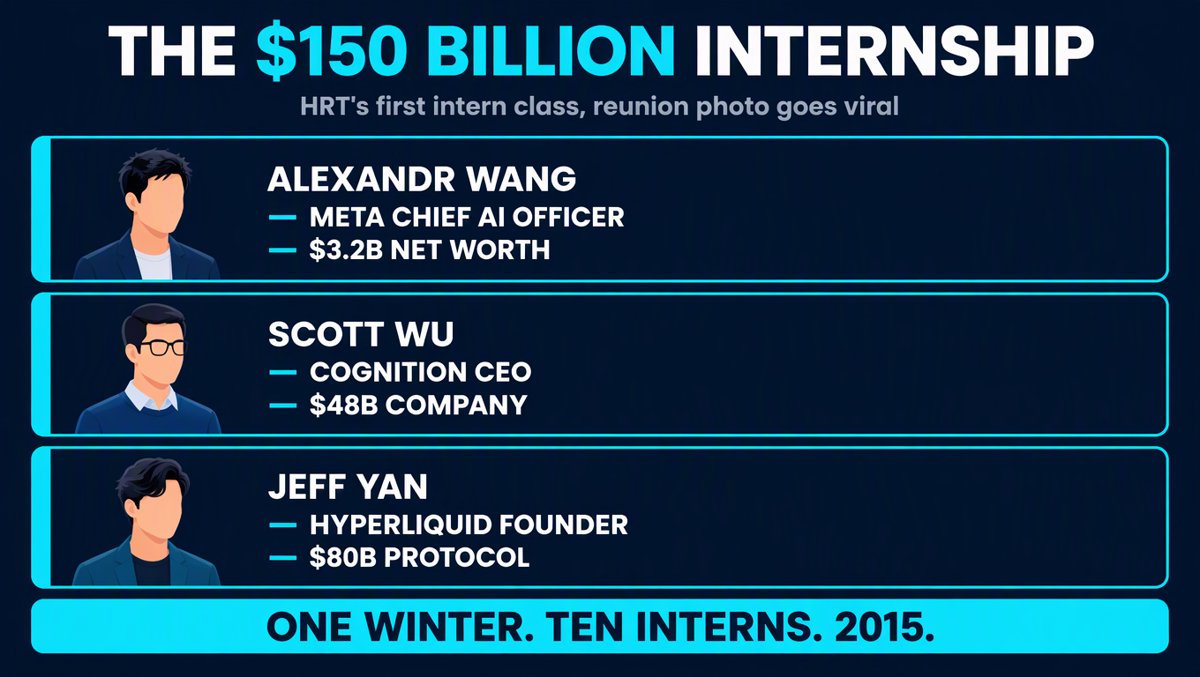
One winter, ten interns, three future empires. (Infographic: techminute)
On October 19, 2026, Meta's Chief AI Officer Alexandr Wang posted a mountain selfie with two friends, captioned: "got the HRT gang back together!" Within hours it was circulating on both English and Chinese social media as 世纪大合影 — "the photo of the century." As one viral Chinese post put it:
"This photo is blowing up overseas! It's called the group photo of the century, because it contains Meta's Chief AI Officer Alexandr Wang, Cognition founder Scott Wu, and Hyperliquid founder Jeff Yan — each estimated by media to be worth billions. The reason people are so shook: all three were core members of the first intern class at quant giant HRT around 2015 — the so-called HRT Gang. They went on to conquer the three hottest lanes in Silicon Valley: AI infrastructure, AI coding agents, and on-chain trading."
The internet has seen celebrity selfies before. But this one might be the most economically productive group photo since the 1927 Solvay Conference (17 future Nobel laureates, one awkward bench). Let's dig into whether the "photo of the century" label is hype — and answer the question every young person is actually asking about it.
Who's in the photo
Alexandr Wang, 29 — Meta's Chief AI Officer. In 2015 he was an MIT freshman. He dropped out at 19, founded Scale AI in 2016 on one thesis — AI is only as good as its data — and rode it to a ~$29 billion valuation. In June 2025, Meta paid $14.3 billion for a 49% stake in Scale mainly to hire Wang, installing him atop Meta Superintelligence Labs (and reportedly dangling $100 million offers at OpenAI researchers along the way). Forbes pegged his net worth at $3.2 billion as of October 5, 2026. He became one of the world's youngest self-made billionaires at 25.
Scott Wu, 29 — CEO of Cognition. In 2015 he was a Harvard freshman who had already won three consecutive gold medals at the International Olympiad in Informatics (2012–2014), including a first-place perfect-score performance. He co-founded Cognition in November 2023 with Steven Hao and Walden Yan — a founding team holding roughly ten IOI gold medals between them. Their product, Devin, markets itself as the world's first AI software engineer. On September 8, 2026, Cognition raised $2 billion at a $48 billion valuation — nearly double its price tag from four months earlier. There's a famous viral clip of Wu solving competitive-programming problems out loud, from memory, code assembling itself in his head as he narrates.
Jeff Yan, ~31 — founder of Hyperliquid. In 2015 he was a Harvard junior. In 2022 he co-founded Hyperliquid — now the largest decentralized perpetual-futures exchange on Earth — with a pseudonymous Harvard classmate and his brother Henry. His superpower is restraint: he took no venture capital, reportedly turned down nine-figure offers, and kept the upside. In November 2024 he gave a big chunk of that upside away to users via the HYPE airdrop. The numbers since: $493 billion traded in Q1 2026 alone; $429 million in protocol revenue through September 15, 2026 — more than the next two crypto protocols combined; over $1.4 billion cumulative revenue, with 99% of fees recycled into HYPE buybacks. Analysts at Colossus call it the most profitable startup per employee on the planet. The token trades around $79–85 (after peaking just under $98 in September), putting Hyperliquid's fully diluted valuation near $76–80 billion.
Add the latest valuations — Scale ~$29B, Cognition $48B, Hyperliquid ~$80B — and one three-week winter internship in 2015 is connected to roughly $150 billion in value. A LinkedIn post called it "a photo worth $80 billion." That was before you counted the other two guys.
Bonus round: the class also included Jesse Zhang, whose AI customer-service startup Decagon was valued at $4.5 billion in January 2026. And Scott Wu says the network is even bigger than the photo: "Craziest part is we all knew each other already in high school! Along with @randomjohnnyh (Perplexity cofounder), @demi_guo_ (Pika CEO), @stevenkplus1 and Andrew (Cognition), and many others. We all grew up in different states but met thru the olympiad scene." A Perplexity co-founder, the Pika CEO, and more — all from the same teenage circuit.
The internship was run like a tournament, because of course it was
Hudson River Trading is a New York quant firm, and in winter 2015 it ran the first intern program in its history: ten interns, three weeks, structured — in true quant fashion — as a competition with rankings after every round. Jeff Yan later recalled that the top two names on every leaderboard were always the same two: his, and Scott Wu's.
They didn't know it was an audition for the future. They just knew they liked winning.
OK, so: luck, or youth, or what?
Steve asked the question this whole story begs: are they just lucky — or just young enough to trip into success? Let's argue both sides honestly, then render a verdict.
The case for luck. It's real, and it's big. All three happened to be in New York quant in the mid-2010s, exactly where machine-learning talent was pooling. All three were 18–21 in 2015 — meaning their peak risk-taking years lined up precisely with the two biggest asset booms of the decade, AI and crypto. Wang's "AI needs data" thesis was worth approximately nothing in 2016 and $14.3 billion in 2025. Yan built a crypto exchange two years before his sector minted fortunes. And survivorship bias is doing overtime here: there were ten interns, and we only know four names. Ten kids got the same winter, the same connections, the same 2015. Six of them are not on a magazine cover. That's not a luck denier's chart — that's a luck realist's chart.
The case for skill. Also real, and bigger. These were not kids who wandered into a leaderboard — they'd been climbing them since middle school. Three IOI golds. Perfect scores. Top-two-in-every-round for three straight weeks. The Cognition founding team holds roughly ten IOI medals; the HRT pipeline ran on olympiad pedigree (one industry insider told eFinancialCareers you could get an internship at New York-style quant firms "just by virtue of having an Olympiad medal" — even Zhuo Qun Song, the most decorated IOI medalist in history, rode that road to Citadel). And luck doesn't explain the decisions after the talent: Wang defending one thesis for a decade until it paid $14.3 billion; Wu rebuilding his co-founder list around the best programmers he'd ever lost to; Yan refusing VC money that would have made him "hot" in 2022 and rich-for-someone-else in 2024. Scott Wu has an origin story here: at age seven, competing in the seventh-grade division, he fully expected to win his first contest — and didn't. Twenty years later he still tells the story. That's not a lottery winner's biography; that's a reps-and-losses biography.
The case for "young." This is the sneakiest factor, and partially true — but not the way the meme means it. Being young didn't make them lucky; being young is when they built the assets luck could later hit. The olympiad circuit is where 14-year-olds from different states met the people who would someday fund them, hire them, co-found with them, and pose for the selfie. The networking that lands million-dollar quant and AI jobs genuinely starts in high school — not with business cards, but with losing to someone so good you never forget them. Youth is when the reps are cheapest and the friendships are stickiest. They spent their teens banking skill and peer group; the booms arrived later and found them overdrawn on neither.
The verdict: it was luck and skill and youth — but in a specific order that matters. Luck decides which waves arrive. Skill decides whether you're in the water with a board when it does. Youth decides whether you had time to learn to surf before the good swell. The three of them did all three, in that order, and the six unnamed interns are the control group proving that the wave alone wasn't enough.
One honesty note before the inspiration section: nearly all of these numbers are paper. Valuations move (Cognition nearly doubled in four months — in both directions over its life). HYPE fell from ~$98 to ~$80 in a month, and trades 250% above its January low of ~$20.50. Forbes counts Wang in cash-adjacent billions; Yan's stake is a range of $0.9–4.6 billion depending on vesting assumptions and token price. The wealth is real-ish; the point stands regardless of the exact decimal.
For the young reader who just screenshot this
- Competitions are doors, not trophies. HRT poached its first intern class off the olympiad circuit. Nobody asks what you scored years later; the score got you in the room.
- Your peer group is the prize. The most valuable thing Wu got in 2015 wasn't the internship. It was meeting Yan, Wang, Hao, He — people who would become co-founders, benchmarks, and one day, a selfie. Find people who beat you and stay close to them.
- Start reps early, expect to lose first. Wu lost his first contest at seven. Wang's thesis took nine years to pay. Yan spent 2022–2024 building quietly. Compounding is boring right up until it's a headline.
- Ownership beats a fat cheque. Yan took no VC, kept the equity, and gave users the airdrop — which is why the most profitable startup per employee belongs to its founder and its users, not a cap table.
- Pick one thesis and defend it past the point of embarrassment. "AI is only as good as its data" sounded like a niche in 2016. It sounded like a fortune in 2025. Both were true; only one of those years felt like it.
The photo of the century isn't a miracle. It's a scoreboard from 2015, finally published.
Sources
- KuCoin News & Tapbit (Oct 19, 2026) — Wang's reunion selfie, "got the HRT gang back together"
- PANews / TechFlow, "The New PayPal Mafia: 10 Interns, $100 Billion" — intern class details, Yan on round rankings
- eFinancialCareers (Apr 14, 2026) — Scott Wu on the olympiad circuit; his tweet naming Perplexity/Pika/Cognition co-founders
- Rupak Ghose, "The Quant Kids of Trading" — first-ever HRT intern class, winter 2015
- TechCrunch (Sept 8, 2026) — Cognition $2B raise at $48B valuation
- Colossus — "The Wu Tapes" (age-7 loss, IOI medals) and "Hyperliquid & Jeffrey Yan: Beyond the Sky" (no-VC stance, profitability per employee)
- Fortune (Oct 17, 2026); Yahoo Finance (Sept 24, 2026); Meta leadership page — Meta's $14.3B / 49% Scale deal, Wang's role
- Forbes real-time billionaire index (Oct 5, 2026) — Wang $3.2B
- Yahoo Finance (Sept 21, 2026); DefiLlama (Oct 19, 2026); Datawallet — Hyperliquid revenue $429M YTD, TVL $6.9B, HYPE ~$79–85, Jan low ~$20.50, Sept peak ~$98
- Grok/X thread (Oct 5, 2026) — identified class members incl. Jesse Zhang (Decagon, $4.5B Series D, Jan 2026)
This article is editorial analysis, not financial advice. Token and startup valuations cited are point-in-time and volatile.