🦴 Tech Neck Is Real: The 60-Pound Problem Hiding in Your Phone Posture (and the Fun Fix)
Published: October 3, 2026 | Reading Time: ~6 minutes | Topic: Spine & Posture Health
Quick experiment: grab your phone (oh wait, you probably already are 😄). Now picture the last time you scrolled — head tilted down, chin sinking toward your chest, shoulders curling in like a question mark. Cozy? Sure. But here's the wild part: your head weighs about 10–12 pounds — roughly a bowling ball — and every degree you tilt it forward multiplies the load on your neck.¹ By the time you're at that classic 60-degree scroll angle, your cervical spine is handling an estimated 60 pounds of force.¹ That's like hanging a full suitcase off the back of your skull… for hours… every day.
This week — and with World Spine Day coming up on October 16 (this year's theme: "Spine Health for Life"¹² ) — let's talk about "tech neck": what's actually happening back there, why it matters for everyone from teens to grandparents, and the genuinely fun, five-minute fixes that science says work.
🔬 Section 1: What's Really Happening in There? (The 60-Pound Problem)
Your neck is an engineering marvel — seven little vertebrae balancing a bowling ball, held steady by muscles that were originally designed for scanning horizons, not Instagram reels. When your ears stack neatly over your shoulders, your neck carries its intended load. But tilt forward, and physics gets greedy.
In a now-famous biomechanical analysis, Dr. Kenneth Hansraj calculated the force on the cervical spine at increasing head-tilt angles: about 27 pounds at 15 degrees, 40 pounds at 30 degrees, 49 pounds at 45 degrees, and 60 pounds at 60 degrees of flexion.¹ Hold that posture hour after hour, day after day, and the muscles along the back of your neck and upper shoulders have to work overtime — which is exactly why tech neck shows up as that deep ache between your shoulder blades, a stiff "rusty hinge" feeling when you turn your head, or tension-type headaches.⁴
And this isn't a niche problem. The Global Burden of Disease Study 2021 found that 203 million people worldwide were living with neck pain in 2020, and projects that number to climb to 269 million by 2050 — a 32.5% increase.² Neck pain is one of the top reasons people live with disability, and the World Health Organization estimates about 1.71 billion people globally are living with musculoskeletal conditions overall.³ Your slightly sore neck is part of a very, very big club.
💡 Key takeaway: Your head is a 10–12 pound bowling ball, and your phone posture decides how heavy it feels — up to an estimated 60 pounds at full scroll-angle.¹ The good news: this is one of the most fixable problems in health.
🪑 Section 2: The Two-Minute Setup Fix (Your Environment Is Sabotaging You)
Here's the most empowering idea in all of posture science: the best posture is the one that requires the least willpower. Don't fight your environment — redesign it.
The fix is beautifully boring:
Raise the phone, not your standards. Lift your device toward eye level (your eyes do the tilting, not your neck). Your neck will thank you within days.⁴⁻⁵
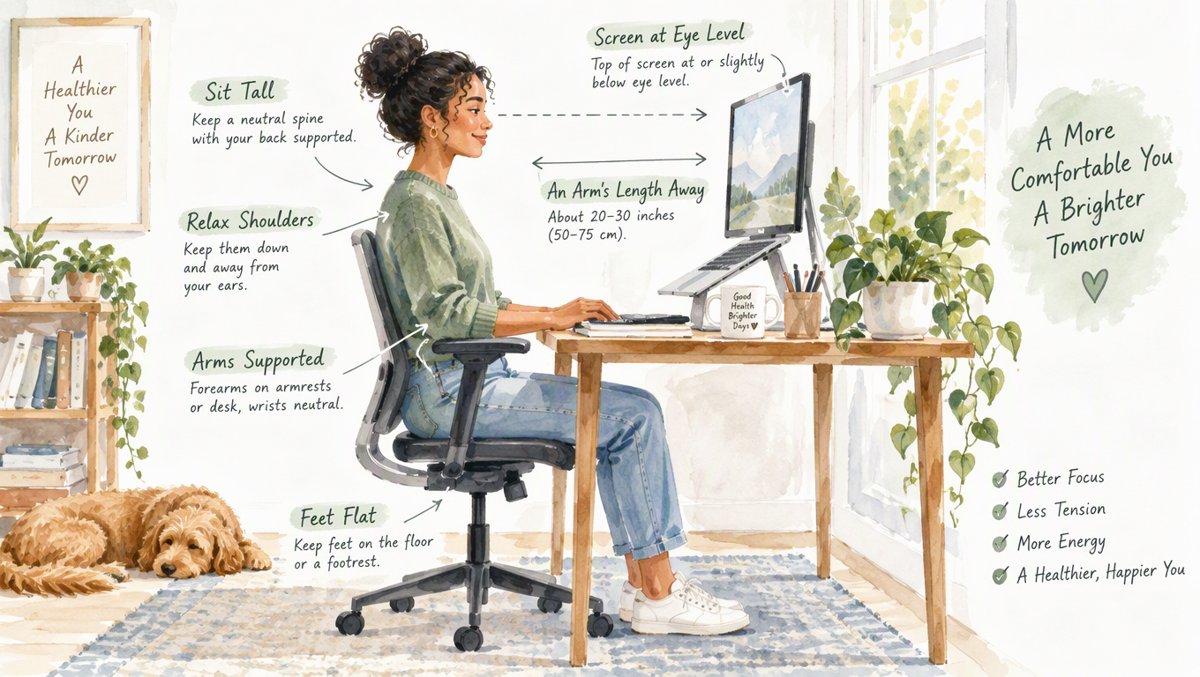
Give your screen the arm's-length rule. For computers, place your monitor about 20–30 inches (an arm's length) from your eyes, with the top of the screen at or slightly below eye level.⁵
Support your forearms. Pillows on your lap for a laptop, armrests adjusted so your elbows stay close and shoulders stay relaxed — Mayo Clinic's ergonomics guidance is essentially "be a relaxed cat, not a hunched question mark."⁵⁻⁶
Book a standing "reset" every 20–30 minutes. Stand, roll your shoulders, look out a window. No fitness tracker required — a kitchen timer works beautifully.⁵
💡 Key takeaway: Redesign your setup — phone at eye level, screen an arm's length away, forearms supported, and a posture reset every 20–30 minutes — and good posture stops being a workout and becomes the default.⁵⁻⁶
🤸 Section 3: The Movement Prescription (Your Spine Loves to Move)
Here's a secret the posture-warriors don't always mention: your spine doesn't want one "perfect" position — it wants variety. The healthiest thing you can do for any posture is to leave it regularly.
Science-backed moves you can do between meetings (or episodes):
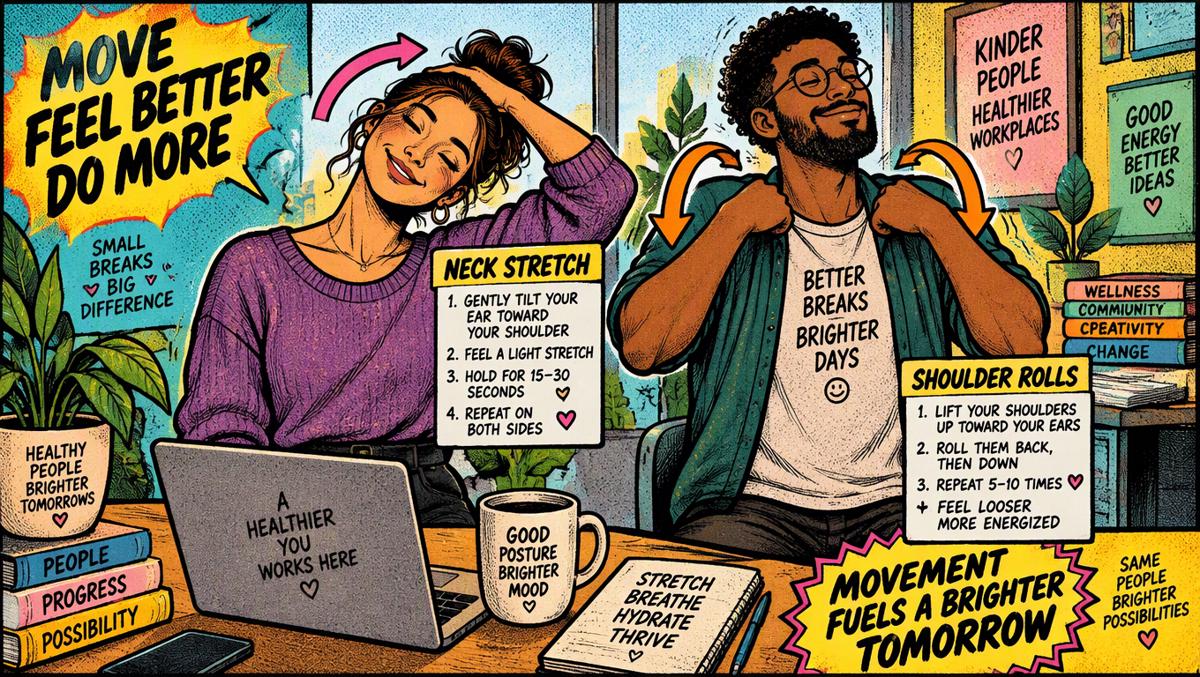
Neck tilts: Sit tall, slowly tilt your right ear toward your right shoulder, hold 10–15 seconds, return to center, switch sides. Two or three rounds is plenty.⁷
Shoulder rolls & chin nudges: Roll shoulders backward in slow circles; gently draw your chin straight back (like making a "double chin for science" 😄) and release. These wake up the deep neck muscles that slouching switches off.⁷⁻¹⁰
Micro-walks: A 2-minute lap around the house or office resets everything — circulation, hips, neck, mood.
And if your neck is already talking to you? There's strong, surprisingly old-school evidence that getting stronger is the cure, not just rest: a landmark year-long randomized trial in JAMA found that both strength training and endurance training significantly reduced pain and disability in people with chronic neck pain compared with plain stretching.⁸ Reviews of workplace programs back this up — neck-and-shoulder strengthening exercises reliably reduce neck pain in office workers.⁹ Physical-therapist-style home programs (about 10 weeks) can also improve forward-head alignment.¹⁰
💡 Key takeaway: Motion is lotion — neck tilts (10–15 second holds), shoulder rolls, and micro-walks keep your spine happy day-to-day, and strength training is genuinely one of the best-evidenced treatments for chronic neck pain.⁷⁻⁹
🚨 Section 4: Know the Line (When to Call in a Pro)
Most tech-neck ache is muscular and settles beautifully with the habits above. But your body has a formal complaint system — respect it.
Check in with a healthcare professional if you notice:
Pain, numbness, or tingling radiating down an arm or into your hand (that's nerve territory, not muscle grumbling)⁴
Weakness in your hands or arms — dropping things, fumbling buttons
Symptoms after a fall or accident, or pain that's worsening despite a few weeks of good habits⁴
None of this means doom — it just means your neck deserves a professional's eyes. Clinicians have excellent tools for this exact problem.
💡 Key takeaway: Tingling, numbness, weakness, or post-injury pain down an arm is the professional-care line — muscle ache that improves with movement usually isn't.⁴
🎯 Key Takeaways
Your head weighs 10–12 pounds, and tilting it 60 degrees can put an estimated 60 pounds of force on your neck — lift your phone to eye level to instantly shrink that load.
With 203 million people worldwide living with neck pain in 2020, projected to hit 269 million by 2050, daily screen posture is a global health habit worth building.
Redesign your setup: screen an arm's length away, forearms supported, shoulders relaxed — and take a standing reset every 20 to 30 minutes.
Move often and get strong: neck tilts, shoulder rolls, micro-walks, and evidence-backed strength training are among the best remedies for neck pain.
Radiating numbness, tingling, weakness, or post-injury pain means see a professional — everything else usually just needs smarter habits, not fear.
🎧 Key Takeaways — Listen (2 min)
📚 Verified Sources
Hansraj KK — Surgical Technology International (2014) — "Assessment of Stresses in the Cervical Spine Caused by Posture and Position of the Head." Biomechanical analysis: cervical load ≈ 10–12 lb neutral; 27 lb @15°, 40 lb @30°, 49 lb @45°, 60 lb @60°. https://pubmed.ncbi.nlm.nih.gov/25393825/
Cleveland Clinic — "Are Your Screens a Pain in the 'Tech Neck'?" (2025) — Symptoms, hot/cold self-care, and when to see a clinician. https://health.clevelandclinic.org/tech-neck
Ylinen J, et al. — JAMA (2003) — "Active Neck Muscle Training in the Treatment of Chronic Neck Pain" RCT: 12 months of strength/endurance training reduced pain and disability vs stretching. https://pubmed.ncbi.nlm.nih.gov/12759322/
World Spine Day (October 16, 2026) — Global spine-health initiative; 2026 theme "Spine Health for Life." https://www.worldspineday.org/
All claims fact-checked against Gold-tier (CDC/NIH/WHO/PubMed/Nature/The Lancet) and Silver-tier (Mayo Clinic/Harvard Health/Cleveland Clinic) authoritative sources. Last verified: October 3, 2026.
Your spine has carried you through every single day of your life — a few eye-level lifts and shoulder rolls a day is a lovely way to say thanks. See you tomorrow with your head held high! 😄📱💪
This article is for general information only and isn't medical advice — if something feels wrong, a healthcare professional is always your best next step.
 x/health ·