Stop Being Boring: Marcus Jones's Stranger Test, Fact-Checked — Plus the Six Levers His Email Left Out

Stop Being Boring: Marcus Jones's Stranger Test, Fact-Checked — Plus the Six Levers His Email Left Out
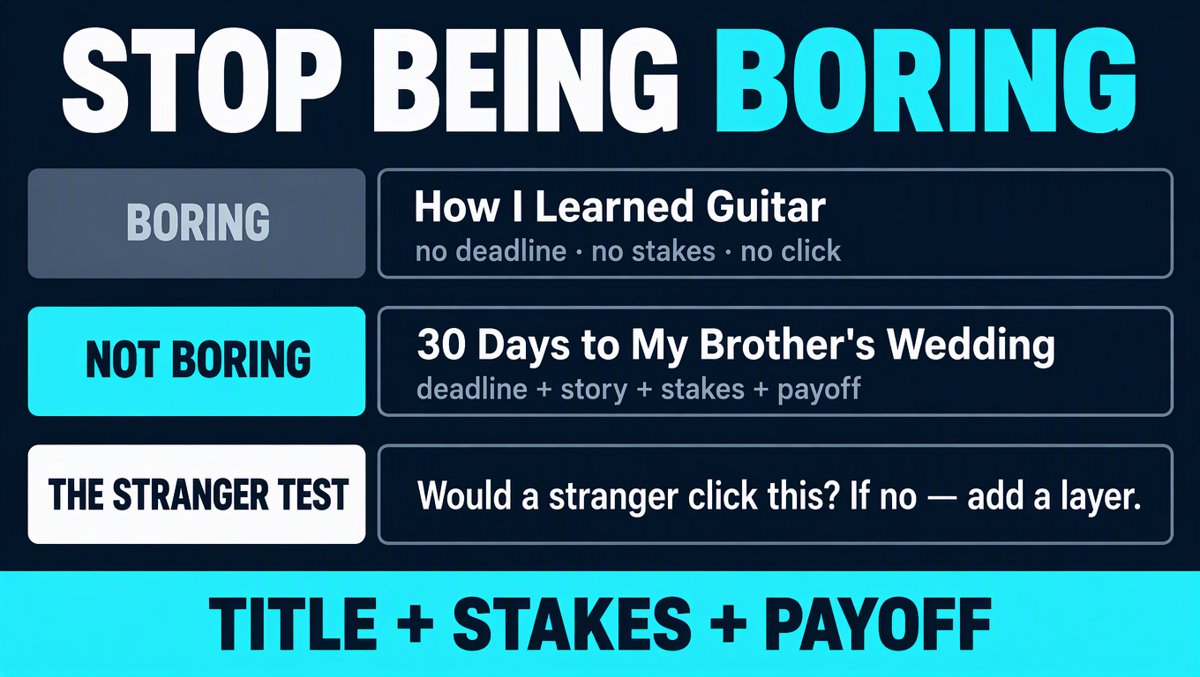
The whole newsletter, compressed into one image: what fails, what clicks, and the one question that separates them.
This week's inbox gold came from a YouTube strategist named Marcus Jones. His newsletter arrived with a subject line that reads like an order, not a suggestion: "Stop being boring."
And then, instead of the usual 2,000 words of guru filler, he sent this:
"I used to confuse:
'A video I find interesting to make'
with:
'A video idea strangers find interesting to watch'
They're not the same thing."
That's it. That's the whole disease. And if you're a small YouTube channel wondering why your videos get triple-digit views while the same idea gets millions on a bigger channel — this is very often the reason.
Marcus continues with an example:
"How I Learned Guitar"
But unless people already care about you, it's not giving them much of a reason to click.
Now compare it to:
"I Learned Guitar in 30 Days to Play at My Brother's Wedding"
Same broad topic.
But now there's a deadline.
A story.
Emotional stakes.
A payoff viewers want to see.
Then he hands you a litmus test you can run in ten seconds:
"Before making your next video, ask: 'Would this still be interesting if the viewer knew absolutely nothing about me?'
If yes, good. If no, the idea probably needs another layer."
So: is this guy legit, is the advice actually backed by evidence, and — since our goal here is more subscribers and more views — what's the advice still missing? Let's dig.
Who Is Marcus Jones, Anyway?
Before taking packaging advice from anyone, check whether they package their own stuff well. Marcus passed our three-step background check, with one asterisk:
 Marcus Jones — YouTube strategist, consultant, and (apparently) a man who owns exactly one t-shirt for stage appearances.
| Claim / signal | What we found |
|---|---|
| YouTube channel @Marcus-Jones | Real and active. Formerly called "Grow Your Gaming Channel" — he rebuilt his own channel mid-flight, which is a good sign he tests his own advice |
| "YouTube Strategist" signature | Checks out. His LinkedIn lists YouTube Certified Consultant at Silkie Consulting, since April 2018 (Australia-based), plus Udemy instructor listings |
| Audience size | A StreamYard interview describes him as helping over 150,000 creators; his own channel's growth guides pull real numbers — the "How To Grow A YouTube Channel From 0 Subs In 2025 (Complete Guide)" video sits at roughly 967,000 views |
| "Billions of views over the last decade" (channel bio) | Plausible for a consultant counting client channels over ten years — but unauditable, so file it under marketing until provenanced |
| Thumbnail chops | His October 2026 video claims a thumbnail process built after "2,000+ designs and 64 million views" on his own content |
| Newsletter funnel | His site marcusjonesmedia.com is literally a "Launching Soon" page — the email newsletter exists before the website. That's a deliberately email-first strategy, and honestly? For someone teaching creator growth, growing an owned audience before building a website is exactly the playbook he'd recommend |
| Monetization | Disclosed affiliate links (an AI thumbnail tool), a "Four-Digit 90 Challenge" coaching cohort for first-1,000-subscriber creators, and appearances in paid creator communities like Million View Club |
Verdict on the messenger: real credentials, real audience, and a channel that practices what it preaches. The advice below is worth testing. The scale claims ("billions of views") are standard consultant biography — believe the specific numbers, enjoy the big ones with a grain of salt.
Why the Guitar Example Works: The Anatomy of a Click
Let's dissect Marcus's two titles, because the difference is more mechanical than "one is boring":
| Element | "How I Learned Guitar" | "I Learned Guitar in 30 Days to Play at My Brother's Wedding" |
|---|---|---|
| Topic | ✔ Same | ✔ Same |
| Deadline | ✖ | ✔ 30 days — the viewer knows when it ends |
| Stakes | ✖ | ✔ A wedding. Fail publicly at your brother's wedding |
| Story promise | ✖ | ✔ Journey + transformation |
| Payoff | ✖ ("I learned guitar", so... done?) | ✔ We get to see the performance |
| Who clicks | People who already like you | Strangers — the entire Browse/Home feed |
The second title is what packaging nerds call an outcome-with-stakes promise. The viewer isn't clicking to learn about guitar — guitar tutorials are infinite. They're clicking to find out whether he pulls it off. Deadline + stakes + payoff converts a topic into a question the viewer needs answered, and unanswered questions get clicks.
And Marcus's litmus test — would a stranger care with zero context about you? — is precisely the right frame for small channels, because the brutal math of YouTube discovery is that almost nobody watching your next video is a subscriber. Your Browse/Home impressions are strangers. Your search traffic is strangers. Your video is on trial in front of people who have never heard your name, every single upload.
Fact Check: Is "Make It Interesting to Strangers" Actually Supported by Evidence?
This advice sounds like common sense. The good news: it's also one of the best-documented claims in all of YouTube strategy. The receipts:
1. YouTube's own numbers say clicks are decided by the package. YouTube's published benchmark puts half of all channels and videos at an impressions click-through rate of just 2% to 10% — meaning the feed shows your video to 100 people and 90+ of them scroll past. The title-and-thumbnail pair is essentially the entire click decision surface. That 8-point spread between weak and strong packaging is the difference between a dead video and an algorithm favourite, because CTR is a direct input into how widely YouTube keeps promoting a video.
2. MrBeast — the most-watched individual YouTuber on Earth — runs his entire studio on this principle. His leaked 36-page onboarding document ("How To Succeed In MrBeast Production") states flatly that the creative process for every video starts with the title and thumbnail — before filming. His team reportedly makes 20 to 50 thumbnail options for a single video, and he has said a good thumbnail can be worth about $10,000. His videos run around 10% CTR — five times the middle of YouTube's normal range. When the biggest operator in the medium treats packaging as the first step and the idea test as everything, a strategist's newsletter saying "the idea needs to work for strangers" isn't hype; it's the entrance exam.
3. A/B testing data confirms packaging is high-leverage and improvable. YouTube now has native "Test & Compare", letting creators trial up to 3 title/thumbnail combinations (with the winner chosen by watch-time share, not just clicks). Documented case studies show proper A/B testing lifting CTR by 37% to 110% — and one published case took a video from 1.9% to 5.1% CTR (nearly 3x) purely with a tighter face crop, shorter text, and higher contrast. Same video. Same content. Triple the clicks. If packaging can do that to an existing video, imagine what doing it before filming — Marcus's way — does.
4. Curiosity-gap + stakes titles measurably help unknown creators. For a viewer with zero brand trust, a plain topic title gives no reason to click, while stakes + specificity create an information gap they want closed. That's why "I Survived"-format and deadline-format titles dominate outside-of-search feeds.
Scoreboard: the advice is legitimate. Four for four. If anything, the evidence says Marcus is understating the case — packaging may be closer to 80% of a video's click fate than a friendly newsletter suggestion.
| Fact-check item | Claim | Evidence | Verdict |
|---|---|---|---|
| Packaging decides clicks | "Strangers need a reason to click" | YouTube's own 2–10% CTR benchmark range; CTR gates further promotion | ✔ TRUE |
| Title-first workflow | (implied) idea/packaging comes before filming | MrBeast's leaked onboarding doc: process starts with title + thumbnail, 20–50 options per video | ✔ TRUE |
| Packaging is high-leverage | A layer can transform an idea | A/B case studies: +37% to +110% CTR; 1.9%→5.1% documented case | ✔ TRUE |
| Stakes work on strangers | Deadline + stakes + payoff earn clicks from non-subscribers | Curiosity-gap research; "I Survived" format ubiquity in Browse feeds | ✔ TRUE |
| "Billions of views" bio | Decade of consulting at scale | Unauditable; plausible across client channels | ⚠ UNPROVEN (marketing) |
What the Email Leaves Out: The Six Levers You Also Need
Here's the thing about Marcus's newsletter: it's excellent idea-vetting advice, and it's about one lever of the machine. Growing subscribers and views runs on at least six, and if you only fix the one he wrote about, you'll get better clicks on videos that then fail somewhere else. So here's the rest of the machine:
| # | Lever | What it is | The metric that tells you it's broken | How to fix it |
|---|---|---|---|---|
| 1 | Packaging as ONE unit (Marcus's lever) | Title + thumbnail designed together, before filming — thumbnail carries the emotion, title carries the clarity | Low impressions CTR (<2–4%) | Run the stranger test at the idea stage; write the title and sketch the thumbnail before you shoot |
| 2 | Retention payoff | The video must actually deliver the promised stakes — the wedding performance, the reveal, the result | AVD far below video length; ~30–40%+ intro drop-off | Deliver the payoff you promised; cut the intro; tease the payoff early, pay it off at the end |
| 3 | Testing instead of guessing | Let real viewers vote between your packaging options | Flat CTR across uploads; dead videos that never recover | Use YouTube's Test & Compare (up to 3 combos); swap the thumbnail on dead uploads — documented +37–110% CTR gains |
| 4 | Route by intent | Search traffic and Browse traffic reward different title styles | High impressions, low clicks on Home (or vice versa) | Search = plain, clear, keyword-matching titles; Browse = stakes + curiosity. Note Marcus's own biggest video (~967K views, "How To Grow A YouTube Channel From 0 Subs In 2025") is a plain title — because it wins search. His guitar rule is a Browse-feed rule |
| 5 | Outlier mining before production | Study proven outperformers in your niche before you invest 30 hours | Videos that are well-made but about ideas nobody wanted | Study outlier videos (vidIQ / 1of10-style tools), confirm demand for the idea before filming |
| 6 | Subscriber conversion | CTR gets a view; only a reason to return gets a subscriber | Good views, terrible sub conversion | Episodic formats, series with open loops, a stated reason to come back, and actually asking |
Read that table again and notice the shape: Marcus's advice is lever #1 — the click. It's the right lever to start with, because nothing downstream matters if strangers never click. But subscribers come from levers #2 and #6, and long-term views come from #3, #4 and #5. A channel that only runs lever #1 gets clicky titles, disappointing watch time, and a shelf full of videos that tricked people into clicking.
The full loop, in order: mine a proven idea (#5) → package it for strangers (#1) → deliver the payoff (#2) → let the audience test your packaging (#3) → route the format to the traffic source (#4) → convert the click into a returning viewer (#6). That's how you get subscribers and views, not just one viral-ish video.
One Honest Complication (Because We Fact-Check, Not Fan-Girl)
Marcus's stranger test is close to universally right for feed traffic — but it cuts one way he doesn't mention: not every video is for strangers. A community update, a milestone celebration, or "responding to your comments" video will fail the stranger test by design, and that's fine — those videos serve the 150,000-creator-sized audiences of people who already care. The skill is knowing which game each video is playing:
- Stranger game (Browse/Home/search): run the test, ruthlessly. No stakes, no click.
- Fan game (notifications, subscribers, community tab): different rules — connection, continuity, in-jokes.
Small channels should live in the stranger game almost exclusively, which is exactly why Marcus's rule is the right default. Just don't let it bully you into deleting the community posts that keep your first 500 subscribers warm.
The Verdict
In order:
- The advice is correct and it is the highest-leverage single sentence in small-channel YouTube. "Would a stranger click this with zero context about me?" — run it on every idea before you film. The evidence (YouTube's CTR benchmarks, the MrBeast playbook, A/B case data) all points the same direction.
- As a complete growth system, it's one lever of six. Clicks without retention payoff = disappointment; the six-lever loop above is the actual machine.
- The messenger is credible. Certified consultant, real numbers on his own channel, a decade of consulting history — just discount the "billions of views" biography marketing to its proper decimal place.
Your homework this week (because advice without a deadline is... well, "How I Learned Guitar"):
- Take your next planned video idea and run the stranger test out loud. If it fails, add a deadline, stakes, or payoff.
- Write the title BEFORE filming, and design the thumbnail with the title as one unit.
- If your video flops in week one, don't delete it — swap the thumbnail and title, then use Test & Compare. The content you already shot is leverage.
- Check where your views come from (Studio → Reach): mostly search? Use plain clear titles. Mostly Home? Stakes and curiosity, always.
- And ask yourself Marcus's question about your own channel page, not just your videos: would a stranger who watched one video see a reason to come back?
Marcus signed off with "Cheers," — which, by his own rules, is a payoff-free sign-off. We'll allow it. The email earned it.
Sources: Marcus Jones newsletter (Oct 21, 2026, [email protected]); youtube.com/@Marcus-Jones; Marcus Jones LinkedIn (Silkie Consulting); YouTube Help — A/B testing titles & thumbnails; YouTube Creator Insider CTR benchmark range; "How To Succeed In MrBeast Production" leaked onboarding guide (Sept 2024); documented thumbnail A/B case studies (TubeBuddy, r/PartneredYoutube); Million View Club; StreamYard interview (150K+ creators figure).