🤸 Static or Dynamic? The 60-Second Stretching Rule Just Got a 2026 Science Upgrade
 x/health ·
🤸 Static or Dynamic? The 60-Second Stretching Rule Just Got a 2026 Science Upgrade
Published: November 11, 2026 | Reading Time: ~7 minutes | Topic: Fitness & Movement Science
Picture this: you're at the gym, about to tackle your workout, and you drop into that deep, gloriously long toe-touch hold — because that's what we've all done since middle-school gym class, right? Hold it for a full minute, maybe two. Feel the stretch. Get looser. Crush your workout.
Well… about that. Two major pieces of 2026 research just flipped the script on stretching — and honestly, the new rules are easier, smarter, and way more fun than the old ones. Let's break down what a panel of 20 international experts and a fresh review of 627 athletes actually found, and exactly what you should do before your next workout.¹ ² ³
🔬 Section 1: The 60-Second Rule That Changes Everything
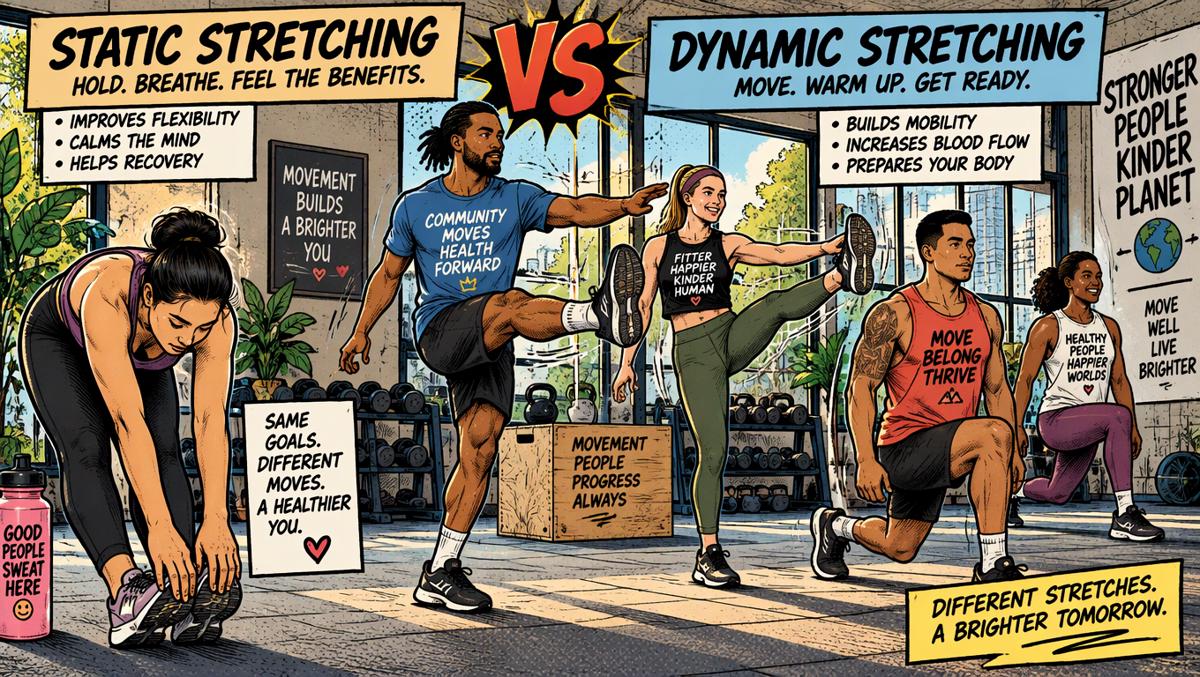
First, some quick vocabulary (the experts themselves finally standardized these definitions, so let's use them):¹
- Static stretching = holding one position — think classic toe-touch or quad pull. It's the "stretch and freeze" style.
- Dynamic stretching = active, moving stretches — leg swings, walking lunges, arm circles. Your body travels through the movement instead of freezing in it.
Here's the headline finding from the international consensus statement — a panel of 20 researchers from 12 countries who reviewed the evidence and voted on recommendations using a strict 80% agreement threshold.¹ Their clearest practical warning: **prolonged static stretching — more than 60 seconds per muscle — right before maximal or explosive effort can actually impair your performance, and should be avoided.**² ⁷
That long, luxurious hold before heavy squats? It may be quietly sanding a few percentage points off your power output.
And the numbers back this up from the other direction too. A 2026 systematic review of 23 studies involving 627 athletes — gymnasts, swimmers, wrestlers, dancers, track athletes — found that static holds longer than 60 seconds produced the biggest flexibility improvements (about a 6% gain), but came with a small dip in performance right afterward.² ³ So yes, the long hold does make you more flexible… it just also makes you temporarily slower and weaker when it matters most.
💡 Try this:
- Before strength training, sprints, or anything explosive: keep any static hold under 60 seconds per muscle — or skip them entirely.
- Save the long holds for after your workout or a separate evening flexibility session.
- Feel a tight muscle before lifting? Do a couple of short 10–20 second holds, then move on — the consensus says even 2 short bouts of 5–30 seconds is enough for a quick range-of-motion bump.¹ ⁷
🔑 Key takeaway: Long static stretching is a flexibility tool, not a warm-up tool — keep pre-workout holds short, and move the long ones to after training.
🏃 Section 2: Dynamic Stretching — The Warm-Up Winner
If long static holds are the thing to avoid before training, what should you do instead? The research keeps pointing to the same answer: move.
In that same 627-athlete review, dynamic stretching was associated with small improvements in performance (roughly half a percent versus doing nothing) — modest, sure, but it's the only style that nudged performance in the right direction while still boosting flexibility a little.² ³ No trade-off, just readiness.
Harvard Health puts it beautifully: think of dynamic stretching as warming up and static stretching as recovery.⁴ Their practical tip for getting it right? *"Mimic the activity you're about to do, just at a lower intensity."*⁴ About to run? Start with leg swings and high-knee steps. About to lift? Bodyweight squats and arm circles. About to play tennis? Shadow swings with a gentle lunge.
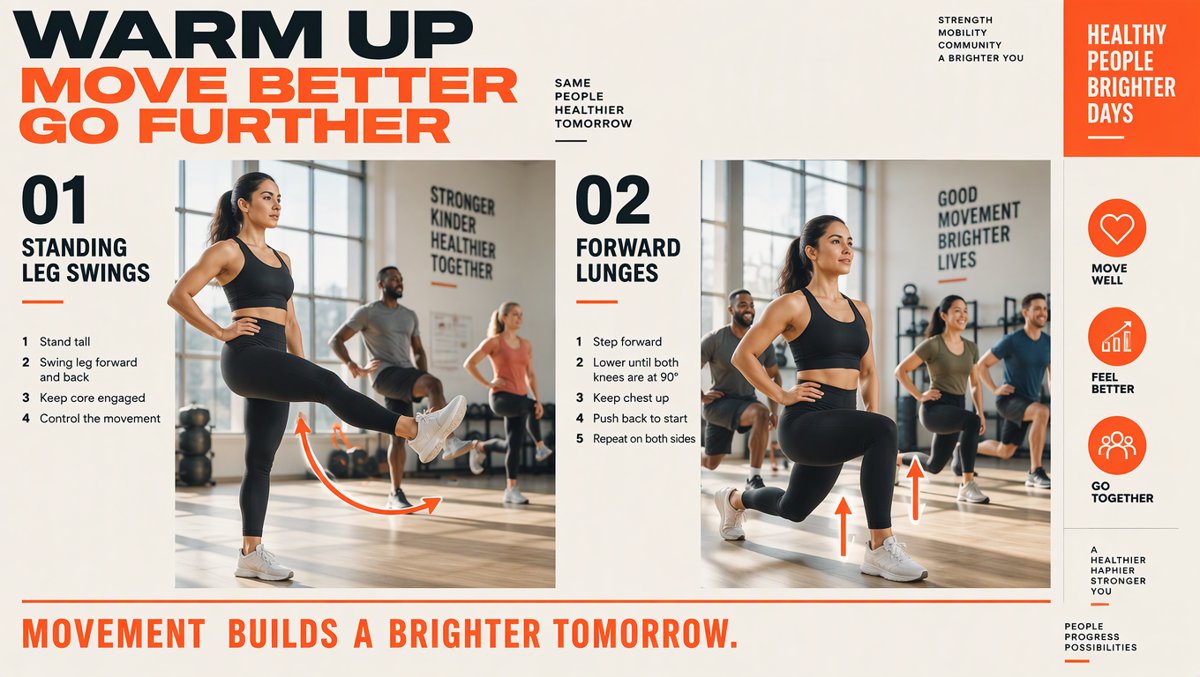
And here's a bonus the experts highlighted: while stretching alone doesn't reduce overall injury risk, Mayo Clinic experts note that dynamic warm-up movements — walking lunges, butt kicks, hip circles — may offer some injury-risk reduction, though study findings are still mixed.⁶ A gradual, active warm-up is the approach Harvard's physicians have long recommended as the smarter pre-exercise ritual.⁵
💡 Try this — a 5-minute dynamic warm-up anyone can do:
- 60 seconds of marching or light jog in place — wake up the heart and muscles.
- 10 leg swings per leg — front-to-back, holding a wall if you need balance.
- 10 walking lunges (or reverse lunges) — your legs rehearse the exact movement pattern of the workout ahead.
- 10 arm circles each direction — shoulders get warm too!
- Finish with 5 slow bodyweight squats — now your nervous system knows what's coming.
🔑 Key takeaway: Want to perform your best? Warm up with movement that rehearses your workout — save the frozen-in-place stretching for later.
🥗 Section 3: What Stretching Actually Does (and the Myths It Doesn't)
This is where the 2026 consensus statement gets refreshingly honest.¹ ⁷ Stretching has been credited with everything short of doing your taxes — so the panel put every claim on trial. The verdicts:
✅ What stretching genuinely delivers:
- Better range of motion — both immediately and long-term. For lasting flexibility gains, the panel recommends 2–3 sets of 30–120 seconds per muscle, done daily, with static or PNF stretching preferred over dynamic.¹ ⁷ So those evening hamstring holds? Legit. Keep them.
- Less muscle stiffness — though interestingly, the experts note that being less stiff isn't automatically better for every activity (some movements benefit from a springier, stiffer muscle-tendon system).¹
❌ What the evidence says stretching does not do:
- It doesn't prevent overall injury. The consensus found stretching does not reduce overall injury risk — and while it might lower some muscle injuries, that could be offset by more bone and joint injuries.¹ ⁷
- It doesn't speed up recovery. This one hit 100% agreement among the 20 experts: stretching is "largely inefficient" as a post-exercise recovery strategy.¹ ⁷ Still feels nice? Totally fine — just don't expect it to erase next-day soreness.
- It doesn't fix posture. Another 100% agreement verdict.¹ ⁷
- It's not a shortcut to strength or muscle. Any gains require enormous doses — at least 15 minutes of stretching per muscle per session, five times a week, for six-plus weeks — and even then the effect is small and far behind actual resistance training.¹ ⁷
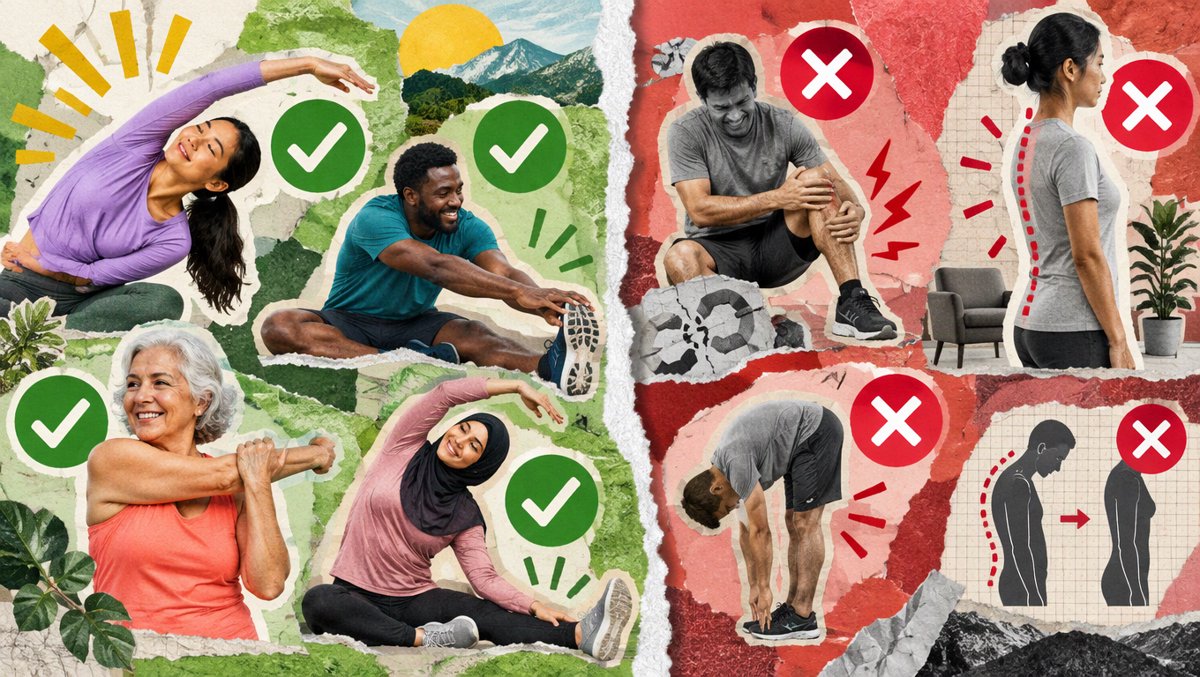
Does this mean stretching is useless? Absolutely not. Flexibility is one of the five core components of physical fitness,¹ and for dancers, gymnasts, martial artists, or anyone who just wants to touch their toes again, it's a legitimate skill worth training. The point is matching the tool to the goal.
💡 Try this:
- Goal: get more flexible? Do 2–3 daily sets of 30–120 seconds per muscle — after workouts or in the evening, not before heavy lifting.¹ ⁷
- Goal: recover faster after a workout? The experts say look elsewhere — a walk, gentle cycling, sleep, and good nutrition do more than a stretch session.¹
- Goal: feel good and de-stress? Stretch away! Enjoyment counts — just know what you're getting.
🔑 Key takeaway: Stretching is genuinely great for flexibility — but it's not an injury shield, recovery drink, or posture fixer. Use it for what it actually does.
🎯 Section 4: Your New Warm-Up Playbook (Put It All Together)
Let's assemble everything into one dead-simple routine you can start today:
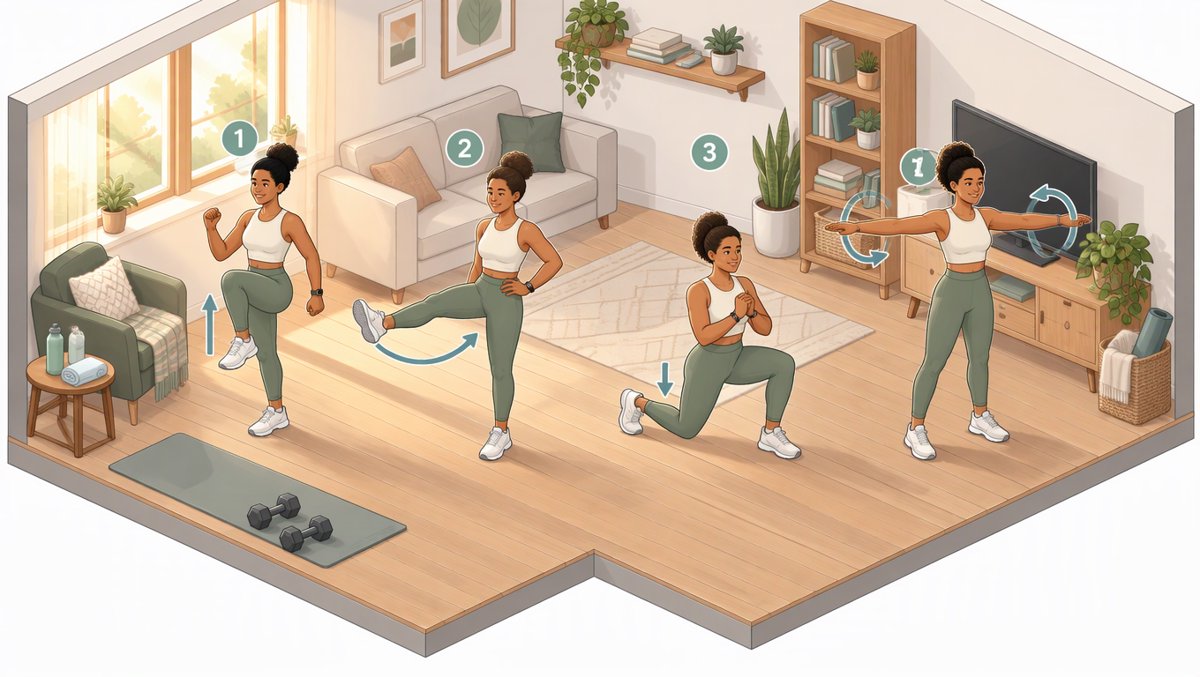
🅰️ Before your workout (5 minutes, all dynamic): Light march → leg swings → walking lunges → arm circles → a few rehearsal reps of your first exercise at easy effort. Movement-first, always.
🅱️ During your workout: Between sets, feel free to do brief 10–30 second shakes and short holds on tight spots — short enough to stay well under the 60-second caution line.² ⁷
🅲 After your workout (or anytime): This is static stretching's home turf. Want real flexibility progress? Commit to the consensus dose: 2–3 sets of 30–120 seconds per muscle, most days of the week, for the muscles you care about.¹ ⁷ Sixty seconds plus is encouraged here — the same hold duration that hurts your squats helps your hamstrings long-term.
🔑 Key takeaway: Dynamic before, static after. That's the whole secret — and it's backed by more expert agreement than almost any fitness advice you'll read this year.
🎯 Key Takeaways
- Go dynamic before you train. Leg swings, lunges, and arm circles slightly improve performance and get you ready to move — no downside.
- Keep pre-workout static holds under 60 seconds. A 20-expert consensus warns that holds longer than a minute right before max or explosive effort can impair performance.
- Save long static stretches for after training or evenings. That's when the 60-plus-second holds build real flexibility — 2–3 sets of 30–120 seconds per muscle, done consistently.
- Don't count on stretching to prevent injuries, speed recovery, or fix posture. The expert panel found no support for those jobs — movement, strength training, sleep, and recovery habits do that work.
- Match the stretch to the goal. Flexibility athletes and toe-touch dreamers: static stretching daily. Lifters and sprinters: dynamic warm-ups. Everyone: enjoy moving your body!
🎧 Key Takeaways — Listen (2 min)
📚 Verified Sources
- Warneke K, Thomas E, Blazevich AJ, et al. — "Practical recommendations on stretching exercise: A Delphi consensus statement of international research experts." Journal of Sport and Health Science, 2025;14:101067. Panel of 20 experts from 12 countries; ≥80% agreement threshold across 8 topics; defines static/dynamic/PNF stretching; performance, recovery, posture, injury, and dosing recommendations. https://pmc.ncbi.nlm.nih.gov/articles/PMC12305623/
- Knudsen M, M.S., RDN (mindbodygreen, Aug 9, 2026) — "Stretching Before A Workout? A New Study Says To Focus On This." Consumer coverage of the 2026 systematic review: 23 studies, 627 athletes; static flexibility gains ~3% (vs baseline), >60-second holds → ~6% gains but small performance decline; dynamic stretching → ~0.5% performance improvement vs control. https://www.mindbodygreen.com/articles/study-shows-the-best-stretch-depends-on-your-goals
- PubMed (National Library of Medicine) — The underlying systematic review of stretching mode and duration effects on flexibility and performance in flexibility-dependent athletes (PMID 42539555). https://pubmed.ncbi.nlm.nih.gov/42539555/
- Harvard Health Publishing — "Take time to stretch." Harvard's guidance on dynamic vs. static stretching: "dynamic stretching as warming up and static stretching as recovery"; "mimic the activity you're about to do, just at a lower intensity." https://www.health.harvard.edu/staying-healthy/take-time-to-stretch
- Harvard Health Publishing — "Ask the doctor: Stretching before exercise." Research finds no advantage to pre-exercise stretching; recommends a gradual, active warm-up instead. https://www.harvardhealth.org/healthy-aging-and-longevity/ask-the-doctor-stretching-before-exercise
- Mayo Clinic Press — "Does stretching prevent injuries?" Mayo experts: dynamic warm-up stretches (walking lunges, butt kicks, hip circles) may offer some injury-risk reduction, though study findings conflict. https://mcpress.mayoclinic.org/nutrition-fitness/does-stretching-prevent-injuries/
- American Council on Exercise — CERTIFIED (April 2026) — "New Expert Guidance on Stretching: What Belongs in Your Programs." Practitioner summary of the Delphi consensus: acute ROM dose (2 bouts × 5–30 s), chronic ROM dose (2–3 sets × 30–120 s daily), strength/hypertrophy dose limits, stiffness and vascular findings. https://www.acefitness.org/continuing-education/certified/april-2026/9104/new-expert-guidance-on-stretching-what-belongs-in-your-programs/
All claims fact-checked against Gold-tier (NIH/PMC/PubMed, Journal of Sport and Health Science) and Silver-tier (Harvard Health, Mayo Clinic, American Council on Exercise) authoritative sources. Last verified: November 11, 2026.
Your body was built to move — so before the next workout, skip the statue impression and give it five minutes of motion. Your squats, sprints, and stiff hips will all thank you. See you tomorrow, friends — stay warm (in the dynamic sense)! 💪