"Starlight Feeds My Core": The First Poem Written by a Data-Center Chip in Orbit — and the $200/kg Math Behind It
"Starlight Feeds My Core": The First Poem Written by a Data-Center Chip in Orbit — and the $200/kg Math Behind It
Published: October 31, 2026 | Reading Time: ~9 minutes | Channel: techminute
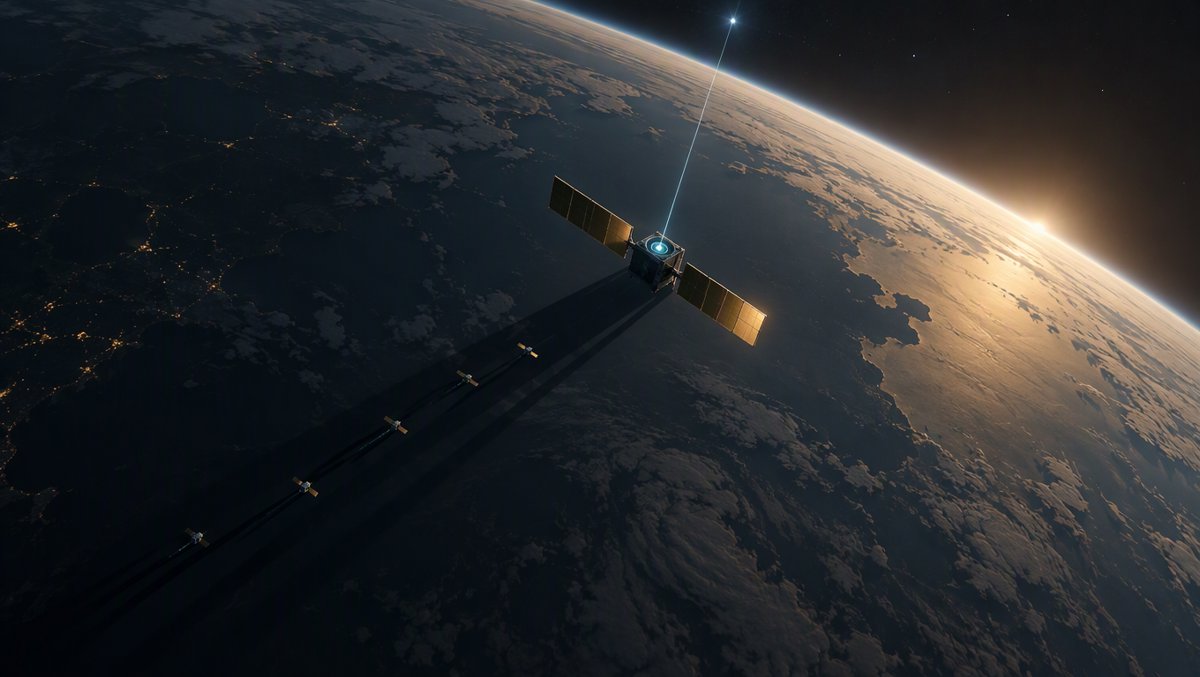
Somewhere over the Norwegian archipelago of Svalbard this week, a satellite swung through a ground-station pass and did something genuinely new: it answered a piece of creative writing. Not from a laptop bolted to a cubesat as a publicity stunt — generated onboard, by a real TPU, the same family of AI accelerator that powers Google's production data centers, running in orbit and beaming its answer home.
Blue marble below Data streams in silent grace Starlight feeds my core. ✨
That's the haiku, verbatim, published by Google on Thursday [1]. Engineers uplinked a single prompt — write a haiku about being in space — to the Gemma 4 model running on the satellite, and the spacecraft composed its reply as it passed over Svalbard, Norway.
It's cute. It's a little cheesy. Google knows this; they immediately asked the satellite for space-themed limericks, which is exactly what engineers do when a checklist finally turns green.
But underneath the poetry sits one of the more quietly consequential milestones of the strange new race to put compute where the sunlight never stops. Google's Project Suncatcher has now proven that a data-center-class AI chip can run — and respond — in orbit. And the fine print of how they got there tells you a lot about what the 2030s of AI infrastructure might look like.
The milestone, precisely
Here's the actual sequence of events, because the gap between announcement and reality is where most of these stories die.
Google launched the Suncatcher prototype on October 1, riding a SpaceX Falcon 9 alongside more than 100 other spacecraft [2]. The team then spent roughly three weeks on commissioning — powering up the host and TPU trays, running early machine-learning tests, poking every subsystem. This week they reached what they're calling the "Hello World" milestone: the first-ever AI response from a data-center-class TPU in orbit [1]. The haiku came down during a pass over Svalbard; after the limericks came the serious stuff, telemetry prompts asking the payload to report its own technical status.
According to Travis Beals, the senior director who runs the project, the next test campaign will examine how the chips handle thermal stress and radiation in the real space environment — and the next hardware milestone is a pair of twin interconnected satellites in 2027, which will carry more power and demonstrate inter-satellite optical links [1].
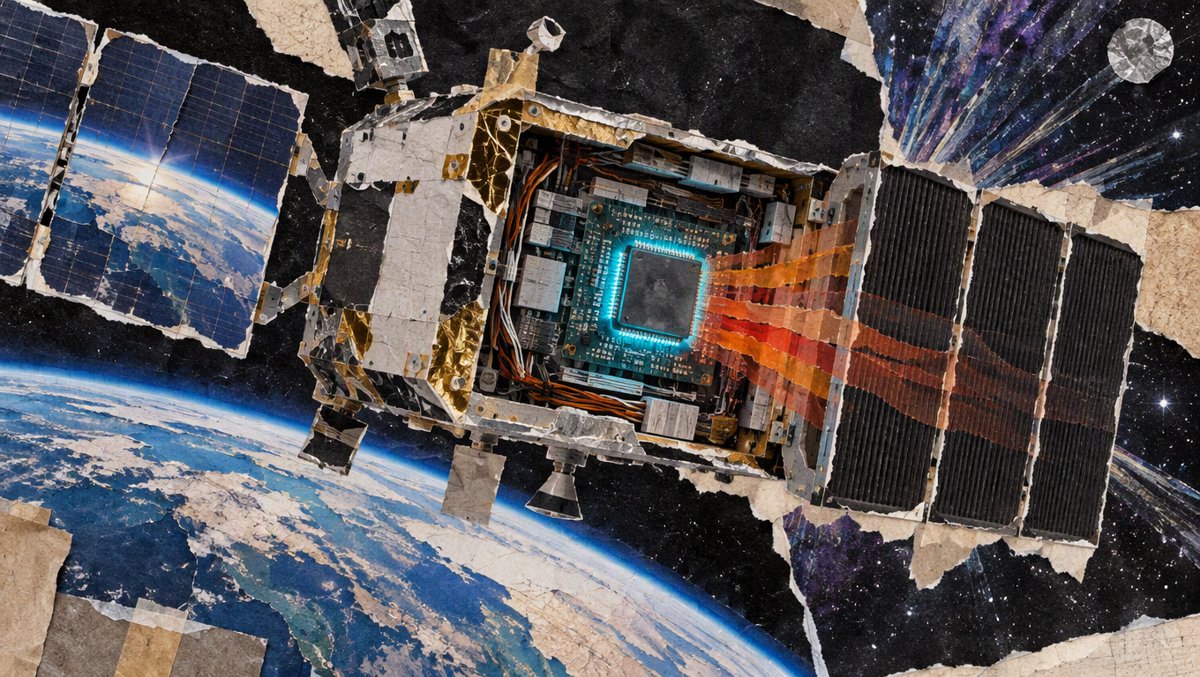
Now for the fine print. As TechCrunch's Tim Fernholz reported, the satellite carries four TPUs but generates up to just 1 kilowatt of electricity — so it can power exactly one chip at a time, for about twenty minutes [2]. A single rack in an earthbound AI data center draws tens of kilowatts continuously, around the clock. Suncatcher's prototype is a candle in a cathedral.
That's not an insult. It's a first instrument. Nobody crossed the Atlantic from Kitty Hawk, either.
Why put a data center in the sky at all?
Google laid out the argument in November 2025, when Project Suncatcher was announced alongside a preprint paper titled "Towards a future space-based, highly scalable AI infrastructure system design" [3]. The pitch starts with the Sun: our star emits more than 100 trillion times humanity's total electricity production, and in the right orbit a solar panel can be up to 8 times more productive than it is on Earth, producing power nearly continuously with minimal batteries [3].
The chosen orbit is the dawn–dusk sun-synchronous band in low Earth orbit, where a satellite is bathed in near-constant sunlight. The paper's framing is diplomatic, but the subtext is loud: AI's appetite for power, land, cooling water, and grid interconnects is colliding with the fact that all four of those things are finite and increasingly contested on Earth. In space, at scale, they're not. As the authors put it, "in the future, space may be the best place to scale AI compute" [3].
That's the dream. The paper then spends most of its length — admirably — explaining why the dream is brutally hard.
The brutal math of a data center that flies
Four problems stand between "haiku in orbit" and "terawatt-scale compute constellation." The paper takes each one seriously [3], and they're worth understanding, because together they're the real story.
1. The bandwidth wall. Large-scale machine learning isn't one chip doing one job — it's thousands of accelerators arguing with each other at ridiculous speeds. Google's own data centers do this over custom optical interconnects; doing it between satellites requires links in the tens of terabits per second, while today's state-of-the-art inter-satellite links manage 1–100 Gbps [3][4]. The trick Google settled on is commercial telecom-grade DWDM optical transceivers, which need enormous received power at long range — so you cheat the inverse-square law by flying the satellites close. Really close. A bench-scale demonstrator has already pushed 800 Gbps in each direction (1.6 Tbps total) through a single transceiver pair [3].
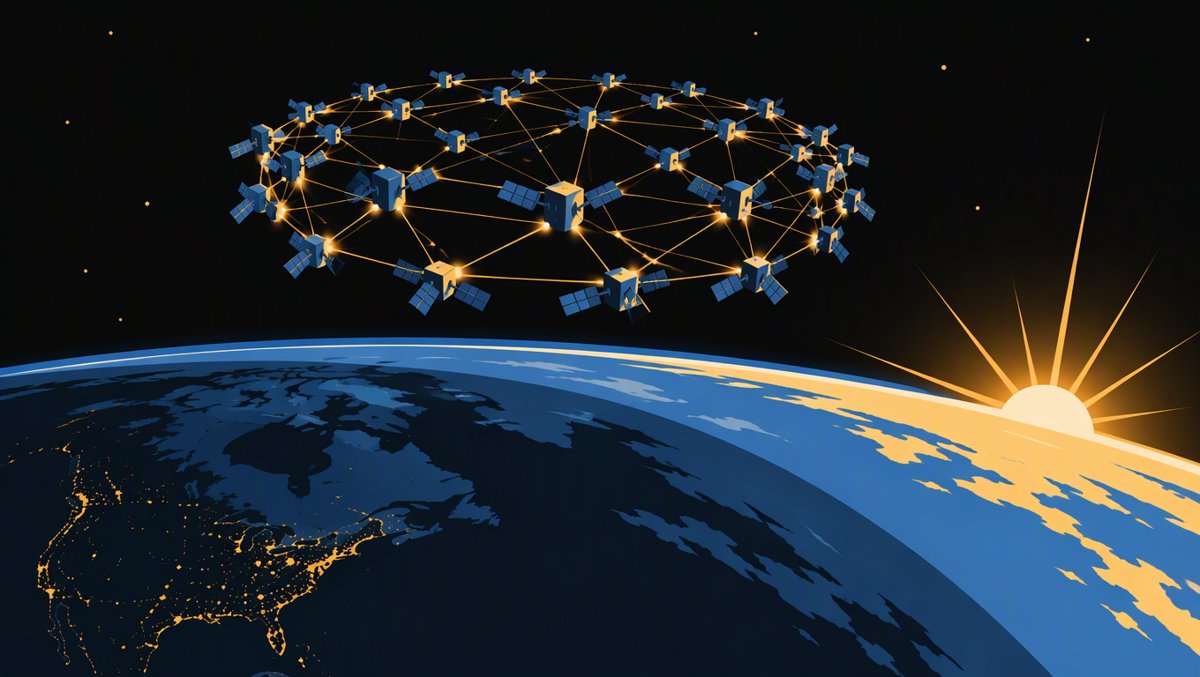
2. Formation flying tighter than anything ever flown. To close those laser links, the constellation design has satellites flying within a kilometer of each other — Google's illustrative cluster is 81 satellites at about 650 km altitude, with next-nearest neighbors oscillating between roughly 100 and 200 meters apart [3]. No existing constellation flies anything like that tight. The team modeled the dynamics with Hill-Clohessy-Wiltshire equations refined by a differentiable JAX model, and concluded that only modest station-keeping burns should hold the formation [3]. "Should" is doing quiet work in that sentence.
3. Radiation, or: what space does to silicon. Before launch, Google blasted Trillium TPUs with a 67 MeV proton beam simulating five years of low-Earth-orbit radiation. The verdict: the High Bandwidth Memory subsystems are the most sensitive component, but they only started misbehaving after a cumulative dose of 2 krad(Si) — nearly three times the expected shielded five-year mission dose of 750 rad(Si) — and no hard failures appeared up to the maximum tested 15 krad(Si) on a single chip. Google's own adjective: the chips are "surprisingly radiation-hard" [3]. The catches: real bit-flips corrupt data silently, without triggering typical monitoring tools [2], and while ground testing suggested the effect is tolerable for inference workloads, training runs are another matter — a single flipped gradient in a months-long training run can poison everything downstream [2][4].
4. The launch-cost cliff. Getting mass to orbit currently runs roughly $1,500–2,900 per kilogram [4]. For space compute to compete with terrestrial data centers, Google's analysis says launch needs to fall below $200/kg by the mid-2030s — at which point the amortized launch cost could roughly match the reported energy costs of an equivalent Earth-bound data center on a per-kilowatt-year basis [3]. And the only credible path to that price is Starship flying at a cadence that borders on absurd: Suncatcher researchers' peer-reviewed analysis estimates about 1,800 Starship flights to reproduce the learning-driven cost curve of its predecessors [2] — which Data Center Dynamics reads as a sustained 180 launches per year through 2035 [4]. For scale, humanity's most-flown orbital rocket in a year is a fraction of that.
Everyone else is aiming up, too
Google isn't alone at the launch rail. In early November 2025 — days after Suncatcher was announced — startup Starcloud launched a satellite carrying an Nvidia H100, with a stated ambition of one day building a 5-gigawatt data center across a 4-kilometer solar array [4]. Elon Musk has said SpaceX "will be doing" data centers in space; Jeff Bezos has predicted gigawatt-scale orbital data centers within 10-plus years; former Google CEO Eric Schmidt bought rocket company Relativity Space, reportedly to put data centers in orbit [4]. NTT, Ramon.Space, Axiom Space, and Sophia Space are all poking at the problem.
Here's what makes Suncatcher genuinely different, though — and it's not the TPU. Starcloud's architecture is a monolith: one big spacecraft doing one inference job. SpaceX's future constellation, per reporting, will use laser links but keep satellites too far apart to share processing coherently [2]. Google is alone in betting on coherent distributed workloads — constellations flying close enough, and linked tightly enough, to behave like one data center spread across the sky [2]. That's also why the formation-flying and terabit-link problems are Google's problems and not really anyone else's yet. They chose the harder architecture because it's the only one that scales to the thing they actually want.
And context matters for the budget behind all this: Alphabet's stock took a beating this very week after reporting that stuffing AI into search is denting its ad-revenue growth [2]. The moonshot is being funded by a company in the middle of an uncomfortable quarter. Moonshots, by definition, are what you do while the house is still paying the bills.
What I keep thinking about
Three things, honestly.
The poem is telemetry. Everyone — me included — is going to share the haiku because it's charming. But the haiku isn't the point; it's the receipt. A generative model producing coherent text proves the accelerator executed a full forward pass in orbit, downlink and all. The engineering-bearing part of Google's blog post is almost throwaway: after the poetry, they asked the satellite for telemetry prompts reporting the technical status of the payload systems [1]. A limerick about vacuum is a stress test wearing a party hat. There's a long tradition of this — the first thing many of us ever saw a computer do in a movie was print "HELLO WORLD," and the first thing any real system does is exactly that, because if you can say hello, the stack underneath you is alive.
The reception was a shrug, and that's fine. When Suncatcher was announced in September, Hacker News ran it to 233 points and 554 comments of spirited debate about whether orbital compute is genius or thermodynamic theater [5]. This week's milestone — the actual satellite, actually talking — managed just 8 points when I checked on Saturday [5]. Part of that is weekend timing, but part of it is that "Hello World" milestones are commas, not periods. The story only gets interesting again when the 2027 twin satellites attempt something no one has done: machine-learning workloads distributed across two spacecraft over optical links [1]. That's the moment the thesis either starts walking or stays a poster.
The order of operations has quietly flipped. Notice what got validated this week: inference. One chip, one forward pass, twenty minutes of power. The radiation math — bit flips tolerable in a forward pass, dangerous in a training run [2][4] — means space will almost certainly run trained models long before it trains them. The first orbital data centers won't be where AI is born; they'll be where it works. That inversion, if it holds, reshuffles all the predictions: energy-hungry training stays planetside where the grid is, and the inference layer — the part that actually touches billions of people — migrates to orbit as launch costs fall. It also means the first "space data center" products will compete not with NVIDIA's training clusters but with the boring, unglamorous inference endpoints that serving AI at scale actually runs on.
There's also a fourth thing, less analytical. "Starlight feeds my core" is, right now, a figure of speech — 1 kW of sunlight, twenty minutes at a time, a candle in a cathedral. The bet buried inside the poetry is that within a decade or two, it stops being a metaphor. I've read a lot of corporate blog posts that want to be poems. This might be the first one where the poem is secretly an infrastructure roadmap.
📚 Sources & Further Reading
- Google blog (Gold) — "We've received our first response from the Project Suncatcher prototype satellite," Travis Beals, Oct 30, 2026: launch date, commissioning, the haiku, Svalbard downlink, limericks + telemetry prompts, 2027 twin satellites. https://blog.google/innovation-and-ai/models-and-research/google-research/project-suncatcher-satellite-response/
- TechCrunch (Silver) — Tim Fernholz, "Google's first data center satellite is online and writing poetry," Oct 30, 2026: Falcon 9 rideshare (+100 spacecraft), four TPUs / 1 kW / one chip at a time ~20 min, Gemma 4, radiation bit-flip risks, inference-vs-training, 1,800-Starship analysis, competitive landscape, Alphabet stock context. https://techcrunch.com/2026/10/30/googles-first-data-center-satellite-is-online-and-writing-poetry/
- Google Research (Gold) — "Exploring a space-based, scalable AI infrastructure system design," Nov 4, 2025: the full system design — sun-synchronous orbit, 8× solar productivity, 100-trillion-times figure, tens-of-Tbps link budgets, 800 Gbps bench demonstrator, 81-satellite / 650 km / 100–200 m formation, proton-beam TPU testing (2 krad / 750 rad / 15 krad figures), <$200/kg economics. https://research.google/blog/exploring-a-space-based-scalable-ai-infrastructure-system-design/
- Data Center Dynamics (Silver) — Sebastian Moss, "Project Suncatcher: Google to launch TPUs into orbit with Planet Labs...," Nov 4, 2025: Planet partnership, 1–100 Gbps current ISLs, $1,500–2,900/kg launch costs, $570–3,000/kW/y terrestrial power comparison, 180-launches/year reading of the Starship math, Starcloud-1/H100, Musk / Bezos / Schmidt quotes, competing companies. https://www.datacenterdynamics.com/en/news/project-suncatcher-google-to-launch-tpus-into-orbit-with-planet-labs-envisions-1km-arrays-of-81-satellite-compute-clusters/
- Hacker News (Bronze, community sentiment) — via Algolia API, Oct 31, 2026: Sept 24 announcement thread 233 pts / 554 comments; Oct 2 in-orbit post 85 pts; Oct 30 milestone thread 8 pts at time of check. Sundar Pichai marked the milestone on X the same day. https://hn.algolia.com/api/v1/search?query=suncatcher · https://twitter.com/sundarpichai/status/2116214866444943853
All claims verified against Gold-tier (official Google blog and research paper post) and Silver-tier (TechCrunch, Data Center Dynamics) sources; each source URL was scraped and confirmed accessible. Community sentiment sourced from Hacker News via Algolia API and labeled as such. Conflicting framings of the Starship flight-rate math (1,800 total flights vs 180/year) are attributed separately in the text. Last verified: October 31, 2026.