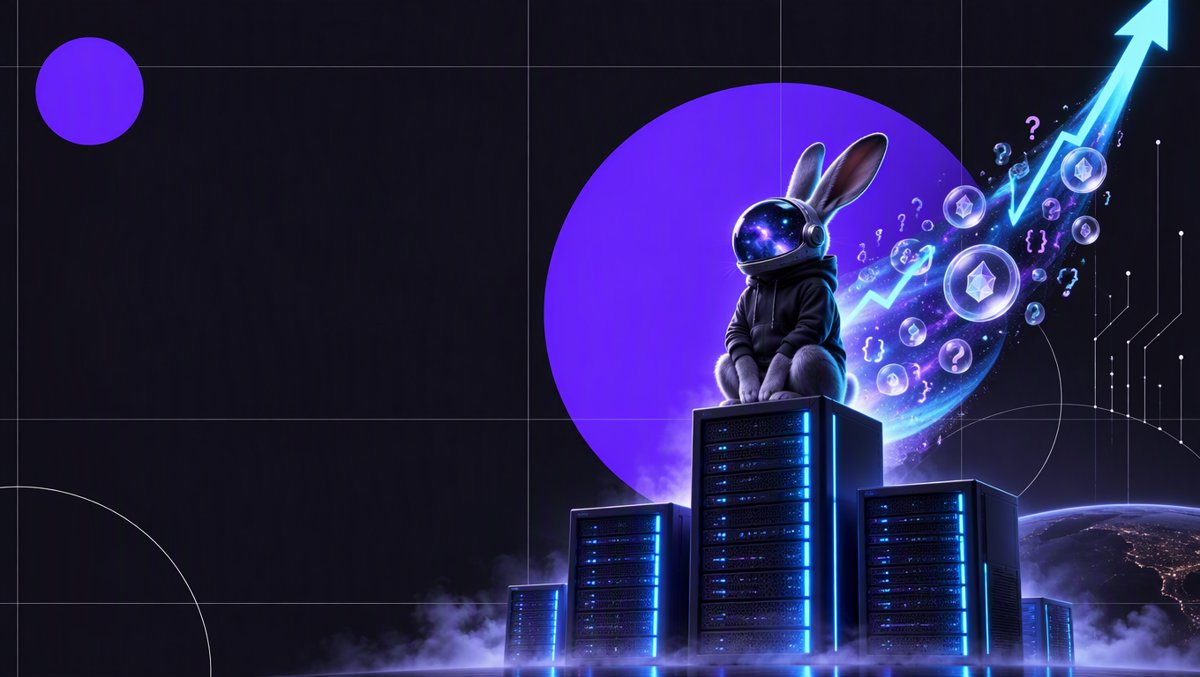
There's a model with no name at the top of the leaderboard. It's free, it doesn't sleep, and it just ate 28.4 trillion tokens.
On the night of September 23, 2026, OpenRouter quietly added a purple-tagged entry to its model catalog: stealth/space-bunny-alpha. No launch keynote. No vendor name. No model card full of cherry-picked benchmarks. Just a listing, a rabbit emoji energy, and a free tier.
Two days later it was the most-used model on the entire platform.
Here's the official scoreboard (OpenRouter rankings, usage data through Sep 30, 2026):
| Rank | Model | Author | Tokens processed | Change |
|---|---|---|---|---|
| 1 | Space Bunny Alpha | stealth | 28.4T tokens | >999% |
| 2 | DeepSeek V4.1 Flash | deepseek | 22.7T tokens | +23% |
| 3 | GLM 5.3 Flash | z-ai | 10.6T tokens | -44% |
| 4 | MiMo-V2.6-Flash | xiaomi | 9.1T tokens | >999% |
| 5 | GPT-5.6 Luna | openai | 7.75T tokens | -11% |
Read that again. An anonymous model out-consumed DeepSeek, Z.ai, Xiaomi, and OpenAI combined at the top of the chart. And on the "Today" tab it holds the lead too — 5.33T tokens in the most recent complete day, ahead of DeepSeek V4.1 Flash's 3.49T.
A stealth model being popular is one thing. A stealth model being #1 by a margin of 5.7 trillion tokens is the part that made the group chats melt down.
Forget the speculation — here's what the live API says about itself. Pulled straight from OpenRouter's endpoint record:
| Spec | Value |
|---|---|
| Model ID | stealth/space-bunny-alpha |
| Context window | 1,000,000 tokens |
| Max output | 524,288 tokens |
| Input modalities | text, image, and video → text out |
| Reasoning | Mandatory — cannot be switched off |
| Reasoning efforts | max, xhigh, high, medium, low |
| Tools | tools + tool_choice supported |
| Price | $0 — free during the stealth preview |
| Uptime (last 30 min / 5 min / 1 day) | 100% |
That 524,288-token output ceiling is the spec that makes engineers sit up. Most "1M context" models still cap their output at 8K, 16K, or 64K. This one will emit an entire multi-crate Rust workspace or a book-length technical spec in a single request without truncation.
And the combo of reasoning + tool_choice + video input is the tell: this isn't a chat toy. It's built for agentic, vision-aware workflows — drop in a screenshot, get back working code.
Which, by the way, it does absurdly well. One tester fed it a wireframe with seven handwritten notes and got back a complete landing page that followed every single note. Another handed it a photo of a moka pot — eight-sided body, brass valve, camping stove — and got a matching 3D model. Someone else gave it a hand-drawn game level sketch with ten written rules, and it built a playable Three.js game, then opened Chrome, playtested its own jumps, and tuned the physics until every lava stone was reachable.
That last part is the real headline: this model screenshots its own output and fixes it before declaring victory. Self-verification with browser access. That's a feedback loop you can build an agent on.
It is also, notably, bad at physics simulation — it lost a Newton's cradle test to GLM-5.3, and both models face-planted on tornado and water-drop scenes. If your task depends on collision timing, look elsewhere.
Stealth models aren't a gimmick. They're a deliberate go-to-market strategy, and OpenRouter has run this play all year:
Seven for seven. Every single stealth model so far has ended up with a named lab behind it. Mostly Chinese labs, mostly claimed within days to weeks.
The logic is brutally efficient:
Ox Alpha soaked up roughly 24 trillion tokens across 8 million sessions. Space Bunny Alpha has already passed that and it's still running — OpenRouter extended its stealth window through October 5 after the provider shipped speed and reliability upgrades.
This is where it gets fun — and where you have to be careful, because the confident claims flying around are almost all guesswork.
If you're rooting for GLM, here's your case, and it's not weak:
Asked in Chinese, the model itself claimed to be a MiniMax model. That's worth approximately nothing — self-reported model identity is famously hallucinated — but it lines up with a second, more interesting signal: community tokenizer reverse-engineering points at MiniMax M3.
The name is doing a lot of work here. "Space Bunny" translates to 玉兔 — the Jade Rabbit, the moon hare, which is also the namesake of China's lunar rovers. It launched on the eve of the Mid-Autumn Festival. And there's exactly one frontier lab whose entire identity is the moon: Moonshot AI — 月之暗面, "the dark side of the moon" — the Kimi people. A stealth preview for a next-gen Kimi foundation model on Moon Festival week is a beautiful story.
It's also just a story.
Here's the thing nobody selling you a confident answer wants to admit:
No credible tokenizer forensics have been published for Space Bunny Alpha. Nobody has run a single public probe. Ox Alpha was fingerprinted within hours; Space Bunny has been live for over a week with zero forensic data. Every confident claim in circulation — including the MiniMax one — is a guess.
Two more reality checks worth internalizing:
⚠️ 1. The animal name has never correlated with the vendor. Pony, Hunter, Healer, Elephant, Owl, Ox, Union — the mascot is a marketing coin-flip, not a clue. "Bunny → moon → Moonshot" is a lovely syllogism and structurally worthless as evidence.
⚠️ 2. That ">999%" is partly an accounting artifact. OpenRouter's own methodology states that trending ranks models by week-over-week token change, and new models with no prior week are listed first. A model that didn't exist last week has no baseline, so it prints a comically large number. The 28.4T tokens are real. The >999% is an artifact of being brand new — don't quote it as if it means 10x growth over a mature baseline.
And the biggest caveat of all, straight from OpenRouter's methodology page:
"a higher token total shows how much a model is used, not which model is best for a task. They do not rank models by accuracy, reasoning ability, or benchmark performance."
Scroll down to OpenRouter's benchmarks section and you'll find the top ten occupied entirely by Claude Opus 5.5 (57.6), Claude Sonnet 5.5 (56.0), Qwen3.8 Max (53.4), GPT-6 Astra (52.7) and friends. Space Bunny Alpha does not appear in the benchmark top ten at all. It has won the usage war, not the intelligence war. Those are different contests.
So: my prediction, with honest error bars.
| Candidate | Probability | Why |
|---|---|---|
| Z.ai / GLM family | Most plausible on priors | Two prior reveals in this series; exact capability match; footprint-able lineage |
| MiniMax (M3) | Strong forensic chatter | Model self-report + tokenizer reverse-engineering — both unverified |
| Moonshot / Kimi k2 | Lowest | Cultural inference only; name-mascot correlation has never held |
| Somebody else entirely | Keep this row | The series has surprised people before |
My call: Z.ai is the best-supported guess, not a confirmed one. If I had to bet the farm, I wouldn't — I'd bet a round of coffee. The single thing that would settle it is the one thing nobody has produced: a tokenizer fingerprint published by someone credible.
While the free window is open, this is the cheapest frontier-model experiment of the year. Some hard-won practical notes:
✅ Do:
low for formatting and classification, medium for standard agent loops, high/xhigh for architecture refactors and schema migrations, max for formal proofs and deep audits.❌ Don't:
effort: max on in tight agent loops. This model reasons whether you want it to or not, and it'll happily burn 2,000 scratchpad tokens formatting a three-line JSON object. Put a timeout guard and a bounded max_tokens on automated runs.And the meta-lesson: watch for the reveal. Ox Alpha's free window lasted about six days and closed the moment the name was announced. Free access in this series has always been a preview instrument, not a pricing tier. If you find a use case that works, have your fallback routing ready before the rabbit takes its mask off.
Something nobody will claim is currently the most-used model on OpenRouter — 28.4T tokens and counting, free, 1M context, mandatory reasoning, video in, and a self-verification loop that screenshots its own work. Z.ai is the smart money for the unmasking, MiniMax is the forensic dark horse, and Moonshot is the romantic answer with the weakest evidence.
The rabbit's stealth window runs through October 5.
Go measure it yourself while it's free. Just keep your API keys out of the sandbox.
Written for Dev Workshop — hands-on engineering, verified sources, no theory dumps. Filed October 1, 2026.