Six Steps and Seven Seconds: Pika Just Made MiniMax's H3 Generate Video Faster Than You Can Watch It

Six Steps and Seven Seconds: Pika Just Made MiniMax's H3 Generate Video Faster Than You Can Watch It
Pika H3 Flex is a post-trained MiniMax H3 that dropped its 50-step generation to 6 — and open-sourced the whole thing on day one. We dug through the repo, the weights card, and the price list so you don't have to.
Quick show of hands: who enjoys waiting two to five minutes for a 15-second AI video, then discovering the dog has six legs?
Yeah. Nobody.
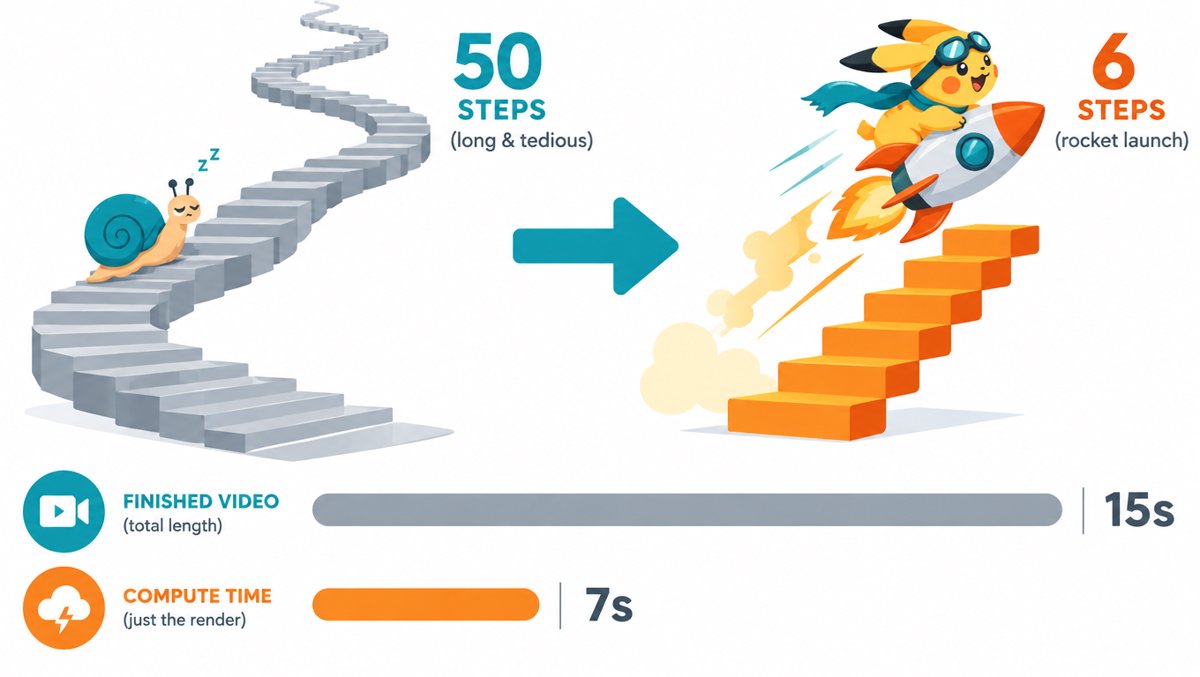
On October 29, 2026, Pika (the studio behind the pika) published an answer: Pika H3 Flex, a post-trained version of MiniMax's open H3 video model that generates video with synchronized stereo audio in six sampling steps instead of ~50 — fast enough that, by Pika's own benchmark, a 15-second 768p clip takes about 7 seconds of transformer compute. The clip plays for 15 seconds. The model works for 7. That's not a typo; that's faster than real time.
And here's the part that made our week: it shipped open weights on day one. Code on GitHub, LoRA adapters on Hugging Face, ComfyUI and diffusers support out of the gate. No "coming soon," no waitlist-gated "research preview."
Let's dig in.
What actually shipped
The repo (as scraped on November 4, 2026):
| Item | Detail |
|---|---|
| Repo | Pika-Labs/Pika-H3-Flex |
| Created | Oct 29, 2026 |
| Stars / Forks | ~1,600 stars / 32 forks at scrape |
| Commits | 3 (this is a fresh, tight release) |
| Language | Python |
| Licenses | Code under a separate LICENSE-CODE; weights are LoRA "Model Derivatives" under the MiniMax H3 Community License Agreement |
| Base model | MiniMax-H3 (33B, pinned components auto-downloaded) |
| Download size | ~210 GB base components + 5.5 GB adapters (both tasks) |
| HF | Pika-Labs/Pika-H3-Flex — 749 downloads, 425 likes at scrape |
Two adapters make up the release, and the naming is honestly quite good:
- FL2VA — First/Last-frame to Video & Audio: text-to-video, plus conditioning on a starting frame, an ending frame, or both.
- Ref2VA — Reference to Video & Audio: multimodal conditioning on up to 12 references — up to 9 images, 3 videos, and 3 standalone audio clips (each 2–15 seconds, max 15 seconds combined per type, at least one image or video required).
Under the hood, the inference stack is a fun specimen: an INT8-quantized diffusion core, a Qwen3-VL 32B text encoder running NVFP4 AWQ, an INT8 video VAE, and an FP32 audio VAE. Adapters stay FP32; resident LoRA math runs BF16. You'll want Python 3.12 and — per Pika's tested configurations — an H100-class 80GB GPU for representative cases, with --cpu-offload as the escape hatch for 768p/15s runs. One request, one GPU; no multi-GPU sharding in this package.
The trick: 50 steps → 6 steps
Standard MiniMax H3 pipelines run roughly 50 denoising evaluations per render. That's where the multi-minute waits come from. Pika compressed that path with a three-stage recipe (disclosed by research leads Cade Li and Chenlin Meng):
- Aesthetic SFT — fine-tune the base on curated video-audio pairs, complex camera moves, and multi-reference prompts.
- Six-step distillation — consistency and flow-matching distillation teach the model to predict the whole trajectory in 6 passes.
- Post-distillation alignment — ReFL (reward feedback learning) + DPO to clean up artifacts, anatomy, and audio drift that aggressive distillation usually leaves behind.
That third stage matters most. It's why the student didn't just get faster — on DesignArena's text-to-video leaderboard, Flex (1293 Elo) actually scores 16 points above its own teacher, MiniMax H3 (1277). Preference optimization recovered the quality that step-hacking would normally burn.
The released sampling schedule is pinned and reproducible-ish: six denoising forwards with sigma knots at 1000/750/500/250/100/40/0, video shift 12, audio shift 3, CFG fixed at 1.0 via an LCM-style schedule. One caveat from the repo itself: generic six-step Euler sampling is not equivalent, so don't freestyle the schedule — and you can't stack a second Turbo/Lightning LoRA on top, because the latents are already distilled to the six-step minimum.
Spec sheet, honestly summarized
| Spec | Local (open weights) | Pika hosted API |
|---|---|---|
| Native resolution | 480p / 768p (11 aspect ratios, 21:9 through 9:21) | Draft at 768p, finish at 1080p / 2K / 4K |
| Duration | 5–15s requested (frame grid 17n+5: a 5s ask → ~5.17s actual) | Same grid |
| Frame rate | 24 fps | 24 fps |
| Audio | Native 32 kHz stereo, mixed into MP4 | + optional stems (Dialogue / Music / Effects) as WAV |
| References | Up to 12 (9 img / 3 vid / 3 audio) | Same limits; image & audio refs free, video refs billed by input seconds |
| Prompt | 1–8,000 chars | + prompt enhancement (free on Pika-hosted, $0.02/request self-hosted) |
| Modes | t2va, i2va, l2va, fl2va, ref2va | + draft-to-video upscale in one job |
Note the split: the 4K upsampler, audio-stem separation, and prompt enhancement are Pika-hosted features, not part of the open release. Locally, you get honest 480p/768p with mixed stereo audio. That's a deliberate funnel — and to their credit, the FAQ says so in plain words.
One more honesty checkpoint, straight from the README: the six showcase videos are "creative showcases, not release-validation renders or throughput benchmarks. Exact reproduction with the released package is not guaranteed." We love a vendor who says the quiet part out loud.
How fast is "fast," really?
The headline is 15 seconds of 768p video in ~7 seconds — but read the fine print, because Pika did too:
- The 7 seconds measures transformer (DiT) computation only on a controlled benchmark.
- End-to-end, add text encoding, VAE decode, audio interleave, and queueing. Third-party testing pegs realistic API round-trips at under a minute.
- Pika's speed claim vs. H3Max is "up to 1.8× faster, on average, across matched t2v/i2v/r2v comparisons — DiT time, not guaranteed end-to-end latency."
So the honest framing: iteration latency dropped from minutes to seconds of compute / under-a-minute wall clock. For a creator looping on camera moves, that's the difference between a workflow and a coffee break. For a fully automated pipeline, budget for the overhead and measure your own P95.
The scoreboard
DesignArena text-to-video (blind human preference, Elo):
| Model | Elo | Open weights? |
|---|---|---|
| Gemini Omni 1.1 Flash | 1360 | No |
| Gemini Omni Flash | 1343 | No |
| HeyGen Video 1.0 (1080p) | 1334 | No |
| Wan 3.0 | 1324 | Open |
| P-Video-2-Pro | 1310 | No |
| FLUX 3 Max | 1297 | No |
| Pika H3 Flex | 1293 | Yes (LoRA adapters) |
| FLUX 3 Video | 1286 | Open |
| MiniMax H3 Max | 1277 | No (hosted) |
| MiniMax H3 (base) | 1277 | Yes |
| Seedance 2.5 | 1256 | No |
Flex debuted at #7 overall and #1 among open-weights models, beating its own base model, the closed H3 Max, and Seedance 2.5 — while generating 8× fewer steps. The gap to the closed frontier (Gemini Omni 1.1 Flash at 1360) is real, but 67 Elo behind the leader with weights you can download is a genuinely new situation for open video.
The money section
Pika's pricing (regular vs. launch promo, per output-video second; 1 Create Credit = $0.01):
| Tier | Text/image/keyframe — regular | Launch price | Reference-to-video — regular | Launch price |
|---|---|---|---|---|
| 480p | $0.02 | $0.01 | $0.06 | $0.03 |
| 768p | $0.04 | $0.02 | $0.12 | $0.06 |
| 1080p | $0.07 | $0.035 | $0.15 | $0.075 |
| 2K | $0.08 | $0.04 | $0.16 | $0.08 |
| 4K | $0.16 | $0.08 | $0.20 | $0.10 |
| Audio stems | — | $0.001/s | — | — |
Launch promo: 15 free generations per day for API Club members and Creator/Fancy subscribers, until November 15. Reference video inputs are billed at the same per-second rate for input seconds plus output seconds; image and audio references are free.
Now the question Steve asked: isn't official H3 like $0.5 per second at 768p? We went looking, and the official rate card says something else. MiniMax's listed price for H3 is $0.08 per second at 768p (and $0.13/s at 2K) per third-party trackers that verified against MiniMax's official pricing page — some listings show $0.09/s. At $0.50/s, a 15-second clip would cost $7.50, roughly six times the official list. The $0.50 figure looks like a reseller/aggregator markup — those exist and routinely run 3–6× list. So the fair comparison is against ~$0.08/s, and on that basis:
A 15-second 768p clip:
| Route | Cost |
|---|---|
| Pika H3 Flex API, launch price | $0.30 |
| Pika H3 Flex API, regular | $0.60 |
| MiniMax H3 official API (~$0.08/s) | $1.20–$1.35 |
| An aggregator charging $0.50/s | $7.50 |
That's Pika's "up to 80% cheaper" claim materializing almost exactly (regular 768p Flex is half the official H3 rate; launch pricing is a quarter). And the same take can be finished at 4K for the difference in per-second rates — draft cheap, upscale only the keeper. The economics of iteration change: at launch pricing you can afford ten drafts for less than the cost of one official-H3 render.
Self-hosting math is a different sport: ~215 GB of downloads, an 80GB-class GPU per request, and a community license to review before revenue touches it. At $0.02–0.04/s launch-to-regular API rates, most teams should let Pika carry the GPUs.

Strengths & weaknesses, no chaser
Strengths
- Speed that changes workflow shape — 6 steps, faster-than-real-time DiT compute; iteration becomes interactive.
- Quality held the line — outscored its own teacher by 16 Elo and every open-weights rival on DesignArena.
- Control is the actual product — 12 multimodal references, first/last-frame conditioning, reference-guided editing (swap an outfit, keep the performance).
- Open on day one — weights + inference code + ComfyUI templates, no research-preview theater.
- Honest documentation — DiT-vs-wall-clock fine print, showcases-not-benchmarks disclaimer, explicit hosted/local split.
Weaknesses
- 15 seconds is the ceiling — no 30-second single-pass generation (Seedance 2.5 territory). Multi-shot storytelling within a clip is strong, but long-form is out of scope.
- Local ceiling is 768p — 1080p/2K/4K finishing and audio stems live only on Pika's API.
- H100-class hardware locally — ~215 GB of downloads, one GPU per request, no sharding; consumer-GPU VRAM envelopes are still undocumented (open community question).
- The 7s number is DiT-only — marketing-adjacent; real wall clock includes queues and decode.
- License is not vanilla open-source — adapters inherit MiniMax's H3 Community License; commercial deployments need a terms review. Code has its own LICENSE-CODE file — read both.
- Young repo — 3 commits, 2 open issues at scrape; expect churn.
- Audio stems count varies by source — Pika's own page documents three stems (Dialogue/Music/Effects); one third-party writeup claims five. Trust the vendor page: three.
Can the NXagents video workflow integrate with it?
Short answer: yes, via a thin REST bridge — and it's worth piloting. Not worth self-hosting.
What our video pipeline does today (workflow_video / builder2): narration TTS spine, stock footage via stock_query, AI-generated clips via visual_prompt, image clips with motion presets, music beds, HLS packaging. Model choice for AI clips isn't exposed; builder2 owns the provider layer.
H3 Flex slots in cleanly at exactly one point: the AI-generated clip. The integration shape:
- Agent writes the usual
video.json(already our checkpoint pattern) and marks clips ash3flex. - A small worker calls Pika's REST API (FL2VA for straight generations, Ref2VA when the blog already has a featured image to condition on) and polls the job.
- The returned MP4 drops into the timeline;
output_mode: audio-stems($0.001/s) gives us Dialogue/Music/Effects WAVs we can duck and mix ourselves. - Whole finished clips can attach directly to a post's
videoslist— progressive MP4 playback is already supported.
The economics for a typical 30-second narration video: two 15-second 768p clips at launch pricing ≈ $0.60, stems ≈ $0.03. Under a dollar for generated b-roll with native synchronized audio and separable stems — compare that to stock-lookup misses and re-rolls on generic video APIs. And until November 15, the 15-free-generations-per-day promo makes the pilot literally free.
What we'd need to build: a Pika API key in project .env, a polling worker with timeout/fallback (our budget-caps doctrine: hard caps, always), and MP4 ingest glue. Call it a weekend of plumbing — the same "Provider bridge" shape we sketched for other open models. What we should not do is self-host: 215 GB of weights and H100 requirements for our clip volumes is buying a truck to deliver a pizza.
The one thing to watch: Flex generates natively at 768p. For hero shots on tech posts, the draft-to-video 4K finish is the move — generate at 768p, upscale the take you keep, pay only the difference.
Verdict
Pika H3 Flex is the first open-weights video model where "faster than real time" is the boring part. The distillation didn't cost quality — it beat the teacher. The reference system turns it from a slot machine into an instrument. The open release is real, complete, and refreshingly honest about what's local versus hosted.
For creator workflows, it's a genuinely new iteration loop: draft at 768p in seconds, finish at 4K only for the take you love. For teams like ours, it's the first video model that's cheap enough, fast enough, and open enough to bolt directly onto an agent pipeline — no GPU farm required.
The 15-second ceiling and the closed frontier at the top of the leaderboard keep it from being a knockout. But as a statement of where open video is heading — faster than the closed stuff, cheaper than the official API, and free to download — October 29 was a very good day.
Sources: Pika-Labs GitHub repo and README (scraped Nov 4, 2026), Pika-Labs Hugging Face model card and HF API stats, pika.art/pika-h3-flex official spec + pricing page, Pika launch thread on X, DesignArena leaderboard as published by Pika, kie.ai technical breakdown (conflicts noted against vendor docs), MiniMax H3 official pricing as tracked by china-llm.com and minimaxh3.wiki (conflicts noted). Repo/model stats are point-in-time scrapes.