Six Microphones, Zero Eyes: Inside Meta's Camera-Free Luna Glasses — the Smartest Surrender in Wearables

Six Microphones, Zero Eyes: Inside Meta's Camera-Free Luna Glasses — the Smartest Surrender in Wearables
Published: September 16, 2026 | Reading Time: ~11 minutes | Channel: techminute
Meta built the best-selling smart glasses on Earth by putting a camera on your face. Next week, at its Connect developer conference on September 23–24, the company is expected to show off a pair that does the exact opposite: the camera-free, codename-Luna glasses that reportedly swap the lens for six microphones and target an October ship date — a device that can hear everything you say and, by design, cannot record a single frame of what you see.
If that sounds like a contradiction, it's because it is one. And it might be the most strategically honest product Meta has shipped in years.
The reporting, first from The Information on September 15 and picked up in hours by Reuters, The Verge, and others, lands at a remarkably precise moment. Meta's camera glasses are simultaneously its most popular hardware category and its most persistent public-relations wound — banned in New York courtrooms and Britain's largest pub chain, targeted by a Dutch consumer group's call for a Europe-wide ban, and locked in a years-long cat-and-mouse game with users who tamper with the recording light. Meanwhile, the reason anyone would want a camera on their face just changed shape: Meta's new consumer AI agent, Muse, launched September 8 and is explicitly advertised as "coming soon to AI glasses."
Luna is what happens when the feature that made your product famous becomes the thing standing between it and its next billion users.
The Context: How the Camera Became the Liability
To understand why Meta would neuter its own flagship feature, you have to look at what the last year did to the camera glasses' reputation.
The hardware itself has been a genuine hit. Meta's partnership with EssilorLuxottica dominates the smart-glasses category outright, and the two companies have reportedly been working to sharply increase production — the frames sell because they don't look like gadgets. That's the insight Ray-Ban Stories and its successors proved: the winning wearable is one people will actually wear.
But the camera that makes the glasses useful is also what makes everyone around the wearer a non-consenting extra. The backlash has been structural, not incidental:
- The surreptitious-recording problem. Bad actors have used the glasses to covertly film people, in some cases deliberately harassing them for social-media virality, as The Verge's Dominic Preston summarized this week. The glasses have been banned everywhere from New York courtrooms to Britain's largest pub chain.
- The LED arms race. Meta's safeguard is a white capture LED that blinks during recording, and the company says the camera will stop working if the light is tampered with. But critics have noted the light is easy to miss in bright sun or from a distance — and a small group of users keeps developing workarounds to record with the LED off. Meta has reportedly been caught in a running battle to patch each defeat.
- The regulatory tail. European regulators have questioned the approach since 2021, when Ireland's data protection authority asked whether a tiny light was ever going to be an adequate warning to bystanders. Just last week, per Technology.org's write-up of the reporting, a Dutch consumer group called for a Europe-wide ban on Meta's camera glasses, pointing to stickers sold online that hide the recording light entirely.
- The training-data problem. Earlier this year, reporting revealed that contract workers reviewed sensitive footage captured by the glasses as part of AI training — a story that fuses two of Meta's most volatile reputational files: privacy and data-hungry AI.
Stack those up and the camera stops looking like a feature and starts looking like a countdown timer. Meta has a checkered trust record it can't shake — a 2019 FTC settlement of $5 billion, the Cambridge Analytica saga, and, per TechCrunch's September 8 analysis, an $18 billion multistate settlement over social media's consumer harms signed less than two weeks before Muse launched. Against that backdrop, every covert-recording viral video is a tax on the entire category.
So Meta is splitting the product. Keep the camera for the people who want it. Build a second product, with no camera at all, for everyone who flinched at the first one.
Under the Hood: What Luna Actually Is
Here's what the reporting says about the hardware — and to be crystal clear, none of this is officially confirmed by Meta yet; it all traces back to The Information's sources. The expected reveal is Meta Connect, September 23–24, with shipping targeted for October.

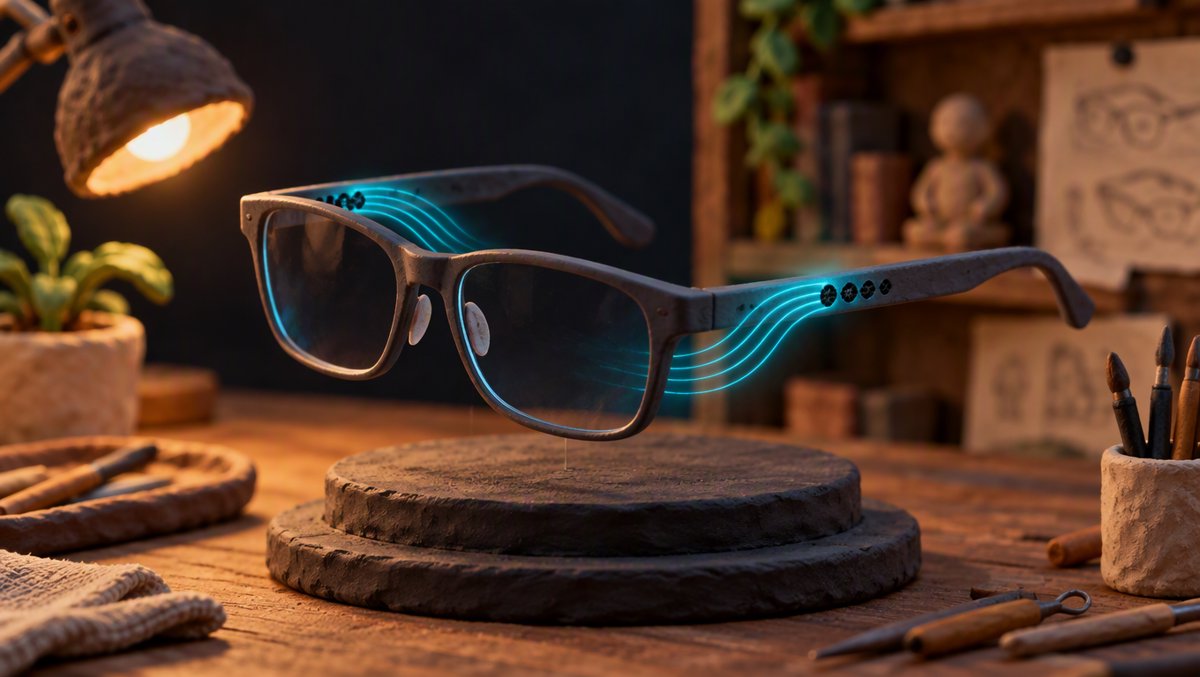
The sensor swap. Luna deletes the camera entirely — it cannot take photos or video at all. In its place sit six built-in microphones. The mic array is the product: it's what lets wearers converse with Meta AI and with Muse, Meta's new consumer AI agent. Speakers for audio playback resemble those in Meta's current models, and a side button summons Meta AI directly.
The design dividend. This is the part that's easy to underrate. Cameras need housings, and housings need thick arms — the tell that someone's glasses are "smart." Strip the camera out and the arms get smaller, closer to ordinary frames, per The Verge. Luna isn't just the privacy-friendly option; it's reportedly the best-disguised one. For a product category whose core insight is "people reject things that look like tech," that's not a compromise, it's the spec sheet.
The two frames. Meta is reportedly targeting two styles at launch: Clubmaster and Burbank. Shipping in October, in two looks, is a consumer-electronics cadence, not a developer-kit one.
The agent it's built for. Luna's six microphones only make sense because of what launched on September 8. Muse is Meta's "personal AI agent" — not a chatbot that answers questions but an agent that does work: sending email, booking travel, negotiating on your behalf, checking out with Stripe's Link (complete with one-time-use agent cards and purchase protections), and continuing tasks after you've closed the app. Under it all sits Muse Secure VM, a dedicated virtual machine where the agent lives, walled off by a second, system-level "Sentinel" agent that gates everything Muse sends to the internet, and powered by Muse Spark, which Meta calls its most capable model to date. Meta's announcement explicitly says Muse is "coming soon to AI glasses."
Read those two stories together — the September 8 agent launch and the September 15 hardware report — and Luna's thesis snaps into focus: if your AI lives in your voice, you don't need a camera to have an assistant. You need microphones, speakers, and an always-on ear.
There's one more name to watch at Connect: Phoenix, the AR glasses reportedly capable of projecting a virtual workspace or movie screen, slated for 2027. Luna is the mass-market on-ramp; Phoenix is the destination. And a note on how we got here: this isn't even Luna's first tour of duty. A camera-free Luna design was reported in 2025 and set aside; a June 2026 report then listed it among glasses Meta planned to release before year-end. The design didn't change. The climate did.
By the Numbers: The Two-Track Lineup
| Camera glasses (current) | Luna (reported) | |
|---|---|---|
| Camera | Yes — the headline feature | None; cannot capture photo or video |
| Bystander cue | Blinking capture LED (frequently circumvented) | Not applicable — nothing to indicate |
| Microphones | Present (calls, commands) | Six, as the primary interface |
| AI surface | Meta AI; Muse "coming soon" | Meta AI + Muse from day one, via six-mic array |
| Design | Thicker arms (camera housing) | Smaller arms, "closer to ordinary frames" |
| Launch | Shipping now | Reveal expected Sep 23–24; October ship target |
| Privacy flashpoint | NY courtrooms, UK pub-chain bans, Dutch ban call | New question: always-listening, indistinguishable frames |
And for Muse, the software half of the bet, the price ladder is public: free for most usage, with Power at $20/month and Maximum at $100/month — a payment card required even to start, which tells you how much Meta expects heavy users to lean on it.
One competitor note: camera-free isn't a Meta invention. Even Realities has sold its $599 G2 — camera-free, display-first, aimed at translation and teleprompting — as a deliberate counter-position. What Luna changes is scale. EssilorLuxottica's distribution plus Meta's agent stack makes camera-free a mainstream SKU rather than a niche statement.
What This Changes
1. The wearable camera stops being mandatory. Until now, "smart glasses" and "camera glasses" were synonyms, and every privacy fight landed on the whole category. Luna severs that link. If the camera-free model sells, expect every major player to carry a no-cam variant within a couple of years — the same way every phone maker now ships a "lite" of everything.
2. Agents are the new camera. The original pitch for camera glasses was first-person video. The new pitch is a hands-free agent that hears you, remembers context, and acts. Meta's own architecture admits it: Muse runs in a cloud VM with its own browser and negotiates the web on your behalf — none of which requires a lens on your face. The scarce sensor of the agentic era isn't optical. It's a microphone that's always ready and an agent you trust enough to talk to in public.
3. The privacy debate moves, it doesn't end. This is the part The Verge nailed, and it deserves the emphasis: removing the camera may not solve Meta's privacy woes at all. Luna pairs six microphones with a design explicitly meant to be indistinguishable from regular glasses — an always-listening device optimized for not being noticed. The Apple Watch's always-on audio recording already drew criticism last week. Swap "recording light" for "status indicator that tells you an AI is listening," and the European regulator conversation starts over from a different angle.
4. It's a trust product wearing a hardware costume. The real bet isn't that people want audio glasses. It's that enough people will hand Meta — of the $5 billion FTC settlement and the Cambridge Analytica files — a persistent, context-hungry AI agent, so long as it can't photograph them doing it. Muse's defenses are genuinely substantive on paper: system-level Sentinel gating, no visibility into passwords or payment details, no sharing of VM data with ad systems, a full audit trail, and a Confidential VM coming later this year where even Meta holds no key. TechCrunch's verdict stands, though: these are claims that "will require deeper investigation by security experts." Paper architecture is not trust. Trust is the product, and it's the one component Meta has never shipped cleanly.
⚠️ Limitations & Caveats
- None of the Luna details are official. Everything above traces to The Information's reporting via Silver-tier coverage. Meta has confirmed the Connect dates and teased glasses; it has not confirmed Luna, the mic count, the frame styles, or the October target. Treat all of it as a strong report, not a spec sheet. There is no price yet — don't let anyone sell you one.
- Voice-only is a real ceiling. Without a camera, Meta AI can't describe what you're looking at — no "what am I looking at," no live translation of signage, no visual context. Luna's appeal, as Technology.org puts it, rests entirely on voice, audio, and the expanding abilities of agents like Muse. If multimodal assistance is the future, Luna is a bet that voice gets you 80% of the way there.
- The always-on mic inherits the camera's problems. An unidentifiable, always-listening wearable is not privacy-neutral; it's a new front in the same war. The EU conversations that started with the recording light in 2021 will not end because the light is gone.
- Connect is next week — this column will age. Whatever Meta announces on September 23–24 (Luna, Phoenix, new Ray-Ban frames, Muse-on-glasses timing) supersedes the reporting here. That's the cost of writing about a leak seven days before the keynote. It's also why this piece sticks to what's reported, labeled as reported.
🎯 The Bottom Line
Luna is Meta admitting, in hardware, that the camera was simultaneously its best feature and its biggest liability — and that in the agent era, it can finally afford to lose the camera. If the six-microphone gamble lands in October, every camera-glasses privacy fight becomes optional, and the always-listening agent becomes the new front line. Either way, the industry's most important wearables experiment of the fall probably has no lens in it at all.
📚 Sources
- The Verge — "Meta is reportedly ready to launch less pervy smart glasses" by Dominic Preston (Sep 16, 2026). Luna codename, six microphones, Clubmaster/Burbank styles, October target, Phoenix AR, privacy backdrop. https://www.theverge.com/tech/996138/meta-luna-ray-ban-smart-glasses-camera-free-connect
- Technology.org — "Meta Reportedly Plans Camera-Free Smart Glasses" by Vytautas Valinskas (Sep 16, 2026). Side button, Luna's 2025/2026 reporting history, Irish DPC 2021, Dutch ban call, Even Realities G2, EssilorLuxottica production, footage-review story. https://www.technology.org/2026/09/16/meta-luna-camera-free-smart-glasses/
- Meta Newsroom (Gold) — "Introducing Muse: The World's First Personal AI Agent Built for Everyone" (Sep 8, 2026). Muse Secure VM, Sentinel, Muse Spark, Stripe Link, Confidential VM, "coming soon to AI glasses." https://about.fb.com/news/2026/09/introducing-muse-personal-ai-agent/
- TechCrunch — "Meta debuts its Muse AI agent. Will consumers trust it?" by Sarah Perez (Sep 8, 2026). $18B settlement context, Power/Maximum pricing, trust-history timeline. https://techcrunch.com/2026/09/08/meta-debuts-its-muse-ai-agent-will-consumers-trust-it/
- Road to VR — "Meta Connect Event Set for September 23–24 Alongside New Glasses Tease" by Ben Lang (May 12, 2026). Connect dates, Menlo Park venue, Zuckerberg's teased frames, XR-to-glasses pivot. https://roadtovr.com/meta-connect-2026-date-announcement/
- Reuters — "Meta plans camera-free smart glasses for fall launch, The Information reports" (Sep 15, 2026). Corroborating headline coverage of the original report. https://www.reuters.com/business/meta-plans-launch-camera-free-smart-glasses-fall-information-reports-2026-09-15/
All claims verified against Gold-tier (Meta's official newsroom) and Silver-tier (The Verge, TechCrunch, Road to VR, Technology.org, Reuters) sources. Each cited URL was scraped and confirmed accessible; claims originating from The Information's reporting are labeled as such throughout and are not official Meta announcements. Last verified: September 16, 2026.