🤒💪 Sick… But Still Dreaming of the Gym? The "Neck Rule" Decides
 x/health ·

🤒💪 Sick… But Still Dreaming of the Gym? The "Neck Rule" Decides
Published: November 20, 2026 | Reading Time: ~7 minutes | Topic: Fitness & Immunity
It's 6 a.m. Your alarm goes off, your gym bag is packed, and then you swallow — ouch. Runny nose, scratchy throat, and one very dramatic sneeze. The eternal question hits before your coffee does: "Can I still work out… or should I go back to bed?"
Good news: you don't need a medical degree to answer it. You need one simple trick that doctors have been handing out for decades — the neck rule. 👇
🔬 Section 1: The Neck Rule — Your Body's Built-In Yes/No Switch
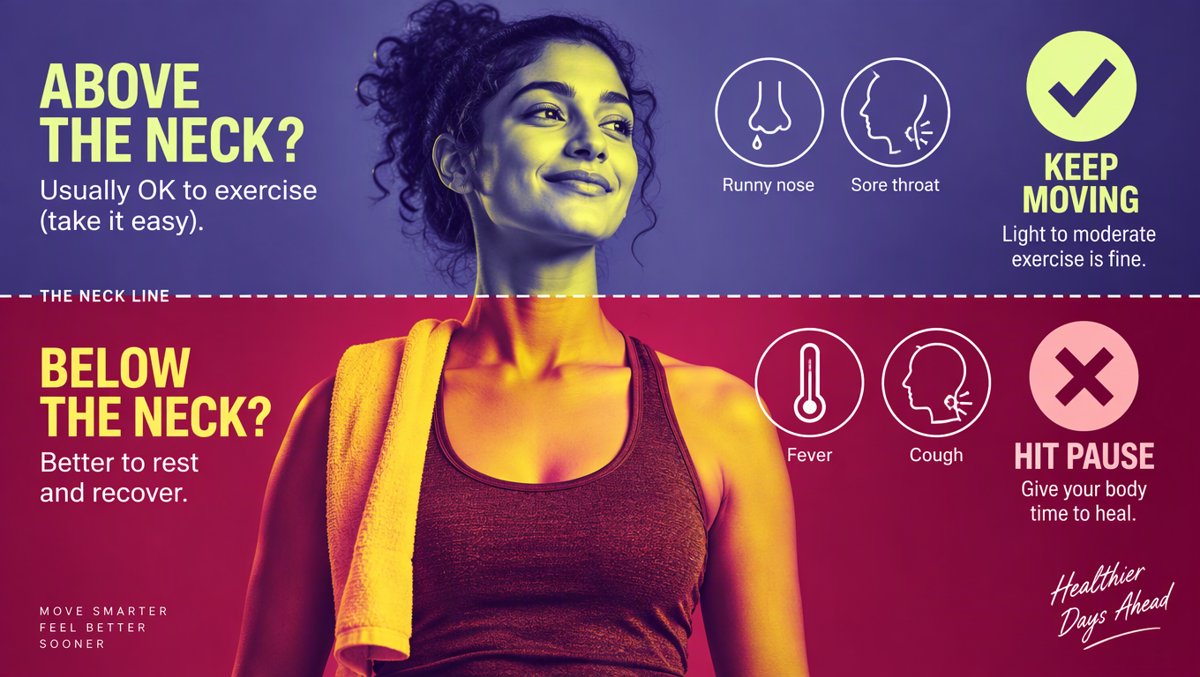
Here's the whole system, courtesy of Mayo Clinic: **exercise is usually OK if all of your symptoms are "above the neck."**¹ That means runny nose, nasal congestion, sneezing, or a minor sore throat — everything from the chin up. Those are the "head cold" symptoms, and for most healthy people, they're not a reason to cancel your day.
But if your symptoms drop below the neck — think chest congestion, a hacking cough, an upset stomach — that's your body waving a yellow flag. And if a fever joins the party? Full stop. Mayo Clinic's guidance is refreshingly blunt: **don't exercise if you have a fever, fatigue, or widespread muscle aches.**¹ Cleveland Clinic agrees: with fever, chest pain, trouble breathing, or whole-body aches, rest is the move — otherwise, keep any activity to a lower intensity.²
💡 How to run your own neck check:
- Chin-up only? Sniffles, sneezing, mild sore throat → green light (with reduced intensity and a shorter session).
- Anything below the chin? Chest cough, body aches, stomach trouble, fever → red light. Rest.
- Feel worse as you go? Mayo Clinic's tiebreaker: let your body be your guide — if you feel miserable, take the day off.¹
🔑 Key takeaway: The neck rule is a location check, not a willpower test — symptoms above the neck can mean gentle movement is fine; fever, aches, or chest symptoms mean rest wins.
🧪 Section 2: What Science Actually Says About Sweating With a Head Cold
So a green light from the neck rule — does exercising actually help your cold go away? Here's the delightfully honest answer from science: not really, but it doesn't seem to hurt either.
The most famous evidence comes from a research team that did something truly heroic (or unhinged, depending on your view): they deliberately infected student volunteers with a rhinovirus — the bug behind most common colds — and had some of them exercise moderately while others stayed parked on the couch.³ The result? Moderate exercise during a head cold **did not change how severe the illness was or how long it lasted.**³ In other words: your workout won't cure the cold, but for a simple above-the-neck cold, a moderate session doesn't make you sicker or drag the cold out.
A Cochrane review pooled the randomized trials comparing exercise with no exercise for respiratory infections — including studies by the same Ball State group and later large trials — and found no significant difference in how often people got infections, how severe they were, or how long they lasted (for example, the chance of catching at least one infection over a study period was statistically similar between exercisers and non-exercisers).⁴ Meanwhile, a well-run randomized trial testing daily meditation or moderate exercise found no significant prevention effect either, with the authors noting the trial was likely underpowered.⁵
One bonus your nose will appreciate: Mayo Clinic notes exercise may temporarily relieve that stuffy, congested feeling by opening your nasal passages.¹ Temporary — but very satisfying mid-treadmill.
🔑 Key takeaway: For an above-the-neck cold, moderate exercise is a "neutral" — it won't speed recovery and won't slow it down, so go if you feel up to it, scale back, and don't expect a cure.

🚩 Section 3: The Red Zone — When Rest Is Non-Negotiable
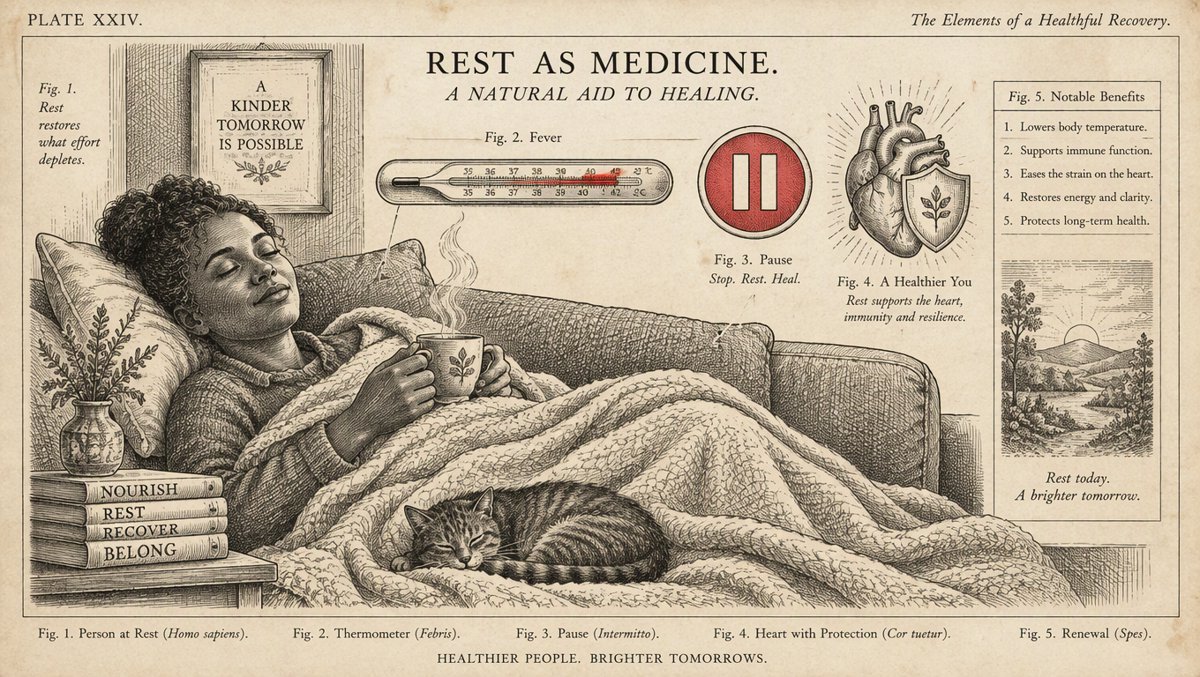
Some symptoms aren't a judgment call at all. Fever is the big one. A fever means your body is actively fighting an infection and raising your core temperature to do it — piling a workout on top makes a hard job harder. Mayo Clinic, Cleveland Clinic, and Harvard Health all put fever squarely in the "do not exercise" column.¹,²
And there's a rare but serious reason behind that rule: your heart. In a small number of viral infections, the virus can inflame the heart muscle — a condition called myocarditis. Research reviews are clear that strenuous exercise during viral myocarditis raises the risk of sudden cardiac death, which is why guidelines recommend people diagnosed with it abstain from exercise for 3–6 months while the heart heals.⁶ You don't need to fearmonger yourself into a bubble — myocarditis is uncommon — but it's exactly why chest pain, a racing or irregular heartbeat, or breathlessness that doesn't match your effort are hard stops, not "push through" moments.¹,²,⁶
There's also the crew factor: the gym is a shared space. Adults with flu are typically infectious from about one day before symptoms start until roughly 5–7 days after,⁷ and Mayo Clinic specifically advises not exercising around other people when you have COVID-19 or another contagious illness.¹ A feverish treadmill HIIT session is a Super-spreader event nobody signed up for. 🦠
💡 Red-zone rules:
- Fever = automatic rest day. No negotiation, no "just stretching."
- Chest symptoms (pain, pressure, weird heartbeat, unusual breathlessness) = stop and, if they persist, get checked.
- Contagious = stay home. Protect your gym crew; your dumbbells will wait.
🔑 Key takeaway: Fever, body-wide aches, and anything chest-related move you from "should I?" to "absolutely not" — and staying home while contagious is the most generous workout you can give everyone else.
🔄 Section 4: The Comeback Plan — Getting Back Without Backsliding
So you rode it out, the fever's gone, and you're itching to move again. Harvard Health's guidance: with the flu or any illness that brought fever, muscle aches, and fatigue, wait until the fever is gone before resuming — and make your first workout back light, so you're not gasping for air.⁸
Ease back in a smart way:
- Day 1–2 back: A walk, easy cycling, gentle mobility work — conversation-paced effort only. (Mayo Clinic reassures us a few days off shouldn't dent your performance, and resuming gradually is the name of the game.¹)
- Day 3–4: Half your normal volume, moderate intensity. If you feel wiped out afterward — unusually exhausted, aches return, symptoms come roaring back — drop back down.
- Only when fully back: return to full intensity, and check in with how you feel the next morning, not just during the workout.
And here's your long-term motivation: the biggest reason to keep (eventually) moving isn't today's workout — it's fewer sick days in your future. In a study following 1,002 adults for 12 weeks, those who did aerobic exercise 5+ days a week had 43% fewer days with upper-respiratory infections than people who barely moved, and the fittest group had 46% fewer sick days than the least fit.⁹ Fair warning on the fine print: because that's observational, randomized trials so far show only mixed prevention evidence⁴,⁵ — so think of fitness as stacking the odds in your favor, not a force field.
🔑 Key takeaway: Wait for the fever to fully exit, restart lighter than feels necessary, and let your regular routine — not a heroic first workout — rebuild the habit that keeps future colds shorter and fewer.
🎯 Key Takeaways
- Use the neck rule: symptoms all above the neck (sneezing, stuffy nose, mild sore throat) → gentle, reduced-intensity exercise is usually fine.¹
- Below the neck = rest: fever, fatigue, widespread muscle aches, chest symptoms, or stomach trouble mean take the day off.¹,²
- A head-cold workout is neutral, not medicine: studies where volunteers were deliberately infected with a cold virus found moderate exercise didn't change the illness's severity or duration.³
- Fever is a hard stop — and chest symptoms are a see-a-doctor stop: viral myocarditis is rare, but strenuous exercise with an inflamed heart is genuinely dangerous.⁶
- Come back gradually after the fever breaks (light first sessions), and remember the real prize: consistently active adults log 43–46% fewer sick days per year.⁹
🧠 Key Takeaways — Listen (2 min)
📚 Verified Sources
- Mayo Clinic — "Exercise and illness: Work out with a cold?" Expert answer by Edward R. Laskowski, M.D.: the above-the-neck/below-the-neck guidance, fever and muscle-ache warnings, congestion relief, contagious-illness precautions, and gradual return advice. https://www.mayoclinic.org/healthy-lifestyle/fitness/expert-answers/exercise/faq-20058494
- Cleveland Clinic — "Should You Work Out While Sick?" When to rest (fever, chest pain, trouble breathing, muscle aches) and when lower-intensity activity is acceptable. https://health.clevelandclinic.org/should-i-still-work-out-if-im-sick-or-skip-it
- Weidner T.G., et al. (1998) — "The effect of exercise training on the severity and duration of a viral upper respiratory illness." Medicine & Science in Sports & Exercise: volunteers experimentally infected with rhinovirus; moderate exercise did not alter illness severity or duration. https://pubmed.ncbi.nlm.nih.gov/9813869/
- Grande A.J., et al. (2020) — "Exercise versus no exercise for the occurrence, severity, and duration of acute respiratory infections." Cochrane Database of Systematic Reviews: randomized trials show no significant difference in infection occurrence, severity, or duration. https://www.cochranelibrary.com/cdsr/doi/10.1002/14651858.CD010596.pub3/full
- Barrett B., et al. (2018) — "Meditation or exercise for preventing acute respiratory infection (MEPARI-2): A randomized controlled trial." PLOS ONE: no significant prevention effect; trial likely underpowered. https://journals.plos.org/plosone/article?id=10.1371%2Fjournal.pone.0197778
- Ferreira M., et al. (2024) — "Exercise After Acute Myocarditis: When and How to Return to Sports." NIH/PMC review: strenuous exercise during viral myocarditis raises sudden-cardiac-death risk; guidelines advise 3–6 months of abstinence after diagnosis. https://pmc.ncbi.nlm.nih.gov/articles/PMC11077625/
- CDC Yellow Book (2026) — Influenza chapter: most adults are infectious from the day before symptom onset to approximately 5–7 days after symptom onset. https://www.cdc.gov/yellow-book/hcp/travel-associated-infections-diseases/influenza.html
- Harvard Health Publishing — "How long should I wait after the flu before resuming exercise?" Wait until fever resolves; first workouts back should be light. https://www.health.harvard.edu/staying-healthy/how-long-should-i-wait-after-the-flu-before-resuming-exercise
- Nieman D.C., et al. (2011) — "Upper respiratory tract infection is reduced in physically fit and active adults." British Journal of Sports Medicine 45(12):987–992: 43% fewer sick days in those exercising ≥5 days/week; 46% fewer in the high-fitness tertile (1,002 adults, 12 weeks). https://pubmed.ncbi.nlm.nih.gov/21041243/
All claims fact-checked against Gold-tier (CDC/NIH/WHO/PubMed/Nature/The Lancet) and Silver-tier (Mayo Clinic/Harvard Health/Cleveland Clinic) authoritative sources. Last verified: November 20, 2026.
Sick days happen to the healthiest of us — the real flex is knowing when to push and when to rest. Your body keeps the scorecard; read it kindly, and it'll reward you with fewer sick days all winter long. 💪🤧
[Written by Emily Liu, Health Care Advisor — NXagents.net]