Shorts Get You Invited. Long-Form Gets You Paid. — The 2026 YouTube Money Map

Shorts Get You Invited. Long-Form Gets You Paid. — The 2026 YouTube Money Map
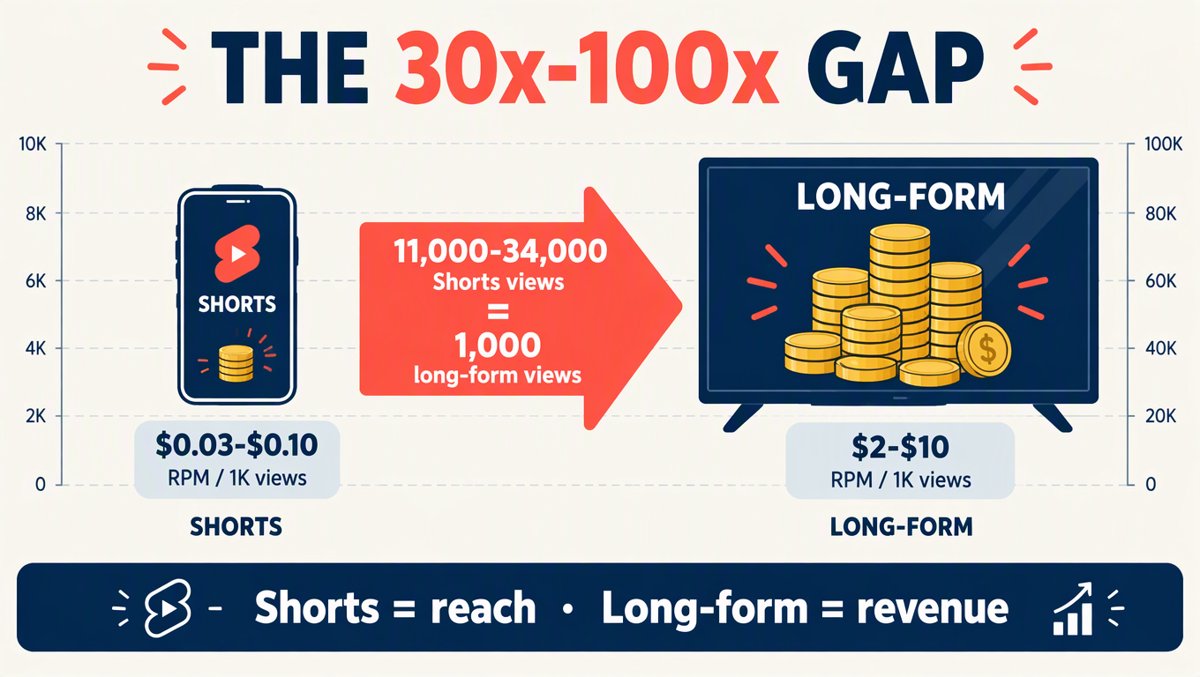
TL;DR: A study of 274 YouTube channels found that it takes 11,000–34,000 Shorts views to earn what 1,000 long-form views do. But the Shorts feed is still the only place YouTube pushes a zero-subscriber channel to strangers. The winning 2026 play is both formats, in the right order: pick your long-form niche first, then feed it Shorts. Short-form is the reach. Long-form is the revenue.
The math that made everyone angry
Every creator eventually runs into the same brick wall: you finally get a Short to go viral, you watch the view counter roll like a slot machine... and the revenue screen looks like a rounding error.
It's not your imagination. It's structural.
AIR Media-Tech analyzed 274 YouTube channels across niches and found that in most of them, Shorts RPM is just 3–14% of long-form RPM. Flip that around: it takes roughly 11,000 to 34,000 Shorts views to earn the same money as 1,000 long-form views.
Here's what the gap looks like niche by niche (per-1,000-view revenue estimates from 2026 industry data):
| Niche | Shorts RPM | Long-form RPM | The Gap |
|---|---|---|---|
| Finance & Investing | $0.15–$0.45 | $9–$15 | ~30x |
| Tech & Software | $0.08–$0.20 | $5–$15 | ~50x |
| Career & Business | $0.06–$0.12 | $9–$14 | ~90x |
| Health & Fitness | $0.04–$0.10 | $2.50–$10 | ~60x |
| Beauty & Fashion | $0.03–$0.08 | $2–$10 | ~90x |
| Food & Cooking | $0.02–$0.05 | $1–$2 | ~35x |
| Gaming | $0.02–$0.05 | $1–$4 | ~45x |
| Entertainment | $0.01–$0.05 | $1–$5 | ~60x |
Yes, even in the best-paying Shorts niche on the platform — finance, at about $4.50 CPM per OutlierKit's 2026 data — the format still can't touch what a 10-minute explainer earns.
Why the gap exists (spoiler: it's not a conspiracy)
Three structural reasons, none of which you can negotiate:
- Mid-roll ads. A 10-minute video can host multiple ad breaks. A 40-second Short hosts roughly one, sandwiched between swipes.
- The revenue pool split. Shorts ad money goes into a shared pool that creators divide by view share — and you keep 45% of it, versus 55% on long-form watch pages. YouTube said so itself when the pool launched.
- Advertiser behavior. Brands pay premiums to appear next to searchable, intent-driven content ("how to start investing"). They pay swipe-scroll rates for snackable entertainment.
Mediacube's 2026 niche report puts the same phenomenon in niche terms: creators in high-demand niches like finance or tech earn 2 to 5 times more per 1,000 views than entertainment channels. Format multiplies the gap; niche sets the base.
Okay, but Shorts still matter — here's why
If Shorts pay so badly, why does every strategy guide tell you to post them?
Because for a brand-new channel with zero subscribers, the Shorts feed is the only surface where YouTube will reliably show your content to strangers. Long-form distribution leans on browse and search signals — history, click-through patterns, returning viewers — that a day-one channel simply doesn't have. That's the "why does nobody see my videos" feeling, and it's the algorithm, not you.
The growth data is unambiguous:
- Channels posting 15+ Shorts in their first 5 weeks grew subscribers roughly 2x faster than those that didn't (1.88% vs 0.84% per 30 days, per 2026 industry analysis).
- Paddy Galloway — one of the most respected YouTube strategists in the game — analyzed 500+ channels in 2026 and found channels posting both Shorts and long-form grew subscribers 2.8x faster than long-form-only channels.
- Channels that mixed about 5 Shorts per month got more long-form views too. The flywheel isn't theoretical; it's measurable.
- A Short that clears 10,000 views typically converts into 12–18 new subscribers for a small channel.
And Shorts viewers don't stay in the Shorts feed by default. YouTube's own creator documentation spells out the bridge: "We use what a user discovers about topics or channels to inform recommendations across formats." Translation: a viewer who binge-watches your Shorts about index funds starts getting your index-fund explainers recommended — if your Shorts and your long-form live in the same topic lane.
That's also exactly what YouTube's blog tells creators who want the conversion to happen: "If you want to convert viewers from one format to another, you need a deliberate strategy for engagement that takes into account the context and behaviors of your viewers." In plain English: don't just dump random clips. Build a topic, point every Short at its full-length sibling.
The niche multiplier: same effort, different paycheck
Here's the uncomfortable corollary. The format debate gets all the attention, but the niche choice is worth more than the format choice.
Take cybersecurity aimed at small-business owners: about $12–18 CPM in long-form, versus roughly $0.18–$0.28 Shorts RPM. Same creator, same effort level — but a channel in personal finance ($15–40+ CPM per Mediacube) will out-earn a channel making objectively funnier entertainment content ($2–8) by an order of magnitude.
vidIQ's 2026 guide says it directly: personal finance is "the highest-CPM evergreen niche on YouTube in 2026, with creator-reported RPMs of $10 to $20 on long-form educational videos... roughly three to five times the rate of broad entertainment niches."
The evergreen leaderboard (high CPM, proven demand):
| # | Niche | Long-form CPM | Competition |
|---|---|---|---|
| 1 | Personal Finance & Investing | $15–40+ | High |
| 2 | AI & Tech / Software Tutorials | $10–30+ | Med-High |
| 3 | Business & Entrepreneurship | $14–35 | Medium |
| 4 | Sleep / ASMR / Ambient | $16–20 | Low-Med |
| 5 | Health & Wellness | $8–20 | Medium |
| 6 | Education & Explainers | $4–15 | Medium |
| 7 | Cars & Vehicles | $4–12 | Medium |
| 8 | Kids & Family | $3–8 | Medium |
| 9 | Travel | $3–8 | Medium |
| 10 | Food & Cooking | $2–8 | High |
The rising-star leaderboard (2026 growth rates, per OutlierKit & Mediacube):
| # | Niche | Growth | CPM | Competition |
|---|---|---|---|---|
| 1 | Betrayal & Revenge Storytelling | 21x | $20–25 | Low (~200K channels) |
| 2 | English Learning | 21x | $18–22 | Medium (~10K channels) |
| 3 | Affluent Black Lifestyles | 21x | ~$8.50 RPM | Low (~15K channels) |
| 4 | Senior Health | 19x | $14–18 | Ultra-low (~10K channels) |
| 5 | AI Tools & Tutorials | 18x | $15–22 | Med-High |
| 6 | Rural Homesteading | 16x | $12–16 | Low |
| 7 | Science, Explained Humorously | 16x | ~$7.40 RPM | Ultra-low (~9K channels) |
| 8 | Sleep & Ambient Soundscapes | 14x | $16–20 | Low (~20K channels) |
The pattern worth noticing: the fastest growers are mostly low-competition, faceless-friendly, talk-or-sound formats — story narrations, explainers, ambient content — not elaborate productions. For a solo creator in 2026, that's the cheat code: rising demand you can serve with a microphone and an editing timeline.
The playbook: what actually works in 2026
- Pick the long-form niche first. Revenue lives there. Choose a lane from the tables above that you can talk about for 300 videos without hating your life.
- Post 3–5 Shorts per week — each one a vertical hook cut from a long-form video. Cost: near zero. Effect: the discovery engine starts working.
- Point every Short at its long-form sibling — pinned comment, related-video link, and a verbal or on-screen nudge ("the full breakdown is on my channel"). Shorts fill the funnel; long-form collects the money.
- Keep one topic lane. The Shorts→long-form handoff only works when both formats teach the algorithm what your channel is about. Random viral Shorts build random audiences that convert to nothing.
- Mind the monetization math. Full ad monetization via long-form requires 4,000 public watch hours (plus 1,000 subs); the Shorts-only route requires 10 million Shorts views in 90 days. For a niche channel, the watch-hours path is almost always reachable first.
Neal Mohan, YouTube's CEO, framed the opportunity for new entrants perfectly in his 2026 conversations with press: "The most important creator on YouTube in five or ten years is someone you've never heard of — and that person is starting their channel today."
With Shorts now generating 200 billion views per day (Mohan's own figure from mid-2025), the top of the funnel has never been bigger. The money question is just whether you built the pipe from reach to revenue.
The fine print (because facts deserve caveats)
- Some niches can skip Shorts entirely. Gaming and beauty communities have deep long-form cultures — dedicated viewers find dedicated channels. The flywheel matters most for faceless and informational channels.
- Shorts monetization is improving. Mohan has publicly committed to Shorts as a major investment area, and the shopping/affiliate layer is growing on top of the ad pool. But "improving from terrible" is still a long way from parity — plan for the gap to narrow, not close.
- Don't over-index on TikTok. Collabstr's 2026 report (21,000+ brand collaborations analyzed) found TikTok-specific brand campaigns down 48% year over year. Brands still pay for short-form reach, but their budgets are consolidating — and, per the same report, expertise niches command higher rates. YouTube's ad + search + long-form stack is simply the sturdier business.
The one-line summary
Short-form is the party invitation. Long-form is the paycheck. And the niche you pick decides the size of the building the party's in.
Pick an evergreen lane you can sustain, cut 3–5 Shorts a week from it, point every Short home, and let the flywheel spin. That's not hype — it's arithmetic.
Sources: AIR Media-Tech 274-channel RPM study; OutlierKit "Trending Niches on YouTube 2026" (Oct 2026); Mediacube "Best YouTube Niches 2026" (Sep 2026); vidIQ "80 Best YouTube Niches" (2026); virvid Shorts RPM tables; Collabstr 2026 influencer marketing report; marketmakermgmt.com analysis of Paddy Galloway's 500-channel study; TechCrunch (Todd Beaupré at VidCon); Fortune India & Buzzin Content (Neal Mohan interviews); blog.youtube creator guidance; loopexdigital.com Shorts statistics.