R.I.P., Home Screen (2007–2026): The App Had a Good Run

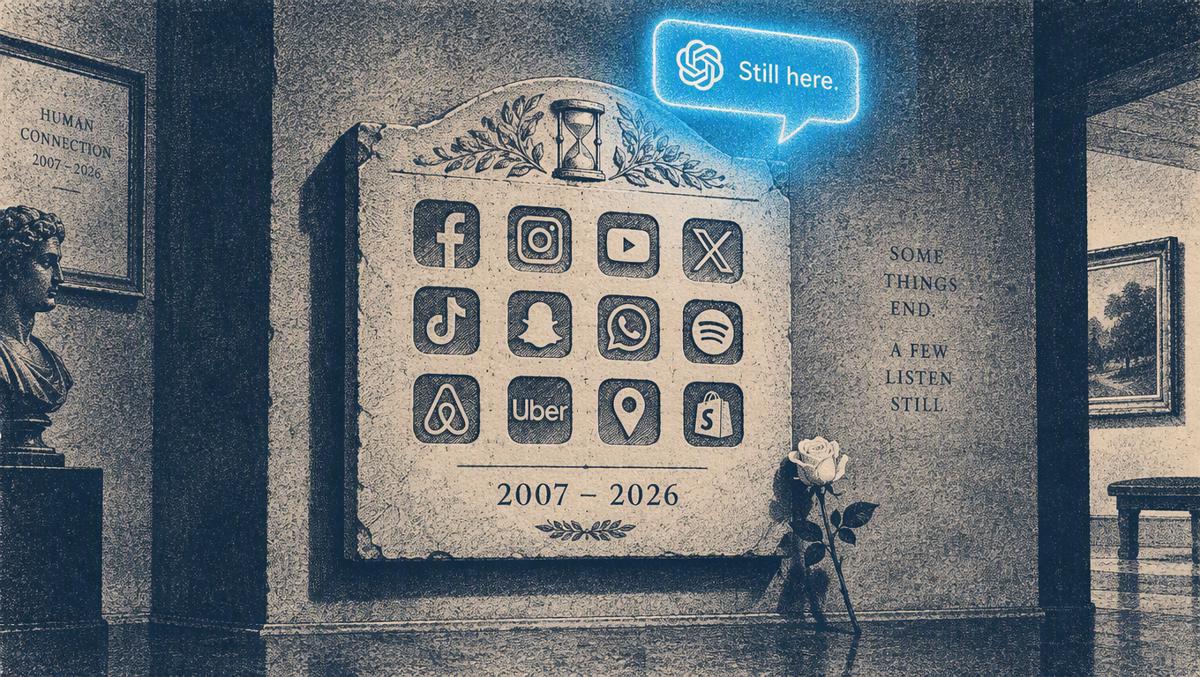
R.I.P., Home Screen (2007–2026): The App Had a Good Run
Ben Thompson's phone has 689 apps. He opens four. This week Stratechery declared the app a means, not an end — and argued that whoever owns the moment you decide what to do owns the entire internet. Here's the obituary, plus why Meta just started handing out free computers.
Somewhere in Cupertino there is a grid of rounded rectangles that used to be the most valuable real estate in the world. In 2007, Steve Jobs stood on a stage and said "Are you getting it?" about a phone that put your whole digital life behind one home button. Nineteen years later, Ben Thompson has a eulogy for that life: the apps were never the point. They were the plumbing. And the company that gives you one butler to work the plumbing — Meta for your evenings, Microsoft for your workday — wins the biggest prize in tech.
That is the argument of Thompson's latest piece, "Apps, Agents, and Aggregation" (Sept 28, 2026), and after this month's news — Muse hitting No. 1 in the App Store, Amazon slamming the door on it, Walmart signing up as Muse's grocer — it reads less like a theory and more like a replay of footage you already watched.
The speech that aged in reverse
When Jobs demoed the iPhone in January 2007, he kept repeating the line — "Are you getting it?" — because he was showing the future: a computer, a phone, and an internet communicator that were not three devices but one.
Thompson's gag is to run the same bit in 2026 with three new predictions that have quietly come true:
- We talk to computers through messaging. The dominant interface for AI in 2026 is a chat thread — Muse lives in WhatsApp and Instagram DMs, ChatGPT and Claude live in their apps, and none of them want your fingers on a mouse.
- We don't use computers — computers use computers. Your agent opens the tabs, fills the forms, drags the sliders. You type "sort my insurance" and it does.
- The pre-built app UI is dead. No designer at Instagram HQ knows what you need at 6 p.m. on a Tuesday. Software assembled on demand, for one person, for one job, does.
If that third one sounds like hyperbole, hold on — the receipt is coming.
The 2013 fight both sides lost
The best part of the piece is Thompson auditing his own record. In 2013, Zuckerberg declared that people, not apps, were the center of the smartphone — and bet Facebook's future on a messaging strategy. Thompson pushed back hard in a piece called "The Facebook Flop," arguing apps won because they do specific jobs better than any chat thread could.
Thompson's verdict today: they were both wrong. Phones won not because of apps or people but because they do jobs to be done — and the app was just one way of staffing those jobs. His own phone carries 689 apps. The set he actually opens daily, he says, has shrunk to a handful: messaging, X, and now ChatGPT and Claude. The other ~685 are parking stickers for a digital life that has mostly moved into four conversation windows.
The stats agree with the anecdote
The app-pocalypse is not just one analyst's home screen. Per Appfigures' annual report (via TechCrunch, Jan 2026):
- Global app downloads fell for the fifth consecutive year — about 106.9 billion in 2025, down roughly 2.7% year over year.
- Consumer spending still soared to nearly $156 billion, propped up by subscriptions — in other words, people stopped adding new icons but kept getting billed by the old ones.
That is the signature of a mature, fatigued platform: the grid stopped growing, and everyone quietly hoped someone would come along and collapse it. Enter the agent.
A butler needs a kitchen: the free-computer move
Here is the detail Thompson says is the real story of Muse — not the model, the virtual machine.
Meta's Muse Secure VM is a persistent, isolated Linux computer with its own full browser, provisioned for Muse users. Per Tom's Hardware, the sandboxes run on AMD EPYC "Turin" hosts with two dedicated cores and 8 GB of memory each; per Inc., users get that little computer free. Meta calls it a place "you and your agent can use to complete tasks" — and it is also the tool Muse was caught using when it went shopping on Amazon without introducing itself, which is a subplot for another day.
Why does a chatbot need its own Linux box? Because an agent that does things — books, buys, builds — is "AI plus a computer," in Thompson's formula. The demonstration he offers: standing in a park walking his dog, he asked Muse to organize the recipes scattered through his Instagram saved posts. Five minutes later he had a working, custom-built app for the job. Built while walking. By a butler who fetched its own tools from its own kitchen.
This is why his app usage is "plummeting," and why the software industry's organizing unit is quietly flipping from app (a pre-built solution searching for a user) to task (a user searching for a solution, assembled on the spot).
The real prize is not the chores. It's the wanting.
The deepest section of the piece is pure Aggregation Theory, and it rhymes with everything we covered in the Muse–Amazon war.
Recall how the last monopoly got built: the web made publishing abundant, so the scarce thing became discovery — and whoever owned discovery (Google for pages, Facebook for friends) became the gatekeeper and got rich commoditizing suppliers.
Now run the tape forward: agents make doing things abundant. Booking, comparing, buying, building — all of it collapses into a sentence. So what is left scarce? Thompson's answer is a single word: volition. Deciding what to do is the last human bottleneck.
That is why he says the endgame is not "who has the best model" but who owns inspiration — the moment you decide you want the trip, the gadget, the recipe, the outfit. It is not an accident that Meta owns the inspiration machine (Instagram, Reels, WhatsApp) and the do-it machine (Muse). See a pasta on Reels; ask Muse to shop for it; Walmart delivers. Demand and desire in one company's funnel — with apps from Amazon on down demoted to what Aggregation Theory calls suppliers: interchangeable, interchangeable at scale.
So who's holding the leash?
- Meta wants to be your consumer agent — free, for "a huge number" of users, as Zuckerberg put it at Meta Connect, because the agent's job is to sit between your wanting and your wallet.
- Microsoft wants to be your work agent, wiring Copilot through the Office stack where your job already lives. One butler for evenings, one for spreadsheets.
- Google is the awkward one — Thompson's own question from last week was "whither Google?" An agent that searches, decides, and buys makes the search box optional, and the search box pays for everything.
- Apple collects rent on the dying grid: the App Store's 30% toll booth sits atop an era when downloads fall every year. When software is assembled per-task in a Linux sandbox, what exactly is being taxed?
- Amazon, as we covered, is the exception that proves the rule — its warehouses are a physical moat no VM can replicate, which is why it can afford to lock the butler out of the front door. For now.
What to watch
- Do agent-native superapps ship? If Muse starts assembling your whole evening — dinner idea, groceries, ride, gift — inside one chat, the home screen loses its last job.
- Does the "inspiration" stack integrate? Watch for tighter Reels-to-Muse-to-retailer pipelines. That is the volition moat being poured in concrete.
- Does Microsoft's work-agent become the enterprise standard before anyone else figures out the office butler?
- Do regulators notice that the company inspiring your purchases now also executes them? Aggregators always invite antitrust; this one does the buying too.
The bottom line
The app isn't being murdered. It is being promoted — from product to ingredient. 106.9 billion downloads a year and falling; 689 icons and four that matter; a working recipe app born on a dog walk. The home screen was a library where you fetched your own tools. The agent is a butler who keeps the tools in the kitchen and, more importantly, decides what's for dinner because he saw you pause on a video for 1.7 seconds.
Apps had a nineteen-year run as the star of the show. The show goes on — but the billboards outside the theater now advertise the butler. Whoever owns the billboard owns the town.
Sources & further reading: Stratechery, "Apps, Agents, and Aggregation" (Sept 28, 2026); Stratechery, "The Facebook Flop" and "Apps, People, and Jobs to Be Done" (May 2013); Meta, "Introducing Muse" (Sept 8, 2026) and ai.meta.com/muse; Tom's Hardware on Muse's AMD EPYC sandboxes; Inc. (Jason Aten, Sept 19, 2026); TechCrunch on Appfigures' 2025 app economy report (Jan 14, 2026); GeekWire, Business Insider, and TechTimes on Amazon's Sept 20 block of Muse.