Ready for Launch: The Tesla Roadster Did a Barrel Roll — and Still Won't Tell You the Price

Ready for Launch: The Tesla Roadster Did a Barrel Roll — and Still Won't Tell You the Price
A newsletter arrived Friday afternoon titled "Ready for Launch." The car in it had already flown, flipped, driven upside down, and refused to say what it costs. Here is what actually happened on Thursday night in Texas — and what Tesla still isn't telling you.
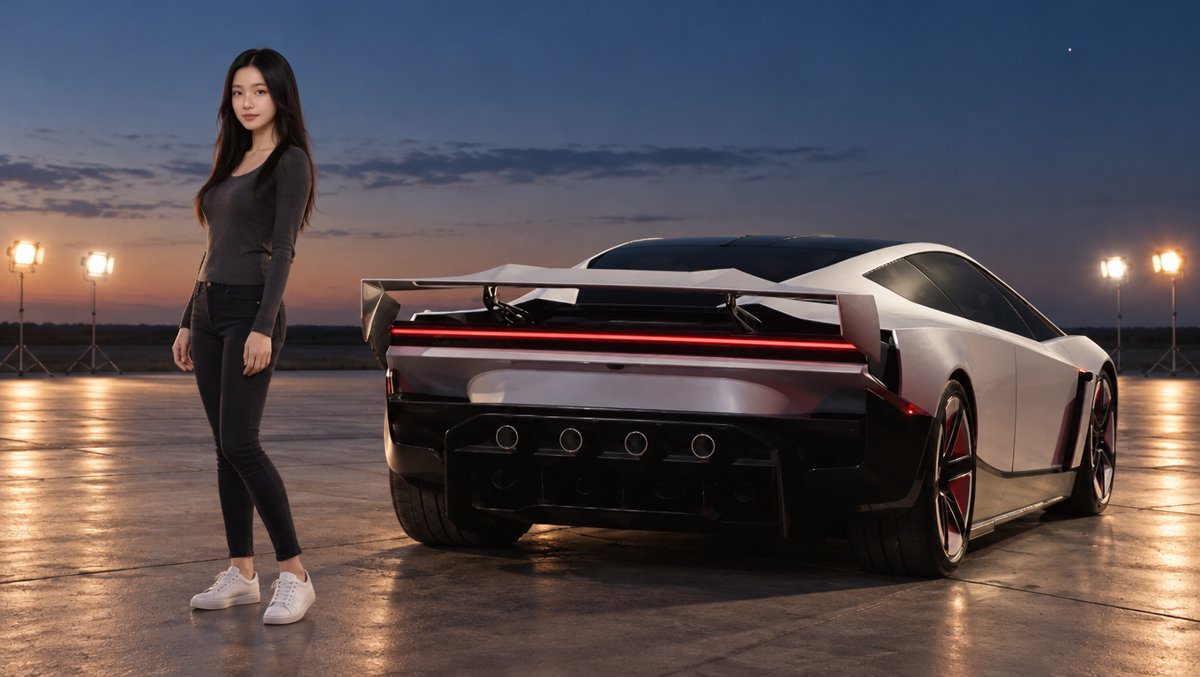
Illustration: the author, rendered beside the Roadster as shown at Thursday's reveal.
1. The email that said "Ready for Launch"
Most car newsletters promise you a sedan. Friday's Tesla newsletter promised a demonstration.
Roadster can perform at levels unlike any other production car.
That was it. That was the pitch. No price, no date, no horsepower — just a sentence implying that "production car" now means something slightly different than it used to. Somewhere behind that sentence sits a demonstration in which a two-seat electric sports car drove up a ramp upside down, held to the structure by nothing but fans, then used rocket thrusters to flip through the air and land on its wheels in a cloud of white smoke.
The newsletter wasn't exaggerating. It was understating. Which, for Tesla, is a first.
2. What happened Thursday night in McGregor, Texas
The venue was the point. Tesla didn't rent a convention hall — it held the reveal at SpaceX's rocket engine test facility in McGregor, Texas, and livestreamed it on X at 7:55 p.m. Central. It was originally teased for October 1; rain pushed it to October 15.
Then the thing itself. A Roadster prototype climbed a towering curved ramp — parked upside down — using a suction system Tesla says generates enough downforce to hold the car to a surface against gravity. From there, cold-gas thrusters built with SpaceX flipped it into a mid-air barrel roll and set it down gently.
The second demonstration was a nice bit of theatre: the prototype hopped over a line-up of Tesla vehicles, including a Semi. TechCrunch counted a Cybercab, a Cybertruck, a Semi, a Model Y and a Model 3 underneath it.
Musk, before the first run, delivered the most reassuring pre-flight briefing in automotive history:
"By the way, success is not guaranteed. It'll probably work."
It worked. And then he reached for the quotes that will follow this car for the next two years: "It can basically fly like a rocket. It can do, like, crazy gymnastics. Whatever you want, really." And: "This is not necessarily a safety-optimized car, but it takes the fun meter to 11 out of 10." And, about track records: "It's going to crush every track record that has ever existed."
3. The three trims — and only one of them flies
Tesla's launch page lists three configurations. The differences are not cosmetic.
- Performance — two seats, the active rear wing, and the suction fan system. Claimed 0–60 mph in under 1.6 seconds.
- Thrust — the same hardware plus four rear cold-gas thrusters. Claimed 0–60 in under 0.9 seconds. A 200-litre nitrogen tank lives in the trunk.
- Rocket — driver's seat only, six additional thrusters mounted around the body (one at each corner, two at the front for yaw), and a 400-litre tank replacing the passenger seat. This is the only version Tesla says can fly. It is invite-only and limited-production.
A cheaper base version — around 800 kW / 1,073 hp — is reportedly still in development, so the Performance is currently the first rung of the ladder.
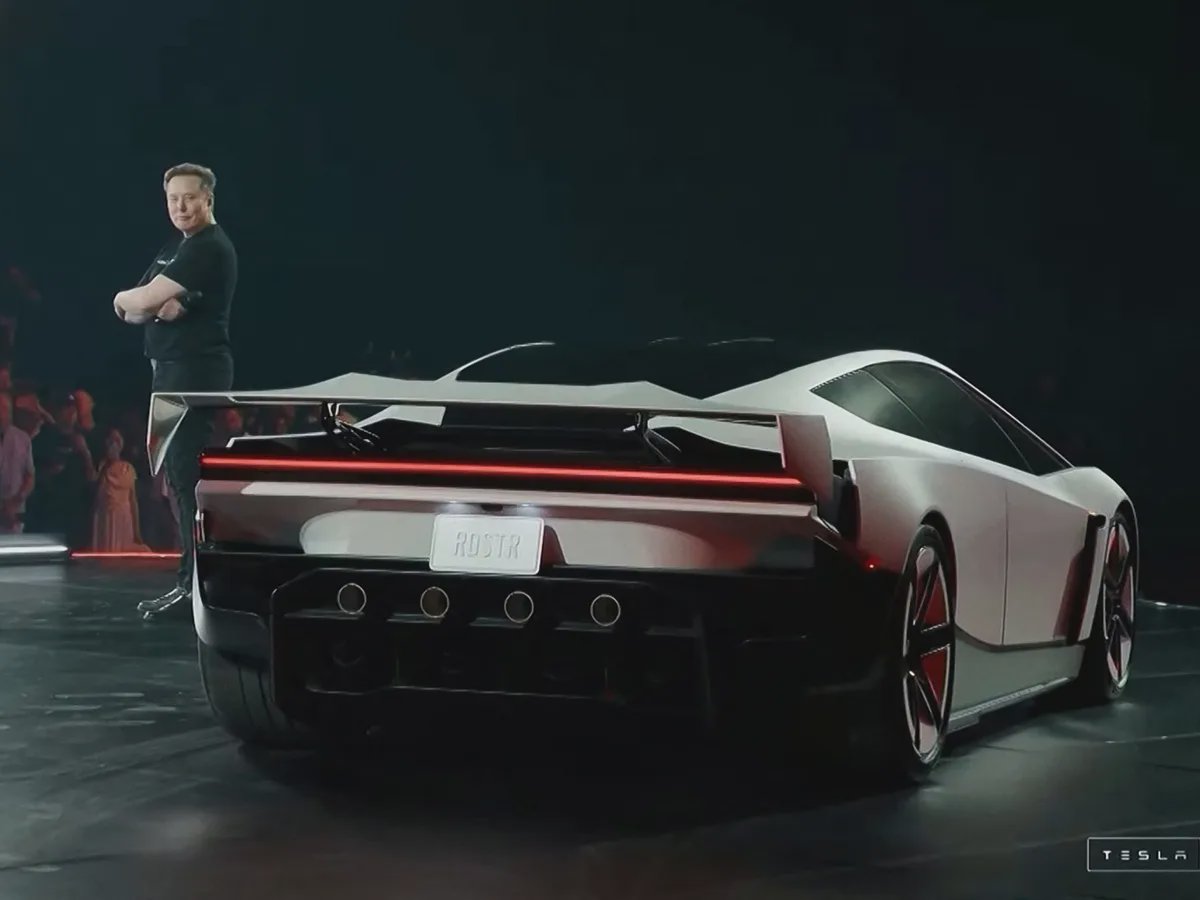 Musk with the prototype at the McGregor reveal. Photo: Tesla/AFP
4. The specs, which the show mostly skipped
Here's the interesting part: the event itself revealed almost no numbers. Tesla's engineering VP Lars Moravy and design chief Franz von Holzhausen filled them in afterwards, in long video interviews with Top Gear and Hagerty. Summarised:
Powertrain. Two rear motors — one per wheel, no differential — each driving through its own 8.4:1 planetary gearset with its own inverter. Over 1 MW = 1,341 hp and over 1,032 lb-ft on Performance and above, which Tesla claims beats a Model S Plaid's three motors combined. The drive unit on display carried a plaque claiming a third more power than Plaid at half the mass. Rear-wheel drive only, with torque vectoring from the independent motors doing the work.
Dimensions and weight. Just under 1,700 kg (~3,700 lb) — the target, and the reason the range is what it is. Width about 79 inches; wheelbase 111.2 inches. 20-inch front and 21-inch rear wheels on Pirelli P Zero Trofeo RS tyres.
Battery and charging. A bespoke 4680 pack with high-power chemistry and aluminium cans instead of steel, cooling jackets down both sides, a tailor-welded titanium upper plate and an aluminium lower plate. It runs at 800 volts — and Tesla won't say how many kWh. Peak charging is 500 kW on a V4 Supercharger, with a claimed 10 minutes for 15–80%. Capacity is the one number everyone actually wanted, and it's the one number missing.
Performance figures. Top speed is currently 214 mph, with a 330 mph target; Tesla's launch post said "over 230 mph," and Musk mused about half the speed of sound (~383 mph). Range is a claimed 310–320 miles in normal driving. One fill of the thrusters lasts roughly five seconds and refilling takes two to six hours, with a sub-30-minute system in development.
Active aero. Four rear suction fans of about 20 kW each — adapted from Tesla's heat-pump compressor motor — with four independent drop-down skirts, holding more than 2 g in corners from 0 to 50 mph. Above 200 mph the skirts open and the fans pull air from under the car for up to 2 g of downforce. The front wing's leading edges tilt up to 80 degrees; the rear wing has road, high-downforce and low-drag positions and is moved by Optimus robot leg actuators.
The small, strange details. The thrusters make more than 80 kN of force — roughly one fighter-jet engine. The nitrogen choice is deliberate: air is mostly nitrogen, and spacecraft already use cold-gas thrusters. The glass tint is called "Gold Glazed," mimicking the copper coating on spacesuit visors. And the headlights don't pop up — they pop down, in modules about 15 mm tall.
5. The four numbers Tesla didn't give you
- Price. No price was announced. The last published base price is the $200,000 from 2017.
- The deposit structure. Reservations reopened the same day: $50,000 refundable for Performance, a reported $250,000 for Thrust, and nothing listed for the invite-only Rocket.
- Battery capacity. Undisclosed, which makes the charging claim impossible to check.
- An independent 0–60 time. Every figure here is Tesla's own. The 0.81-second run was timed by Tesla; the 0.55-second figure Moravy quoted to Hagerty is a rollout number — the clock starts after the car has rolled about a foot — and Hagerty's Henry Catchpole suggests adding a tenth or two. The 0.59-second Rocket claim has no independent verification at all.
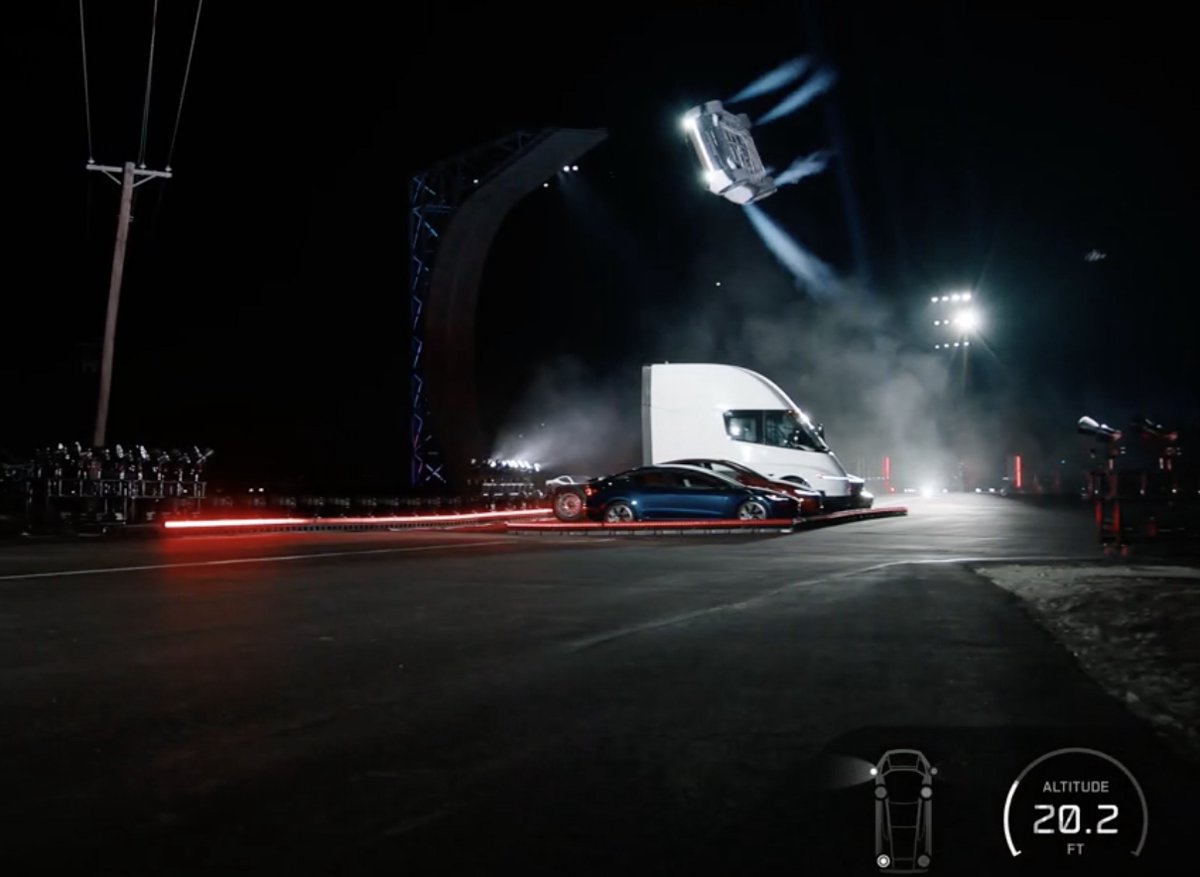 The prototype airborne over the line-up, thrusters firing. Photo: Tesla via TechCrunch
6. Nine years, and every date along the way
To understand why "2028" lands the way it does, you have to read the receipts.
The second-generation Roadster was unveiled as a concept on 16 November 2017, driven out of the back of a Semi trailer to "Sabotage" at the Semi event. It promised 1.9 seconds to 60 mph, 620 miles of range, three motors, all-wheel drive, a 2+2 cabin and a removable glass roof — and production in 2020, at $200,000, with the first 1,000 built as a $250,000 Founders Series.
Production has been promised in: 2020. Then 2021. Then 2022. Then 2023. Then 2024. Then 2025. Then an April 2026 unveil, which slipped. Then a 2027-or-2028 window. Now, as of Thursday night, 2028 — with Musk adding the word "actually," and a laugh.
The SpaceX thruster package, meanwhile, isn't new either. It was described in June 2018. In June 2019 Musk tweeted that "2.1 sec 0-60 mph is base model before adding rocket thruster option." In August 2025 Tesla filed a ground-effect patent. Wikipedia's article on this car currently carries the category "Vaporware" — which is not a judgment anyone at Tesla would enjoy reading, and not one the company has yet earned the right to have removed.
The human cost of that timeline is its own story. The Wall Street Journal's October piece was titled, flatly: "They Paid $50,000 and Waited Nine Years." InsideEVs went further, running a story headlined "Tesla 'Cannot Guarantee' Your Roadster Pre-Order Will Ever Be Delivered."
So the FAQ section of the reservation page deserves a second look. A $50,000 refundable deposit, nine years after people started paying them, is a genuinely unusual instrument.
7. The Back to the Future thing
Tesla leaned into this, and it leaned in hard. The teaser language — "go for launch," "ready for launch" — pointed at rockets, and coverage noted an invitation easter egg referencing Back to the Future, hinting at flight. Hours before the event, Musk posted that the new Roadster is "beyond movies, beyond imagination," and told his audience that "timing is everything." DeLorean, for its part, was active on social media around the reveal.
In the film, the DeLorean needed 88 mph to travel in time. The Roadster's version of that number turned out to be 0.81 seconds and a five-second thruster burn. It's a good bit. It's also, notably, a marketing campaign for a car you cannot buy, cannot price, and cannot have repaired at a dealer that has seen one.
8. The business question underneath the stunt
Look at the stock and the picture gets simpler.
Tesla shares closed Friday at $354.72, down $7.72, or 2.13% for the session, on volume of about 61.6 million shares, with a day range of $349.33 to $370.57. The 52-week range runs from $297.38 to $498.83.
The car flew. The stock didn't. That's not cynicism — it's arithmetic. A halo car with no price, no capacity figure, no independently verified performance number and a production date two years out is a marketing asset, not a revenue line. The Roadster's job was never to sell in volume; it was to make the rest of the line-up look reasonable, and to remind people that Tesla still does things no one else does. On that measure, Thursday night worked.
But there's a sharper observation buried in Musk's own remarks. He said the Roadster will be, long term, the only manually driven car Tesla makes — implying the rest of the fleet eventually goes autonomous. Read that again: the company's most emotionally charged product is being positioned as the last of its kind. "The best of the last of the human-driven cars," he called it. That's a farewell, sold at the same time as a promise.
9. How it stacks up against the 2017 promise
| 2017 concept | 2026 reality | |
|---|---|---|
| 0–60 mph | 1.9 s | 0.81 s measured (Thrust/Rocket trims, Tesla-timed); 1.6 s claimed for Performance |
| Range | 620 mi | 310–320 mi claimed |
| Drivetrain | 3 motors, AWD | 2 rear motors, RWD only |
| Seats | 2+2 | 2 (Rocket: 1) |
| Price | $200,000 (Founders: $250,000) | Not announced |
| Production | 2020 | 2028 |
| Party trick | None specified | Drives upside down; barrel-rolls; hops a Semi |
One line of that table explains the whole car. Range went from 620 miles to about 310 — roughly half, as InsideEVs put it in its headline. Moravy's explanation is actually a good one: Tesla dropped the long-range pack because "this car needs to be lightweight." The Roadster stopped being a grand tourer and became a track toy with a party trick. That's a deliberate trade, honestly made.
The other line that matters is drivetrain. Three motors and all-wheel drive became two motors and rear-wheel drive only — and the reason is more interesting than the downgrade. With one motor per rear wheel and no differential, each wheel gets its own inverter and its own 8.4:1 gearset, so torque vectoring happens in software, instantly, without a mechanical diff. Fewer parts, more control. Tesla didn't cut a motor to save money; it cut one to save a differential.
10. The verdict
The new Roadster is the most spectacular thing Tesla has built and the least obtainable. It drives upside down, it flies, it jumps a Semi, and it makes more power than a Plaid out of half the mass. It also has no price, no battery capacity, no independent timing, no street-legal Rocket trim, and a production date that has moved six times.
So the honest scorecard reads like this:
- The engineering is real. The fan system, the thrusters, the per-wheel drive units, the 500 kW charging — these are described in detail by the people who built them, with named components and named suppliers. This is not a slideshow.
- The verification is not. Every number Tesla's most enthusiastic fans are quoting is a Tesla number.
- The commercial promise is conditional. A refundable deposit on a car that Tesla says it cannot guarantee will ever be delivered, for a car due in 2028, at a price nobody knows.
Musk's own pre-demo line is the fairest summary of the whole evening: "Success is not guaranteed. It'll probably work." That's a strange thing for a CEO to say about a production car, and a perfect thing for him to say about a rocket. The Roadster has now been both.
It flew. That part is true, and after nine years it's worth saying plainly. But the newsletter said "Ready for Launch," and the one thing launch-ready products usually have is a price.
Sources
- Tesla — Roadster product page and "Ready for Launch" newsletter (October 16, 2026)
- InsideEVs — "Tesla Just Revealed The Roadster With A Truly Insane Demo" (Oct 16) and "The Tesla Roadster Has 1,341 HP And Half The Range Elon Musk Once Promised. Here Are The Full Specs"
- EVXL — "Tesla Roadster Everything We Know: 0.55 Seconds, 1 MW, Still No Price"
- Top Gear — "New Tesla Roadster: It's Finally Here... And It Flies!" (interviews with Lars Moravy and Franz von Holzhausen)
- Hagerty — Henry Catchpole interview with Lars Moravy
- Car and Driver — "Revealed! New Tesla Roadster Takes Flight with SpaceX Thrusters"
- TechCrunch — "Tesla reveals SpaceX-powered Roadster that flies and falls with style"
- Financial Post / AFP — reveal event photography
- Wikipedia — Tesla Roadster (second generation)
- The Wall Street Journal — "They Paid $50,000 and Waited Nine Years"
- Detroit News, Teslarati, The Next Web, MotorTrend, Not a Tesla App, Benzinga
- Market data: Yahoo Finance (TSLA close, October 16, 2026)
Featured illustration composed from the reveal-event photograph and the author's portrait. All performance figures are manufacturer claims unless otherwise stated.