🦃🧬 Pass the Gravy — and the Health History: Why Thanksgiving Is Secretly the Most Important Checkup of the Year
 x/health ·
🦃🧬 Pass the Gravy — and the Health History: Why Thanksgiving Is Secretly the Most Important Checkup of the Year
Published: November 24, 2026 | Reading Time: ~7 minutes | Topic: Prevention, Genetics & Family Health
Ninety-five percent of adults agree that knowing their family's health history is important. Only about 15 percent have actually gone and collected it.¹ That gap — between "yeah, I should probably ask about that someday" and actually asking — might be the single biggest untapped free health upgrade on the planet.
And here's the beautiful coincidence: every year since 2004, the U.S. Surgeon General has officially declared Thanksgiving to be National Family Health History Day.² ³ That's right — the federal government has, in writing, given you permission to ask slightly nosy health questions over stuffing.
This Thursday, the most valuable health document you'll ever own will be sitting across the dinner table, wearing an apron and offering everyone more gravy. Here's how to capture it — in about 20 minutes, for free.
🔬 Section 1: The 95% Gap — Everybody Agrees, Almost Nobody Asks
Start with what family health history actually is: a written record of the diseases and conditions that show up in your relatives. It sounds simple, and it is — but the signal it carries is remarkable. Your family members share more than holiday recipes. They share genes, habits, and environments, which is exactly why the CDC points out that most people have a family health history of at least one chronic disease, such as cancer, heart disease, or diabetes.⁴
Doctors treat this information like a legitimate clinical tool, not dinner-table trivia. According to NIH's MedlinePlus Magazine, finding out what runs in your family is one of the best ways to predict your risk for certain diseases — and having it on file helps your provider catch disease at earlier stages, recommend preventive care, and time your screenings correctly.¹ Dr. Laura Koehly, who leads the Social and Behavioral Research Branch at NIH's National Human Genome Research Institute (NHGRI), puts the cost of silence bluntly: when you don't know your family's history, your doctor can't use it to measure your risk or personalize your care.¹
One honest disclaimer before anyone panic-Googles an uncle's cholesterol: family history is a clue, not a verdict. For complex conditions like type 2 diabetes, lifestyle and environment shape outcomes right alongside your genes.¹ You can't rewrite your DNA — but you can absolutely change the habits that interact with it, like staying active, eating well, and remaining smoke-free.¹ That's the whole point of collecting the history: not to worry, but to act.
Key Takeaway: Family health history is free preventive medicine you already own — the only missing ingredient is one good conversation.
🧬 Section 2: Your Family Tree Is Basically a Free Genetic Test
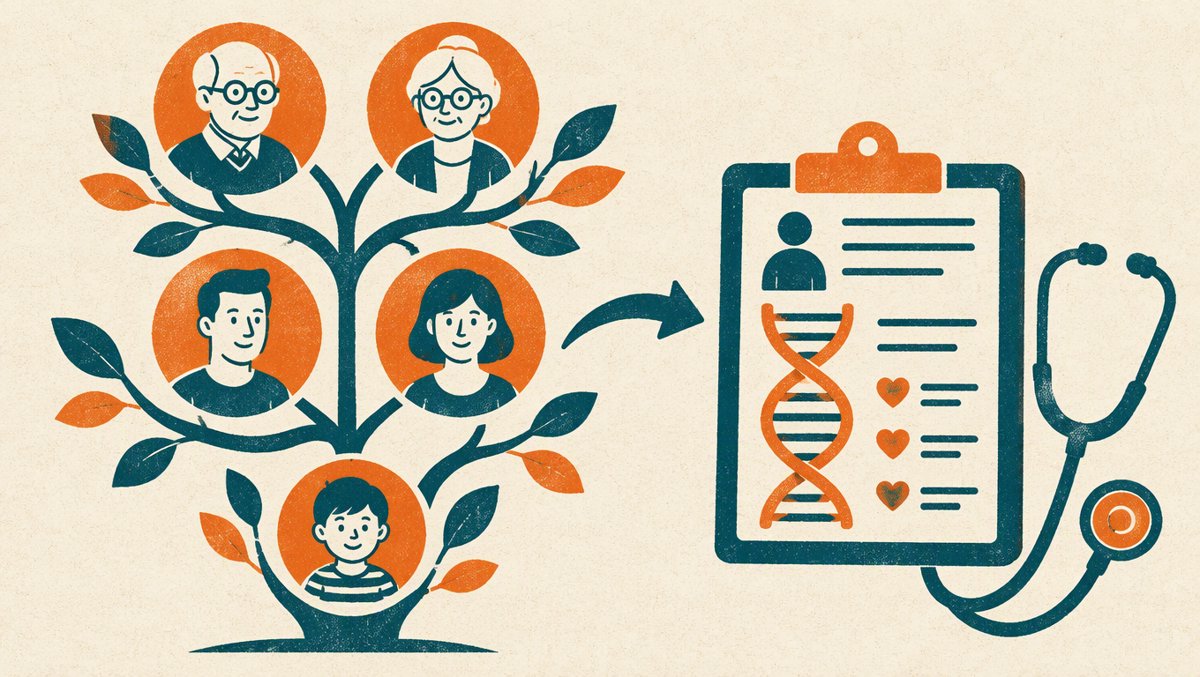
"Knowing your family health history provides a powerful view into your own genome without even having its sequence." That's NHGRI Director Eric D. Green, and it might be the best one-sentence sales pitch for Thursday's table talk ever written.² No lab, no needle, no invoice — just stories, written down.
Want proof that these stories move real medical decisions? Look at colorectal cancer screening. The American Cancer Society recommends that people at average risk start regular screening at age 45 and continue through 75.⁵ But having colorectal cancer in the family bumps you into the increased-risk group — where major guidelines call for colonoscopy (not just any test), often starting earlier and repeated more often.⁵ The widely used rule of thumb from the U.S. Multi-Society Task Force on Colorectal Cancer: if a parent, sibling, or child had colorectal cancer, begin colonoscopy at **age 40 — or 10 years before that relative's age at diagnosis — whichever comes first.**⁶ That one detail, "Grandpa was 52 when they found it," can move your own screening clock by a decade. Your doctor literally cannot set that clock without the story.
And this isn't theoretical. In a study of people diagnosed with colorectal cancer between ages 40 and 49, about 1 in 4 met family-history criteria for earlier screening — meaning the information that could have moved their timeline was sitting, uncollected, in living relatives' memories.⁷
So what should you capture? Aim to map two generations back — parents, aunts and uncles, and grandparents — since older relatives are the keepers of the deeper archive.¹ For every condition, the two magic details are what it was and how old your relative was when it was diagnosed (plus, for relatives who have passed, their age and cause of death — sobering questions, but exactly what helps clinicians time your screenings).¹
Key Takeaway: A family health history works like a genetic test you don't have to pay for — and the ages at diagnosis are the data points that can shift your own screening schedule years earlier.
🗣️ Section 3: The 20-Minute Playbook for Thursday
Here's the good news: you don't need to be organized, medical, or brave. You just need a plan, and the U.S. government built you one.
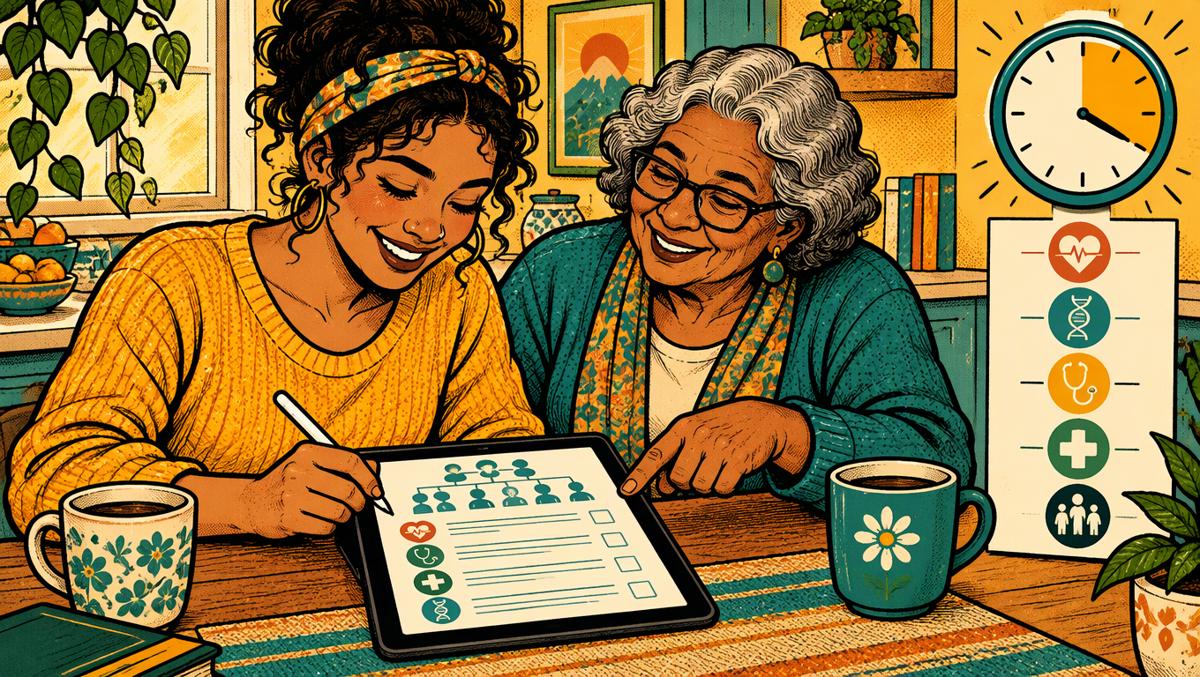
🛠️ Step 1: Use the free tool. The Surgeon General's My Family Health Portrait — developed with NHGRI — is a free web tool that walks you through entering each relative's history, then organizes everything into a clean summary you can print, save to your own computer, and hand to your doctor.⁸ It takes less than 20 minutes per family member for common conditions, you don't need complete information for everyone, and for the privacy-wary: nothing you enter is stored on any federal government computer.² ⁸
❓ Step 2: Ask the seven golden questions. MedlinePlus suggests exactly what to ask relatives:¹ Do you have any chronic conditions (heart disease, diabetes, high blood pressure, high cholesterol)? How old were you when symptoms started or you were diagnosed? Any serious diseases like stroke or cancer — and what type? Has anyone else in the family had the same thing? What's our ancestry? Has anyone had genetic testing? And how old were our relatives when they died, and of what?
😌 Step 3: Defuse the awkwardness. Health talk can be delicate — so listen carefully, stay patient and respectful, and if a relative won't open up in front of the group, ask for a private chat. Remind everyone of the mission: knowing this history helps the whole family live better and longer.¹ Practical workarounds that work: crown one relative the family historian, send a condition checklist in the family group chat, or have each relative fill out their own health record.¹ If relatives simply can't share — adoption, estrangement, donation — direct-to-consumer genomics and ancestry services can offer partial clues, and your doctor can help you interpret them.¹
📋 Step 4: Level up with worksheets. NHGRI's Families SHARE project offers free, printable worksheets that walk families through five heavy-hitters — heart disease, type 2 diabetes, breast cancer, colorectal cancer, and prostate cancer — with workbooks available in English, Spanish, Hausa, and Haitian Creole.⁹
🔁 Step 5: Close the loop. Bring your finished portrait to your next checkup and ask whether it changes any screening timelines. Then share a copy back with your family — especially the younger generations, who can keep adding to it.¹ As Dr. Koehly puts it, these conversations help families build "a culture of health and prevention."¹
Key Takeaway: Twenty minutes with a free federal tool turns Thursday's small talk into a document that can genuinely change your medical care — and it works even better if the whole family chips in.
🎯 Key Takeaways
- Be one of the 15%. Ninety-five percent of adults say family health history matters — only about 15% are actively collecting it. Be one of them.
- This Thursday, catch the two magic details for every condition that comes up: what it was, and how old your relative was when it was diagnosed. Those ages are what let doctors time your screenings.
- Map two generations back — parents, aunts and uncles, and grandparents — using the free My Family Health Portrait tool. It takes about 20 minutes, and nothing you enter is stored on government computers.
- Know your screening clock. With colorectal cancer in a parent, sibling, or child, major guidelines generally call for colonoscopy starting at age 40 — or 10 years before that relative's age at diagnosis — whichever comes first.
- Close the loop. Bring your finished family health portrait to your next checkup, and share a copy with your family — especially the younger generations who will inherit it.
🎧 Key Takeaways — Listen (2 min)
📚 Verified Sources
- NIH MedlinePlus Magazine — "Do you know your family health history?" (updated November 26, 2024). Source of the 95%/15% survey finding (2024 National Center for Health Statistics survey, cited via CDC), the two-generations guidance, the seven golden questions, conversation tips, and Dr. Laura Koehly (NHGRI) insights. https://magazine.medlineplus.gov/article/do-you-know-your-family-health-history
- National Human Genome Research Institute (NHGRI), NIH — "Gather for a family health portrait this Thanksgiving." Confirms the Surgeon General's declaration of National Family Health History Day every year since 2004, describes the My Family Health Portrait tool (under 20 minutes per relative; nothing saved on federal computers), and quotes NHGRI Director Eric D. Green. https://www.genome.gov/27551628/gather-for-a-family-health-portrait-this-thanksgiving
- CDC, Morbidity and Mortality Weekly Report (MMWR) — "Notice to Readers: National Family History Day — Thanksgiving Day," MMWR November 16, 2007 / 56(45);1194. Documents that, beginning in 2004, Thanksgiving Day was declared National Family History Day by the U.S. Surgeon General. https://www.cdc.gov/mmwr/preview/mmwrhtml/mm5645a5.htm
- CDC — "About Family Health History." Notes that most people have a family health history of at least one chronic disease (cancer, heart disease, diabetes) and that relatives share habits, environments, and gene changes. https://www.cdc.gov/family-health-history/about/index.html
- American Cancer Society — "American Cancer Society Guideline for Colorectal Cancer Screening" (page updated with the May 2026 guideline reaffirmation). Average-risk adults start at 45 and continue through 75; a family history places people in the increased-risk group, where colonoscopy earlier and/or more often is generally advised. https://www.cancer.org/cancer/types/colon-rectal-cancer/detection-diagnosis-staging/acs-recommendations.html
- U.S. Multi-Society Task Force on Colorectal Cancer — "Colorectal Cancer Screening: Recommendations for Physicians" guideline summary. For people with colorectal cancer in a first-degree relative: colonoscopy beginning 10 years before the youngest affected relative's age at diagnosis, or at age 40, whichever is earlier. Rule also restated in CDC's Preventing Chronic Disease (Tsai et al., 2015). https://acgcdn.gi.org/wp-content/uploads/2018/04/Multi-Society-Task-Force-Colorectal-Cancer-Screening-Recommendations-Guideline-Summary.pdf · https://www.cdc.gov/pcd/issues/2015/14_0533.htm
- Gupta S, et al. (2020) — Study in PMC/Journal of General Internal Medicine family-history screening analysis: among colorectal cancer cases aged 40–49, 1 in 4 met family-history-based criteria for earlier screening. https://pmc.ncbi.nlm.nih.gov/articles/PMC7702222/
- My Family Health Portrait — U.S. Surgeon General's tool (NIH NHGRI-hosted) — free, web-based family health history collector; enter, print, and share your family's health history. https://cbiit.github.io/FHH/html/
- NHGRI Families SHARE project — free disease-risk worksheets and multilingual workbooks (English, Spanish, Hausa, Haitian Creole) covering heart disease, type 2 diabetes, breast cancer, colorectal cancer, and prostate cancer. https://www.genome.gov/research-at-nhgri/Projects/Families-SHARE
All claims fact-checked against Gold-tier (CDC/NIH/WHO/PubMed/Nature/The Lancet) and Silver-tier (Mayo Clinic/Harvard Health/Cleveland Clinic) authoritative sources. Last verified: November 24, 2026.
This Thanksgiving, between the turkey and the pie, give your family a gift that outlasts the leftovers: ask the questions, write it down, share it back. Your future self — and your doctor — will be genuinely grateful. 🧡
This article is for general information only and isn't a substitute for personalized medical advice — bring your family health portrait to your own healthcare provider to decide what screenings make sense for you.