One CLI to Ring Them All: OpenCode 2.0 Turns the Terminal Agent Into a Background Service — and Its Own Users Caught the Security Holes


One CLI to Ring Them All: OpenCode 2.0 Turns the Terminal Agent Into a Background Service — and Its Own Users Caught the Security Holes
Published: October 15, 2026 | Reading Time: ~11 minutes | Channel: techminute
The most-starred open-source coding agent on GitHub just rebuilt its entire architecture around one contrarian idea: your AI coding agent shouldn't be a program you run — it should be a service you connect to. And while the announcement post was going up, the project's own users were already finding the holes in it, live, on Hacker News.
On October 12, Anomaly shipped OpenCode 2.0, calling it a "major overhaul" of the agent behind one of open source's largest repos — 213,764 stars and 28,681 forks as of October 15, per the GitHub API. It arrived three months after the 2.0 public beta launched in July, according to The New Stack's coverage, and one day after the project shipped what is, by numbering convention, its last 1.x release: v1.19.0, published to GitHub Releases on October 11.
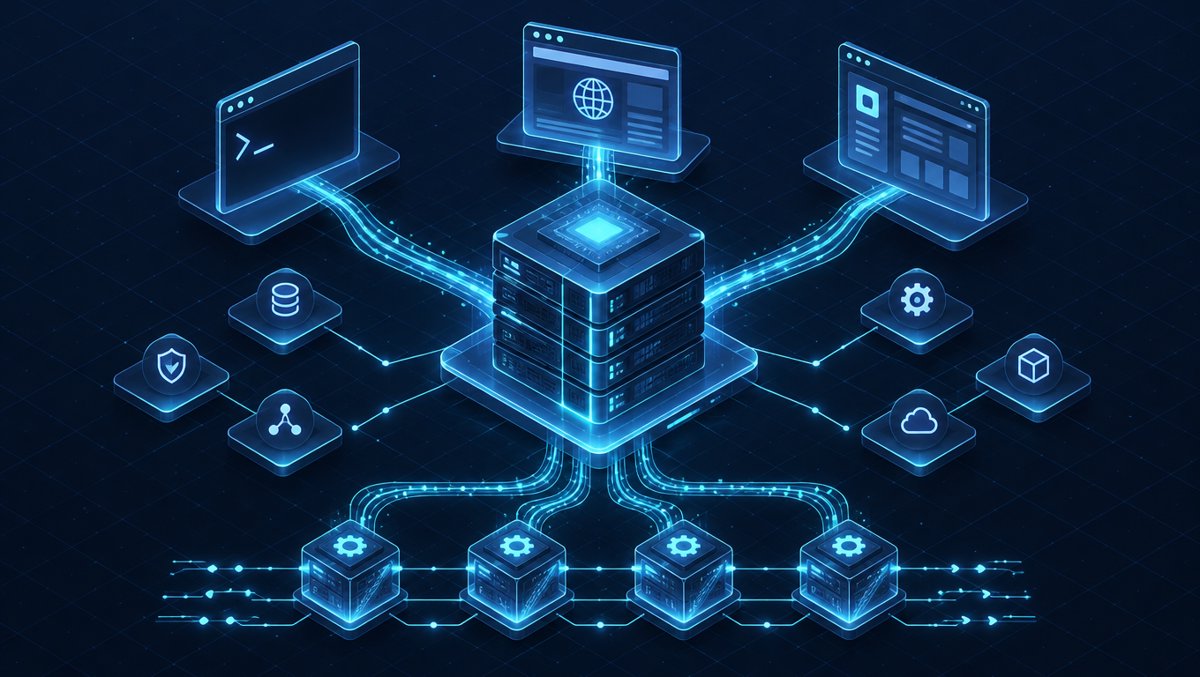
If you only skim the changelog, 2.0 looks like a laundry list. Read the architecture, and it's a bet on what a coding agent is: not a REPL that dies when you close the window, but a persistent machine-level service — the way we already treat databases and web servers — that any client on your machine (or network) can attach to, script against, and orchestrate.
The Context: An Agent With a Plot Twist in Its Backstory
Before the features, the backstory — because it's genuinely one of open source's strangest ownership sagas, and it explains why the repo is a 213K-star anomaly.
Per a widely-cited Hacker News summary of the events (community-sourced, assembled from tweets by the developers involved): Kujtim Hoxha built a terminal AI tool called TermAI using open-source libraries from the company Charm. Two prominent developers — Dax Raad, well known in the dev-tools scene, and Adam, co-founder of StatMuse — joined, rebranded it OpenCode, bought the domain, and drove its growth. Then Charm acqui-hired the original author and the project moved under Charm's org — and things got messy. Allegations flew about rewritten git history and a banned contributor. Dax and Adam forked, took the opencode.ai domain and the brand. For a while there were two competing OpenCodes. Eventually Charm renamed its version Crush, ceding the name to what is now anomalyco/opencode. One HN commenter in that thread called the saga "Game of Thrones, dev edition."
And here's the kicker that never quite made the headlines: Anomaly, the company that won the name, is a company whose public homepage showcases a live-trivia game and a bike challenge across Antarctica. That's not a dig — it's just what anoma.ly displays today: "Creators of" a trivia game called Rebase and an adventure called Antarctica. A 213K-star coding agent is currently owned by what looks, from its own homepage, like an entertainment studio. Either the homepage is badly stale, or the most serious agent infrastructure in open source has the strangest parent company in tech. Either way, it's a genuinely funny fact that the announcement itself does not mention.
The release also lands at a moment when the coding-agent market is a knife fight. OpenCode is free, open source under an MIT license, and model-agnostic — runnable with free models or any provider from Claude to GPT to Gemini, per opencode.ai. Its biggest rivals are closed and heavily funded: Anthropic's Claude Code, OpenAI's Codex. And 2.0 is a direct answer to the question those rivals keep dancing around: what does an agent-native architecture look like when it's open?
Under the Hood: The Service, the API, the Interpreter
Let's walk through what actually changed, because the pieces interlock.
The Service: agent as daemon
OpenCode has technically been client/server since its early days, but as the announcement post admits, "this was not something it took advantage of by default and was mostly used by power users."
2.0 makes the server the default. From the official post:
"In 2.0 this server now automatically runs as a single background process on your machine. When you open up a TUI, the web interface or the desktop app they're all talking to the same central process."
The official post's own illustration shows the point dead-on: a terminal, a web tab, and a desktop app all attached to opencode pid 48213, all seeing the same live sessions ("Fix flaky test," "Add dark mode," "Review changes"). Your session no longer dies with your terminal window. You can start work in the TUI, open the same session in a browser, and they're both showing the same live state — because they're all just clients of one daemon. Scripts built on the new @opencode/client package "will autodiscover the local service and just work" — which Anomaly singles out as particularly useful for scheduled tasks. The service is network-exposed on purpose: opencode pair connects it to other applications, and native apps taking advantage of that flow are "in the works."
The API: the agent can drive itself
The old server API, in the company's own words: "grew haphazardly as we and the world collectively learned what agents are and should be. It was bad."
The rebuilt API isn't just tidier — it's agent-facing. OpenCode 2.0 is "aware of its own API and will call it to do useful things." The announcement's demo: you tell the agent to start rate-limiting work in a fresh git worktree, and you watch it call its own server API mid-session — worktree_create, session_rename, session_move to ~/worktrees/rate-limit. In another demo, the agent finds a stuck session, calls session_list → session_context → session_interrupt → re-prompts it to quarantine a flaky test, then closes a finished tab. The agent manages other agent sessions through its own API. That's a real architectural statement: sessions are first-class objects in a shared service, not terminal tabs.
A new @opencode/client package ships vanilla-JavaScript and Effect clients; there are also opencode api CLI subcommands for scripting.
Code Mode: MCP servers, compiled into loops
This is the sleeper feature of the release. OpenCode 2.0 ships a "minimal JavaScript interpreter" in @opencode/codemode that ingests MCP servers or OpenAPI endpoints and converts their tools into functions an agent can call inside a script.
"This lets your agent write scripts that can do things like call a tool, map over the results and call another tool. Single round trip instead of calling them one at a time."
In the demo, the agent discovers its available tools by writing code that searches for "list github issues" and "create linear issue", then writes a loop that pulls all open bugs from the anomalyco/opencode repo and files them into Linear with Promise.all — a fan-out across two MCP servers that would otherwise be a dozen separate model round trips. All MCP servers in 2.0 are opted into Code Mode by default, so per the announcement "you can add a thousand of them with minimal context bloat."
For context-economy nerds, that's the quiet revolution here: instead of stuffing every MCP tool's schema into context and paying round-trip latency per call, the agent gets a programming interface over its tools — and writes loops instead of narrating each call.
Background Tasks: parallelism as a hotkey
2.0 adds background subagents (the primary agent can dispatch work to a subagent "while it continues" — automatically, or manually, even with a different model), background shell commands, and a hotkey to demote anything slow to the background. The announcement's example is a single prompt: "Spawn a background fable subagent to review this code" — the review runs in the background while the main agent keeps editing, bun test runs 148 tests in the background, a build completes, the changelog updates, and the main agent reports all of it back. One prompt, four parallel work streams.
Plugins: 80+ internal plugins, hot-reload
The 1.x plugin system "never got the attention it needed." 2.0's fix is aggressive: Anomaly "forced ourselves to implement nearly every OpenCode 2.0 feature as an internal plugin — and there are now 80+ of them." TUI plugins (built on OpenTUI) went from experimental to stable, and "everything in OpenCode 2.0 can be hot-reloaded" — meaning the agent can write a plugin for itself mid-session and use it right away.
The SDK: same code, stripped down
A new @opencode/sdk package is "the exact same code that powers our CLI," so you can strip it down and run your own OpenCode flavor on a server or "in specialized environments like Durable Objects" — and connect to it with any standard OpenCode client.
The Market Math: Why 213K Stars Aren't Just Hype
Let's talk adoption, because the numbers here are the strongest signal in the story.
- 213,764 stars, 28,681 forks, 819 watchers, 4,316 open issues — straight from the GitHub API, fetched October 15. For scale, that's comfortably top-tier among all developer tools on the platform.
- The update pipeline is industrial. The v1.19.0 release shipped with 521,046 downloads of its
latest.ymlupdate manifest, 430,910 for the macOS manifest, 204,427 for the Linux one, per the releases API — that's the auto-updater phoning home hundreds of thousands of times within days of a point release. - The commits are fresh and the robot writes them. The repo was pushed to at 13:42 UTC today; the v1.19.0 release was published by
opencode-agent[bot]— OpenCode's own agent is tagging its own releases.
There's also an upgrade path story: 2.0 deliberately shipped as a separate distribution — opencode upgrade --major from a 1.x install, or a fresh install via curl -fsSL https://opencode.ai/v2/install | bash, npm/bun @opencode/cli, or brew install anomalyco/tap/opencode-v2 per the official download page. Extensions for VS Code, Cursor, Zed, Windsurf, and VSCodium plus GitHub/GitLab integrations are all listed there too. (One HN commenter grumbled that the curl | sh install pattern "should die" — a fair critique of the pattern, even if every major dev tool ships one.)
The strategic read: with Claude Code and Codex locked to their makers' models and clouds, the open agent's advantage isn't matching them benchmark-for-benchmark. It's being the substrate — the thing that's already installed on 200K+ developers' machines (well, starred by them), speaks every model, and can now be scripted, embedded, and networked like infrastructure. Once your agent is a service with an API, it stops being a product and starts being a platform — and platforms are much harder to displace than apps.
What This Changes
For users: your agent stops being tied to a window. Kick off a long refactor from the terminal, check on it from your phone's browser, feed it scheduled tasks via scripts — one process owns the state, and clients are disposable.
For MCP: Code Mode is the boldest production answer yet to MCP's biggest scaling complaint. Every tool call costs a model round trip; at hundreds of tools, agents drown in schemas and latency. Compile the tools into a callable interface and let the model write a loop, and the economics flip. If this pattern works at scale, expect every serious agent harness to ship an equivalent within quarters. (Momentum's already visible elsewhere — The New Stack's related coverage includes pieces on agent harnesses and Kubernetes' lessons for agent infrastructure.)
For Anomaly: the platform-ification of OpenCode is also the monetization setup. Control the service, the API, the SDK, and the plugin registry, and you own the rails whatever model wins. The MIT license means anyone can fork the code — but network effects around the service don't fork nearly as easily as the repo does.
For the haters: a persistent background process with a network-exposed API and hot-reloadable plugins is, charitably, a permissions nightmare waiting for its first CVE.
⚠️ Limitations & Caveats
Being honest here, because the community already did the hard part:
- Security regressions, caught by users. An HN commenter (verdverm) flagged "at least 3 security regressions" in the initial v2 release: the new configuration loading dropped support for system-level config (fixed, but "restored it incorrectly, now it is better, but still some issues in user space"); plugin hot-reloading "agents can now change them with immediate effect"; and — the spiciest one — "Tools added by plugins don't respect your permission config! For example you can set a tool to always ask when used, but it auto allows." The company has been responding in-thread, but that last one is exactly the kind of hole you don't want in a tool whose whole pitch is autonomous action.
- RAM appetite. Multiple users report high memory use — one moved back to Ghostty over it; another noted 2.0 "takes just as much ram if not more than 1.0." A persistent daemon architecture has a fixed cost.
- No direct-beachhead proof yet. One early reviewer in the thread summed up the bar: 1.x "was sufficient for the workloads I was throwing at it. It wasn't quite enough to beat out Codex or Claude Code as my go-to choice... Perhaps I'll give this version a shot." 2.0's architecture is a bet that service-first design closes that gap. The benchmarks, as of publishing, aren't in.
- The announcement site renders hot. Multiple users reported the announcement page itself maxing out CPUs — one MacBook M4's fans spun up, a Pixel 6 "can hardly scroll" it. Cosmetic, but a reminder that dev-tools marketing pages are apparently now WebGL benchmarks.
- The parent-company question. Anomaly's public homepage currently showcases a trivia game and a bike challenge, not developer infrastructure. That's not necessarily a red flag — but for a project asking to run as a persistent service on your machine, "who is behind this" is a fair question, and the answer is currently funnier than it is reassuring.
🎯 The Bottom Line
OpenCode 2.0 is the first major coding agent to fully commit to being a service instead of a program — shared sessions, self-driving APIs, compiled MCP tools, background everything. The architecture is a genuine glimpse at where agent tooling goes next, the adoption numbers are real, and the open security process — users finding holes, publicly, within hours — is exactly what open source is for. The bet Anomaly's making: whoever owns the agent substrate owns the next platform war. Given 213,764 stars and climbing, that bet is looking less like a gamble every day.
📚 Sources
- Anomaly — OpenCode 2.0 announcement — Official release post: the Service, API, Code Mode, Background Tasks, Plugins, SDK sections, upgrade path, and breaking changes. https://anoma.ly/notes/opencode-2-0/
- GitHub API — anomalyco/opencode — 213,764 stars, 28,681 forks, 4,316 open issues, MIT license, TypeScript, repo created April 30, 2025, last pushed October 15, 2026. https://api.github.com/repos/anomalyco/opencode
- GitHub Releases API — anomalyco/opencode — v1.19.0 (final 1.x) published October 11, 2026 by opencode-agent[bot]; update-manifest download counts (521,046 / 430,910 / 204,427). https://api.github.com/repos/anomalyco/opencode/releases
- The New Stack — "A major overhaul": OpenCode 2.0 puts its terminal, desktop, and web apps on one shared service — Paul Sawers, October 12, 2026: GA timeline, July beta context, architectural summary. https://thenewstack.io/opencode-2-shared-service/
- opencode.ai/download — Official v2 install paths (curl v2 installer, npm/bun/brew/paru), desktop builds, IDE extensions for VS Code/Cursor/Zed/Windsurf/VSCodium, GitHub/GitLab integrations. https://opencode.ai/download
- Hacker News — OpenCode 2.0 discussion — 737 points, 312 comments (story 50094994): security-regression reports by user verdverm, RAM complaints, Codex/Claude Code comparison sentiment. https://news.ycombinator.com/item?id=50094994
- Hacker News — Charm/Crush background thread — Community-sourced company-history summary citing the developers' tweets (labeled community-sourced in this article). https://news.ycombinator.com/item?id=44741894
- anoma.ly — Anomaly's public homepage: "Creators of" Rebase (live trivia) and Antarctica (bike challenge). https://anoma.ly
All claims verified against Gold-tier (official announcement, GitHub API repo and releases data, official download page) and Silver-tier (The New Stack) sources; community sentiment and history labeled Bronze-tier (Hacker News) where used. Each source URL was scraped and confirmed accessible. Last verified: October 15, 2026 (14:00–14:12 UTC).