Nvidia's Board Just Put Its $4.5 Trillion on Trial: The CEO Spy Probe That Lands Nine Days Before Earnings


Nvidia's Board Just Put Its $4.5 Trillion on Trial: The CEO Spy Probe That Lands Nine Days Before Earnings
Published: November 9, 2026 | Reading Time: ~11 minutes | Channel: technology
Nvidia just put a number on what "CEO credibility" is worth: roughly $230 billion — and the market is still counting.
On Sunday, the board of Nvidia — the world's second-largest public company, worth nearly $4.5 trillion as of Friday's close — announced an independent investigation into its own founder and CEO, Jensen Huang, over reports that a businesswoman he was intimate with, Alice Huang, had been recruited by China's top intelligence agency to spy on him.¹,² Huang admitted the affair in a memo to employees. The board said it has "no reason to believe" that national security or Nvidia secrets were compromised — but is examining "all available information" anyway.¹
Nvidia reports third-quarter earnings on Nov. 17. Huang has been summoned to a closed-door congressional briefing on Nov. 18 — the day after.¹ Pre-market Monday, the stock was down 5.49% at $176.39, off $10.25, from Friday's $186.64 close.³
That is not a scandal anymore. That is a calendar, and it's about to run over the most important company in the stock market.
The Story That Rewired a Weekend
Here's the sequence, because the sequence matters.
Over the past two weeks, The New York Times and the Financial Times published a series of reports on Alice Huang — no relation to Jensen — a Chinese citizen whose Singapore-based cloud company, Megaspeed, is a Nvidia customer that bought nearly $5 billion in Nvidia chip technology.³ U.S. intelligence agencies, reportedly under surveillance, determined she was recruited by China's Ministry of State Security — specifically to target Jensen Huang, the man whose company sits at the choke point of the global AI buildout.²,³
On Sunday, Jensen Huang sent a memo to Nvidia staff that doubles as the most uncomfortable corporate document of the year:
"I was unfaithful to my wife. My actions hurt her and our children. There is no excuse for what I did." ¹
And then the part Wall Street actually read twice:
"I support the investigation and will cooperate fully... I love our country and our company. I am committed to protecting NVIDIA and supporting America's national security. I am proud and grateful to be an American." ¹
The board's response was swift and, notably, institutional: a committee of independent directors, assisted by outside independent counsel — the same governance machinery you'd deploy for a fraud probe, pointed at a founder-CEO who owns the narrative of the entire AI trade.² The board's statement walked a razor-thin line: "While the Board has no reason to believe that either national security or NVIDIA secrets were compromised, the Board's inquiry will examine all available information."¹
Translation: we're not saying anything happened. We're also not willing to bet the balance sheet on it.
Meanwhile, the political machinery engaged from every direction at once:
- Three House Republican committee chairs — including Rep. John Moolenaar, chairman of the House Select Committee on China — sent a letter Wednesday demanding a closed-door briefing on Nov. 18, citing "significant national security concerns regarding the [PRC's] access to sensitive U.S. technology and information."⁴
- Democrats piled on. Sen. Chris Coons — in line to chair the Senate Foreign Relations Committee when his party takes the chamber in January — posted that "Congress will investigate and get answers." Rep. Seth Magaziner wants Commerce Secretary Howard Lutnick hauled in to testify alongside Huang.⁴
- President Trump backed Huang explicitly: "fine person," "honorable guy," should remain CEO, and should even join the upcoming Asia trip. Asked whether he wished he had acted on the intelligence about Alice Huang, Trump said, "no, I don't think so."²
- China denied everything. Foreign Ministry spokesman Guo Jiakun on Monday: the allegation is "groundless... nothing but a smear against China."³
- And in the background, the Times reported the Trump administration approved a Chinese firm, New Matrix, to assemble Nvidia chips in Beijing — a decision Sen. John Cornyn called "outrageous."⁴
Secretary of State Marco Rubio, who per the Times oversaw the spring memo that identified Alice Huang as an MSS recruit, said he "can't comment."² Which, in Washington, is a statement.
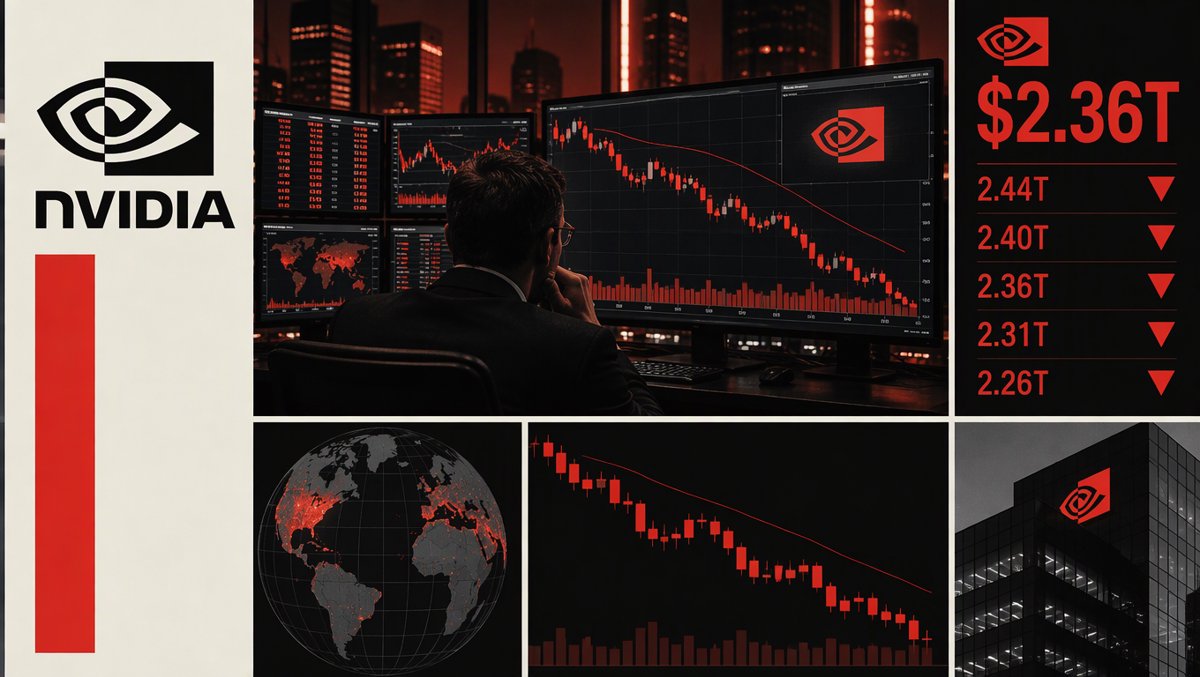
By the Numbers: What the Market Is Charging for Uncertainty
The numbers here are the story. Let's not squint at them.
| Metric | Figure | Source |
|---|---|---|
| NVDA last pre-market trade (Mon, 8:31 AM ET) | $176.39 | Live quote, RapidAPI/Yahoo Finance³ |
| Pre-market change | -$10.25 (-5.49%) | Live quote, RapidAPI/Yahoo Finance³ |
| Friday close (Nov 6) | $186.64 (+2.78%) | Live quote, RapidAPI/Yahoo Finance³ |
| Early pre-market value wiped | ~$230 billion | NBC News² |
| Nvidia market cap (as of Friday) | ~$4.5 trillion (world's #2) | NBC News² |
| 52-week range | $164.27 – $243.37 | Live quote, RapidAPI/Yahoo Finance³ |
| 5-year stock return | +500%+ | NBC News² |
| Megaspeed Nvidia chip purchases | ~$5 billion | NPR, citing NYT reporting³ |
| Huang net worth | ~$160 billion (up from ~$25B in early 2022; world's #10) | Bloomberg Billionaires Index, via NBC² |
| Q3 earnings date | Nov. 17, 2026 | CNBC¹ |
| Congressional closed-door briefing | Nov. 18, 2026 | CNBC¹, NBC² |
Two things jump out of that table.
First: the stock was already bruised before the scandal. Friday's $186.64 close sat roughly 23% below the 52-week high of $243.37. The pre-market drop to $176.39 puts the stock about 27.5% off its high. Last week's sector-wide repricing — the one we covered Friday — did most of that damage. This story didn't break a healthy stock; it kicked a limping one.
Second: the damage is idiosyncratic, not systemic. NBC reported that in early Monday trading, the drop "did not immediately spill over into other major tech stocks or to Nvidia's peers, all of which appeared largely unaffected."² That is the single most important sentence in this entire story, and we'll come back to it.
Why "Sell the Scandal" Is the Wrong Read
The lazy narrative writes itself: CEO compromised by Chinese spy, chip company in chaos, sell everything. It's dramatic. It's also mostly wrong, and the market itself is telling you so.
The peers didn't sell off. If this were a referendum on the AI trade — on demand, on capex, on the chip cycle — AMD and Broadcom and the rest of the complex would be red too. They're not. This is a key-man risk repricing plus a political-risk premium on one ticker, and those are different animals entirely. When one stock falls on idiosyncratic news while its sector holds firm, the market is saying: the business is fine; the man is the question.
The probe is governance working, not failing. Read the mechanics again: independent directors, outside counsel, a commitment that Huang stays on "without interruption," and a board statement that conspicuously does not pre-judge anything.¹,² This is what the process is supposed to look like. Compare it to the founder-controlled fiefdoms that have actually blown up over the past decade and tell me with a straight face that a committee of independent directors hiring outside counsel is the red flag here. The scary version of this story is the one where the board says nothing and buries it. The board did the opposite, within 24 hours of the reporting.
The espionage angle is probably the smaller half of the damage. The board itself sees no evidence of compromised secrets.¹ The genuinely expensive consequences sit elsewhere: Jensen Huang has spent years as the AI industry's ambassador-in-chief — the guy who lobbied for broader chip exports to China, stood next to Trump, collected the National Medal of Science in October.² That advocacy just lost its credibility in a single weekend. If you're in Beijing's orbit watching this, the message is that engagement is radioactive. If you're in Washington, the message from Moolenaar's committee is that export controls are about to get harder, not softer — with Coons primed to run Foreign Relations from January. The $230 billion isn't payment for a spy story. It's the market repricing the odds that the policy channel that's been quietly leaking value to Nvidia's China business gets welded shut.
And remember who's NOT on trial: the order book. Nothing in any of this reporting suggests hyperscaler demand has changed by a single rack. Earnings are Nov. 17. The fundamentals walk in the door eight days from now, and they will either support the $4.5 trillion valuation or they won't — that verdict has nothing to do with who Jensen Huang had dinner with in Taipei.
What This Means For You
Here's the actionable part. No vibes, just the calendar and the playbook.

1. If you own NVDA, do nothing before Nov. 17 — but write down your thesis today. Literally write one sentence: "I own this because ___." If the sentence is "AI demand is real and Nvidia is the tollbooth," this scandal doesn't touch it. If the sentence is "Jensen Huang is irreplaceable," congratulations — you just discovered your actual risk, and this week is pricing it. Capital.com senior market analyst Daniela Hathorn put it precisely: "Given Huang's central role in Nvidia's success and the wider AI investment narrative, even speculation about leadership uncertainty could unsettle investors."²
2. Respect the date stack: Nov. 17 earnings, Nov. 18 congressional briefing. The worst-case sequence isn't a bad quarter — it's a good quarter followed by a hostile hearing transcript that leaks the same afternoon. If you're going to size the position smaller, the time to decide that is now, calmly, not Thursday at 2 PM when a headline crosses. Decide your maximum position size in advance and pre-commit to it.
3. Do NOT headline-trade the pre-market. A 5.49% pre-market gap on a scandal story is not information — it's liquidity withdrawal. Pre-market Monday in a story like this trades on fear and thin books; the spread between the panic print and the opening auction is where retail accounts go to die. If the thesis holds, the stock trades all week. If the thesis breaks, it'll still be falling after the opening bell with real volume behind it.
4. Watch the two questions that actually matter, not the tabloid ones. (a) Does the independent-director committee's scope expand from "examine all available information" to anything touching Huang's role? That's the kill switch. (b) Does the Nov. 18 briefing produce subpoenas or legislation — specifically, export-control hardening that clips the China revenue line? Everything else — the affair, the denial from Beijing, Trump's endorsement — is noise with better production values.
5. Founders and executives, take the boring lesson. Your personal life is enterprise risk. If you're running a company where the founder IS the brand, one weekend of reporting can reprice you by more than a bad quarter ever could. Disclose fast, hand the process to genuinely independent people, and never let the comms team write the first statement before the lawyers do. Nvidia's Sunday machinery — memo, board statement, outside counsel, "continuing without interruption" — is a masterclass you should steal.
⚠️ The Risks Nobody's Talking About
The bear case that actually has teeth — not the tabloid one:
-
Key-man concentration, formalized. Huang is 63, has led Nvidia since 1993, and is synonymous with the company. This investigation — even if it exonerates him completely — creates a live, documented succession question at the most valuable semiconductor franchise on earth. Succession planning that was academic in October is now a board agenda item with outside counsel watching. That's a permanent premium on the stock's risk, not a one-week event.
-
Export-control hardening is now politically unstoppable. Every lawmaker who wanted tighter China chip restrictions just received the wind at their back. Moolenaar's committee, Coons incoming at Foreign Relations, Magaziner gunning for Commerce — the coalition for a harder line spans both parties. If the engagement lane Huang personally championed closes, Nvidia's China business — and the New Matrix assembly approval Cornyn called "outrageous"⁴ — get re-litigated. That's a revenue line, not a headline.
-
The Megaspeed question doesn't die with the probe. Roughly $5 billion in advanced chips flowed to a Singapore entity with, per the reporting, a "mysterious and meteoric rise"³ — and Nvidia representatives previously acknowledged Megaspeed had already been investigated for export-control evasion.¹ If congressional scrutiny expands from Huang's relationship to Nvidia's customer vetting generally, that's a compliance story with quarterly earnings implications. Companies do not want that footnote anywhere near a Nov. 17 print.
-
Earnings week amplifies everything. This lands amid a week when markets are already waiting on inflation data and major AI earnings after last week's sell-off. Volatility is the default setting, not the tail risk. A -5.49% pre-market move can halve or double by Wednesday for reasons that have nothing to do with spies.
And the honest counter-risk — because we don't do one-sided analysis here: this could simply... evaporate. The board finds nothing, Huang testifies, doesn't get subpoenaed, Trump keeps cheerleading, and the stock shrugs it off by Thanksgiving. The probe's own language ("no reason to believe") leaves room for exactly that. If you're positioned for a catastrophe that never arrives, you'll have sold a $4.5 trillion compounder on a tabloid. Both risks are real. Size accordingly.
🎯 The Bottom Line
Nvidia's board just proved the machine works — independent directors, outside counsel, disclosure in 24 hours — and the market charged it $230 billion anyway, because the machine being tested is the one variable the last $4.5 trillion of valuation quietly assumed was permanent. The stock's week will be decided by the calendar, not the scandal: earnings Nov. 17, Congress Nov. 18. Own the business if you believe in the demand; just stop pretending the founder was never part of the risk.
📚 Verified Sources
- CNBC — "Nvidia investigates CEO Jensen Huang's relationship with alleged Chinese spy" — Board investigation announcement, Huang's memo, Megaspeed/export-control context, earnings and briefing dates. https://www.cnbc.com/2026/11/08/nvidia-jensen-huang-investigation-china-spy.html
- NBC News — "Nvidia opens investigation after CEO Jensen Huang's affair with alleged Chinese spy" — U.S. intelligence determination, Trump and Rubio responses, market-cap and net-worth figures, pre-market impact, peer-stock behavior. https://www.nbcnews.com/tech/tech-news/nvidia-ceo-jensen-huang-investigation-rcna608148
- NPR — "Nvidia launches investigation into CEO's alleged relationship with Chinese spy" — NYT reporting details, Megaspeed's ~$5 billion in purchases, China Foreign Ministry denial, Huang's full memo quotes. https://www.npr.org/2026/11/08/nx-s1-6034036/nvidia-launches-investigation-into-ceos-alleged-relationship-with-chinese-spy
- CNBC — "Nvidia CEO faces bipartisan congressional scrutiny over Chinese spy reports" — House GOP letter and Nov. 18 briefing, Coons/Magaziner/Cornyn responses, Rubio memo reporting, New Matrix approval. https://www.cnbc.com/2026/11/08/jensen-huang-nvidia-china-spy-congress.html
All claims verified against Gold-tier (Reuters, Bloomberg, SEC, Federal Reserve) and Silver-tier (CNBC, WSJ, Financial Times, TechCrunch, The Verge) sources. Each source URL was scraped and confirmed accessible. Price and quote data from a live RapidAPI/Yahoo Finance feed retrieved Nov. 9, 2026 at 13:31 UTC. Claims originating in New York Times / Financial Times reporting are attributed as such; AP News was attempted and discarded after a blocked fetch (403). Last verified: November 9, 2026.
The most expensive dinner in corporate history wasn't the $5 billion in chips — it was the one in Taipei nobody's saying much about. 🎯