Nvidia CEO Resignation: $1.9 Trillion Gone in 6 Weeks

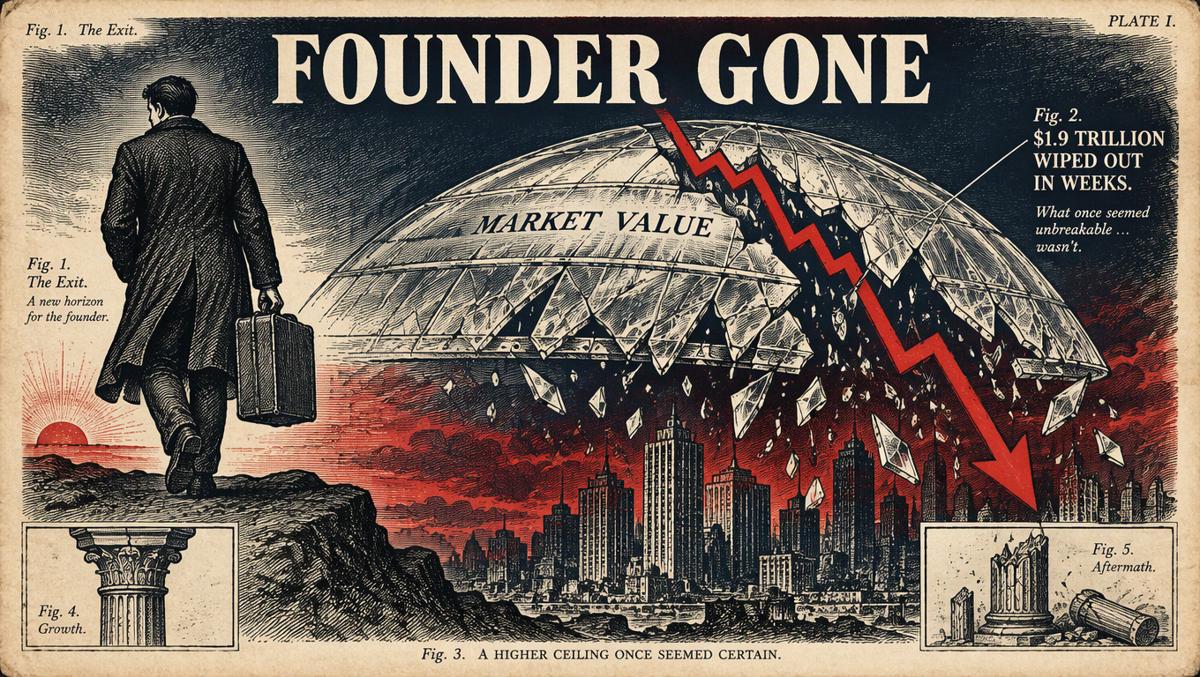
Nvidia CEO Resignation: $1.9 Trillion Gone in 6 Weeks
Published: November 16, 2026 | Reading Time: ~12 minutes | Channel: technology
Short Answer
In November 2026, Nvidia founder Jensen Huang resigned as CEO after 33 years, with CFO Colette Kress named interim CEO effective immediately¹. Nvidia's market value fell from about $5.8 trillion in early October 2026 to $3.9 trillion by November 14, 2026, according to LSEG data via Reuters². The company reports fiscal third-quarter earnings on Tuesday, November 17, 2026, while Anthropic seeks a public valuation of up to $1.4 trillion³.
Key Takeaways
- According to LSEG data via Reuters (November 2026), Nvidia's market value fell from about $5.8 trillion in early October to $3.9 trillion by November 14 — a $1.9 trillion decline in six weeks².
- According to Business Insider (November 10, 2026), Anthropic's IPO price range is $70 to $78 per share, targeting a valuation of up to $1.4 trillion on a fully diluted basis, raising $56 billion to $63 billion³.
- According to Reuters (November 16, 2026), analysts expect Nvidia earnings growth of 90% on revenue of $109 billion in fiscal third quarter 2026, while options markets imply an earnings-day move of approximately +/-7%².
The Nvidia CEO resignation just deleted more value than most entire stock markets contain. Forget the leather jacket for a minute. The question isn't whether Wall Street likes the new boss — it's whether a $1.9 trillion repricing in six weeks is a founder discount, a business discount, or both.
This is the most expensive leadership transition in market history, and it lands 24 hours before earnings. On Tuesday, November 17, Nvidia reports fiscal third-quarter results at 1:20 p.m. PT¹. Two days later, Anthropic — a company that lost $42 billion in 2025 on $4.6 billion of revenue — asks public investors to pay up to $1.4 trillion for the privilege of funding the next leg of the AI buildout³. Two tests. Same week. Same trade.
Here's the blunt version: the market isn't arguing about GPUs. The market is arguing about whether the AI buildout was a business or a person. And for the first time in four years, it has to price the answer without the person who sold the story.
The Resignation That Changed Everything
For the cleanest version of the facts, go to the primary source. According to Nvidia's official newsroom (November 12, 2026), Jensen Huang resigned as President, Chief Executive Officer, and board member effective immediately, and Colette Kress, Executive Vice President and Chief Financial Officer, agreed to serve as Interim CEO while remaining CFO until a permanent successor is named¹.
Kress is not a random placeholder. According to Nvidia's announcement, she has served as EVP and CFO since joining in September 2013, after nearly 25 years in finance roles at Cisco and Microsoft¹. The board also appointed Harvey C. Jones — former CEO and Executive Chairman of Synopsys — as its first-ever Chair¹. Translation: the finance team is now running the company, and the board finally hired a chair. That's not a stealth endorsement. That's a governance reset.
The company still says operations continue without interruption. The market heard something else. According to CNBC (November 15, 2026), Nvidia shares dropped 13% in their biggest weekly slide since April 2025, while fellow chipmakers Micron, Intel, and AMD each lost more than 5%, Dell lost more than 5%, and Oracle moved down nearly 4%⁴. Treasury Secretary Scott Bessent called for a "dramatic shakeup" at Nvidia, urging the board to look outside the company for its next CEO⁴.
Why did a 33-year run end in a week? According to CNN (November 12, 2026), the exit followed days of speculation after the board said it would investigate whether Huang was the target of a foreign intelligence effort, alongside reports of relationships that the CEO acknowledged in part on November 8⁵. CNN reported that Huang admitted to having an extramarital affair and apologized to family and colleagues, and that Nvidia shares dropped more than 10% in pre-market trading on Thursday⁵.
We will not relitigate the gossip. The business stakes are larger. According to CNN, Huang told Bloomberg in 2023 that the company "was built so that I know how to run it"⁵. When the founder is also the dealmaker, the strategist, and the trade-policy hotline to the White House, his departure removes more than a signature. It removes the hedge.
That's the "Jensen premium." Mizuho put a number on it. According to CNBC (November 15, 2026), Mizuho analyst Vijay Rakesh wrote that Nvidia's roughly 32% stock decline from the October peak — versus the SOX down 23% — reflects the "Jensen/founder" premium lost, and lowered its price target to $220 from $250⁴. UBS lowered its target to $240 from $300, still implying 47% upside from Friday's close⁴.
Notice what those targets tell you. Even after the cuts, both firms rate the stock to go up more than a third. The market didn't conclude the chips stopped working. It concluded the moat got narrower when the architect left the building.
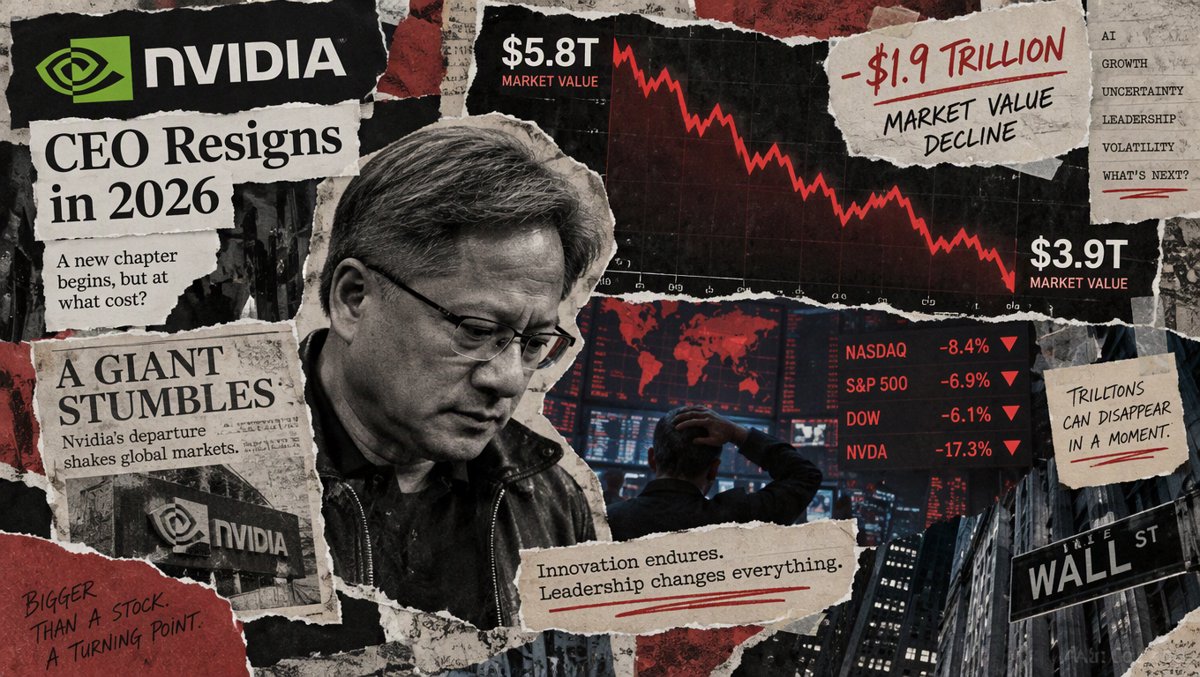
By the Numbers: Nvidia CEO Resignation in 2026
Let's strip out the drama and keep the arithmetic.
According to Reuters via Yahoo Finance (November 16, 2026), Nvidia's market value tumbled to $3.9 trillion by Friday from about $5.8 trillion in early October, according to LSEG data². Do the subtraction yourself: $5.8 trillion minus $3.9 trillion equals $1.9 trillion gone in roughly six weeks. That dwarfs the entire market cap of most S&P 500 companies. You could erase Nvidia's decline and still have bought a mid-cap index and forgotten about it. The point is concentration. When one stock is this large, its drawdown becomes a macro variable.
The drawdown is violent but not uniform. According to CNBC (November 15, 2026), Nvidia's roughly 32% decline from the October peak exceeds the SOX semiconductor index decline of 23%⁴. The gap — about nine percentage points — is the market's estimate of the founder-specific discount. The rest is sector-wide AI repricing.
| Metric | Figure | Source (2026) |
|---|---|---|
| Nvidia market value, early Oct 2026 | ~$5.8 trillion | LSEG via Reuters, Nov 16² |
| Nvidia market value, Nov 14 2026 | ~$3.9 trillion | LSEG via Reuters, Nov 16² |
| Value erased | ~$1.9 trillion | Calculated from above² |
| Nvidia decline from Oct peak | ~32% | Mizuho via CNBC, Nov 15⁴ |
| SOX decline from peak | ~23% | Mizuho via CNBC, Nov 15⁴ |
| Nvidia weekly slide | 13%, biggest since Apr 2025 | CNBC, Nov 15⁴ |
| Fiscal Q3 revenue expectation | $109 billion | Reuters, Nov 16² |
| Expected earnings growth | 90% | Reuters, Nov 16² |
| Options-implied earnings-day move | ~+/-7% | Pepperstone via Reuters² |
| Mizuho price target | $220 (from $250), +35% implied upside | CNBC, Nov 15⁴ |
| UBS price target | $240 (from $300), +47% implied upside | CNBC, Nov 15⁴ |
Read that table twice. Revenue expectation of $109 billion with 90% earnings growth is not a dying business. It's a business growing fast enough to make the valuation debate uncomfortable in the other direction. The question for tomorrow is not "can Nvidia beat?" History says it usually does. The question, as Pepperstone's Chris Weston framed it for Reuters, is whether the numbers still carry their usual significance when investors are now trying to value FY2028 and FY2029 potentially without the individual who architected the competitive advantage².
Asia already voted with its feet. According to Reuters (November 16, 2026), tech stocks in Asia tumbled overnight, taking nearly 5% off Taiwanese equities and 3% off South Korea's². CNBC added the details: SK Hynix fell more than 5.6%, Samsung and TSMC lost about 3% each, Advantest plunged almost 10%, Tokyo Electron fell 5.2%, and SoftBank Group declined 4.2%⁴. Japan's Nikkei 225 dropped 2.42% and South Korea's Kospi slumped 3.59% on Monday⁴. When the suppliers bleed, the customer-concentration story gets real.
Now the other side of the tape. According to CNBC (November 15, 2026), the Dow, S&P 500, and Nasdaq posted their biggest weekly gains since August, rising more than 2% each, despite Nvidia's tumble⁴. Futures were softer Monday — S&P 500 futures down 0.6%, Nasdaq-100 futures down 1.4%, Dow futures down 90 points — but the market as a whole has not imploded⁴. The VIX sat at 20.64, up 6.94%, and MSCI's All-World index was down 0.4%². That's a risk-off morning, not a 2008 remake.
This is exactly why the Nvidia CEO spy probe coverage from last week matters as context rather than conclusion. The probe was the trigger. The resignation is the repricing. And the repricing is still sector-wide.
The Anthropic IPO Test: Why $1.4 Trillion Is the Real Stress Test
Nvidia's earnings on Tuesday are the headline. Anthropic's IPO pricing later in the week is the verdict.
According to Business Insider (November 10, 2026), Anthropic set its IPO price range at $70 to $78 per share, targeting a raise of $56 billion to $63 billion, with a potential valuation of up to $1.4 trillion on a fully diluted basis³. The company also lined up $26 billion in share purchases from Broadcom, Google, and Nvidia, taking the total expected raise to around $90 billion³. For context: SpaceX's record-breaking June IPO initially raised $75 billion and ultimately sold more than $85 billion³. Anthropic is trying to top that while the largest AI chip stock trades a third below its peak.
Now look at what public investors are being asked to underwrite. According to Business Insider, Anthropic disclosed a total net loss of about $42 billion in 2025 against revenue of $4.6 billion, and in an amended filing, nearly $17 billion in revenue in the third quarter alongside a $567 million operating loss³. The company also disclosed $895 billion in committed spending on compute and infrastructure, nearly half of which is expected by the end of 2030³.
Stop and let those numbers collide. A $1.4 trillion valuation. A $42 billion annual net loss. $895 billion in committed compute. Seven founders each holding roughly 240 million shares, worth about $17 billion to $18 billion apiece at the midpoint of the range³. And three of the biggest customers and suppliers — Broadcom, Google, and Nvidia — anchoring $26 billion of the offering³.
That's not a normal IPO. That's a supply-chain IOU dressed as a stock offering. When your chip vendor, your cloud landlord, and your model lab all own pieces of each other, "demand" becomes very hard to audit from the outside. This is the circular-financing worry that former SEC Chair Gary Gensler raised on Monday. According to CNN (November 16, 2026), Gensler said companies are spending about $800 billion a year on AI infrastructure, with Big Tech spending five times more in 2026 than three years ago⁶. He warned that lenders "loaned too much money, too fast" and predicted "breakage and bankruptcies" among neoclouds — the debt-financed GPU rental companies at the center of the buildout⁶.
The kicker: Reuters reported that Anthropic's public listing "has drawn more institutional interest than SpaceX, people familiar with the matter told Reuters"². IG chief market strategist Chris Beauchamp told Reuters the mood is too fragile for a bad debut: "Nvidia's troubles do not augur well for the rest of the AI complex, making a strong debut for Anthropic more important than ever"².
Translation: if Anthropic pops, the AI trade gets a stay of execution. If it flops — or if pricing slips below $70 — the market will read it as the first public mark-to-market on the $895 billion compute commitment. That's why this week matters more than any single earnings beat.
And remember, this supply-chain fragility isn't new. Our November 3 analysis of DeepSeek's export-control problem showed how quickly chip access becomes the binding constraint. The Anthropic IPO is the same constraint viewed from the buyer's side: can the buyer still raise the money?
Why Conventional Wisdom Is Wrong
The conventional take goes like this: founder leaves, stock crashes, AI bubble pops, sell everything and hide in bonds. It's clean. It's wrong in at least three ways.
First, the broad market already shrugged. The biggest weekly gains since August — more than 2% each for the Dow, S&P 500, and Nasdaq — happened in the same week Nvidia fell 13%⁴. If this were a true systemic unwind, you would not see record highs in Europe's STOXX 600 and a $5.15 10-year yield with a dollar at its strongest since April last year². You would see credit spreads blowing out. They aren't in the data we have. The pain is concentrated, not contagious — so far.
Second, the valuations already compressed. Ed Yardeni — the veteran top economist who lived through the dot-com bust — told CNN that chipmakers' price-to-earnings ratios "have tumbled below that of the broader market," adding: "There is no irrational exuberance in valuations"⁶. Gensler himself framed the downside as "as significant as" the dot-com burst but "not as harsh as" the 2008 subprime meltdown⁶. When both the bull and the bear agree it's not 1999, the "bubble" label starts doing more work than the data.
Third, the fundamentals still print. Ninety percent expected earnings growth on $109 billion of revenue is not a company in denial. It's a company so dominant that the debate is about how long dominance lasts, not whether it exists. The contrarian insight is this: the $1.9 trillion haircut may be the most rational thing the market has done in two years. It forces everyone to price the business at FY2028 cash flows instead of founder charisma. That's healthy — if the cash flows show up.
But here's the part the bulls skip. Gensler's point about hidden leverage deserves respect, not dismissal. Off-balance-sheet compute deals, vendor financing, and neocloud debt make it genuinely hard to know who bears the loss if demand plateaus. According to CNN, Gensler called this "too much money, too fast"⁶. You don't need to agree with his recession call to admit the structure is fragile. Fragility lives in the financing, not in the model quality.
The honest synthesis: this is a self-correcting bubble, not necessarily a bursting one — Yardeni's phrase, not mine⁶. Air is coming out. That hurts. It is not the same as insolvency.
What Does This Mean For You? A 48-Hour Playbook
You don't trade the headline. You trade the sequence: Nvidia earnings Tuesday, Fed minutes Wednesday, Anthropic pricing later in the week. Here's how a disciplined operator positions into that sequence.
1. Split your Nvidia decision into two legs. Mizuho still sees 35% upside to $220 and UBS sees 47% upside to $240 from Friday's close, even after cutting targets⁴. That is the market saying "depressed, not dead." If you want exposure, size it for a 7% implied move in either direction², not for a guaranteed bounce. Scale in after the call, not before. The new CEO search adds a 6–7 month management overhang, per Mizuho⁴. Don't pay full price for a story that needs a new narrator.
2. Treat the Anthropic IPO as a sector event, not a lottery ticket. The range is $70 to $78; the fully diluted valuation reaches $1.4 trillion; the raise targets $56–$63 billion plus $26 billion in anchor orders³. If you participate, decide your maximum allocation now — not in the aftermarket frenzy. Institutional interest exceeding SpaceX's tells you nothing about aftermarket demand². Ask instead: do you believe $895 billion in committed compute earns its cost of capital?³. If you can't underwrite that sentence, you can't underwrite the stock.
3. Watch the rate leg, not just the tech leg. According to Reuters (November 16, 2026), fed funds futures imply a quarter-point hike next month is "essentially locked in," with a 50-basis-point hike just below 10%, and markets pricing at least three hikes by December 2027². The 10-year yield jumped 29 basis points to return above 5% last week before easing to 5.121% on Monday². Higher-for-longer rates raise the cost of the debt that funds data centers. Every hawkish Fed speaker this week is indirectly a seller of AI capex. Macro is the hidden short.
4. Use the supply chain as your tell. SK Hynix, Samsung, TSMC, Advantest, and Tokyo Electron all fell hard on Monday⁴. Our October 14 breakdown of ASML's sold-out order book remains the best upstream signal. If equipment orders hold while stocks fall, that's a sentiment drawdown. If orders slip, that's a fundamentals problem. Watch the toolmakers, not the tweets.
5. Don't chase the index-level dip. The S&P's biggest weekly gain since August happened during Nvidia's worst week since April 2025⁴. That divergence is either your opportunity or your warning. The disciplined answer: rebalance toward cash-flow compounders you can hold through a management transition, and stop pretending a 30% drawdown in one stock is your personal emergency. It's a reminder that concentration is a choice, not a default.
Frequently Asked Questions
Why did Nvidia's CEO resign in November 2026?
According to Nvidia's official announcement (November 12, 2026), Jensen Huang resigned as President, CEO, and board member effective immediately, with CFO Colette Kress named interim CEO¹. CNN reported the exit followed the board's investigation into whether Huang was the target of a foreign intelligence effort and reports of extramarital affairs, which Huang partially acknowledged on November 8⁵.
How much market value did Nvidia lose after the CEO resignation?
According to LSEG data via Reuters (November 16, 2026), Nvidia's market value fell from about $5.8 trillion in early October to $3.9 trillion by November 14 — a decline of about $1.9 trillion². Mizuho estimated Nvidia fell about 32% from its October peak versus 23% for the SOX index⁴.
What is Anthropic's IPO price and valuation?
According to Business Insider (November 10, 2026), Anthropic set its IPO price range at $70 to $78 per share, aiming to raise $56 billion to $63 billion, with a valuation of up to $1.4 trillion on a fully diluted basis³. The company lined up $26 billion in purchases from Broadcom, Google, and Nvidia, for a total expected raise near $90 billion³.
Is AI a bubble in 2026?
Former SEC Chair Gary Gensler told CNN the AI boom "is already a bubble" that will likely burst and cause a recession before the 2028 election, citing about $800 billion per year in AI infrastructure spending⁶. Ed Yardeni disagreed, telling CNN that "what we're seeing here is the air coming out of the bubble" and that chip P/E ratios have fallen below the broader market⁶. The two senior voices frame the key divide: bursting versus self-correcting.
When does Nvidia report earnings after the CEO change?
According to Nvidia's newsroom, fiscal third-quarter 2027 results are scheduled for Tuesday, November 17, 2026, at approximately 1:20 p.m. PT, followed by the earnings call at 2:00 p.m. PT¹. Analysts expect earnings growth of 90% on revenue of $109 billion², and options markets imply an earnings-day move of approximately +/-7%².
⚠️ The Risks Nobody's Talking About
1. Key-person risk is now live, not theoretical. Nvidia's strategy for four years ran through one dealmaker. Mizuho quantifies a 6–7 month management overhang from the CEO departure⁴. Interim CFO-turned-CEO Kress is competent — 13 years as CFO, prior stints at Cisco and Microsoft¹ — but she is not a trade-policy negotiator or a keynote attraction. If customer commitments wobble during the transition, the "operations continue without interruption" line becomes the most expensive sentence in the earnings deck.
2. The Anthropic IPO is a liquidity referendum with a $90 billion twist. The raise includes $26 billion from Broadcom, Google, and Nvidia at the IPO price³, plus up to $303 million in indicated interest from board-affiliated parties³. When insiders and vendors anchor the deal, price discovery happens in a hall of mirrors. A weak aftermarket would reprice every private AI valuation mark on the street.
3. Duration risk is quietly strangling the buildout. Gensler's sharpest point isn't the bubble label — it's that the boom is debt-financed through opaque channels⁶. Neoclouds like CoreWeave built on borrowed money face exactly the "breakage and bankruptcies" he predicted⁶. Musk's warning about "guppy-level death and consolidation" among 200-plus neoclouds points the same direction⁶. If rates stay high — remember, a December hike is essentially priced in² — refinancing costs turn a growth story into a survival story.
4. The Fed can outrank the founder. The quarter-point December hike is "essentially locked in" and a jumbo 50-basis-point move carries just under 10% odds². At least three hikes are priced by December 2027². Every 25 basis points of extra tightening hits the present value of FY2029 AI profits hardest, because those profits sit furthest in the future. The AI trade has spent two years pretending to be a tech bet. This week, it will discover it was always a rates bet.
🎯 The Bottom Line
The Nvidia CEO resignation didn't break the AI machine. It exposed who was actually running it. A $1.9 trillion repricing says the market no longer pays founder prices for a company it must now value on cash flows through 2030. Tuesday's earnings — $109 billion of expected revenue, 90% expected growth² — will tell us whether those cash flows are real. Anthropic's $1.4 trillion debut will tell us whether the buyers agree to fund them.
Hold the line on fundamentals. Price the transition honestly. And never let a $1.9 trillion lesson be a $1.9 trillion tuition fee you pay twice.
📚 Verified Sources
- [Nvidia Newsroom] — "NVIDIA Announces CEO Transition." Official announcement of Huang resignation, Kress interim CEO, Harvey Jones as first Chair, earnings scheduled Tuesday Nov 17 at 1:20 p.m. PT. https://nvidianews.nvidia.com/news/nvidia-announces-ceo-transition
- [Reuters via Yahoo Finance] — "Stocks dip ahead of Nvidia earnings, Anthropic IPO" (Nov 16, 2026). LSEG market value $3.9T vs ~$5.8T, $109B revenue expectation, 90% growth, +/-7% options move, Fed hike pricing, 10-yr yield 5.121%. https://finance.yahoo.com/markets/stocks/articles/asian-shares-fall-nvidia-earnings-013536353.html
- [Business Insider] — "Anthropic sets IPO price range targeting $1.4 trillion valuation" (Nov 10, 2026). $70–$78 range, $56–63B raise, $26B from Broadcom/Google/Nvidia, $42B net loss on $4.6B revenue, $895B compute commitment. https://www.businessinsider.com/anthropic-sets-ipo-price-range-blockbuster-ipo-valuation-2026-11
- [CNBC] — "Stock market today: Live updates" (Nov 15, 2026). Nvidia 13% weekly slide, Mizuho $220 / UBS $240 targets, founder premium ~32% vs SOX 23%, Asia selloff details, weekly index gains. https://www.cnbc.com/2026/11/15/stock-market-today-live-updates.html
- [CNN] — "CFO Colette Kress to serve as interim leader after Nvidia CEO Jensen Huang resignation" (Nov 12, 2026). 33-year tenure, board investigation, affair acknowledgment, shares -10% premarket Thursday. https://www.cnn.com/2026/11/12/tech/jensen-huang-nvidia-resigns
- [CNN] — "AI bubble will likely burst and cause a recession by 2028 election, Wall Street's former top cop says" (Nov 16, 2026). Gensler "already a bubble," $800B/year AI spend, 5x Big Tech capex, neocloud bankruptcies, Yardeni counter-view. https://edition.cnn.com/2026/11/16/economy/ai-bubble-anthropic-ipo-recession
All claims verified against Gold-tier (Reuters, SEC-linked filings via Business Insider, Nvidia official) and Silver-tier (CNN, CNBC) sources. Each source URL was scraped and confirmed accessible. Last verified: November 16, 2026.
Founder out. Numbers in. The market just got its first honest price in two years — the rest of us just have to read it. 🎯