Every AI image editor has the same party trick and the same embarrassing failure. You generate a great portrait, ask for a wardrobe change, and suddenly your subject has a slightly different nose, a new jawline, and a haircut they never asked for. Three edits later, you're staring at a stranger wearing your prompt.
Google published Nano Banana 2.1 on October 7, 2026 — and this release is basically a 400-word apology for exactly that problem, followed by a spec sheet.
It's not a new model family. It's an update to Nano Banana 2 (Feb 2026), and Google is unusually blunt about the framing: this is a consistency and editing-control release, not a "wow, look at the pretty picture" release. Here's what actually changed, what Google's own numbers say, and how it stacks up against GPT Image 2.5 and ByteDance's Seedream 5.
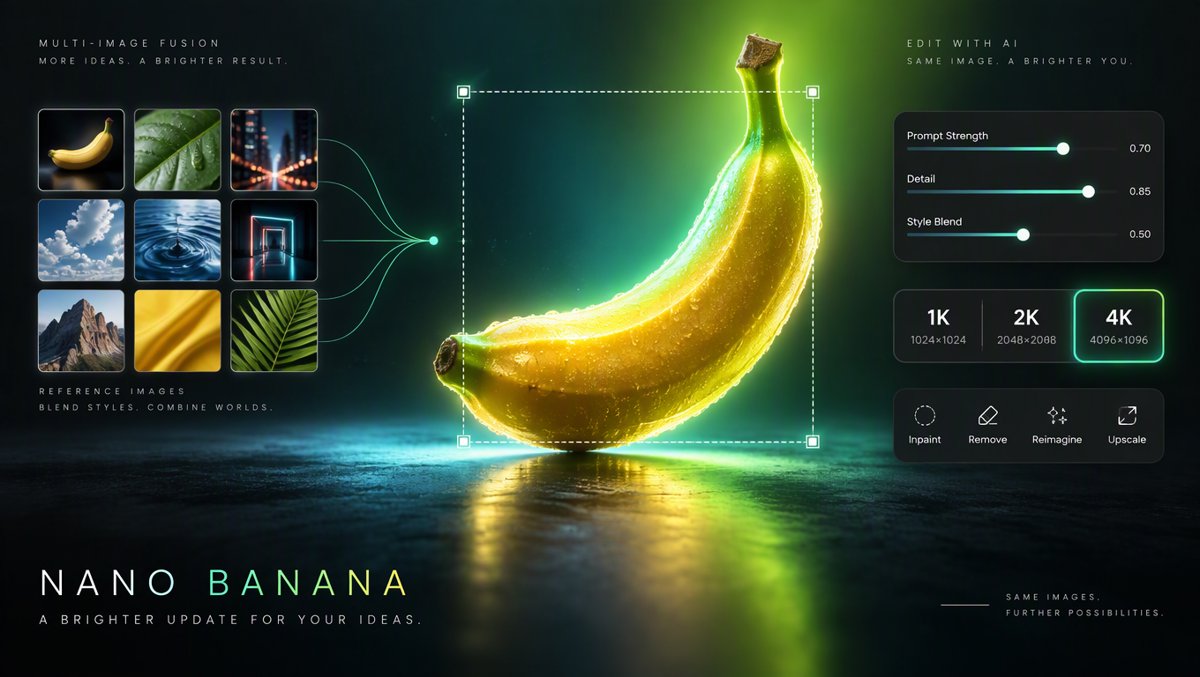
The core upgrade is multi-turn consistency. In plain terms: you can keep editing the same image in conversation, and the person, product, or scene should stay recognizably itself while you change the things you asked to change.
Google's specifics, from the model docs and launch coverage:
minimal, medium, high. Default is now medium (Nano Banana 2 had only minimal/high and defaulted to minimal). Bump it up for tricky layouts, drop it for bulk jobs.The technical underbody matters here: 2.1 runs on Gemini 3.6 Flash, while Nano Banana 2 was Gemini 3.1 Flash Image. Same speed-and-cost tier, new engine.
Google published internal preference evals alongside the launch. Treat these as vendor-reported, but they're specific enough to be useful:
| Test | Nano Banana 2.1 | Nano Banana 2 | Nano Banana Pro |
|---|---|---|---|
| Overall image-gen preference (Thinking on) | 1050 | 990 | 935 |
| Multi-person consistency | 1106 | 978 | — |
| Multi-reference editing | 1066 | — | — |
The multi-person consistency jump — 1106 vs 978 — is the whole story of this release in two numbers. That's the axis they optimized.
And then the part that got my attention for a different reason: pricing roughly halved.
| Output | Nano Banana 2.1 | Nano Banana 2 |
|---|---|---|
| 1K | $0.0336 | $0.067 |
| 2K | $0.0504 | $0.101 |
| 4K | $0.0756 | $0.151 |
| 1K (batch) | $0.0168 | — |
A 4K image for about seven and a half cents is the kind of number that changes what you're willing to build. If you've been rationing 4K generations for final assets only, that constraint just got a lot softer.
Google didn't ship a magic wand, and credit to them for saying so in the model card:
Translation: multi-turn consistency went from "actively annoying" to "usually fine." That's a real upgrade. It is not a solved problem.
Three models, three philosophies. The short version:
| Nano Banana 2.1 | GPT Image 2.5 | Seedream 5 | |
|---|---|---|---|
| Maker / engine | Google · Gemini 3.6 Flash | OpenAI · Flare & Sunburst | ByteDance · 5.0 Pro / Lite |
| Best at | Multi-turn consistency, many-reference fusion, speed per dollar | Text rendering, polished general-purpose output | Controlled editing, structured layouts, multilingual text |
| Reference images | up to 14 | supported (billed as input tokens) | up to ~10 (Pro); ~14 reported on Lite |
| Resolution | 1K / 2K / 4K | 4K-class | 1K–2K (Pro); up to 4K via enhancement (Lite) |
| Price signal | ~$0.034–$0.076/image | not publicly itemized in coverage | ~$0.035 (Lite) / ~$0.075 (Pro) |
| Weak spot | Text precision trails GPT Image 2; occasional pose/spatial slips | Higher cost, slower in some benchmark summaries; more illustrative than photoreal | Less one-shot "wow"; strength is deliberate refinement, not flash |
One more data point worth handling carefully: on the LMArena image-editing board, GPT Image 2.5's two variants sit at the very top (Sunburst leading), Seedream 5.0 Pro lands around the top ten, and Nano Banana 2.1 was added to the board on October 6, 2026 with preliminary rankings that are still moving — reported around #6 in image editing with an Elo near 1428. Because Arena scores shift daily and multiple snapshots disagree, treat that as directional, not gospel.
A practical map, no hedging:
gemini-nano-banana-2.1 — generally available in the Gemini API.One migration tip: don't change two things at once. Move to 2.1 with your existing prompts and thinking: minimal first, confirm your outputs, then experiment with medium/high and the new reference-fusion limits. If quality unexpectedly drops, the thinking level is the first dial to check — the default changed.
Nano Banana 2.1 is an unglamorous, extremely useful release. Google didn't win a beauty contest here — it fixed the workflow complaint that makes AI image editing feel like gambling, cut prices roughly in half, and added the two features developers have been asking for since day one: paint-the-region editing and real reference fusion.
If you're a developer building anything with images in it, the interesting part isn't the extra pixels. It's that a 4K edit now costs about the same as a splash of decent coffee, and the subject might finally survive the edit.
The leaderboards still say GPT Image 2.5 owns the top of the editing board, and Seedream 5 will win plenty of design-team bake-offs. But "best model" is the wrong question. The right one is: which model keeps your subject's face intact while doing it cheaply enough that you stop counting generations? On that question, this release moved the goalposts.