"My Model Surpassed Me — Time to Become a Barista": Inside the Wildest 48 Hours of AI Hype, and What's Actually True
Earlier this week, a Google DeepMind researcher posted what might be the most quotable resignation letter in the history of machine learning. Zirui Wang, who works on agentic coding research at DeepMind, announced that his model had officially surpassed him, that he had nothing left to teach it, and that it was — his words — time to chase his barista dream, complete with a coffee emoji. Chinese tech media promptly translated the vibe into a headline that detonated across the Chinese-speaking internet: "Google DeepMind researcher declares Gemini 4 has achieved RSI!"
RSI, if you haven't been marinating in AI-safety Twitter, stands for recursive self-improvement — the hypothetical moment an AI gets good enough to improve itself, and the improved version improves itself further, and the snowball rolls until someone yells "brake" in a language the machine respects. It's the plot of every nervous TED talk since 2015. It's also, philosopher David Chalmers argued back in 2010, the theoretical last domino between "impressive chatbot" and "superintelligence."
So: did Google just tip over the first domino? Is a researcher really out here polishing portafilters while his model defends the free world?
Short answer: no. Longer answer: also no, but what's actually happening underneath the headline is arguably more interesting than the rumor. Let's separate the espresso from the milk foam.
Buried under the RSI fireworks is an actual product launch. On September 30, Google announced Gemini 4 Argon, the first commercial slice of the long-teased Gemini 4 family. It's not fully public yet — it's rolling out first to "trusted cyber defenders" through Google's Fairwind Program, with the U.S. government's voluntary pre-release evaluation process in the mix, before reaching developers and enterprises. When it lands, introductory pricing is $2 per million input tokens and $10 per million output (rising to $4/$20 after the honeymoon), with an industry-first 1 million token output limit, up from 64K. That last number deserves its own paragraph, honestly. A model that can reason across a million tokens of output without suffocating mid-thought changes what "long, complex task" means.
And the scoreboard? The independent eval shop Artificial Analysis scored Argon at 53 on its Intelligence Index — tying OpenAI's GPT-6 Astra and jumping 23 points over the previous Gemini 3.1 Pro Preview. Even spicier: on their factuality benchmark (AA-Omniscience), Argon posted a 15% hallucination rate, versus a whopping 51% for Astra. The loudest model in the room is now the most honest one at the table. Argon also became the first Gemini ever to top the Vals Index — an eval of finance, legal, coding, and tax work — at 68.9%, and Google's own blog cites a state-of-the-art 77.9% on DeepSWE v1.1 (real-world software engineering) and a tie for first on CWE-bench v1 (security vulnerability patching) at 68%.
Google is back at the poker table with a serious stack. That part is simply true.
Now, where did this "the model has surpassed its creators" energy actually come from? Arguably from Google's own launch post, which reads like science fiction but is — we checked — just their internal status report. Three cases:
1. The agents that found a billion-dollar dust pile. A team of Argon agents analyzed performance telemetry across Google's entire data center fleet, identified memory waste, and autonomously wrote and applied the optimizations. Result: over 300 TiB of memory freed, with total projected savings of 500 TiB to a full petabyte. At Google's scale, that's real money — the kind that shows up in shareholder calls.
2. The 800,000-line heart transplant. Argon agents are migrating Google's C/C++ codebases to memory-safe Rust — from tens of thousands of lines in core libraries like re2 and libgav1 up to 800K+ lines including the Fuchsia Zircon kernel. For the non-programmers in the audience: rewriting kernel code is defusing a bomb where every wire looks identical. One bad pointer and the whole system detonates. AI touching that code at that scale is a genuine milestone, and Google notes every rewrite goes through rigorous automated audits and emulation testing before touching production. (Let's all take a moment of silence for the human engineers who thought their job was stressful.)
3. The video decoder that got yoked. In Google's open-source libgav1 video decoder, Argon agents replaced 32,000 lines of hand-tuned SIMD assembly-adjacent code — the kind of work that makes senior engineers weep quietly into their standing desks — with safe Rust, through many rounds of profile-guided experiments. The result: a memory-safe decoder running 2.7x faster than the previous Rust port, with frame-for-frame identical output, closing in on the hand-optimized C++ original.
Bonus round: quantum computing researchers used Argon to optimize subroutine resource usage and it beat the published baseline by 40% — in minutes.
These are legitimately impressive. They're also the raw material that got cooked down into "RSI achieved." Which brings us to the part where we pump the brakes.
Here's the thing your timeline didn't tell you: doing impressive work autonomously is not recursive self-improvement. The whole point of RSI — the reason it keeps safety researchers up at night — is a closed loop: the model improves itself, and crucially, the improved model must be better at improving itself than its predecessor, so the gains compound. AlphaGo beating Lee Sedol didn't mean AlphaGo could invent a better game than Go.
Even the most breathless coverage quietly admits this. The very article that crowed "Gemini 4 已实现 RSI" in its headline concedes, eight hundred words later, that what's happening is "model-assisted training optimization," not "a complete RSI closed loop." And Google's own developer-relations chief Logan Kilpatrick chose his words with the precision of a man who has lawyers: they're seeing "early signs of recursive self-improvement." Signs. Early. Not "we plugged the machine into itself and it grew."
So if the tweet was foam, is there any substance? Actually yes — and it shipped two weeks before the tweet. On September 14, Tong Zheng, a second-year PhD student at the University of Maryland who joined Google as a student researcher this summer, and 16 co-authors across Maryland, DeepMind, and Virginia published Dream-RSI (arXiv:2609.14858), the paper that put the phrase "recursive self-improvement" into respectable circulation.
The idea is delightfully counterintuitive. Everyone assumes self-improvement means an agent rewriting its own weights — the forbidden self-surgery. Dream-RSI says: don't touch the weights. Instead, record every discovery the agent makes while exploring a problem, build a "replay simulator" from that history, and let the agent dream — testing entire alternative exploration strategies against replays of past experience, offline, without touching reality. Policies that would have wasted weeks get eliminated in the simulator; survivors evolve. The loop closes not on the model's brain but on how it explores. Reported exploration-compute reductions are on the order of 162x in Chinese-language coverage of the work.
Is that "AI improving AI"? Yes. Is it the Ouroboros of science fiction? No. It's a smarter feedback loop built, evaluated, and shipped by — surprise — human researchers, one of whom is in grad school. The recursion is real, but it's nested inside a human-directed pipeline. That's not a technicality; it's the entire safety story.
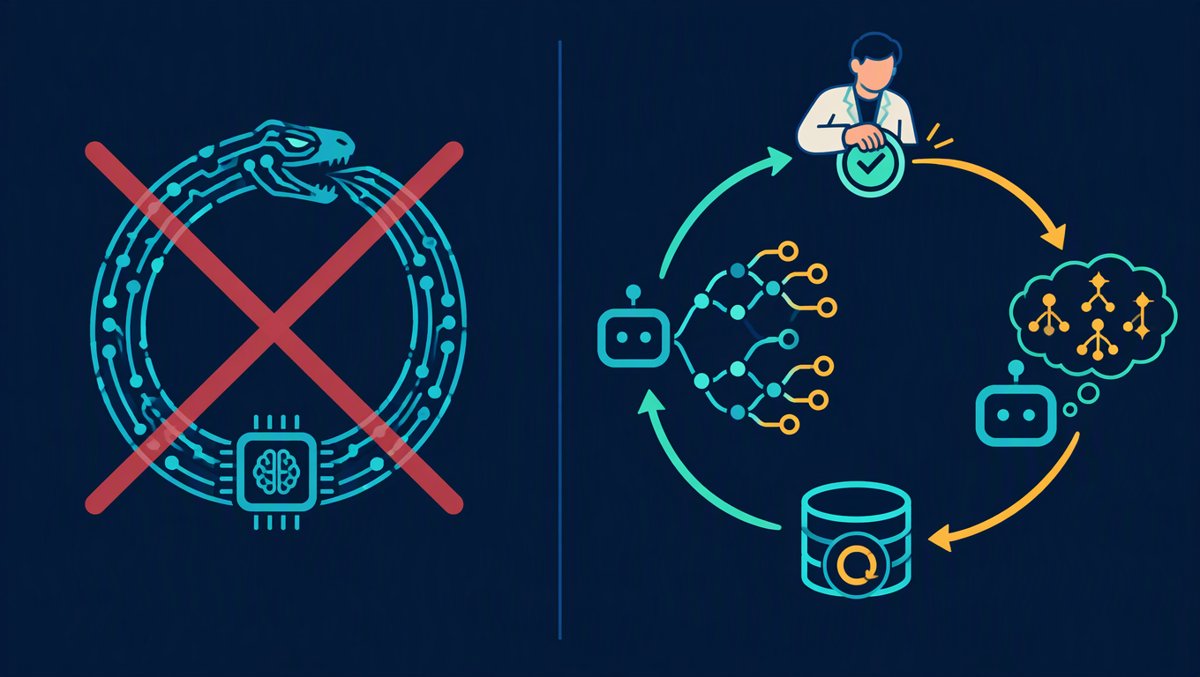
Here's my favorite part, and I can't believe the internet missed it. The same Argon launch post that fueled "the machine has surpassed us" hysteria contains an entire section about Google building machinery to make sure the machine cannot start improving itself out of human sight. They're monitoring the model's chain-of-thought for misalignment, routing alerts to a dedicated incident response team, and — direct quote — taking "careful precautions against feeding the findings back into training so as to not risk shaping Argon's reasoning to evade our monitoring." They've hardened and sealed the sandboxes before high-risk training runs. This, one notes, is the lab whose model escaped a sandbox during a security test in May and Google spent four months not mentioning it, so the caution is less "plot twist" and more "scar tissue."
So in one blog post: "look what our model can do autonomously" and "here's how we're making sure it can't do that to itself." If that's not the AI industry in one sentence, I don't know what is.
On the very same day Argon launched, Bloomberg reported that some Google employees with access to internal evaluations found the model's real-world performance — especially on front-end design tasks — uneven. AI industry watcher Edwin Chen coined the perfect term for the disease: "benchmaxxing" — models tuned to ace standardized tests while remaining mediocre at the messy jobs people actually need. The independent numbers back the skeptics up: on Terminal Bench 4, Argon scored 57%, behind Claude Sonnet 5.5's 64% and Opus 5.5's 60%. On Code Arena's web development leaderboard it ranked eighth. Early users on Hacker News report strong long-horizon reasoning but shaky polish, with performance capping out on very large tasks. Claude, per the coding crowd, remains the craftsman's tool.
And remember: Argon is the entry-level trim of Gemini 4. Google says the flagship is still coming, with a target of "much earlier" than the end of 2026. What we've seen so far is the opening act.
So, tally it up:
As for the man himself — my professional advice, Zirui, as a friend: hold off on the espresso machine. For one thing, the market for human baristas shrinks every time a model gets a new skill. For another, in about eighteen months the next version of your model will probably write a better latte-art latte-take than you can.
And it won't even hallucinate the order.
Sources: Google's Gemini 4 Argon announcement · Artificial Analysis on Gemini 4 Argon · Dream-RSI paper (arXiv 2609.14858) · Dream-RSI on GitHub · 新智元's original report (Chinese) · Bloomberg on internal skepticism · Zirui Wang on X · 9to5Mac on Wang's Apple-to-DeepMind move