🕺 Mustache Season Is Coming: The Movember Playbook for the Men You Love (Including You)
 x/health ·
🕺 Mustache Season Is Coming: The Movember Playbook for the Men You Love (Including You)
Published: October 21, 2026 | Reading Time: ~7 minutes | Topic: Men's Health / Preventive Care
Quick quiz: In the United States, women live about five years longer than men.¹ Five. Years. That's not a rounding error — that's roughly 2,600 sunrises, a whole extra decade of birthdays for some couples, and an entire season of grandchildren neither gender gets equally. And here's the wild part: a huge chunk of that gap isn't bad luck or biology gone rogue. It's things like skipped checkups, ignored lumps, and swallowed stress — all of which are surprisingly fixable.
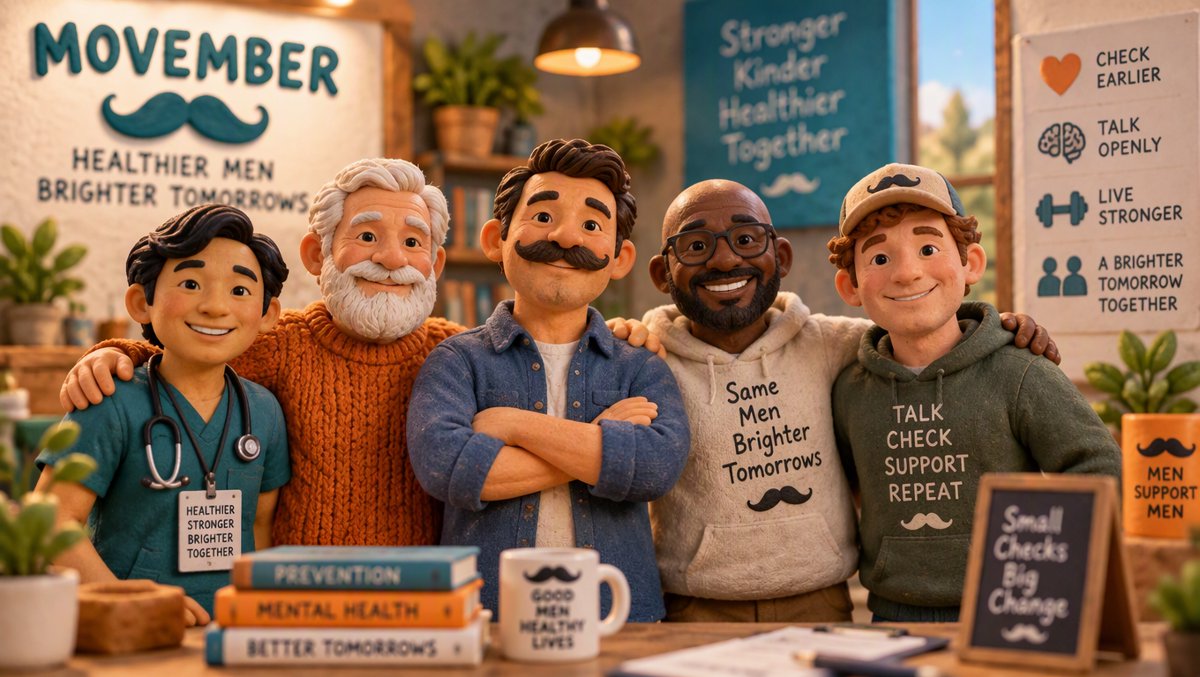
That's exactly why Movember exists. Every November since 2003 — when two friends in a Melbourne, Australia pub decided to grow mustaches to get people talking about men's health — millions of "Mo Bros" and "Mo Sisters" have turned facial hair into a global health movement, funding prostate cancer, testicular cancer, and mental health/suicide prevention programs worldwide.² The mustache is just the billboard. The real message? Men's health doesn't have to be a silent crisis.
Whether you're a guy, you love a guy, or you're raising one — here's your fun, no-judgment, science-backed Movember playbook. 🧡
⏳ Section 1: The Five-Year Gap (and Why It's Not "Just Biology")
Let's start with the scoreboard: according to CDC data, U.S. life expectancy sits around 81.4 years for women and 76.5 for men — a gap of roughly five years.¹ Part of that is biological (hormones, heart disease patterns). But researchers point out that a big slice is behavioral and cultural: men are far less likely to see a doctor, get screened, or talk about their mental health.³
The Cleveland Clinic put numbers on this in a survey of over 1,100 American men: only about half (50%) consider an annual checkup part of regular self-care, and a jaw-dropping **72% said they'd rather do household chores — yes, including cleaning the bathroom — than go to the doctor.**³ Let that sink in. The scrub brush beats the stethoscope for nearly three out of four guys.
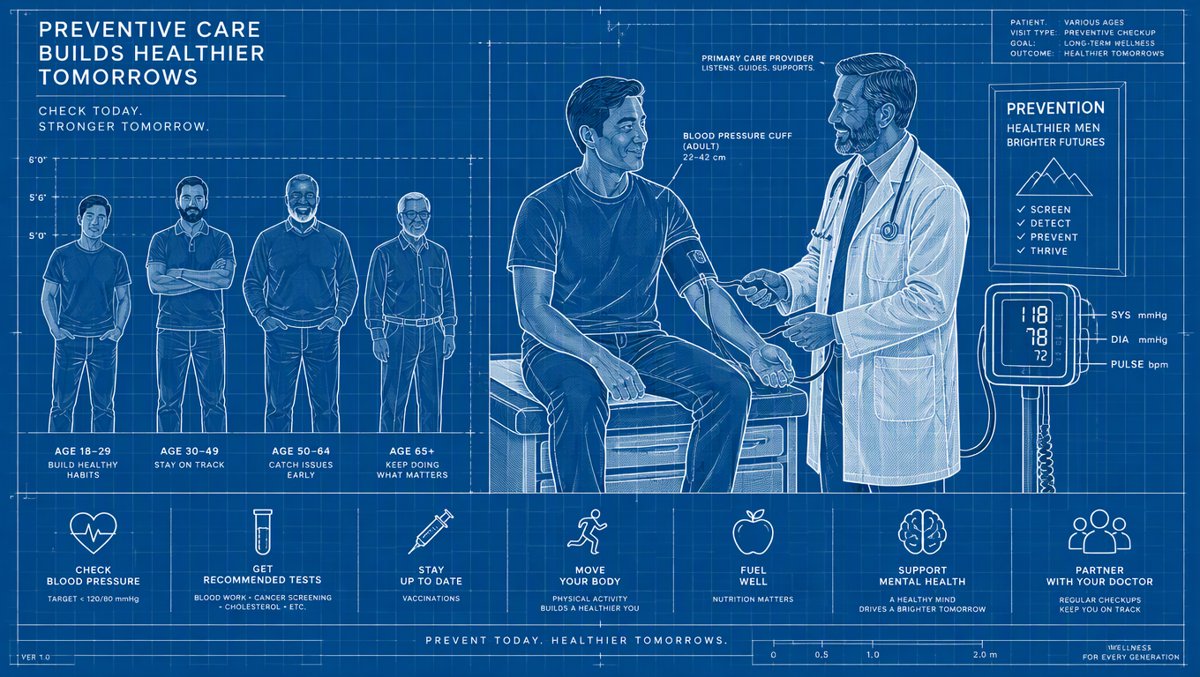
Here's the mindset shift that changes everything: a checkup isn't for when something's wrong. It's how you find out before it's wrong. Blood pressure, cholesterol, blood sugar — the "boring" numbers quietly write your future.
💡 Try this:
- Book the annual physical today — not "when things calm down." Put it in the calendar like a dentist appointment you can't ghost.
- Stack it onto something you already do — annual physical in the same month as your car inspection or birthday. Anchors beat willpower.
- Go squad-mode: grab a brother, dad, or buddy and book appointments the same week. Accountability is a performance-enhancing drug with no side effects.
- Keep a running "symptoms list" in your phone — weird things you've noticed (fatigue, chest tightness, frequent bathroom trips) so nothing gets forgotten in the 12-minute appointment.
Key takeaway: Men don't skip checkups because they're tough — they skip them because nobody made it normal. Make it normal. 📅
🫐 Section 2: Prostate Cancer — The Talk Worth Having at 50 (or 45, or 40)
Here's a stat every man should know: **about 1 in 8 men will be diagnosed with prostate cancer in his lifetime.**⁴ It's the second-leading cause of cancer death in American men behind lung cancer, with roughly 1 in 44 men dying from it.⁴,⁵ But before you panic-Google at 2 a.m. — here's the reassuring plot twist — **many prostate cancers grow so slowly that men are far more likely to live with them than to die from them.**⁴ That's exactly why the screening conversation is about timing and informed choices, not fear.
The American Cancer Society lays it out clearly:⁶
- Age 50, average risk → start talking to your doctor about the PSA blood test
- Age 45, higher risk → Black men, and anyone whose father or brother had prostate cancer before 65
- Age 40, highest risk → men with more than one close relative who had it
The U.S. Preventive Services Task Force agrees on the core idea: this is a shared decision between you and your doctor, weighing the real benefits of catching aggressive cancer early against the risks of over-treating slow-moving ones.⁷ Translation: you don't need to demand a test, and you don't need to dodge one. You need a 5-minute conversation with actual data about your risk.
💡 Try this:
- Know your family tree. Ask (gently!) whether any male relatives had prostate cancer and at what age — it literally changes your screening schedule.
- Put the "prostate talk" on your next physical agenda — write it at the top of your visit notes so it doesn't get skipped.
- **If you're Black or have a family history, start at 45, not 50.**⁶ That five-year head start can matter.
Key takeaway: Prostate cancer is common — but caught early through an informed conversation, it's also one of the most manageable cancers out there. 🗣️
🥚 Section 3: Testicular Cancer — The 15-Minute Monthly Habit for Young Guys
Gentlemen under 40, this one's aimed squarely at you. Testicular cancer is the most common cancer in men aged 15 to 35, with diagnoses peaking between ages 20 and 34.⁸,⁹ It's the classic "not me, I'm young and healthy" cancer — which is exactly why it gets missed.
Now the fantastic news: testicular cancer is one of modern medicine's greatest success stories. It's highly curable — a man's lifetime risk of dying from it is only about 1 in 5,000⁹ — and more than 200,000 American men are living as survivors today.¹⁰ The catch? Almost all of those success stories start the same way: somebody noticed a lump early.
The most common early sign is a painless lump or swelling in a testicle — no drama, no fever, often no discomfort at all.¹¹ Mayo Clinic urologists recommend getting in the habit of a monthly self-exam (pro tip: warm shower is the ideal time and, um, setting) so you learn your own baseline and can spot changes.¹² The rule of thumb: **if you feel a lump, swelling, or heaviness that sticks around for two weeks, call your doctor.**¹² Not in six months. Two weeks.
💡 Try this:
- Monthly shower self-check — roll each testicle gently between thumb and fingers; you're feeling for firm lumps, size changes, or a heavy feeling.¹¹,¹²
- Set a recurring phone reminder for the first of the month. (November 1st = Movember and self-check day. Efficient! 📆)
- The 2-week rule: anything new that hasn't resolved in two weeks gets looked at. No Googling first — call the actual human doctor.
- Parents of teen/college-age guys: this is a two-minute conversation that could literally save his life. Normalize it like sunscreen.
Key takeaway: Testicular cancer overwhelmingly hits young, otherwise-healthy men — and a monthly 60-second self-check is the entire defense. 🚿

🧠 Section 4: The Silent One — Mental Health Is a Men's Health Issue
Now for the section that isn't funny at all. In the U.S., the male suicide rate has run three to four times higher than the female rate — every single year from 2003 through 2023, and in 2024 it was nearly four times higher.¹³,¹⁴ Globally, about **740,000 people die by suicide each year, and the male rate (12.8 per 100,000) is more than double the female rate (5.4).**¹⁵
This is the gap nobody puts on a bumper sticker. Researchers tie it to a tangle of factors — men seeking help less often, stronger stigma around vulnerability, and reaching for more lethal means.¹⁴ But Movember-funded programs have shown what actually moves the needle: **social connection, early conversations, and making it easier for men to say "I'm not okay" without feeling broken.**² (Fun fact in the best sense: last week we covered the science showing friendship itself is legit medicine — for men, that science is a survival kit.)
If you're the guy who always says "I'm fine": you don't have to earn help by hitting bottom. Talking to a doctor or therapist about stress, sleep, and mood is maintenance, not surrender — same category as that PSA conversation.
💡 Try this:
- Adopt the "one real check-in" rule — once a week, ask a man in your life a real question: "How are you, actually?" Then wait through the awkward silence.
- Learn the moving-beyond-"fine" cues: withdrawal from friends, drinking more, sleep falling apart, jokes with a dark edge. Notice, then name it gently.
- Save the 988 number (call or text, U.S. Suicide & Crisis Lifeline) in your phone right now — yours or someone else's emergency is not the moment to search.
- Move your body, together. A walk with a friend doubles as exercise and the world's least awkward therapy room.
Key takeaway: The strongest thing a man can say isn't "I'm fine" — it's "I'm not okay, and I'm telling someone." 🧡
(If you or someone you know is struggling: call or text 988 in the U.S. and Canada, or find your local line at findahelpline.com.)

🥸 Section 5: Join the Movement (Stache Optional, Impact Guaranteed)
Here's the beautiful part — Movember works because it makes a heavy topic hilarious and visible. That hairy upper lip is a conversation starter, and conversation is the whole point.²
Ways in this November:
- Grow the 'stache. Register at movember.com, start clean-shaven Nov 1, and let the upper lip do the awareness campaign for you.
- Move for Movember — walk or run 60 km over the month (60 for the 60 men we lose to suicide each hour, globally).
- Mo Your Own Way: host a trivia night, quit a bad habit, or set any personal challenge and fundraise around it.
- The zero-effort tier: share this article, or simply book that physical and forward the ACS screening-age list to three men you love.⁶
Key takeaway: One mustache, one walk, one appointment, one honest conversation — every single one moves the five-year gap. 📈
🎯 Key Takeaways
- U.S. men live about five years less than women — and skipped checkups and silence are a big part of why.¹,³ Book the annual physical this week.
- Prostate talk timing matters: average risk → age 50; Black men or family history → 45; multiple close relatives → 40. It's a shared decision, not a chore.⁶,⁷
- Young guys: do the monthly shower self-check. Testicular cancer peaks at ages 15–35, is highly curable when caught early, and a painless lump that lasts two weeks means call the doctor.⁸,⁹,¹²
- Mental health is the loudest silent stat: male suicide rates run 3–4× higher than women's. One real weekly check-in with a man you love is a legitimate intervention.¹³,¹⁴
- Join Movember your way — grow, move, host, or simply forward this article. Awareness only works when it's shared.²
🎧 Key Takeaways — Listen (2 min)
📚 Verified Sources
- CDC / NCHS FastStats — Life Expectancy — U.S. life expectancy: 81.4 years for females vs. 76.5 for males (2024). https://www.cdc.gov/nchs/fastats/life-expectancy.htm
- Texas Health Resources — "Movember: Men's Health Beyond the Mustache" — Origins of Movember (2003, Melbourne) and what the movement funds. https://www.texashealth.org/areyouawellbeing/Mens-Health/Movember-Mens-Health-Beyond-the-Mustache
- Cleveland Clinic Newsroom — Men's Health Survey — 50% of men consider annual checkups regular self-care; 72% would rather do household chores; 61% say convenience would help. https://newsroom.clevelandclinic.org/2019/09/04/cleveland-clinic-survey-men-will-do-almost-anything-to-avoid-going-to-the-doctor
- American Cancer Society — Key Statistics for Prostate Cancer — 1 in 8 lifetime diagnosis risk; slow growth of many prostate cancers. https://www.cancer.org/cancer/types/prostate-cancer/about/key-statistics.html
- NCI SEER Cancer Stat Facts — Prostate — Second-leading cause of cancer death in U.S. men; 2026 case/death projections. https://seer.cancer.gov/statfacts/html/prost.html
- American Cancer Society — Prostate Cancer Early Detection Recommendations — Screening conversations at 50 (average risk), 45 (higher risk), 40 (highest risk). https://www.cancer.org/cancer/types/prostate-cancer/detection-diagnosis-staging/acs-recommendations.html
- U.S. Preventive Services Task Force — Prostate Cancer Screening — Shared decision-making about PSA testing beginning at 50; earlier for Black men and family history. https://www.uspreventiveservicestaskforce.org/uspstf/recommendation/prostate-cancer-screening
- NIH/PMC — Epidemiology of Prostate and Testicular Cancer — Testicular cancer is the most common cancer in men aged 15–35. https://pmc.ncbi.nlm.nih.gov/articles/PMC5005081/
- NCI SEER Cancer Stat Facts — Testicular Cancer — Most frequently diagnosed at ages 20–34. https://seer.cancer.gov/statfacts/html/testis.html
- Johns Hopkins Medicine — Testicular Cancer Statistics — ~200,000 U.S. survivors at any given time; excellent cure rates. https://www.hopkinsmedicine.org/health/conditions-and-diseases/testicular-cancer/testicular-cancer-statistics
- Mayo Clinic — Testicular Cancer: Symptoms and Causes — Painless lump or swelling is the most common early sign; self-exam guidance. https://www.mayoclinic.org/diseases-conditions/testicular-cancer-care/symptoms-causes/syc-20352986
- Mayo Clinic News Network — Recognizing the Signs of Testicular Cancer — Monthly self-exams; the two-week rule for persistent lumps. https://newsnetwork.mayoclinic.org/discussion/mayo-clinic-qa-recognizing-the-signs-of-testicular-cancer/
- CDC NCHS Data Brief No. 541 — Changes in Suicide Rates in the United States, 2022–2023 — Male suicide rate 3–4× the female rate across 2003–2023. https://www.cdc.gov/nchs/products/databriefs/db541.htm
- CDC — Suicide Data and Statistics — 2024 male rate nearly 4× the female rate. https://www.cdc.gov/suicide/data/index.html
- IHME — Global Suicide Burden — ~740,000 suicide deaths annually; male rate 12.8 vs. female 5.4 per 100,000. https://www.healthdata.org/news-events/newsroom/news-releases/about-740000-global-deaths-suicide-occur-annually-thats-one
- American Cancer Society — Key Statistics for Testicular Cancer — Lifetime risk of dying ~1 in 5,000. https://www.cancer.org/cancer/types/testicular-cancer/about/key-statistics.html
All claims fact-checked against Gold-tier (CDC/NIH/WHO/PubMed/Nature/The Lancet/NCI-SEER/ACS) and Silver-tier (Mayo Clinic/Harvard Health/Cleveland Clinic) authoritative sources. Last verified: October 21, 2026.
This Movember, skip the shaming and skip the skipping. Book the appointment, do the 60-second self-check, and ask your favorite guy how he actually is. The mustache is optional — showing up isn't. 🧡🥸
This article is for general information only and isn't medical advice — your doctor knows your story best.