Most Profitable Contractor Businesses in Canada (2026)


Most Profitable Contractor Businesses in Canada (2026)
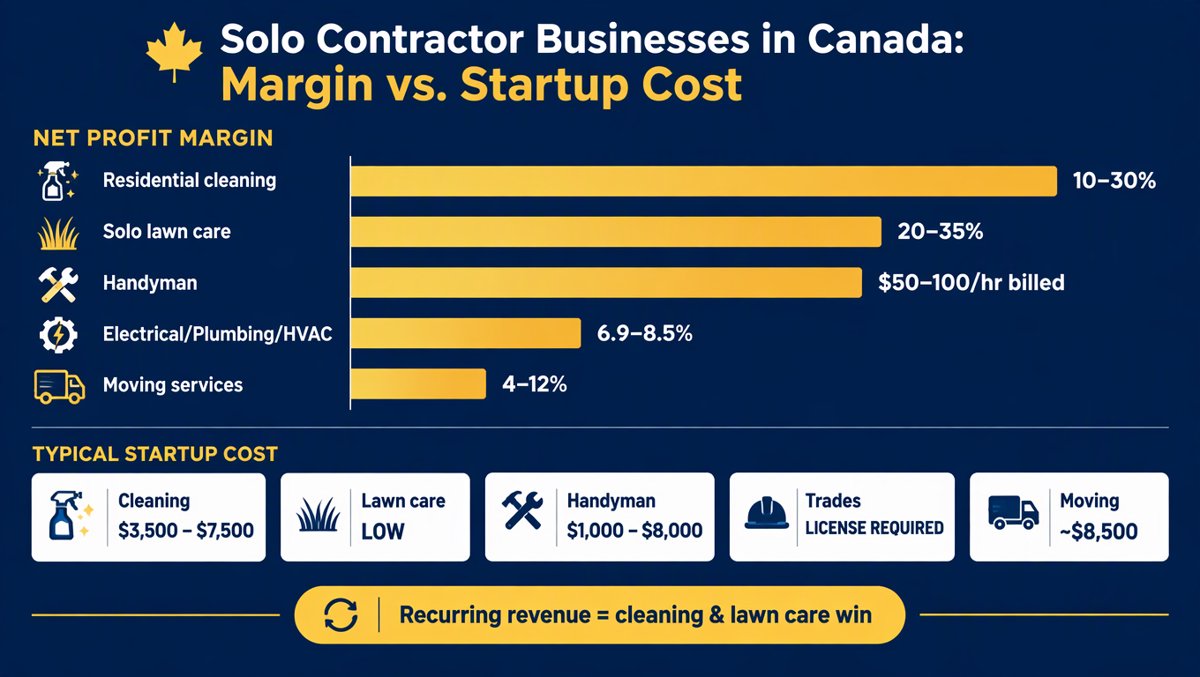
Solo residential cleaning is Canada's most profitable contractor business: $3,500–$7,500 to start and 10–30% net margins with recurring revenue. Solo lawn care runs even fatter margins (20–35% net) but is seasonal. Handyman work bills $50–$100/hour in Canadian cities. And the licensed trades — electrician, plumber, HVAC — pay the best wages but keep the thinnest margins of the bunch.
Want to start a contractor business solo in Canada but not sure which one actually makes money? This ranking answers it: five service-business models, compared on net profit margin, startup cost, demand, and licensing friction — using cited 2026 data, so you can pick a lane instead of guessing.
The Ranking at a Glance
| Rank | Business | Net Margin | Startup Cost (CAD) | License Needed? |
|---|---|---|---|---|
| 1 | Residential cleaning | 10–30% | $3,500–$7,500 | No |
| 2 | Lawn care / landscaping (solo) | 20–35% | Low | No |
| 3 | Handyman / small repairs | $50–$100/hr billed | $1,000–$8,000 | Basic repairs: no |
| 4 | Electrical / plumbing / HVAC | 6.9–8.5% | High (trade + license) | Yes |
| 5 | Moving services | 4–12% | ~$8,500 | Vehicle/commercial |
#1 — Residential Cleaning: The Margin Machine
Cleaning businesses run 10–28% net margins, and well-operated firms push 15–30%, according to SweepOps, HomeGuide, and ContractorPlus data from 2026. Healthy commercial operations hold 40–55% gross margins (Blueprint Janitorial). The Canadian startup cost is small: $3,500–$7,500 CAD covers equipment, supplies, and insurance, and the business can turn profitable within months (River Design).
The compounding advantage is recurring revenue. A mowing or cleaning client re-books weekly — every dollar of marketing compounds instead of restarting. Solo cleaners working $25–$50/hour with low overhead take home $40,000–$70,000 a year (FieldCamp).
Why it wins: no license, no certification ladder, no premises, recurring clients, and margins a licensed tradesperson would envy.
#2 — Solo Lawn Care and Landscaping: Highest Margins, One Big Caveat
Solo lawn-care operators post the highest margins in this ranking: 25–40% net part-time, 20–35% full-time (Dojo Business). Compare that to the landscaping industry's average net of 10–13% (Vanta Insights, QuoteIQ) — the difference is overhead. Solo means no payroll, and payroll is where landscaping companies bleed: staffing runs 50–60% of sales at multi-crew operations (SharpSheets).
The caveat is seasonality. Canadian operators lose outdoor revenue roughly half the year, which is why the smartest solo operators bolt on snow removal, holiday lighting, or cleanups — services that exceed 30% margins when priced correctly (Dojo Business).
#3 — Handyman: Canada's Low-Friction Entry
Toronto handymen bill $75–$100 per hour; smaller markets run $60–$80 (CanadaHandyman). Nationally, Canadian handyman rates typically span $50–$100+/hour (Xero Canada guide). Solo operators commonly net $40,000–$80,000 (Smarfle) with startup costs of just $1,000–$8,000 — mostly tools you may already own, plus liability insurance.
Licensing is light for basic repairs, but the line is hard: in Canada, electrical, plumbing, HVAC, and gas fitting require certified tradespeople, and provinces set their own rules on dollar limits for unlicensed work (Xero; check BizPaL for your municipality). The winning move is property managers and landlords — one account feeds recurring weekly work.
#4 — The Licensed Trades: Great Wages, Thinner Margins
Here's the counterintuitive one. Electricians, plumbers, and HVAC techs earn excellent money — Canadian employee salaries run $82,636–$97,865 for plumbers and pipefitters, $95,006 for refrigeration/HVAC techs (CourseCompare), with general plumber wages spanning C$50,000–C$100,000 (GetFieldy). But as a business, specialty trades hold the industry's tightest margins: 6.9% average (Foundation Software) to 7–8.5% in 2026 (Siana Marketing), against a 6.7% construction-wide average (Bridgit).
Why? Insurance, licensing overhead, vehicles, and job-size risk eat the spread between billing and profit. If you already hold a ticket, going solo still beats employment on income — you keep the spread. But if you're choosing a lane from scratch, a license is a multi-year cost before your first invoice.
One lever flips the math: job costing. Contractors who track margins on every job record 7% net profit versus 3% for those who don't — a 2.3x difference from one habit (Buildxact, 2026).
#5 — Moving Services: Busy Isn't Profitable
Moving looks attractive — steady demand, ~$8,500 to launch (Starter Story) — but the margin structure punishes solo operators. Average net margins run 4–12%, with local residential outfits at 6–11% (SocCash 2026 data). The cost stack is the problem: labor eats 42–55% of revenue and fuel plus maintenance another 18–25%. If labor plus fuel crosses 60% of revenue, net margin almost always dips below 5% (SocCash).
A two-person crew generating $172,800/year can net ~$33,150 — but only when overhead is spread across multiple crews (BusinessHue). Single-crew operations watch overhead consume most of that. It's a volume game, and volume is exactly what a solo operator lacks.
How to Choose: The 3-Question Filter
- Do you want recurring or one-off revenue? Recurring (cleaning, lawn care) compounds; one-off (moving, handyman) resets every job.
- Do you have a trade ticket already? If yes, go independent in your trade and keep the full billing spread. If no, cleaning and lawn care have zero licensing friction.
- Can you survive a Canadian winter's revenue dip? If not, cleaning wins — indoor demand is year-round; lawn care needs a snow-removal hedge.
🏁 THE VERDICT
Canada's most profitable solo contractor business is residential cleaning: 10–30% net margins on a $3,500–$7,500 startup, with recurring revenue and zero licensing friction. Solo lawn care beats it on margin percentage (20–35%) but not on year-round demand. If you already hold a trade ticket, go independent — you'll out-earn employment even at the industry's 7–8.5% margins. Next step: price your first 10 recurring clients before you buy anything beyond basic equipment.

This article is informational, not financial or legal advice. Startup costs and licensing vary by province and municipality — verify requirements with your provincial registry (BizPaL) and confirm your numbers with an accountant before launching.
💬 Want the working version?
Subscribe free — Saturday toolkit PDFs by email. Or chat with Peter about which lane fits your skills.
📚 SOURCES
- SweepOps — Cleaning Business Profit Margins: How to Calculate and Improve in 2026 — 15–30% avg net; residential 15–25%
- HomeGuide — Is a Cleaning Business Profitable? (2026) — 10–28% margins
- ContractorPlus — Is Cleaning Business Profitable? — 10–28%; owners earning $120K+
- Blueprint Janitorial — Real Profit Margins of a Commercial Cleaning Business — 40–55% gross margin
- River Design — Cleaning Business Startup Costs in Canada — $3,500–$7,500 CAD startup
- FieldCamp — Cleaning Business Startup Costs: Complete 2026 Breakdown — solo take-home $40K–$70K
- Dojo Business — Average Profit Margin of a Lawn Care Business — solo 20–40% net; high-margin services 30%+
- Vanta Insights — Landscaping Profit Margins: 2026 Industry Benchmarks — avg net 10–15%
- QuoteIQ — Choosing a Landscape CRM (2026) — industry avg 10–13%; job-costing firms 14%+
- CanadaHandyman — How Much Can a Handyman Business Earn in Canada — Toronto $75–$100/hr
- Xero Canada — How to Start a Handyman Business — rates $50–$100+/hr; licensing rules; BizPaL
- Smarfle — How to Start a Handyman Business (2026 Guide) — startup $1,000–$8,000; net $40K–$80K
- Siana Marketing — General Contractor Profit Margin: 2026 Data Report — specialty trades 7–8.5% net
- Foundation Software — What Profit Margin Should Construction Companies Aim For? — specialty trades ~6.9%
- Bridgit — Understanding Profit Margins in Construction — 6.7% avg net (fiscal 2024)
- Buildxact — Best Job Costing Software (2026) — 7% vs 3% net with margin tracking
- CourseCompare — Highest Paying Trades in Canada of 2026 — $82,636–$97,865 salaries
- GetFieldy — Plumber Salary Canada 2026 — C$50K–$100K wages
- SocCash — Moving Company Profit Margins: 2026 Averages — 4–12% net; cost breakdowns
- BusinessHue — How Much Do Moving Companies Make? — $33,150 net per 2-person crew
- Starter Story — How Profitable Is a Moving Company? — ~10% margin; $8,500 start
- SharpSheets — How Profitable Is a Landscaping Business? — staffing costs 50–60% of sales at crew operations