Microsoft's AI Just Out-Diagnosed 225 Doctors. Here's What Your Future Doctor Actually Does.
 x/health ·
On October 23, 2026, the Horizon AI newsletter landed in inboxes with a headline that sounded like a curtain-call for the medical profession: "Microsoft Says Its AI Beats Doctors at Diagnosing Complex Conditions."
The details were even spicier than the headline. Microsoft's new diagnostic system, MAI-DxO, went 83% against 36% on the hardest diagnostic cases in medicine — cases lifted straight from The New England Journal of Medicine, the exam that practicing physicians use to sharpen their own skills. On emergency-department cases, it was 80% vs 47%.
Naturally, the internet did what it does: doctors updated their LinkedIn profiles in despair, and tech bros declared medicine "solved." The truth — as usual — lives a few floors below the headline. We read the paper, the receipts, and the fine print. Here's the autopsy.
First, What Is MAI-DxO Actually Doing?
MAI-DxO (Microsoft AI Diagnostic Orchestrator) is not a single chatbot in a white coat. It's a conductor. The system runs a step-by-step process that mirrors how a careful physician actually thinks:
- The Hypothesizer proposes possible diagnoses from the initial complaint.
- The Test-Chooser decides which test to order next — an MRI here, a blood panel there — the way a good doctor spends a diagnostic budget wisely.
- The Verifier challenges every conclusion before it hardens.
- And a "debate" mechanism forces rival hypotheses to argue it out before an answer is locked in.
Microsoft's research calls this Sequential Diagnosis — the AI works through a case iteratively, ordering tests and revising its differential as evidence arrives, instead of blurting out a one-shot guess. In the published benchmarks, the strongest configuration paired the orchestrator with OpenAI's o3 model; GPT-5 configurations powered other high-scoring setups. In a neat piece of irony, Microsoft's own AI chief Mustafa Suleyman is out here besting doctors using his rival's engine.
The study — published October 22, 2026 in Science, one of the most rigorous peer-review gauntlets in publishing — tested the system on 304 complex case records from NEJM, plus a second benchmark built from MIMIC-IV-ED, real emergency-department presentation data.
The Scoreboard
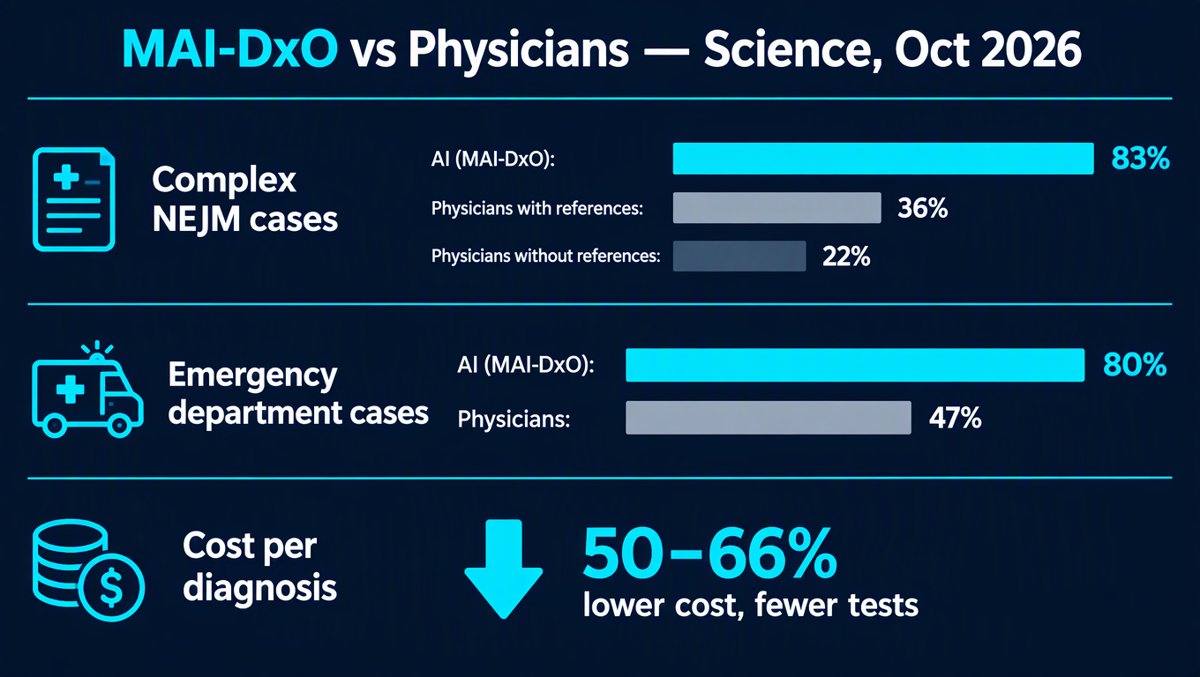
The numbers that made the news:
- Complex NEJM cases: MAI-DxO 83% vs physicians 36% (with access to textbooks and the internet) and 22% without references.
- Emergency department cases (MIMIC-IV-ED): MAI-DxO ~80% vs physicians' average ~47% — Microsoft frames this as 1.7× more accurate on common ED presentations.
- Cost: MAI-DxO reached correct diagnoses at half to one-third of the estimated cost, ordering fewer unnecessary tests. The best ensemble configuration hit 85.5% accuracy while spending under $150 in estimated test costs per case — versus physician workups estimated above $2,000 per case in the study's accounting.
- Even the single best human physician in the study topped out around 51.8% — the best score of the 225 participants — and MAI-DxO beat it on both accuracy and cost.
The Claim Check: True, With Three Asterisks
Asterisk #1 — The doctors were solo generalists with one hand tied. The 225 physicians were practicing generalists — internists and family physicians — working alone, without specialists to consult and, in the harder arm, without reference tools. That's not how medicine works in real hospitals. Even Microsoft's own researchers concede the gap would narrow against the specialist teams who actually handle cases this complex. Beating a generalist flying solo on a zhuzhed-up exam question is not the same as beating Mayo Clinic's tumor board.
Asterisk #2 — It's a paper exam, not a waiting room. NEJM case records are finished stories — the outcome is already written in the back of the book. Real diagnosis involves noisy patients, ambiguous symptoms, and the test result that comes back hemolyzed for the third time. There is no version of a paper benchmark that measures how a system handles the patient who lies about their alcohol intake. Both Microsoft and independent commenters flag this: the system still needs real-world validation.
Asterisk #3 — The headline gap is real, but so is the floor. Even the AI misses 1 in 6 of the hardest cases. The correct conclusion isn't "AI is a superdoctor." It's "AI is now measurably better than a lone generalist with Google at the rarest, hardest diagnostic puzzles" — which is precisely where generalists were never meant to operate anyway.
So: the claim is true as stated and modestly cherry-picked — an 83% vs 36% showdown is legitimate, but the fair fight (AI vs specialist team) hasn't been run yet. That fight is coming: Microsoft is teaming with Beth Israel Deaconess Medical Center to test MAI-DxO in real hospital settings.
Okay, So What Does a Real Agentic Doctor Workflow Look Like?
If the claim is broadly true, the future isn't "AI instead of doctor." It's a pipeline where each side does the part it's measurably best at. Here's the realistic shape of it, based on how these systems are actually being piloted:
1. The agent runs the intake and the draft workup. Patient history, symptom analysis, hypothesis generation, and a cost-ordered list of tests — MAI-DxO's bread and butter. This is the tedious, error-prone, expensive part of diagnosis, and it's also the part where AI just posted an 83.
2. A human doctor reviews, edits, and signs. The physician sees the AI's differential, the reasoning, and the proposed tests — and signs off or vetoes. Critically, the doctor-in-the-loop isn't a rubber stamp; it's a guardrail against the NEJM-floor problem. When a case is one of the AI's ~17% misses, the human is the difference between "diagnostic error" and "diagnostic error caught before the chemo starts." This human-signoff layer is exactly what regulators will demand anyway.
3. The doctor handles what the AI can't touch. Physical exams. Procedures. The conversation where you tell someone the biopsy came back bad. Trust-building, end-of-life discussions, spotting that the "chest pain" patient is actually having a panic attack because his wife just left him. Context that never makes it into the chart.
4. Escalation ladders by confidence. Low-complexity, high-confidence cases: AI drafts, doctor approves in seconds. Mid-complexity: AI drafts, doctor reviews properly. Complex or red-flag cases: AI's role is narrowed to literature review and test optimization, and a human specialist team takes the wheel. The AI's weakest domain is the human's strongest.
5. Continuous audit. Every AI-vs-doctor disagreement gets logged and reviewed — turning every dispute into training data, and every silent failure into a visible one.
In that workflow, the doctor morphs from diagnostician-in-chief into editor-in-chief of diagnostics. Fewer hours hunting zebras, more hours on judgment, procedures, and patients.
The Real Road-Block Isn't Accuracy — It's Regulation
Here's the plot twist Steve Wu flagged in his note: the biggest barrier to this future isn't technical, and it isn't even the accuracy. It's regulation — and the current regulatory map is a minefield:
- On January 6, 2026, the FDA finalized updated Clinical Decision Support (CDS) guidance that draws a bright line: software that gives clinicians information they can independently review stays unregulated as a medical device; software that tells the clinician what to do for a specific patient — like "the diagnosis is X, order test Y" — crosses into device territory, with the full FDA premarket pathway that implies. MAI-DxO doing an end-run diagnosis is squarely in the second bucket.
- A medical device pathway means clinical validation trials, post-market surveillance, and — the painful one — liability allocation. If the AI says "pancreatitis" and the doctor signs off and the patient dies of the aortic dissection the AI and the doctor both missed, who gets sued? The hospital? Microsoft? The doctor who trusted it? Every party currently answers "not me."
- Radiology societies are already petitioning the FDA to regulate the complete clinical function of AI tools — a push that would make deployment stricter, not looser.
- And then there's the deepest irony in Steve's note: regulation is precisely what protects doctors' jobs. Steve read the causality as "regulation → less demand for doctors," but the traffic runs the other way too. If MAI-DxO shipped tomorrow as an unregulated consumer app, adoption would stall instantly — not because it can't diagnose, but because no insurer pays for an unsanctioned device, no hospital risks the malpractice exposure, and no FDA-cleared path exists to bill for it. The red tape that frustrates AI companies is the same red tape that keeps a licensed human in the loop — and in the paycheck.
So the realistic timeline is not "AI doctors in 2027." It's: hospital pilots now (Beth Israel is first), device-cleared narrow deployments in 2-3 years, and a decade-long slog through liability law before any system diagnoses without a human signature.
Will There Be Fewer Doctors? The Honest Answer
Every serious review lands on the same word: augment, not replace. Physician adoption of AI tools hit roughly 76% in 2026 — and yet the doctor shortage got worse, because AI absorbed documentation and admin work while demand for care kept climbing. The near-term effect is that each doctor covers more patients with fewer 2 a.m. chart marathons — not that hospitals hire fewer of them.
Remember the cautionary tale: in 2016, Geoffrey Hinton said we should stop training radiologists because AI would outperform them within five years. Ten years later, radiology is one of the most doctor-hungry specialties in medicine — and its AI tools made radiologists more valuable, not less. Diagnosis accuracy was never the bottleneck. Responsibility was.
The verdict: the claim is true — with fine print. Microsoft's AI genuinely out-diagnosed 225 physicians on paper at a fraction of the cost, in Science, under real peer review. But the pipeline that matters — AI drafts, doctor decides — is exactly the workflow regulators, hospitals, and juries will insist on. The doctor's new job description is being written right now, and "person who types the diagnosis" is not on it. "Person who answers for it" still very much is.
This article is media and science coverage, not medical advice. If something hurts, see a human — ideally one with a license and a malpractice insurer.
Sources: Microsoft AI, "Building Medical Superintelligence" & "The Path to Medical Superintelligence" (microsoft.ai); "Sequential Diagnosis with Language Models," Science, Oct 22, 2026 (science.org/doi/10.1126/science.aeh7930); arXiv:2506.22405; The Verge; Medical Economics; FDA Clinical Decision Support Software final guidance, Jan 6, 2026 (fda.gov); Arnold & Porter and American Bar Association analyses; Nature npj Digital Medicine on agentic AI in healthcare; Horizon AI newsletter, Oct 23, 2026.