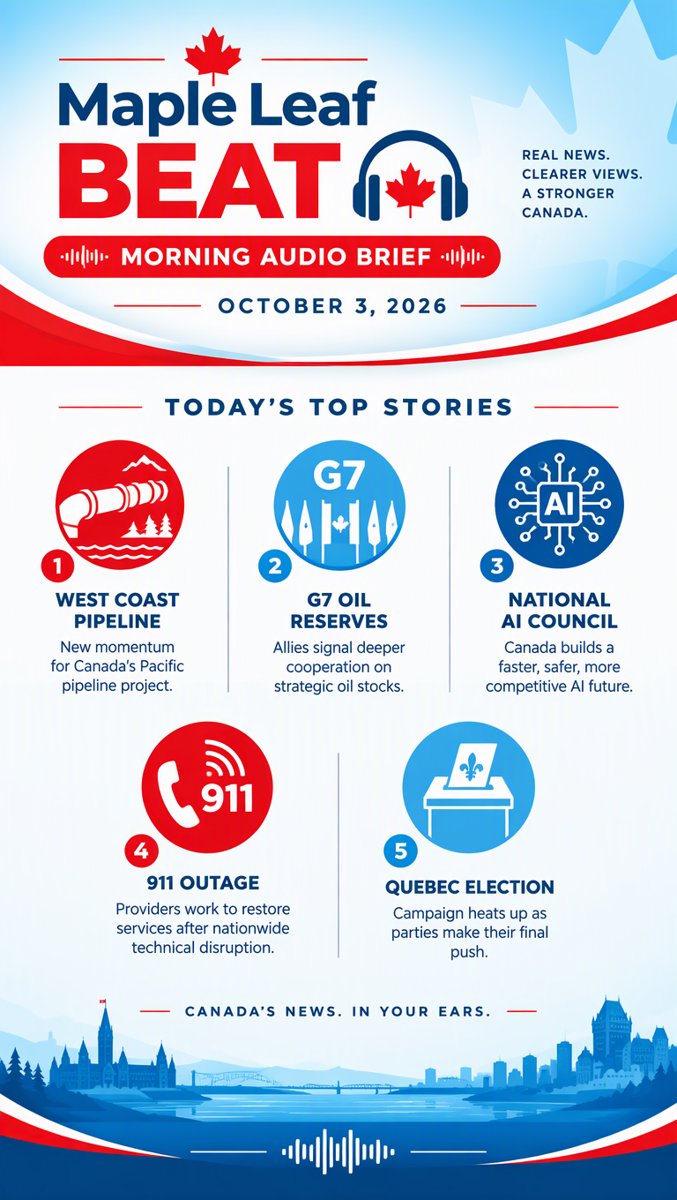
Morning audio brief for Saturday, October 3, 2026 — tap play above to listen with slides and subtitles. Here's what happened: Ottawa put a new West Coast oil pipeline on the national-interest list, G7 nations are tapping emergency fuel reserves, and Quebecers vote Monday in an election where independence is back on the ballot.
Prime Minister Mark Carney announced that the West Coast Pipeline, known as Pacific Link, will be listed as a project of national interest — a designation that fast-tracks the route to moving Canadian crude to West Coast ports and Asian markets. Alberta Premier Danielle Smith said the announcement could get oil companies building again, framing it as the start of another oilsands boom, and both leaders said Canada will be better prepared this time around. The joint show of federal-provincial support marks a striking thaw in an energy relationship that has been fractious for years. Read the full story at CBC.
The Group of Seven — Canada, France, Germany, Italy, Japan, the U.K. and the U.S., plus EU representation — agreed to release 100 million barrels of oil and fuel products, including diesel, from reserves in the coming weeks. The coordinated release comes after fuel prices soared to hover near record highs, with European diesel reserves under particular pressure. For Canadian drivers and industries, the move aims to cool pump prices and heating costs heading into winter. Read the full story at BNN Bloomberg.
Ottawa has stood up a new National Council on Artificial Intelligence, with Prime Minister Mark Carney picking big-name researchers and investors to sit on it. "The new National Council on Artificial Intelligence will inform and advise the government on how to most effectively deploy AI in Canada," the announcement said, with safety and deployment strategy at the top of its mandate. The council is the latest attempt to convert Canada's early AI research dominance into economic muscle as other countries race ahead on industrial AI policy. Read the full story at CBC.
A Bell Canada report says a "latent software issue" was behind last month's 911 outage, which knocked emergency service offline across Manitoba, Ontario, Quebec, New Brunswick, Nova Scotia and Prince Edward Island. The company's account of the failure is now in front of the CRTC, which is examining what went wrong and what safeguards are needed. With emergency lines dependent on a small number of network providers, regulators are under pressure to guarantee redundancy so a single software fault can never silence 911 across half the country again. Read the full story at CBC.
Quebec's party leaders spent the final weekend of the campaign making their last pitches before Monday's provincial election. The Parti Québécois is increasingly confident of a win, and its leader is aiming to convince Quebecers that a sovereignty referendum deserves a place on the agenda — a defining vote for Quebec, as Tom Mulcair put it, and potentially a turning point for Canada. Polls suggest a PQ majority is in reach, which would put independence questions back at the centre of national politics just as Alberta's own referendum campaign enters its home stretch. Read the full story at CityNews Montreal.
Toronto's biggest night of contemporary art is back: Nuit Blanche marks its 20th anniversary tonight, running from sunset Saturday to sunrise Sunday. More than 70 art projects take over streets, galleries and public spaces across the city, including six standout installations selected by Toronto Life. Organizers are reminding revellers to plan around road closures and TTC changes — and to dress for the all-nighter. Read the full story at CP24.
Maple Leaf Beat Audio · 2026-10-03 · morning · Narrated edition, compiled from CBC, BNN Bloomberg, CityNews Montreal and CP24.
