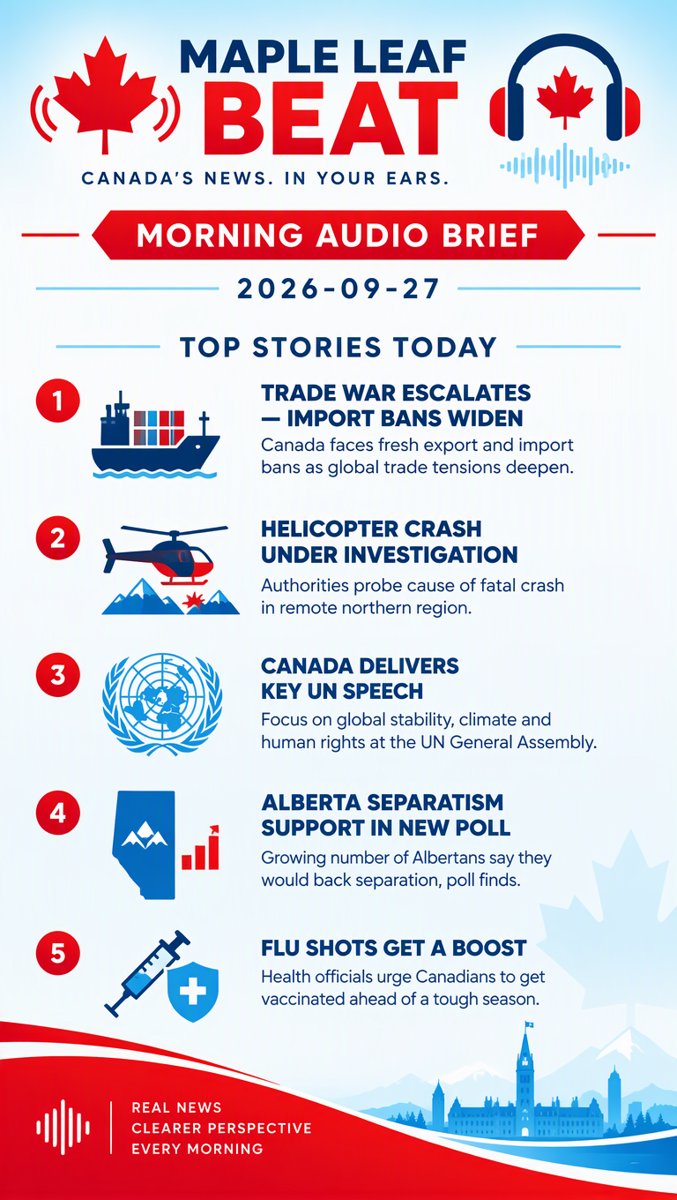
Morning audio brief for Sunday, September 27, 2026 — tap play above to listen with slides and subtitles. Here's what happened overnight and what to watch today, from Quebec's South Shore to the United Nations.
A helicopter crashed late Saturday night in a small town on Montreal's South Shore, roughly 50 kilometres from the city, killing all four people aboard. Quebec's provincial police confirmed the death toll to the BBC, and CBC reported the aircraft went down outside Montreal with no survivors. The Transportation Safety Board is expected to examine the scene as investigators work to confirm the identities of those on board. It's the deadliest aviation accident in the region in recent memory, and more details are expected as the investigation begins.
The next escalation in the trade war arrives Tuesday, when the United States bans a select list of Canadian imports including alcohol, whey, molasses and motorcycles. CBC's Rhianna Schmunk breaks down the bans by the numbers, and producers are already scrambling: Moosehead Brewery is racing to ship its beer south before U.S. supply chains adjust, with American availability of some Canadian beer potentially running dry by November. The moves land as Washington's trade envoy says the U.S. sees no urgency to strike a deal with Canada, and as a CNN analysis notes the whey ban is already reshaping the protein market for consumers on both sides of the border.
Foreign Affairs Minister Anita Anand used Canada's address to the UN General Assembly to criticize "great powers" she says are disrupting the international order. Her office frames Canada's foreign policy around establishing autonomy in strategic fields — defence, energy and critical supply chains — specifically to limit dependence on superpowers. The speech lands amid a tense global backdrop: Germany's foreign minister warned Saturday that Russia's aggression toward NATO is "on a new level," giving Anand's autonomy argument added weight among allied delegations.
Alaska Governor Mike Dunleavy told a binational conference that Canadians have no reason to worry about a U.S. military invasion, calling the notion "unfathomable" and putting the chance at "zero." His remarks came in response to alarm over earlier commentary in the trade-war escalation — with CTV reporting a former Trump aide put the risk "not zero," and commentators arguing Prime Minister Carney is right to prepare for all scenarios. The Calgary Herald's Chris Varcoe writes that the two countries are still "talking past each other" as tariffs and import bans pile up.
A new Janet Brown poll suggests 72 per cent of Albertans would vote to remain in Canada on a separation question, versus 23 per cent favouring leaving. Separatist organizers say the movement remains motivated, arguing the survey doesn't capture the depth of frustration with Ottawa, and the same polling found half of Albertans undecided on nine other constitutional questions. The province's political temperature is rising on other fronts too — the poll shows the Smith UCP and Nenshi NDP now effectively deadlocked heading into what columnists are calling a war for the next election.
Ontario is rolling out fall respiratory vaccines: high-risk groups can book flu and COVID-19 shots starting next week, with free vaccines available to the general public from October 26. Health experts say fall cold viruses are already circulating as people move indoors, and the Toronto Star notes the launch comes as vaccination rates have been declining. Pharmacists are encouraging early booking ahead of the holiday gathering season.
Maple Leaf Beat Audio · 2026-09-27 · morning · Narrated edition, compiled from CBC, BBC, Calgary Herald, BurlingtonToday, CTV News and the Toronto Star.
