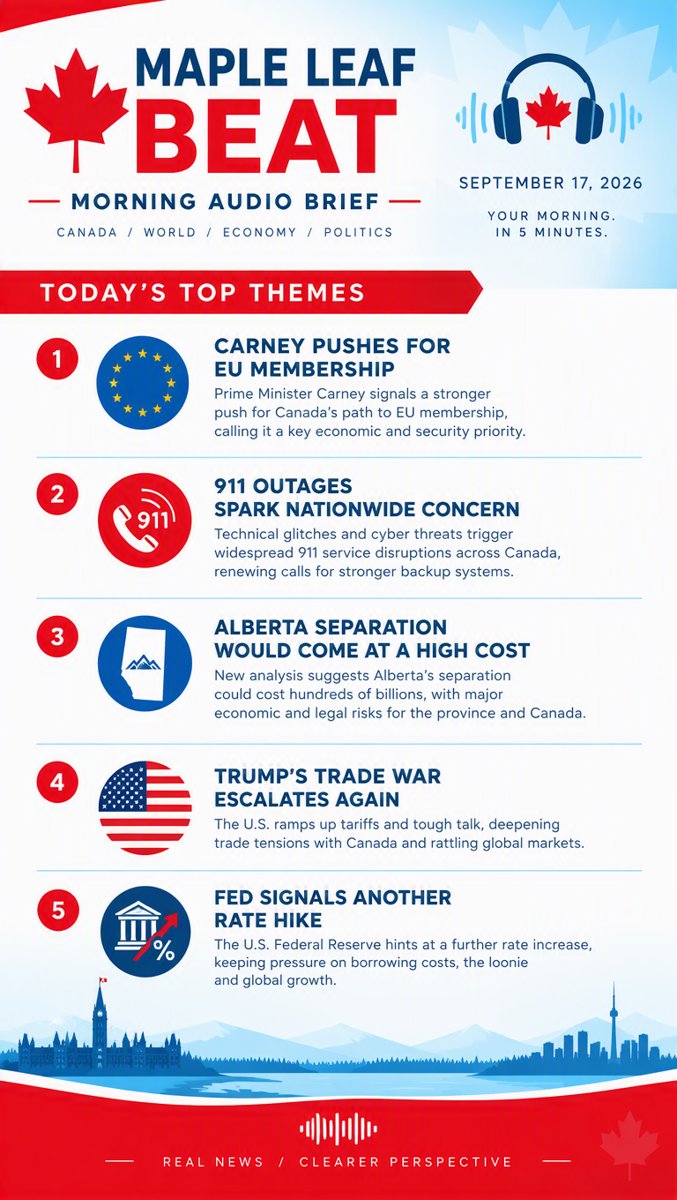
Morning audio brief for Thursday, September 17, 2026 — tap play above to listen with slides and subtitles. Here's what happened:
Prime Minister Mark Carney told the European Parliament that Canada welcomes the EU's ambition for an associate membership proposal — a historic pivot in Canada's trade and security posture as Washington's trade pressure intensifies. Speaking in Brussels, Carney insisted Canada and Europe are "not fair-weather allies," while drawing lines on the exact terms of membership and Canadian sovereignty. The overture provoked an immediate reaction from U.S. President Donald Trump, who called the EU offer "laughable" and threatened to stop trading with the bloc entirely. The moment sets the tone for a fall sitting of Parliament dominated by questions of how far — and how fast — Canada should reorient toward Europe.
Overnight 911 outages hit parts of Ontario, Quebec and Manitoba — including Toronto, Waterloo region and Winnipeg — forcing emergency officials to broadcast alternate numbers while technicians worked the problem. Lines in the GTA were restored by morning, with service gradually returning elsewhere, and Quebec police forces reported problems with call routing as well. Officials have not yet fully explained the cause, and lawmakers will be pressing for answers today. The incident is a stark reminder of how fragile critical emergency infrastructure remains — and why redundancy planning is under fresh scrutiny.
An independent report from the University of Calgary's School of Public Policy estimates that separating from Canada would cost Alberta between $50 billion and $170 billion over five years, and would require building a civil service of up to 70,000 people from scratch. The analysis lands squarely in the middle of the province's escalating separation debate, and opinion writers were quick to note it "settles nothing." Separation proponents questioned the assumptions; federalists called the price tag disqualifying. Either way, the first hard costing of the question gives both camps fresh ammunition heading into a charged political season.
U.S. President Donald Trump has ordered Canadian products removed from the American federal procurement system — formally barring Canadian suppliers from U.S. government purchasing and marking another sharp escalation in the bilateral trade war. The directive lands just as Parliament prepares to return next week, with trade retaliation topping the agenda. Businesses on both sides of the border say the uncertainty is already biting into contracts and supply chains. The move also raises the stakes on Carney's concurrent courtship of European partners as a hedge against American market access.
The U.S. Federal Reserve raised its key interest rate by 25 basis points on Wednesday — the first hike in three years, lifting the target range to 3.75 to 4 per cent (about 3.9 per cent) — defying President Trump's public demands for a cut. Fed officials pointed to persistent inflation pressure despite a cooling economy. Over time, higher U.S. borrowing costs ripple into Canadian mortgages, car loans and business credit through global capital markets. For Canadian households already stretched, the message is that relief on borrowing costs is not coming soon.
Conservative Leader Pierre Poilievre opened his party's B.C. caucus gathering by declaring "Canadians are out of money," promising deep spending cuts as Parliament prepares to return next week. The Conservatives are searching for relevance and unity heading into the fall sitting, with internal talk of an early election floating around a Liberal government weighing its options. Poilievre is framing affordability as the central issue of the coming session — setting up a direct fiscal clash with the Carney government's investment-first agenda. The affordability versus investment divide is shaping up as the defining argument of the fall.
Maple Leaf Beat Audio · 2026-09-17 · morning · Narrated edition, compiled from AP News, CBC, CTV News, The Globe and Mail, BNN Bloomberg and National Post.
