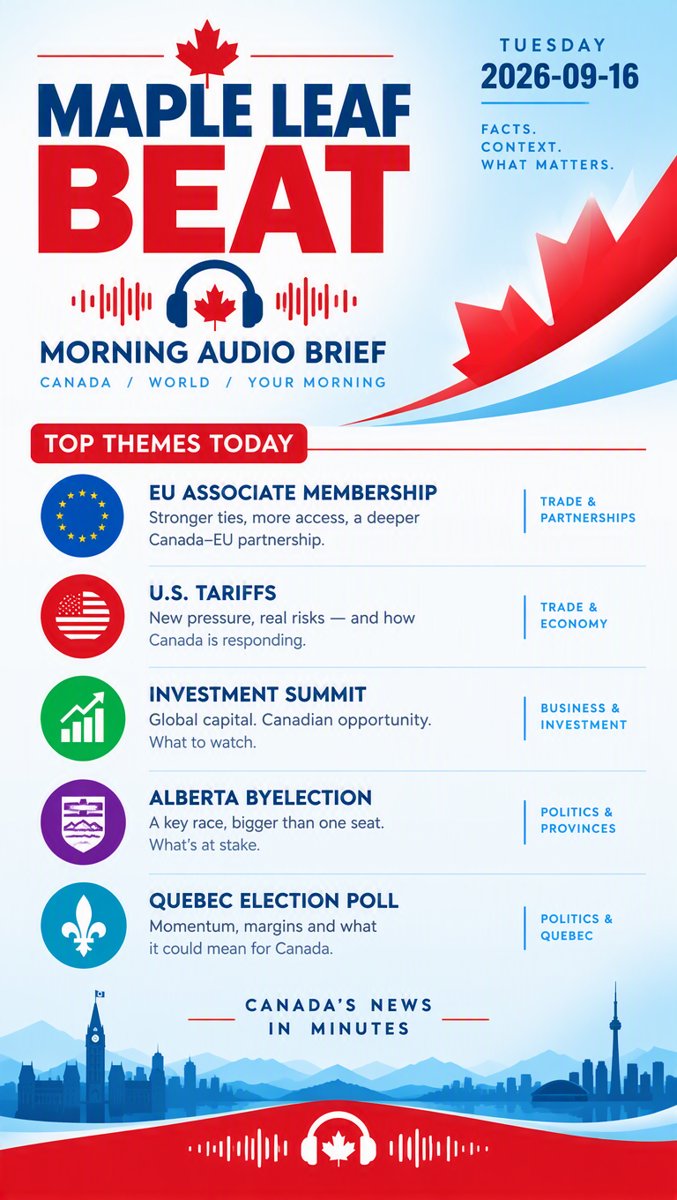
Morning audio brief for Wednesday, September 16, 2026 — tap play above to listen with slides and subtitles. Here's what happened overnight and what to watch today:
The biggest story of the morning: the European Union has invited Canada to become its first-ever "associate member," a landmark offer extended as Prime Minister Mark Carney tours Europe. The Guardian confirms it as the first arrangement of its kind, and the timing is no accident — Ottawa is actively diversifying away from a fraught relationship with Washington. Canadian public opinion appears well ahead of the paperwork: an Abacus Data poll finds four in five Canadians support closer integration with the EU. What "associate membership" means in practice will define the next chapter of Canada's trade and security posture.
Washington's latest round of tariffs — including duties of up to 50 per cent on a short list of Canadian goods — took effect Tuesday, pressing ahead with the trade war even as Canada looks east to Europe. The political reverberations crossed party lines: former Conservative prime minister Stephen Harper said Canada had "no choice" but to walk away from U.S. trade talks, calling it "a very difficult decision" but the only path available. At the same stage in Toronto, Carney said he's looking to attract $1-trillion in new investment — the two threads of the week's story: pressure from the south, pivots everywhere else.
The Canada Investment Summit wrapped in Toronto with a ledger of headline announcements: Brookfield and CPPIB proposed a $50-billion "Maple Fund", Bell Canada committed to expanding data-centre capacity, and the federal government unveiled a "mega-deduction" tax measure to spur corporate investment. The most eye-catching move: opening Canada's four largest airports to private investment. Pearson — the country's biggest airport — has responded cautiously to the plan, while experts say travellers could eventually see upgrades funded by private capital. It's the domestic half of the Carney doctrine: replace U.S. dependence with domestic and allied capital.
In provincial politics, a shock result in Alberta: NDP candidate Kyle Campbell captured Calgary-Shaw, a riding the United Conservative Party could normally count on, winning by nearly 600 votes in unofficial results. The premier's office is blaming a split vote, but CBC's analysis points to anger over the separation referendum — the NDP campaigned hard on the anti-separatist flag and flipped a stronghold. Whether it's a one-off protest or a bellwether for UCP support will be the argument dominating Alberta's airwaves today.
Canada's hunt for trade gateways beyond the U.S. has a northern answer: expanding the Port of Churchill and upgrading the Hudson Bay Railway would cost an estimated $2-billion to $3-billion — a fraction of the LNG megaproject floated by Manitoba's premier — according to Arctic Gateway Group, which operates the port. Manitoba is sweetening the pot, offering to waive provincial sales tax on major Churchill investments. With domestic mining ambitions growing, the arithmetic makes Churchill look less like a dream and more like a line item.
In Quebec's election campaign, a new poll suggests the Coalition Avenir Québec would form the next government if the vote were held today, edging back ahead of the Parti Québécois and the Liberals. The numbers landed just as party leaders geared up for the second televised debate of the campaign, after a first debate that put the CAQ's record under sustained attack. A single poll is a snapshot, not a verdict — but for a party fighting for its political life, the bounce came at the right time.
Maple Leaf Beat Audio · 2026-09-16 · morning · Narrated edition, compiled from Euronews, The Guardian, Global News, CBC News, BNN Bloomberg, The Globe and Mail, CP24, Abacus Data and CTV News.
