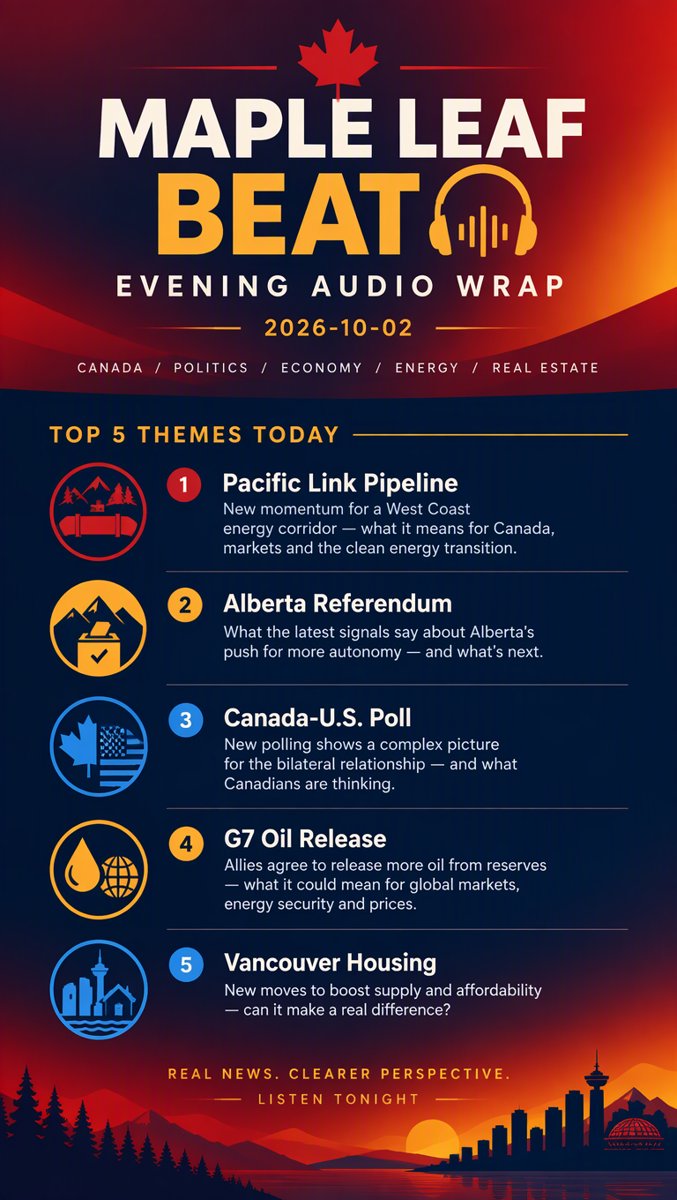
Evening audio wrap for 2026-10-02 — tap play above to listen with slides and subtitles. Here's what happened on this Friday across Canada and beyond:
Prime Minister Mark Carney has designated the proposed $44-billion West Coast oil pipeline — renamed Pacific Link — as the first-ever project of national interest under his major projects framework. The plan would carry Alberta crude to a new terminal on the British Columbia coast, a route previous federal governments declined to champion. Carney and Alberta Premier Danielle Smith both argued the move could get oil companies building again, and editorial writers at The Globe and Mail declared the week the moment Canada "stopped shooting its oil patch in the foot." The designation marks one of the most consequential energy decisions in years — and a significant olive branch to Western Canada heading into a tense referendum season. (BNN Bloomberg · CBC)
Alberta is weeks away from its October 19 referendum, and the debate came to the University of Alberta on Friday night. A panel forum drew prominent voices as Albertans prepare to vote on ten questions spanning the constitution, immigration and the province's place in Confederation. A new CBC-commissioned poll suggests a slight majority of United Conservative voters now favours separation, a finding that puts Premier Danielle Smith's leadership in a delicate spot as the campaign enters its final stretch. Critics including the "No to the Nine" campaign have already taken aim at the immigration questions on the ballot.
A sweeping new State of the Nation survey of more than 10,000 Canadians finds half now consider the United States an adversary, and 45 percent say they feel worse off today than a year ago. Respondents identified the U.S. trade war as the most serious threat facing Canada as a whole. The findings capture a striking souring in national mood — and a remarkable reversal in how Canadians view their largest trading partner and neighbour. (Yahoo News Canada)
Canada and its G7 partners have agreed to release 100 million barrels of oil — including diesel — into the market amid an ongoing energy crunch. The coordinated release begins immediately and will take four months, opening with what organizers called a "substantial" diesel release within the first 20 days. The move follows threats from Washington of a diesel export ban; U.S. President Trump said the U.S. will hold off on that ban in light of the G7 agreement. For Canadian consumers and industry, the release aims to curb price spikes heading into winter. (Financial Post · Bloomberg)
Greater Vancouver home sales fell 8.4 per cent in September compared with a year earlier, as prices continued to slide, the Greater Vancouver Realtors board reported. The board counted 1,717 sales in the month — 25 per cent below the 10-year seasonal average. It's the latest evidence of the sustained cool-down in Canada's priciest housing market; a recent global ranking put Toronto and Vancouver dead last among 25 major markets for year-over-year price performance. (Canadian Mortgage Trends)
Closing on a hopeful note: Edmonton-born actor and Parkinson's advocate Michael J. Fox told CTV News in an exclusive interview that the Canada-U.S. relationship is "doomed to success." His optimism stands out against Friday's polling data on Canadian attitudes toward their southern neighbour — a reminder, from one of the country's most beloved exports, that the ties run deeper than the trade war headlines.
Maple Leaf Beat Audio · 2026-10-02 · evening · Narrated edition, compiled from Financial Post, CBC, National Post, Castanet and CTV News.
