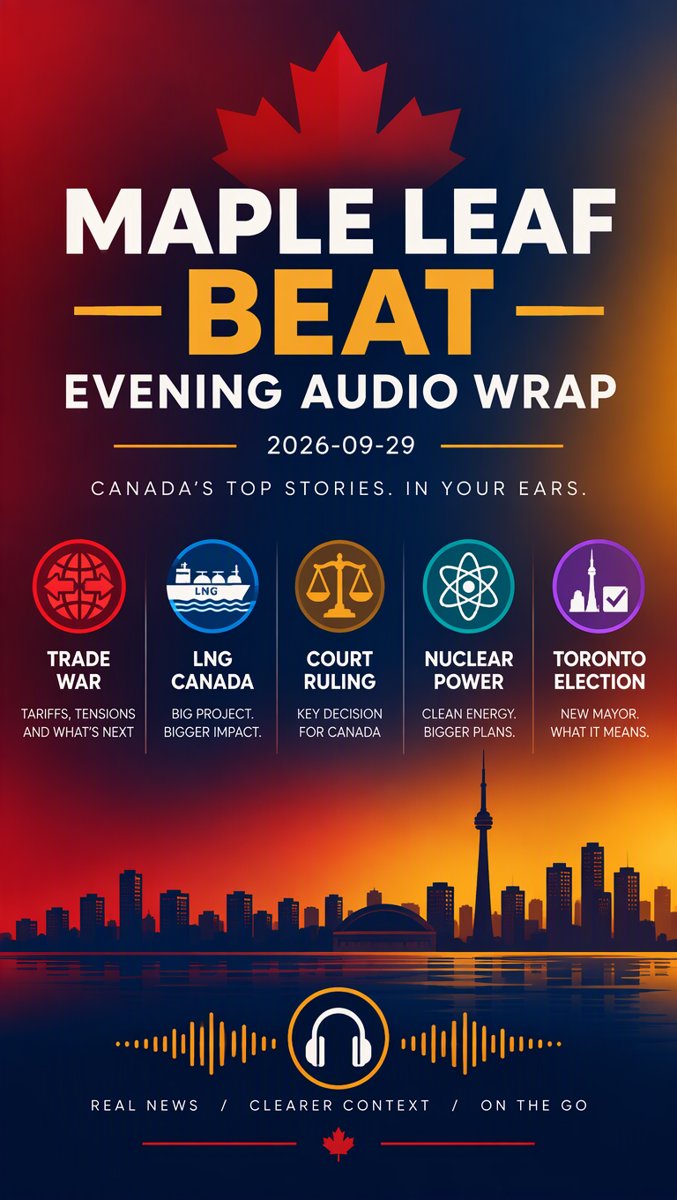
Evening audio brief for 2026-09-29 — tap play above to listen with slides and subtitles. Here's what happened on a day when the trade war hit home: Washington's ban on Canadian goods took effect at midnight, Ottawa counted the cost, and the country answered with a multibillion-dollar bet on natural gas.
The midnight deadline came and went, and as of Tuesday some Canadian products — whisky, wine, beer, dairy and motorcycles among them — can no longer cross the border into the United States at all. Canadian producers are absorbing the blow on one of the trade war's most symbolic fronts, and the ripples are already being felt: U.S. customs blocked a truck carrying supplies to an isolated island community in New Brunswick. In Washington, a Trump adviser reportedly told Canadian lobbyists to "get the hell out" of the U.S. ahead of the midterms. The economic backdrop is darkening too — Deloitte's fall outlook slashed its 2027 growth forecast for Canada by 20 per cent as tariffs grip the economy, even as it expects business investment to edge up 1.6 per cent this year. (CBC News)
Against that grim trade picture, some serious money is still betting on Canada. LNG Canada confirmed its multibillion-dollar Phase 2 expansion in Kitimat, B.C. is going ahead — a project backed by Shell that could roughly double the country's liquefied natural gas export capacity. Prime Minister Mark Carney, in Vancouver for announcements on energy and ocean protection, has framed the project as a cornerstone of his push to make Canada an energy superpower. The announcement landed mid-provincial-election in B.C., where the New Democrats were quick to claim credit. (CBC News)
In a landmark constitutional ruling, a B.C. Supreme Court judge struck down the federal provision that prohibits drug possession for the purpose of trafficking — and tossed the trafficking convictions of the founders of the Drug User Liberation Front's Vancouver compassion club. The judge went further, applauding the activists' work, an extraordinary note in a criminal case. The ruling hands defence lawyers a powerful new argument and puts fresh pressure on Ottawa's drug-prosecution framework. (The Globe and Mail)
Premier Scott Moe announced plans to explore building two large nuclear reactors in northwest Saskatchewan — the province's most ambitious step yet into large-scale nuclear power. The long-term goal is about 2,600 megawatts of nuclear generation by 2050, enough to fundamentally rewire a grid that has leaned on fossil fuels. The plan would put Saskatchewan among a small group of Canadian provinces operating large reactors, alongside Ontario and New Brunswick. (CBC News)
Alberta is positioning itself for a fight with the federal government over who decides who moves to the province. The push comes weeks before Albertans vote October 19 in a referendum featuring ten questions, several of which touch on the province's relationship with Ottawa. Premier Danielle Smith's government wants its own immigration selection powers — a jurisdiction provinces have traditionally shared with the federal government, and a file that is shaping up as one of the most contentious on the fall ballot. (CTV News)
Toronto's mayoral race got a rock-and-roll jolt: Rush frontman Geddy Lee endorsed councillor Brad Bradford, a rare political endorsement from the legendary bassist, as Bradford tries to dethrone Mayor Olivia Chow in the October 26 election. Bradford also unveiled a housing promise — waiving the municipal land transfer tax on the first $1.1 million of a home's purchase price, a cut aimed squarely at first-time buyers. With early voting weeks away, expect affordability and the city's budget math to dominate the debate. (CP24, CP24 on the tax pledge)
Maple Leaf Beat Audio · 2026-09-29 · Evening Wrap · Narrated edition, compiled from CBC News, CTV News, The Globe and Mail, Global News, CNBC and CP24.
