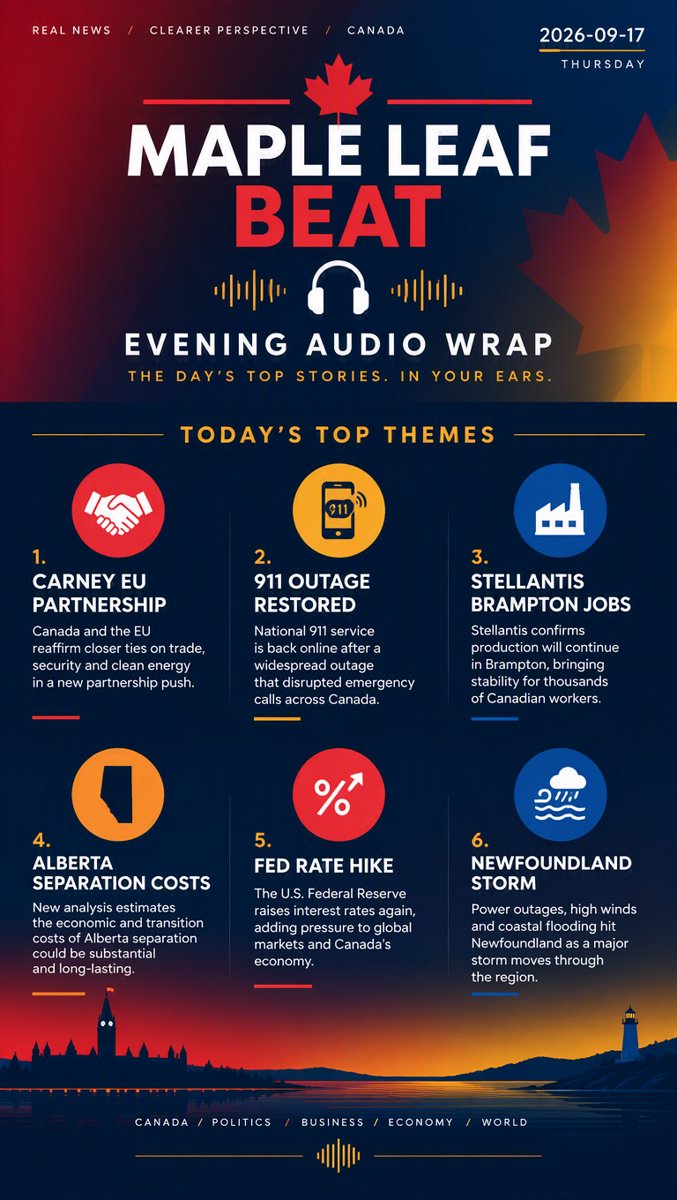
Evening audio brief for 2026-09-17 — tap play above to listen with slides and subtitles. Here's what happened:
Prime Minister Mark Carney is welcoming the goal of Canada becoming the European Union's first associate member — a historic designation no other country holds. Speaking in Strasbourg, Carney called for "deep cooperation" between Europe and Canada, and floated joining Erasmus+, the EU's student-exchange program. The move marks a deliberate pivot in Ottawa's foreign and trade policy as economic tensions with Washington persist. A Republican senator has already warned Carney against tightening links to Brussels, underscoring how closely Washington is watching. For Canadians, the proposal could eventually reshape everything from student mobility to regulatory alignment with the EU's single market.
Emergency callers across much of Canada spent part of the day unable to reach 911, after an outage disrupted service in Ontario, Quebec, Nova Scotia and four other provinces. Bell Canada says service has been fully restored, but the disruption forced police services — including the OPP — to warn residents to use local ten-digit numbers instead. The incident has reignited questions about the resilience of Canada's emergency-communications backbone and how quickly the public is informed when it fails. Officials are still investigating the cause.
Unifor is urging Stellantis to honour its commitment to retool the Brampton assembly plant, after the automaker signalled it may sell the facility instead. The union is threatening to suspend contract talks unless Ottawa intervenes to block a sale — and says strike action remains on the table. Premier Doug Ford and federal minister Mélanie Joly have both publicly pressed the company to build its next model in Brampton, where thousands of jobs ride on the decision. The standoff is shaping up as a major test of Canada's auto-sector strategy.
An independent report from the University of Calgary's School of Public Policy estimates that separating from Canada could cost Alberta between fifty billion and one hundred seventy billion dollars over five years. Economists describe the findings as a scathing counter to separatists' arguments, modelling the lost trade, currency and fiscal costs of independence. The report lands as Alberta's separation debate simmers, and gives federalists hard numbers to point to. Its central message: sovereignty would carry a staggeringly high price tag.
In a major policy turnaround, the U.S. Federal Reserve has raised its benchmark interest rate for the first time since 2023. Analysts say the move puts fresh pressure on the Canadian dollar, and Canadian borrowers — especially those with variable-rate mortgages — could feel the effects as borrowing costs climb. Real-estate watchers warn home sellers may have to "take a hit" as rates rise. The Bank of Canada now faces tricky arithmetic: follow the Fed and squeeze households, or diverge and absorb currency pressure.
A potent fall storm is bearing down on Newfoundland and Labrador this weekend, forecast to bring gusts of one hundred kilometres an hour or more — the strongest winds in months for the island. The Weather Network says damage is possible from downed trees and power lines, and marine conditions will deteriorate quickly. Residents are being urged to secure loose outdoor objects and prepare for possible outages. The system arrives just as the province shakes off summer, a reminder that storm season is settling in.
Maple Leaf Beat Audio · 2026-09-17 · Evening Wrap · Narrated edition, compiled from The Guardian, CBC News, CTV News and Global News.
