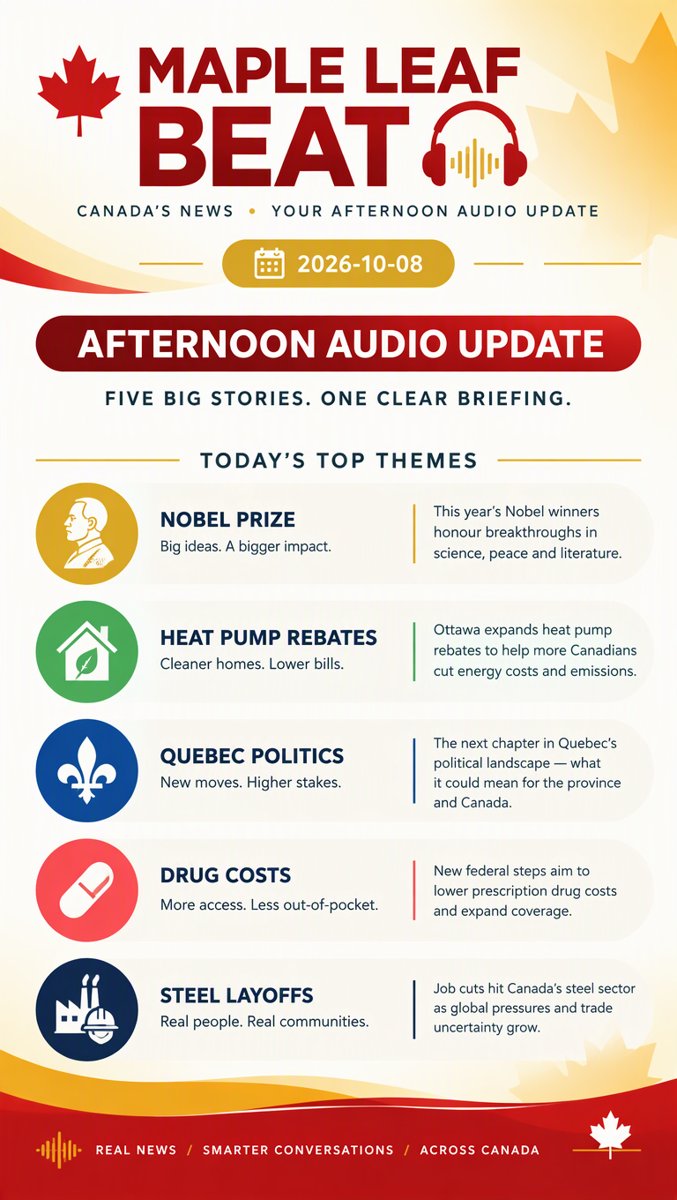
Afternoon audio brief for Thursday, October 8, 2026 — tap play above to listen with slides and subtitles. Here's what happened in Canada and beyond this midday, from a historic Nobel win to a multibillion-dollar home-heating promise.
Canadian poet and essayist Anne Carson has won the Nobel Prize in Literature, awarded Thursday by the Swedish Academy for what it called her "bold and inventive oeuvre." Carson, famous for genre-bending work that moves between poetry, essays and translation, becomes only the second Canadian to take the literature prize, following Alice Munro. The announcement, made just after 11 a.m. Toronto time, was celebrated across Canada's literary community and made headlines around the world within minutes. For a country that has long punched above its weight in letters, the win is both a capstone and a spotlight on Carson's decades of quietly radical writing.
Prime Minister Mark Carney marked the announcement in Sherbrooke, Quebec on Thursday, unveiling a two-billion-dollar federal rebate program to help homeowners install heat pumps. The plan is designed to retrofit about one million Canadian homes, cutting household energy costs and greenhouse gas emissions at the same time. Ottawa is framing it as a signature affordability measure heading into the heating season, when utility bills bite hardest. For homeowners weighing a new furnace against a heat pump, the rebates could shift the math considerably.
Elon Musk — the world's richest man — publicly called for Quebec, Alberta and Saskatchewan to separate from Canada, weighing in just days after Quebec's election. The pitch landed with a thud: Saskatchewan Premier Scott Moe and Alberta Premier Danielle Smith both shut it down with flat refusals on Wednesday, with Smith earlier calling separatist overtures to the U.S. "absurd" and "ridiculous." No first minister in any of the three provinces is embracing the idea. The episode still put national unity back in the headlines, with all sides insisting the premiers' rejections are the story.
Millions of Americans who buy cheaper prescription drugs from Canada are bracing to lose that option when a U.S. customs rule takes effect later this month. The change is expected to sharply restrict personal drug imports across the border, and experts warn prices for those same medicines could soar for American buyers as a result. Canadian pharmacies that have built a business serving cross-border customers could feel the pinch too. It's the latest wrinkle in the trade relationship, this one landing squarely on medicine cabinets.
Layoffs have begun at Stelco's historic Hamilton steel plant, and the union president says the cuts will roll out over three weeks — with not all affected workers formally notified yet. The first job cuts take effect Sunday, October 11. Ottawa has given the plant's American owner five days to explain the planned layoffs, amid the continuing strain of the steel trade war. For Hamilton, a city defined by its steelmaking, the notices are a fresh blow to a workforce already bracing for impact.
New federal figures show a 60 per cent spike in arrests and detentions of Canadians in the United States, according to data from Ottawa recorded by the Toronto Star. The trend suggests U.S. crossings have become materially riskier for Canadian travellers, and consular officials have been quietly tracking the rise for months. With the winter travel season approaching, officials are urging Canadians to know their rights at the border. The numbers are also feeding into a broader conversation about how Canadians are being treated at U.S. points of entry.
Maple Leaf Beat Audio · 2026-10-08 · afternoon · Narrated edition, compiled from CBC News, CTV News, The Globe and Mail, Global News and the Toronto Star.
