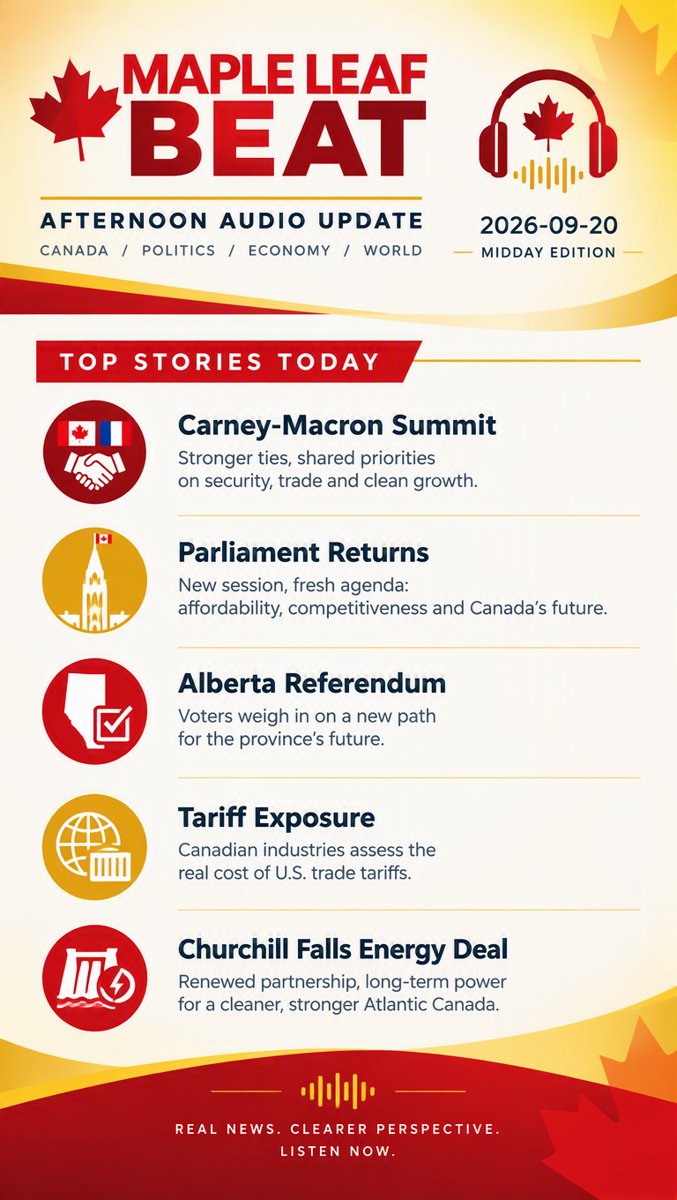
Afternoon audio brief for Sunday, September 20, 2026 — tap play above to listen with slides and subtitles. Here's what happened:
Prime Minister Mark Carney and French President Emmanuel Macron are holding a one-on-one meeting today in Saint-Pierre-et-Miquelon, the French archipelago that sits just 20 kilometres off Canada's southern Newfoundland coast. CTV News calls the sit-down symbolic — a signal of deepening Canada–Europe ties as Ottawa works to diversify its trade relationships away from the United States. The meeting lands just days after Carney's high-profile visit to Strasbourg, where he championed Canada's pitch for associate membership in the European Union. Reuters frames it as a message aimed squarely at Washington, delivered from a piece of Europe that is, quite literally, in North America's backyard.
The House of Commons is back Monday after a three-month summer break, and the National Post reports the Liberal government's fall agenda is jam-packed. The early tension point: a brewing fight between Prime Minister Mark Carney and labour unions, a relationship the Liberals have traditionally counted on. With U.S. tariffs continuing to squeeze Canadian industry, the government's economic response will dominate the session. Expect a combative autumn in Ottawa, with opposition parties ready to test a minority government's resolve from day one.
Alberta's separation question is heading toward a referendum vote, and federalists in the province say the people who should be leading the charge to keep Alberta in Canada are nowhere to be found. The Toronto Star reports that 25 of Alberta's Conservative members of Parliament did not respond to requests about the campaign — silence federalists call missing in action. On the ground, the referendum campaign trail is emotional, mixing fear and unity in equal measure. Separatist leaders, meanwhile, say that whatever happens with the vote, their fight won't end there.
A new mapping of tariff exposure shows which Canadian cities stand to feel the trade war most directly. In Toronto alone, 3,027 businesses — 3.2 per cent of the city's firms — are affected by the latest round of U.S. tariffs, according to CTV News. The data gives municipal leaders a block-by-block picture of where job losses and business closures could land, and where local support programs might be needed most. It's a rare quantitative look at how a national trade conflict translates into street-level economic pain.
The Newfoundland and Labrador legislature has voted in favour of a new Churchill Falls energy deal with Quebec — an agreement worth billions of dollars to the province. The deal rewrites a decades-old arrangement that long delivered most of the value from the Churchill River's hydro power to Quebec, and the PCs are now ready to move ahead with negotiations after winning the House vote. CBC has a reader-friendly explainer breaking down the six big questions about the Churchill Falls deal. Financial advisors note that dealing with Quebec was seen as the only viable option for getting Churchill power to new markets.
Denmark says a "binding" deal reached with Washington over Greenland's security will not compromise Danish sovereignty over the vast Arctic island. It follows President Donald Trump's claim that the agreement gives the United States "permanent control" over Greenland's security arrangements — language that raised eyebrows in capitals across the North Atlantic. The arrangement comes amid Trump's long-stated desire to annex or purchase Greenland outright. For Canada, the deal matters because it reshapes Arctic defence cooperation on the doorstep of Canadian territory.
Maple Leaf Beat Audio · 2026-09-20 · afternoon · Narrated edition, compiled from CTV News, National Post, Toronto Star, CP24, CBC, Al Jazeera.
