Maple Leaf Beat — Afternoon Audio Brief · 2026-10-17

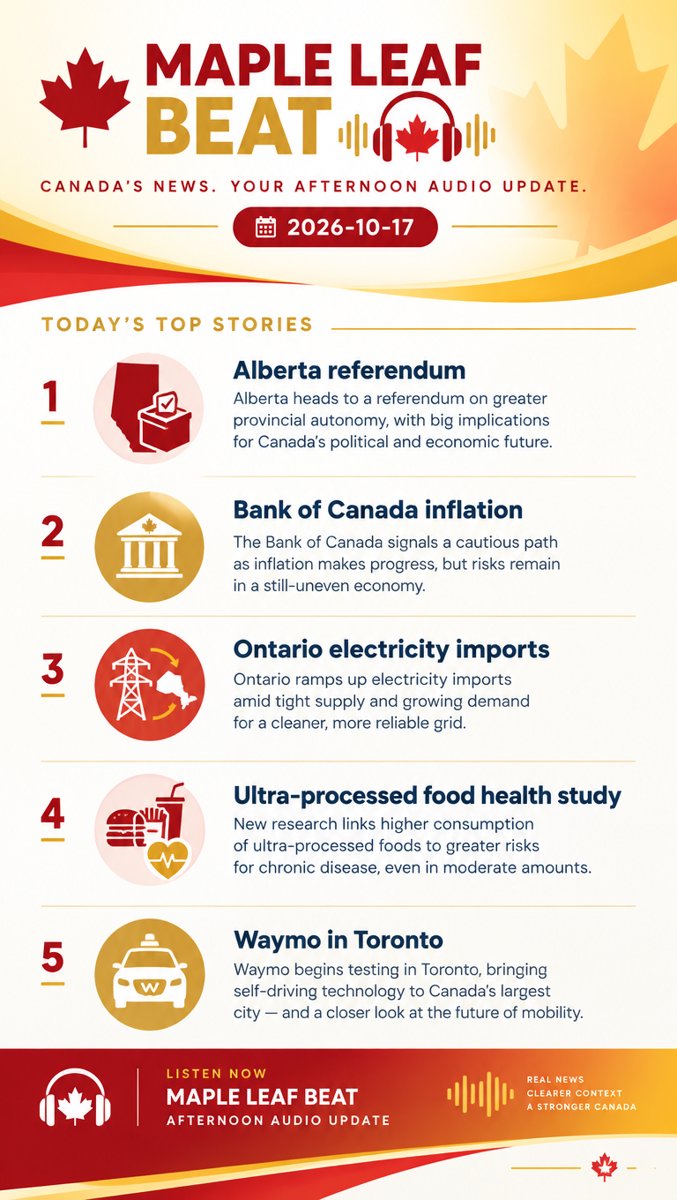
Maple Leaf Beat afternoon audio brief for Saturday, October 17, 2026 — tap play above to listen with slides and subtitles, or read on. It's a big weekend on the national stage: Alberta votes Monday on a separation referendum, the Bank of Canada is signalling higher inflation ahead, and Ontario is quietly buying American electricity to keep the lights on this winter. Here's what happened.
Majority of Albertans are ready to move on from the Oct. 19 referendum: poll
With the vote two days away, new Abacus Data polling finds a majority of Albertans want the province to move past Monday's separation referendum and refocus on pocketbook issues like affordability. A companion Leger survey shows support for staying in Canada rising steadily ahead of the Oct. 19 vote, and Bloomberg reports Alberta support for Canada is climbing overall. The unity message is coming from the top of federal politics too: Conservative Leader Pierre Poilievre told a Calgary crowd Friday that Albertans shouldn't turn their backs on the country — "we don't take our ball and go home" — while Prime Minister Mark Carney urged a "decisive" vote to settle the independence question for good. Former premiers from both parties have urged a "no" on the ballot's immigration questions, arguing they won't deliver a clear mandate.
Researchers find uptick in U.S. influence campaigns targeting Alberta referendum as vote looms
Researchers have documented a jump in American influence campaigns aimed at Monday's referendum, according to The Globe and Mail. Prominent U.S. influencers, podcasts and websites are pushing narratives about the supposed inevitability of Alberta–U.S. integration as the province votes. The findings give the separatism debate a foreign-interference edge, and they land just as other coverage shows Canadians divided on immigration — the same issue wrapped into Alberta's ballot questions. Watch for what the turnout and margins say after Monday.
Bank of Canada's Macklem expects higher inflation outlook as oil prices remain elevated
Bank of Canada Governor Tiff Macklem signalled the central bank expects to revise its inflation forecast higher at its upcoming rate announcement, citing oil prices that have stayed elevated longer than projected. The Globe and Mail's Mark Rendell reports the comments — made alongside IMF meetings — temper hopes for near-term rate relief. For households, the takeaway is that borrowing costs may stay higher for longer, with mortgage renewals and business credit both exposed if the forecast revision sticks.
'Very ironic': Ontario signs contract to buy electricity from U.S. during winter months
Ontario's Independent Electricity System Operator has signed a deal to import 600 megawatts of American electricity through the winter months, CityNews reports. The optics are awkward — critics called the arrangement "very ironic" amid ongoing tariff tensions with Washington — and Premier Doug Ford's office avoided questions when the deal surfaced. The province's framing is reliability: winter demand peaks strain the grid, and cross-border imports help keep prices in check. Readers at the Toronto Star had plenty to say about it.
Ultra-processed food intake linked to brain damage in middle-aged adults
A Hamilton study tracking nearly 9,000 Canadians with no prior stroke history has linked ultra-processed food intake to "silent strokes" — brain lesions that show up on scans without obvious symptoms. The research, out of McMaster-adjacent labs and covered by The Spec, CTV and Radio-Canada, found middle-aged adults eating more chips, cereals and frozen meals carried more of the damage, which is associated with elevated dementia risk down the road. It adds to a fast-growing body of evidence that diet shapes long-term brain health, not just waistlines.
Waymo is coming to Toronto. Will its self-driving cars be winter-ready?
Self-driving giant Waymo is bringing its robotaxis to Toronto, with testing underway ahead of a targeted 2028 launch — the company's first Canadian market. CBC reports experts say winter is the real exam: snow-covered roads obscure lane markings and curb lines, so the fleet will need extensive local training before it can go driverless. The Toronto Star notes humans will ride shotgun first, while critics are already raising privacy and safety questions about always-on sensor cars in a dense downtown.
Sources
- Majority of Albertans are ready to move on from the Oct. 19 referendum: poll — Edmonton Journal
- Researchers find uptick in U.S. influence campaigns targeting Alberta referendum as vote looms — The Globe and Mail
- Bank of Canada's Macklem expects higher inflation outlook as oil prices remain elevated — The Globe and Mail
- 'Very ironic': Ontario signs contract to buy electricity from U.S. during winter months — CityNews Toronto
- Ultra-processed food intake linked to brain damage in middle-aged adults — The Spec
- Waymo is coming to Toronto. Will its self-driving cars be winter-ready? — CBC
Maple Leaf Beat Audio · 2026-10-17 · afternoon · Narrated edition, compiled from Edmonton Journal, The Globe and Mail, CityNews Toronto, The Spec, and CBC.