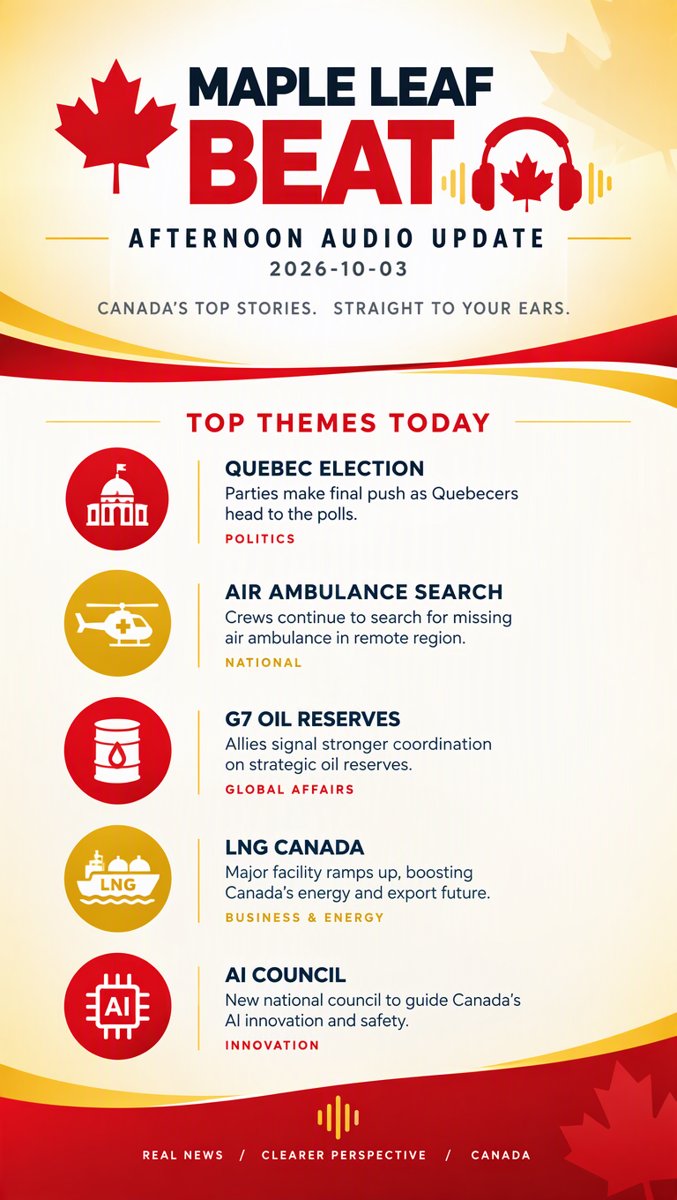
Afternoon audio brief for Saturday, October 3, 2026 — tap play above to listen with slides and subtitles. Here's what happened: a desperate search off the U.S. coast, Quebec's pivotal election eve, and a coordinated oil release to tame prices at the pump.
A Hamilton-based air ambulance jet with six people aboard went missing off the coast of Nantucket, Massachusetts, while flying from Bermuda to Boston, prompting a U.S. Coast Guard search operation. The aircraft lost contact mid-route, and officials have not yet said what caused the disappearance or whether any wreckage has been located. Multiple international outlets, including the BBC and The New York Times, are tracking the developing story. The search remains ongoing as of Saturday afternoon — we'll bring you updates as they develop.
Quebecers head to the polls Monday, October 5, with the Parti Québécois favoured to form government — though polls show it's still unclear whether the party will win a majority. More than three decades after the province last voted "no" to independence, the PQ is finding it harder to persuade voters to actually leave Canada. A Montreal Gazette poll report underscores the uncertainty over the majority question. Separately, documents obtained by the Gazette revealed Élections Québec had prepared scripts requiring workers to answer anglophones in French before deciding whether they qualified for English service — an election-eve controversy over voting rights. The outcome will shape Quebec's relationship with Ottawa for years.
Canada and its G7 partners will release 100 million barrels of oil and diesel from strategic reserves after prices soared, in a coordinated move announced this week. The release follows a U.S. threat to ban diesel exports — a threat President Trump later walked back, admitting "we were never going to do it," according to Fortune. The G7 countries are Canada, France, Germany, Italy, Japan, the U.K. and the U.S., plus EU representation, BNN Bloomberg reports. For Canadian drivers and industries, the aim is simple: curb price spikes at the pump heading into winter.
LNG Canada announced it will use Chinese steel for its Phase 2 expansion in Kitimat, B.C. — a $33-billion megaproject that has just cleared its final investment decision. The decision has drawn criticism from those hoping the build-out would boost Canadian steelmakers, and CBC News notes the politics around offshore sourcing. Still, energy analysts, including the Calgary Herald's Chris Varcoe, frame the FIDs on LNG Canada Phase 2 and the Coastal GasLink expansion as putting Canadian energy on the "cusp of a generational opportunity."
Prime Minister Mark Carney's government has launched a National Council on Artificial Intelligence, staffed with big-name researchers and investors. "The new National Council on Artificial Intelligence will inform and advise the government on how to most effectively deploy AI in Canada," the government said, per CBC News. The move answers growing concern that Canada — an early AI research powerhouse — risks losing its edge, with The Hill Times arguing Canada "cannot claim AI sovereignty if it gives away its knowledge." The council's focus: safety, deployment strategy, and keeping Canadian AI talent and knowledge at home.
New national data shows COVID-19 symptoms up 3.8 per cent and influenza at 3.7 per cent, with increases in reported cough and fever symptoms as of the week of September 26, 2026, CTV News reports. Health officials say the flu season is off to an early start in parts of the country. Vaccination campaigns are ramping up: New Brunswick's updated COVID-19 and flu shots become free for everyone aged six months and older starting October 13, and the province is also now offering free RSV vaccines to newborns. Officials urge Canadians to consider getting the updated vaccines as the season takes hold.
Maple Leaf Beat Audio · 2026-10-03 · afternoon · Narrated edition, compiled from CBC News, The New York Times, Montreal Gazette, Financial Post, BNN Bloomberg, and CTV News.
