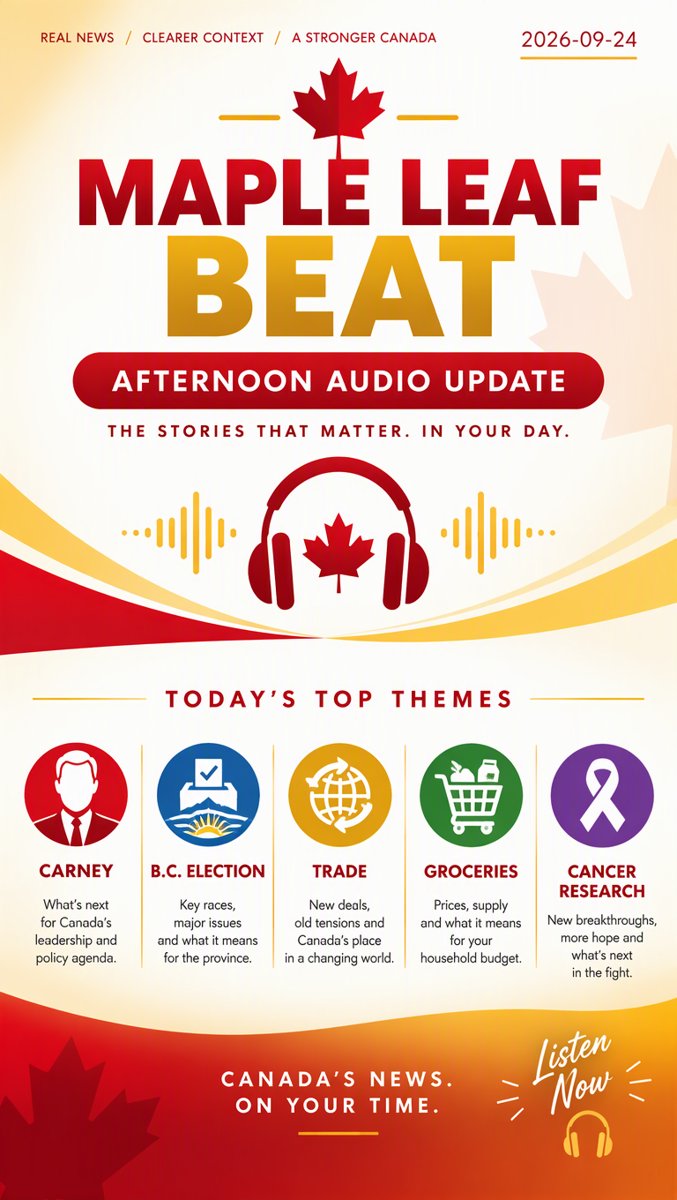
Afternoon audio brief for 2026-09-24 — tap play above to listen with slides and subtitles. Here's what happened across Canada and beyond this midday: Ottawa's invasion-risk contingency, a snap election fight in British Columbia, new details in the Belleville synagogue shooting, a state visit from Vietnam, a grocery-competition breakthrough, more Starbucks closures, and a record-breaking cancer donation.
Prime Minister Mark Carney told The New York Times that his government studied the risk that U.S. President Donald Trump might order military action against Canada, framing the work as prudent contingency planning rather than alarmism. The disclosure lands as Carney continues his push to diversify Canadian trade away from the United States, with parallel coverage from CBC News confirming the New York Times interview. The comment is already fuelling debate at home about how far preparations for an unreliable ally should go. It also underscores the tense, evolving relationship Carney described between Ottawa and Washington. (Politico, CBC News)
Documents obtained by Global News show Sean Ward, the former soldier charged in the shooting outside a Belleville, Ontario synagogue, had been suing the military for one million dollars after declining the COVID-19 vaccine and being deemed unsuitable for further service. A friend told CBC the suspect's online username alluded to killing Jews weeks before the attack. A critically injured police officer is facing what his wife called a difficult road ahead, and Belleville police scheduled an update for this afternoon. The case has intensified scrutiny of both online extremism and the treatment of discharged members. (Global News, CBC News)
British Columbia Premier David Eby's snap election call is off to a rocky start. Constitutional experts say dissolving the legislature early is legal but "dodgy" given the opposition is led by an interim leader, and Times Colonist columnist Les Leyne notes the Premier is already "down three chess pieces" with key incumbents stepping aside. Analysis from CBC frames Eby as running against U.S. President Donald Trump and his tariffs as much as against local rivals, while a Globe and Mail editorial argues the move "snubs democracy." The campaign now tests whether the tariff threat resonates more than the process complaint. (Business in Vancouver, CBC News, Times Colonist)
Vietnamese President Tô Lâm is in Ottawa for a state visit, and Canada is rolling out the red carpet for good reason: Vietnam is now Canada's largest trading partner in Southeast Asia and is racing to become a high-income country by 2045. The Star notes Carney is reaching out to middle powers to reduce reliance on the United States, and the visit is expected to advance talks on tariffs and deeper Asia-Pacific ties. It's a signal of Canada's post-Washington trade strategy in action. (CBC News, Toronto Star)
Empire Company, the parent of Sobeys, has agreed with the Competition Bureau to stop enforcing restrictive property controls — covenants that kept rival grocers out of certain locations, often former grocery sites. An Edmonton councillor was among those applauding the move, which followed a bureau probe, and consumer advocates call it a genuine win for grocery competition. The practical upshot: more room for competitors to open stores, which could mean more choice and potentially better prices in underserved neighbourhoods. (CBC News, CTV News, Global News)
Starbucks will close roughly 250 additional North American locations later this week, its second major round of closures as the coffee giant restructures. The cuts affect stores on both sides of the border, though the company hasn't broken down the Canadian share. It's another sign of the chain shrinking to a smaller footprint while it invests in its remaining locations. (Global News)
The Princess Margaret Cancer Foundation has received an anonymous 100-million-dollar donation that its leader called the largest single investment ever made in cancer research, education and care anywhere in Canada. The gift arrives as the foundation launches its historic 2.5-billion-dollar Carry the Fire campaign. Toronto's cancer research community says the money will accelerate precision oncology work at exactly the moment the Canadian Cancer Society is calling for dedicated cancer-care funding nationwide. (Global News, CTV News, Toronto Star)
Maple Leaf Beat Audio · 2026-09-24 · afternoon · Narrated edition, compiled from Politico, CBC News, Global News, Business in Vancouver.
