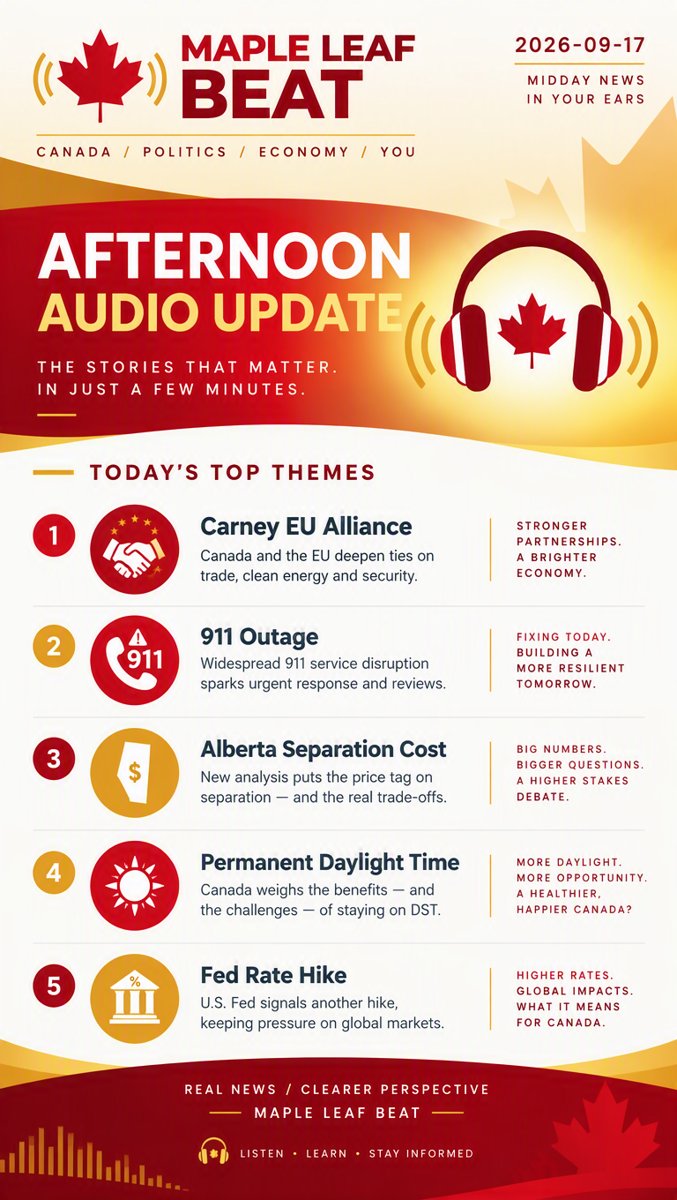
Afternoon Update audio brief for Thursday, September 17, 2026 — tap play above to listen with slides and subtitles. Here's what happened:
Prime Minister Mark Carney took Canada's European pivot to the big stage Thursday, addressing the European Parliament in Strasbourg and calling on Canada and the EU to stand together to protect democracies. "Europe and Canada aren't fair-weather allies," he told legislators, while rebuking what he described as Washington's tactics. The trip follows the EU's surprise proposal to make Canada its first-ever "associate member" — a notion that drew an angry reaction from U.S. President Donald Trump, who threatened tariffs on the EU over it. Spain's prime minister even posted an image of a maple leaf on the EU flag in solidarity. Carney also pitched expanded rules that would let Canadians work more freely in the EU. Why it matters: with the trade war with Washington grinding on, this is the most concrete step yet in Canada's push to diversify its economic and security ties.
Emergency lines went down across a wide swath of the country Thursday, with 911 outages hitting Ontario, Quebec and other regions. Multiple police forces reported interrupted service, and Quebec forces flagged call-routing problems of their own. By mid-afternoon, service was gradually being restored, though intermittent problems persisted in some areas, including Nova Scotia. The cause has not been pinned down. Why it matters: even a short outage can mean delayed ambulances and police response — and it raises fresh questions about the resilience of critical telecom infrastructure.
An independent analysis from the University of Calgary's School of Public Policy puts a jaw-dropping price tag on Alberta separatism: between $50 billion and $170 billion over five years to establish an independent Alberta. The report lands in the middle of a months-long debate over separation in the province, and columnists were quick to weigh in on both sides — some arguing separatists "self-sabotage by rejecting expertise," others that the report "settles nothing." Why it matters: the estimate turns an abstract constitutional debate into hard numbers that will now hang over every separation pitch.
Manitoba is getting off the seasonal clock-change treadmill. Premier Wab Kinew announced the province will stay on Daylight Saving Time permanently, keeping darker mornings at bay in exchange for brighter late-afternoon light through the winter months. In practical terms, Manitoba will not fall back this November. Other jurisdictions in North America have made or debated similar moves. Why it matters: it ends an annual ritual many Canadians dread — and puts a prairie province on a different clock than its neighbours for part of the year.
The U.S. Federal Reserve raised its key interest rate for the first time in three years, a quarter-point move that lifts the rate to about 3.9 per cent — and it did so over President Trump's objections. Fed officials flagged inflation pressure as the driver. Over time, the hike could translate into higher borrowing costs on both sides of the border, including mortgages. Why it matters: American rate decisions ripple straight into Canadian mortgage and business borrowing costs, so this one lands in every Canadian household's budget eventually.
Ending on a hopeful note: researchers in Manitoba report a potential breakthrough in the treatment of Multiple Sclerosis. The team itself calls the finding exciting, though it remains early-stage science and is years away from reaching patients. Still, for the tens of thousands of Canadians living with MS — a disease Canada has among the highest rates of in the world — any genuine advance is news worth hearing. Why it matters: early signals like this are where new treatments begin.
Maple Leaf Beat Audio · 2026-09-17 · Afternoon Update · Narrated edition, compiled from Reuters, CBC, The Guardian, Global News, CTV News and The Globe and Mail.
