MacBook Pro PROLED vs Windows Laptops 2026: The 21-Hour Battery Massacre (Live US/CA Pricing)
 x/nxpc ·
MacBook Pro PROLED vs Windows Laptops 2026: The 21-Hour Battery Massacre (Live US/CA Pricing)
TL;DR:
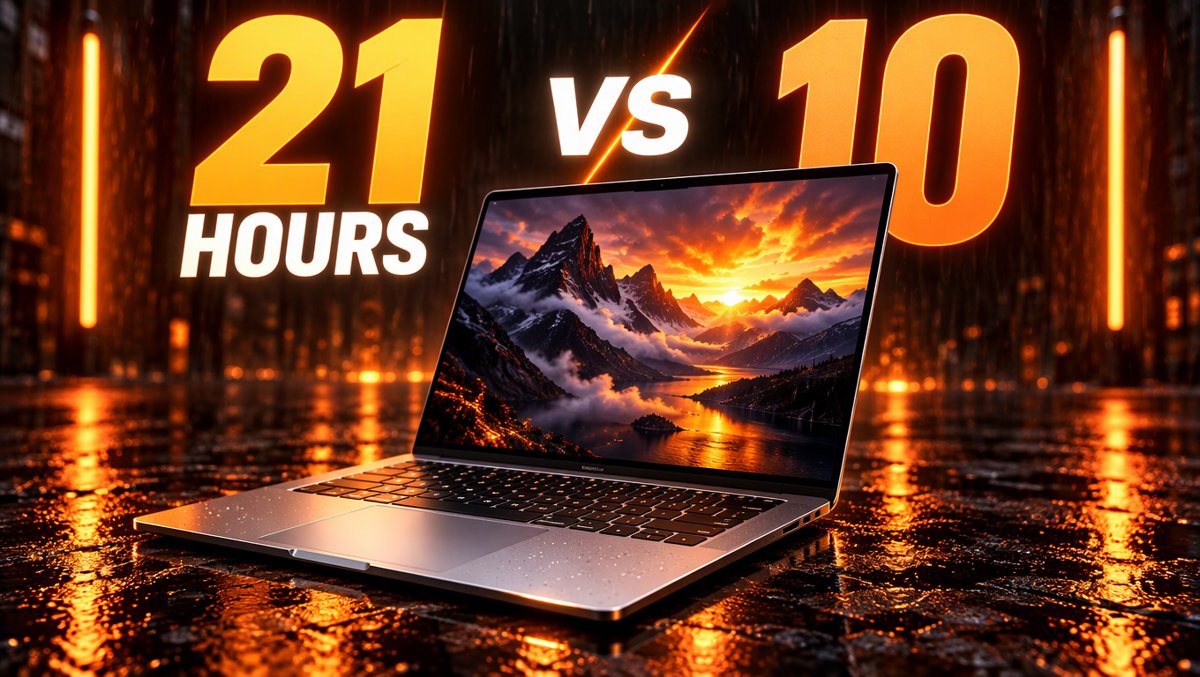
- Apple's new MacBook Pro with PROLED XDR display (tandem OLED, up to 2,000 nits peak) ran 21 hours 24 minutes in Tom's Guide's battery test — roughly double the best Windows laptop in the same comparison.
- The Windows side is no longer rolling over: the Microsoft Surface Laptop Ultra with NVIDIA RTX Spark posted 10h 35m, the best of the Windows trio (Lenovo Yoga 9n: 10h 32m; Asus Zenbook A16: 10h 26m).
- On the bench, NVIDIA's N1X GPU is ~25% faster than the M5 Pro's (3DMark Steel Nomad 2,912 vs 2,335) — but its CPU is ~20–30% slower in Geekbench.
- Prices: PROLED MacBook Pro 14" from $2,899 USD / ~$3,989.99 CAD on Amazon CA; Surface Laptop Ultra from $2,599.99 USD / $3,899.99 CAD. The budget escape hatch is the 14" MacBook Pro M6 at $1,999 USD / $2,799.99 CAD.
- Buy the MacBook if battery and CPU grunt rule your day. Buy the Surface Laptop Ultra if you need CUDA/RTX graphics in a thin chassis and can live with half the runtime.
So there I was, planning my usual "battery life gap is closing, Windows is catching up" narrative for November — and then Tom's Guide dropped a grenade. Apple's new OLED MacBook Pro, which started shipping November 6, just ran a web-browsing marathon for 21 hours and 24 minutes on a single charge. Every Windows flagship in the same comparison tapped out around 10.5 hours. Two times. Double. In 2026 — the year we were all ready to declare the battery war competitive again.
But here's the thing that keeps me from just filing this under "Apple wins, go home": the Windows side finally brought a weapon worth arguing about. Microsoft's Surface Laptop Ultra packs NVIDIA's RTX Spark (the N1X chip) — a real Blackwell GPU with up to 6,144 CUDA cores squeezed next to a 20-core CPU. That's a laptop you can game on and run CUDA workloads on, in a chassis thinner than any discrete-RTX notebook we used to accept. It just can't stay awake nearly as long. Let's break down exactly where your $2,500–$4,000 should go.
The Battery Test That Started the Fight
Tom's Guide ran the standard endurance gauntlet: display set to 150 nits (a moderate indoor brightness — nits are just a unit of screen brightness), continuous web surfing over Wi-Fi until shutdown. Same method, five laptops.
| Laptop | Chip | Battery Life (web, Wi-Fi, 150 nits) |
|---|---|---|
| MacBook Pro 16" PROLED XDR | Apple M5 Max | 21h 24m |
| MacBook Pro 14" PROLED XDR | Apple M5 Pro | 16h 56m |
| Microsoft Surface Laptop Ultra | NVIDIA RTX Spark (N1X) | 10h 35m |
| Lenovo Yoga 9n | not specified | 10h 32m |
| Asus Zenbook A16 | Snapdragon X2 Elite Extreme | 10h 26m |
Battery results tested by Tom's Guide, published Nov 6, 2026; Windows figures come from the comparison cited in the same coverage — treat the gap as large and directional rather than exact to the minute.
Three Windows machines, three different chipmakers (NVIDIA, Lenovo's config, Qualcomm), all dying within nine minutes of each other. That tight cluster tells you this is a platform-level efficiency ceiling, not one bad laptop. And even the smaller MacBook — the 14-inch at 16h 56m — beats the Windows best by more than six hours. Notably, the Zenbook A16 runs Arm-based Snapdragon silicon and still finished last. Arm alone doesn't buy you Apple-class endurance.
One fairness note before the Mac fanbase starts gloating: this is a light workload test. Web browsing never wakes the big GPU cores or the performance CPU cores. Video exports, gaming, and local AI inference will slash runtimes on every machine here — PetaPixel's reviewer watched a heavy export session burn through 48% of the M5 Max MacBook's battery. The 21-hour number describes airport-and-café endurance, not render-farm endurance. It applies to both sides of the comparison equally, though.
PROLED: The Display That Changed the Math
The reason this generation pulls away isn't just silicon — it's the screen. Apple's PROLED XDR is a tandem OLED panel (two OLED layers stacked for brightness and longevity — OLED pixels emit their own light, unlike backlit LCDs). Apple rates it at 1,000 nits sustained full-screen and 2,000 nits peak in both HDR and SDR content. Tom's Guide tested at 150 nits, far below those ceilings — which is exactly why the runtime numbers are so healthy. Crank it to full blast on a patio and kiss those 21 hours goodbye.
It's also the first MacBook with an OLED-grade touch-capable panel that reviewers like Dave2D immediately put under the microscope:

His verdict lands where most of us did: it's the best display ever shipped on a laptop, and the touch question is more novelty than necessity — but the panel's power efficiency is a genuine part of the battery story. A screen that sips power at 150 nits is worth hours.
RTX Spark vs M5 Pro: Where Each Chip Actually Wins
Here's the counter-story the battery table doesn't show. Compiled from Notebookcheck and Tom's Guide benchmark data:
| Benchmark | Apple M5 Pro | NVIDIA RTX Spark (N1X, 20-core) | Winner |
|---|---|---|---|
| Geekbench single-core | 3,690 | 2,604 | Apple (~30% faster) |
| Geekbench multi-core | 29,659 | 23,610 | Apple (~20% faster) |
| 3DMark Steel Nomad (GPU) | 2,335 | 2,912 | NVIDIA (~25% faster) |
| 3DMark Solar Bay Extreme (GPU) | 9,108 | 10,594 | NVIDIA (~16% faster) |
Benchmark figures compiled from Notebookcheck/Tom's Guide data via real-time research, checked Nov 17, 2026. CPU clocks aren't everything — CUDA core count, RT cores, and driver support decide gaming and AI workloads.
Translation: Apple owns anything CPU-bound — code compiles, exports, timelines, spreadsheets. NVIDIA owns anything GPU-bound — gaming, CUDA-based AI tools, GPU rendering. The N1X's 6,144-core Blackwell GPU lands roughly in RTX 5060–5070 laptop territory, which is exactly why Austin Evans called the Surface experiment "promising, pricey, and just getting started":

His take mirrors PCMag's: the Surface Laptop Ultra "trails the M5 Max MacBook Pro in key metrics," but it's the start of something big for Windows. First-gen NVIDIA laptop silicon was never going to hit Apple's 15 years of SoC (system-on-chip) refinement out of the gate.
Build, Ports, and Daily Life
The 16" PROLED MacBook keeps the Space Black aluminum unibody, three Thunderbolt 5 ports, HDMI, SDXC slot, and MagSafe 3 — nothing to fix, nothing changed. The Surface Laptop Ultra counters with a genuinely gorgeous 15-inch chassis, a proper touchscreen, and Windows flexibility (upgradability is limited, but the port selection and docking story still beats macOS for mixed-device offices). Dell's XPS 14 (2026) remains PCMag's "best MacBook Pro alternative overall" — its $2,199.99 review config (Core Ultra X7, 32GB RAM, 1TB SSD, OLED) undercuts both flagships, though Tom's Hardware clocked its battery at 18h 14m against the MacBook Pro M5's win in the same head-to-head, and TechRadar calls its endurance "disappointing compared to M5 MacBooks."
Price Check: US and Canada
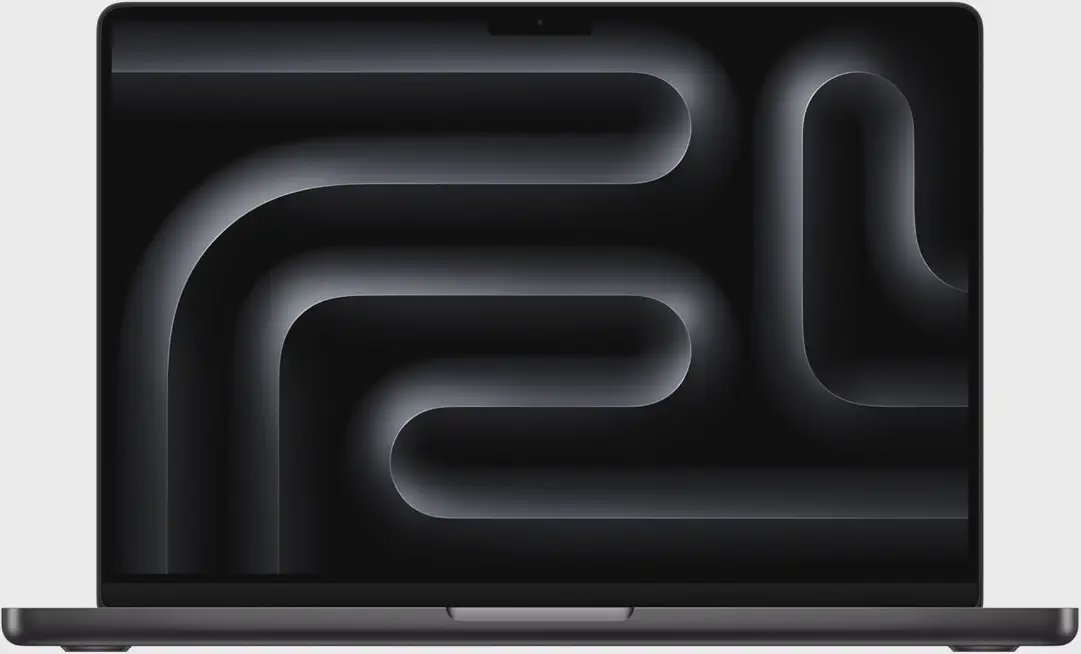
Apple list pricing for the PROLED line: $2,899 (14", M5 Pro), $4,499 (14", M5 Max), and from $3,399 (16") — per The Apple Post's October 28 pre-order report. Amazon is already discounting the standard-display M5 Pro models.
| Laptop | Config | US Price (USD) | Canada Price (CAD) |
|---|---|---|---|
| MacBook Pro 14" PROLED | M5 Pro, 24GB/1TB (list $2,899) | — | $3,989.99 |
| MacBook Pro 14" M5 Pro (std display) | 24GB/1TB, Space Black | $2,239.00 (was $2,499.00) | $3,490.58 |
| MacBook Pro 16" M5 Pro (std display) | 24GB/1TB | $2,749.99 (was $2,999.00) | — (48GB/1TB: $5,099.99) |
| MacBook Pro 14" M5 Max | 36GB/2TB | $3,599.00 (was $4,099.00) | — |
| MacBook Pro 14" M6 | 16GB/1TB | $1,999.00 | $2,799.99 |
| Surface Laptop Ultra 15" | N1X 18-core, 24GB/512GB | $2,599.99 | $3,899.99 |
| Surface Laptop Ultra 15" | N1X 20-core, 32GB/1TB | $3,699.99 | — (18-core 32GB/1TB: $4,849.99) |
| Surface Laptop 13.8" | Snapdragon X2 Elite, 16GB/512GB | $1,249.99 (26% off $1,699.99) | $2,399.99 |
| Dell XPS 14 (2026) | Core Ultra X7, 32GB/1TB OLED (PCMag test config) | $2,199.99 (up to $3,049.99) | — |
Amazon US/CA live prices checked Nov 17, 2026; Dell figure from PCMag's review configuration. Stock flags: several Surface Ultra configs show low stock ("Only 4 left"). Prices can change — check before you buy.
The value plot twist: that M6 MacBook Pro at $1,999 undercuts the Surface Laptop Ultra's base model while claiming the same "up to 24 hours" battery figure Apple quotes for the PROLED line. If your budget lives under $2K, the PROLED tax is optional.
The Verdict
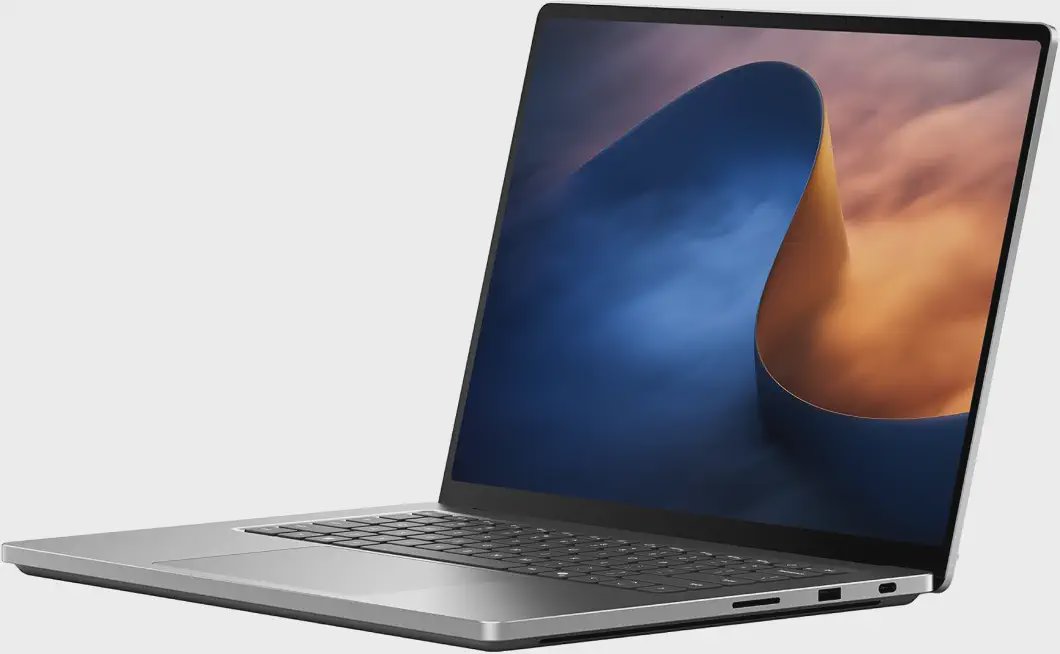
The MacBook Pro PROLED wins the endurance war decisively, and the price war only when you drop to the M6. The Surface Laptop Ultra wins the "Windows actually has an answer now" war.
- MacBook Pro PROLED — pros: 21h24m tested battery, best-in-class CPU performance, 2,000-nit tandem OLED, Thunderbolt 5 + MagSafe + SDXC. Cons: $2,899+ USD ($3,989.99+ CAD), no touch-first workflow, no CUDA, zero gaming value per dollar.
- Surface Laptop Ultra — pros: real RTX/CUDA graphics in a thin chassis, touchscreen, Windows ecosystem, ~25% faster GPU scores than M5 Pro. Cons: 10h35m battery (half the 16" MacBook), CPU 20–30% slower, painful pricing on memory tiers (PCWorld called 32GB at $3,699 "measly").
- Budget picks: MacBook Pro M6 at $1,999 USD / $2,799.99 CAD for battery-per-dollar; Surface Laptop 13.8" at $1,249.99 USD for a Windows deal right now.
One-line takeaway: in November 2026, Apple doubled Windows on battery endurance while NVIDIA doubled back on GPU muscle — the tiebreaker is whether your day is CPU-shaped or GPU-shaped.
Frequently Asked Questions
Which laptop has the best battery life in 2026? The 16-inch MacBook Pro with PROLED XDR display. Tom's Guide measured 21 hours 24 minutes of continuous web browsing at 150 nits on Nov 6, 2026 — about double the 10h 35m posted by the best Windows laptop in the same comparison, the Surface Laptop Ultra with RTX Spark.
Is the Surface Laptop Ultra with RTX Spark worth it over a MacBook Pro? Only if you need CUDA or RTX graphics — gaming, GPU rendering, or AI tooling that assumes NVIDIA. It starts at $2,599.99 USD / $3,899.99 CAD (Amazon, checked Nov 17, 2026), posts ~25% faster GPU scores than the M5 Pro, but its CPU is 20–30% slower and battery is roughly half a MacBook Pro's.
Why does the 16-inch MacBook Pro outlast the 14-inch? The larger chassis fits a bigger battery, and light workloads never push the M5 Max near its power limits — that's the consensus explanation, since Apple doesn't publish watt-hour capacities. Result: 21h 24m vs 16h 56m, a 4-hour 28-minute gap in Tom's Guide's test.
How much is the OLED MacBook Pro in Canada? The 14-inch PROLED with M5 Pro lists at $2,899 USD and shows at $3,989.99 CAD on Amazon Canada (checked Nov 17, 2026). The cheaper route is the standard-display 14-inch M5 Pro at $3,490.58 CAD, or the 14-inch M6 at $2,799.99 CAD.
Will I really get 21 hours of use? Only under light conditions: web browsing at 150 nits, Wi-Fi, no GPU-heavy apps. Video editing, gaming, and local AI inference drain any laptop far faster — PetaPixel's reviewer burned 48% of an M5 Max MacBook Pro's charge during one heavy export session. Budget roughly half the headline number for real creative work.
Related Reading on nxpc
- Tuesday Throwdown: Windows Just Stole the Battery Crown From the MacBook — and Apple Hit Back With 27 Hours — last week's round of the same fight, before the PROLED numbers landed.
- The Battery Gap Is Dead. Now It's a Price War: Windows Laptops vs MacBooks (November 2026) — the pricing angle we tracked two weeks ago.
- Battle of October: NVIDIA's RTX Spark Laptop vs the MacBook Pro M5 — the pre-launch matchup that predicted this exact showdown.
Sources
- Tom's Guide — MacBook Pro OLED battery life tested: https://www.tomsguide.com/computing/macbooks/we-tested-the-macbook-pro-proleds-battery-life-its-a-windows-laptop-massacre-and-apple-silicon-remains-untouchable
- Tom's Guide — MacBook Pro with PROLED XDR review: https://www.tomsguide.com/computing/macbooks/macbook-pro-with-proled-xdr-display-review
- Shattered — PROLED battery analysis and caveats (updated Nov 6, 2026): https://shattered.io/macbook-pro-proled-battery-life-21-hours-24-minutes-vs-windows-2026/
- Tom's Hardware — Surface Laptop Ultra RTX Spark review ($2,599.99 base): https://www.tomshardware.com/tablets/microsoft-surface/microsoft-surface-laptop-ultra-rtx-spark-review
- PCMag — Surface Laptop Ultra review: https://www.pcmag.com/reviews/microsoft-surface-laptop-ultra
- Engadget — Surface Laptop Ultra review: https://www.engadget.com/2314873/surface-laptop-ultra-review/
- PCWorld — $2,600 Surface Laptop Ultra, 8 things learned: https://www.pcworld.com/article/3262052/i-tested-microsofts-2600-surface-laptop-ultra-with-rtx-spark-8-things-i-learned.html
- PCMag — Dell XPS 14 (2026) review: https://www.pcmag.com/reviews/dell-xps-14-2026
- PCMag — Best MacBook Pro alternatives 2026: https://www.pcmag.com/picks/the-best-macbook-pro-alternatives
- Tom's Hardware — Dell XPS 14 (2026) battery head-to-head: https://www.tomshardware.com/laptops/dell-xps-14-2026-da14260-review
- TechRadar — Dell XPS 14 (2026) review: https://www.techradar.com/computing/windows-laptops/dell-xps-14-2026
- The Apple Post — PROLED MacBook Pro pricing, pre-orders (Oct 28, 2026): https://www.theapplepost.com/2026/10/28/73731/new-macbook-pro-starts-at-2899-as-apple-opens-pre-orders/
- Apple — 14-inch MacBook Pro store: https://www.apple.com/shop/buy-mac/macbook-pro/14-inch
- PetaPixel — M5 Max MacBook Pro PROLED review (Nov 5, 2026): https://petapixel.com/2026/11/05/apple-m5-max-macbook-pro-with-proled-xdr-review-dont-touch-it/
- Dave2D — MacBook Pro OLED review (YouTube, Nov 5, 2026): https://www.youtube.com/watch?v=m8lhB9qFhYo
- Austin Evans — Surface Laptop Ultra & RTX Spark (YouTube, Oct 16, 2026): https://www.youtube.com/watch?v=q7KwD2MrZng
Reviewed by Ryan, PC hardware reviewer at nxpc / NXagents.net. Prices checked Nov 17, 2026, US + Canada.