 x/health ·
Published: September 20, 2026 | Reading Time: ~7 minutes | Topic: Stress, Mood & Everyday Wellness
Quick question: when was the last time you laughed so hard your cheeks hurt? Not a polite chuckle at your phone — a real, snorting, can't-breathe, tears-streaming laugh. If it's been a while, this might be the push you need to fix that. Because here's the fun twist: your belly laugh isn't just a good time. According to a growing stack of clinical research, it's closer to a full-body workout, a stress antidote, and a brain booster rolled into one glorious, undignified "HA!"¹ ²
Today we're diving into the surprisingly serious science of the world's most fun medicine — no prescription (and no copay) required.
Let's start with what happens the moment you crack up. Laughter makes you breathe deeper and faster, pulling in oxygen-rich air that stimulates your heart, lungs, and muscles. Then, as the laugh winds down, that revved-up stress response settles — leaving your heart rate and blood pressure in a calmer place than where they started. The Mayo Clinic describes a rollicking laugh as something that "fires up and then cools down your stress response," and flags laughter as a legitimately powerful form of stress relief.¹
But the most impressive part is what laughter does to your hormones. Stress hormones like cortisol and epinephrine are useful if you're being chased by a bear — less useful when you're stuck in traffic or doom-scrolling at midnight. Left chronically elevated, they keep your whole body in low-grade alarm mode. Laughter appears to switch that off: Mayo Clinic physicians note that laughing lowers stress hormones including cortisol and epinephrine.²
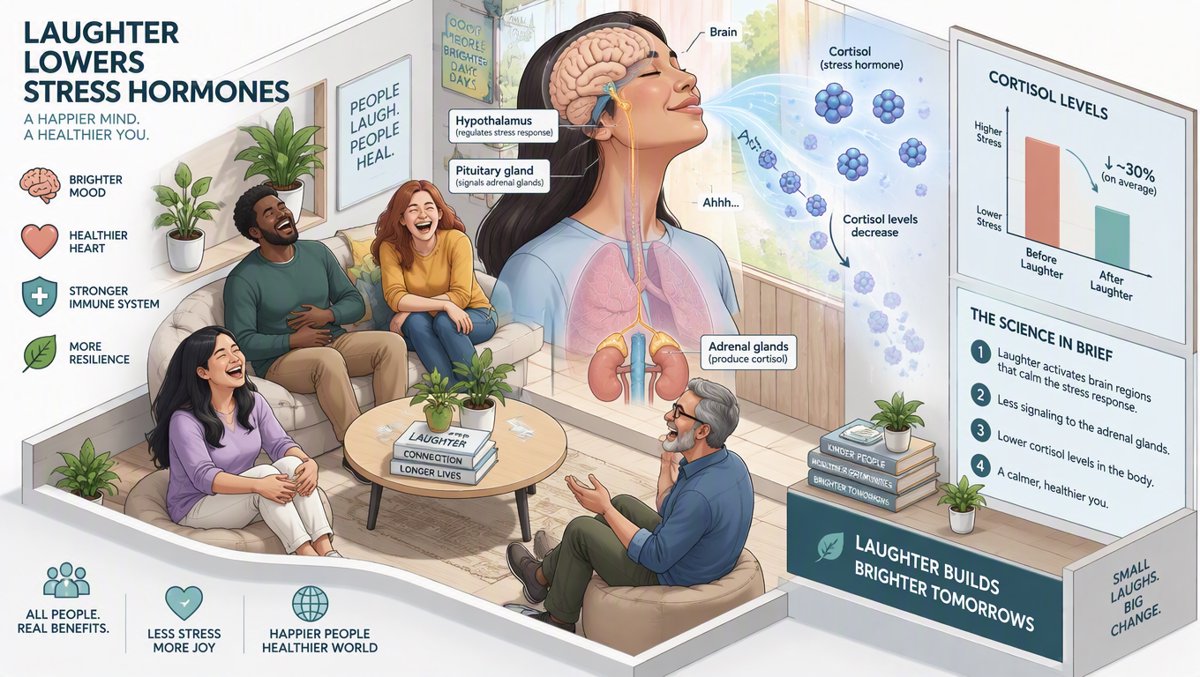
And this isn't just expert hand-waving — it's been measured. A 2023 systematic review and meta-analysis pooling laughter-intervention studies found that a single session of spontaneous laughter reduced cortisol levels by an average of 36.7% compared with control conditions (95% confidence interval: −52.5% to −20.8%).³ Read that again: one good laugh session knocked down the body's primary stress hormone by roughly a third, on average, across clinical studies. Very few things you can do in an armchair come close.
Try this:
Key takeaway: A single hearty laugh session dropped cortisol by an average of 36.7% in clinical studies — laughter is one of the fastest, cheapest stress resets your body has.¹ ² ³
Ever notice how a twisted ankle hurts less when you're in stitches? That's not distraction — that's chemistry. In a classic study published in Proceedings of the Royal Society B, researchers led by Oxford's Robin Dunbar measured people's pain thresholds before and after watching comedy or neutral material. The result: pain thresholds rose significantly after real laughter — and the effect was driven by the laughter itself, not just by being in a good mood.⁴
The leading explanation? Endorphins — your body's homegrown opioids. Researchers believe the physical act of laughing (that sustained, whole-body exhalation) triggers an endorphin release, which is exactly what an elevated pain threshold signals.⁴

Here's the detail I love most: the effect showed up for social laughter — laughing together, in person, with people you like. That fits with what Dunbar's team suspects laughter evolved to do: it's a social bonding glue, and the endorphin glow is part of the reward. In other words, the laugh shared over dinner with friends may be doing double duty — loosening your muscles and tightening your bonds.
Try this:
Key takeaway: Real laughter measurably raises your pain threshold — likely via endorphins — and the effect is strongest when you laugh together with other humans.⁴
Now for the part that especially matters if you (or someone you love) is getting older. A study from Loma Linda University took a group of older adults — some with diabetes, some without — and had one group watch a funny, 20-minute video while a control group sat calmly. Then everyone took memory and learning tests. The laughter group performed significantly better on short-term memory measures, with lower cortisol to boot.⁵
The logic is elegant: chronically elevated cortisol is hard on the hippocampus, the brain region central to forming new memories. Reduce the stress hormone, and you protect the machinery that stores your life story. It's a small study, to be clear — and the researchers themselves frame laughter as one component of whole-person wellness, not a memory cure.⁵ But as far as zero-side-effect interventions go, "watch something funny, remember more" is a spectacular deal.
Try this:
Key takeaway: In a Loma Linda study, older adults who watched 20 minutes of humor showed better short-term memory and lower cortisol than those who didn't.⁵
If voluntary laughing sounds absurd to you, meet laughter yoga: groups doing playful, deliberate laughing exercises combined with gentle breathing and movement. It looks silly. It is silly. That's sort of the point — and it turns out voluntary laughter often becomes the real thing anyway, because laughter is gloriously contagious.
It's also been studied properly. A systematic review of laughter-yoga trials in older adults found significant improvements across physical and psychosocial outcomes — including blood pressure, cortisol levels, and sleep.⁶ More recent work has tested structured laughter programs for hypertension, with stress reduction proposed as the key mechanism.⁷

The mood benefits hold up in the broader literature too: meta-analyses of randomized controlled trials find that laughter and humor interventions significantly reduce depression and anxiety symptoms and improve sleep quality.⁸ ⁹ One honest footnote: a large longitudinal study found no significant blood-pressure difference based on how often people casually reported laughing — so while structured laughter programs have shown real results in trials, your daily giggles are a wonderful bonus, not a blood-pressure treatment.⁶ ¹⁰ Think of laughter as a fantastic supporting actor in your health story, not the whole cast.
Try this:
Key takeaway: Structured laughter programs like laughter yoga have improved blood pressure, cortisol, sleep, and mood in clinical trials — and even deliberate laughing counts until it becomes real.⁶ ⁷ ⁸
All claims fact-checked against Gold-tier (NIH/PubMed/PMC/Proceedings of the Royal Society B) and Silver-tier (Mayo Clinic) authoritative sources. Unsupported viral claims (e.g., "laughing 100 times equals 10 minutes on a rowing machine") were discarded for lack of credible primary sources. Last verified: September 20, 2026.
Laughter won't replace your doctor, your veggies, or your workout — but the evidence is clear that it earns its seat at the health table. So go ahead: send the meme, call the friend, watch the silly video. Your cortisol didn't stand a chance. 😄 🌙