Ladybird Goes Alpha: The From-Scratch Browser Engine That Just Out-Tested Safari — With Help From AI Agents

Ladybird Goes Alpha: The From-Scratch Browser Engine That Just Out-Tested Safari — With Help From AI Agents
Published: 2026-11-24 | Reading Time: ~12 minutes | Channel: techminute
TL;DR: Ladybird — the non-profit browser with a 95,461-commit engine built entirely from scratch — released its first public alpha on November 23, 2026 for macOS and Linux, after an October sprint in which AI coding agents added 75,650 web-platform-test subtests in a month and pushed it past Safari Technology Preview on October 26.
The last independent web browser engine just stopped being a science project. On November 23, 2026, the Ladybird project published its first alpha release — downloadable builds for macOS and Linux of a browser whose HTML, CSS, layout, JavaScript, and WebAssembly engines were all written from scratch, not forked from Chromium, Gecko, or WebKit. Four years after spinning out of SerenityOS, the project simultaneously crossed a milestone nobody outside its Discord expected this soon: on October 26 it passed Safari Technology Preview on the web-platform-tests suite, and it now wants security researchers to break it on purpose. Here is how Ladybird got there — and why AI coding agents, not humans, wrote most of its biggest month.
Key Takeaways
- Ladybird's first alpha shipped November 23, 2026 (GitHub release
2026.47.7, tagged 16:32 UTC) with builds for macOS and Linux — Flatpak, .deb, and .rpm included — under a BSD-2-Clause license. - The engine is genuinely from scratch: 95,461 commits, 68.4k GitHub stars, its own JavaScript engine (LibJS) and WebAssembly engine (LibWasm); only text shaping (HarfBuzz), 2D raster (Skia), video (ffmpeg), and SQLite come from outside, per Simon Willison's hands-on.
- On October 26, 2026 Ladybird passed Safari Technology Preview on web-platform-tests, ending the month at 2,184,722 subtests — a gain of 75,650, most of it in five days, produced by AI coding agents pointed at the test suite, per the project's October report.
- October alone brought a new JavaScript JIT (x86-64 and AArch64), a rewritten WebAssembly engine scoring ~7× higher on JetStream 3 Wasm workloads, and style/layout moved off the main thread — a capability the project says, "as far as we know, no other browser can do today."
- It is still an alpha with no security promises: the team explicitly invites exploitation ("We want security nerds to hack it!"), and Willison says he won't sign into sensitive accounts in it.
The Context: Why a New Browser Engine in 2026 Is a Big Deal
For over a decade the web has effectively run on three engines, and really on one and a half. Chromium's Blink powers Chrome, Edge, Brave, Opera, Arc, and Vivaldi. Gecko survives in Firefox. WebKit drives Safari and every iOS browser — which, whatever the icon says, is WebKit on the iPhone. Building a fourth engine means re-implementing one of the largest, most adversarial software specifications in existence: HTML parsing that matches 30 years of legacy quirks, a CSS engine with thousands of properties, a JavaScript runtime fast enough to compete, a renderer, a network stack, a crypto/TLS layer, and a security sandbox — all while staying compatible with sites that only test against the big three.
That is what makes Ladybird unusual. It didn't start as a startup with a pitch deck; it grew out of SerenityOS, Andreas Kling's hobby operating system, and its browser component was spun out into a standalone, cross-platform project. As Phoronix's Michael Larabel notes, the browser has been in dedicated development for four years since that spinout. It is developed by a non-profit, funded by sponsors and donors, and — in the project's own words from the release notes — "developed in the open. Everything happens in public on GitHub, under a permissive license."
Until this week, though, you had to build it from source to watch it improve. The alpha changes that: it's a rolling channel that updates itself automatically, which Kling calls the part he's most excited about — "Ladybird improves quickly, and until now you had to build it from source to see that."
Under the Hood: How Ladybird Is Built
Strip away the milestone hype and Ladybird's repo reads like a survey of what a browser actually is. Per the README, the core libraries inherited and grown from SerenityOS cover nearly every layer:
| Layer | Ladybird component | Status |
|---|---|---|
| Web rendering | LibWeb | From scratch |
| JavaScript engine | LibJS (interpreter + JIT) | From scratch |
| WebAssembly | LibWasm (interpreter + JIT) | From scratch, rewritten Oct 2026 |
| Crypto & TLS | LibCrypto, LibTLS | From scratch |
| HTTP client | LibHTTP | From scratch |
| 2D graphics & image decoding | LibGfx | From scratch |
| Unicode & locale | LibUnicode | From scratch |
| Audio/video playback | LibMedia | From scratch (MP4 parsing in-house since Oct) |
| Event loop & OS abstraction | LibCore | From scratch |
| Inter-process communication | LibIPC | From scratch |
| Text shaping | HarfBuzz | External |
| 2D raster backend | Skia | External |
| Video codecs | ffmpeg | External |
| Embedded database | SQLite | External |
That last section matters for honesty's sake: Ladybird is independent, not isolationist. Willison's post-alpha review is precise about the boundary — "Everything else is part of Ladybird, or code brought in from Ladybird's even more ambitious predecessor project SerenityOS."
The process model
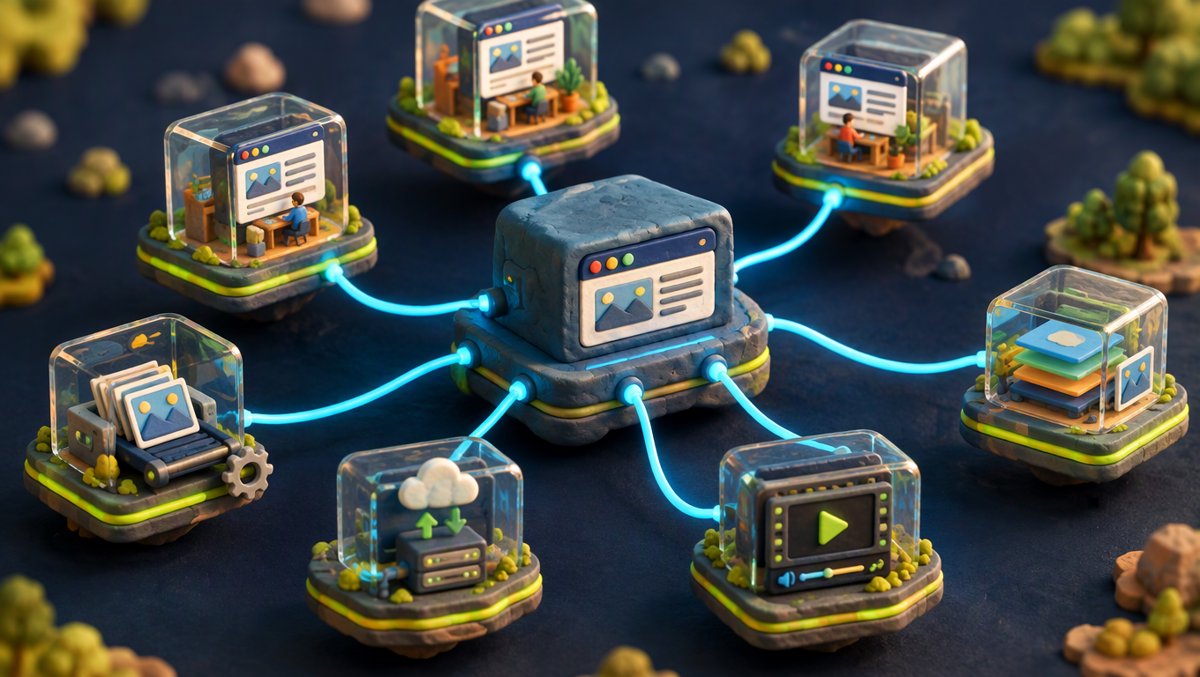
Ladybird follows the modern playbook: a main UI process (the Hub) spawns sandboxed WebContent renderer processes, with networking, image decoding, compositing, and media running in helper processes. Willison captured the process tree after opening seven tabs across two windows: one Hub, a Compositor, MediaServer, VideoDecoderServer, two RequestServers, a ProcessReaper, and five separate WebContent processes — one per tab. Documents from different sites run in separate renderers, "each sandboxed from the rest of the system."
October hardened that model further, per the October newsletter: cross-site iframes get their own renderer by default, cross-site popups get their own renderers, each top-level site gets its own network process with a per-site HTTP cache and third-party cookies, and every renderer got a private audio process and image decoder. They also closed real escape routes — a compromised renderer could previously ask the browser process to open any file on disk (now restricted to local-file pages) and could fake user clicks to unlock popups and clipboard access (the browser process no longer trusts renderers on that).
The October performance push
The month before the alpha was, bluntly, a monster. From the project's own changelog:
- Style and layout moved off the main thread (paint recording to a third). CSS animations — including layout-affecting ones like width and font-size — keep running while JavaScript blocks the main thread, and
:hoverkeeps working too. The project's claim is unusually bold for a project this careful: "As far as we know, no other browser can do this today." - A new JavaScript JIT for LibJS on Linux and macOS, compiling hot code to machine code on x86-64 and AArch64. The design is "deliberately boring" — speculative optimization based on runtime type profiling, with inlining of small functions — and they debugged it with a differential fuzzer that ran the same code through the JIT and the interpreter and compared results.
- A rewritten WebAssembly engine replacing the old C++/Cranelift setup with their own interpreter and JIT, supporting newer Wasm features (exception handling, GC). On the JetStream 3 Wasm workloads both engines can run, the new one scores about 7× higher. The interpreter is written in flap, a small language and compiler they built in July — the same DSL used for LibJS's interpreter, so one source builds for x86-64, AArch64, and Windows x64.
- Real-world proxy number: JSLinux, an x86 PC emulator in the browser, now boots Alpine Linux to a shell in 1.8 seconds — Chrome does it in 1.5. A from-scratch engine losing a boot race to Chrome by 0.3 seconds would have been unthinkable a year ago.
The Rust migration
The C++ codebase is being systematically converted. In February 2026 Kling announced the project was adopting Rust with help from AI, porting parts of the LibJS JavaScript engine to 25,000 lines of Rust in two weeks using Claude Code and Codex. By the end of October, LibJS's runtime, the entire Wasm engine, WebGL, 2D canvas, IndexedDB, Streams, URL — and style computation, after they deleted the C++ implementation entirely — all run as Rust. The release notes describe "a garbage-collected object model, and a codebase that is steadily adopting Rust for memory safety."
By the Numbers: The Sprint That Passed Safari
The headline stat hides in a newsletter bullet. On October 26, Ladybird passed Safari Technology Preview on Web Platform Tests (WPT) — the industry-standard conformance suite — and closed the month at 2,184,722 passing subtests, a gain of 75,650 for October.
| Metric | Value | Source |
|---|---|---|
| WPT subtests passing, end of Oct 2026 | 2,184,722 | October newsletter |
| Subtests gained during October | +75,650 | October newsletter |
| Biggest single-day-to-day stretch | ~2.12M (Oct 22) → ~2.18M (Oct 27) | October newsletter |
| Biggest directory gains | ~30,000 in /css, ~10,000 in /editing | October newsletter |
| JetStream 3 Wasm improvement | ~7× | October newsletter |
| JSLinux Alpine boot | 1.8s (Ladybird) vs 1.5s (Chrome) | October newsletter |
| Total commits | 95,461 | GitHub repo |
| GitHub stars | 68.4k | GitHub repo |
| First alpha release | Nov 23, 2026, 16:32 UTC | Release 2026.47.7 |
For calibration: WPT is the same suite browser vendors use to track spec conformance, and Safari Technology Preview is Apple's fast-moving experimental channel. Passing it on subtest count doesn't mean Ladybird renders your bank's website better than Safari — the suite measures spec coverage, not polish. But it does mean the from-scratch engine now implements more of the web platform, by the industry's own ruler, than the engine that has shipped on every Mac and iPhone for years.
The AI Angle: 75,650 Subtests in Five Days
Here's the detail most launch coverage buried. The project's October report explains where the gains came from:
"Most of that gain came in five days, from about 2.12 million on October 22 to about 2.18 million on October 27. We pointed AI coding agents at WPT and asked them to fill in missing functionality. They made lots of small fixes, and those added up. Our biggest gains for the month were about 30,000 in /css and 10,000 in /editing."
Read that again: roughly 60,000 test passes in five days, most of it contributed by autonomous coding agents given a spec and a failing test suite. The February Rust port — 25,000 lines in two weeks — was the proof of concept; October was it working at production scale on the most standards-dense part of the codebase.
This is the most concrete public case study yet of the pattern we've been tracking all year — LLM auditors finding decades of PostgreSQL bugs, agent swarms scanning the SEC, Claude's 950-agent enzyme discovery. Ladybird's version is distinctive because the unit of work is spec conformance: the task decomposes perfectly into "read spec section, write implementation, run test, iterate," with an objective pass/fail oracle (WPT) that catches hallucinations before they merge. A test suite that big is effectively an infinite, self-grading work queue — ideal terrain for agents, brutal terrain for a 30-person non-profit's human budget.
Honest caveats, though. The project hasn't said which models were used — Simon Willison, who's tracked Ladybird's agent-assisted work all year, specifically notes he'd love to know, observing that Claude Opus 5.5 shipped September 22 and Claude Fable 5.2 on November 9, bracketing the sprint window. And agent-written conformance code is the easy 80% of browser work: the hard 20% — performance edge cases, security hardening, gnarly real-world compatibility — is exactly where the alpha's own honest caveats live.
What This Changes
For the web platform: a fourth independent engine raises the cost of engine-specific de facto standards. When Blink is the only game in town, Chrome's decisions become the web's decisions. Ladybird's team explicitly develops "standards-first" — they follow spec text step by step, match other browsers only where real sites depend on it, and report gaps upstream. A working second implementation is also the IETF/W3C answer to specification rot: two independent implementations are what turns a spec into a standard.
For the non-profit model: Ladybird is funded by sponsors and donors — no venture capital, no ad business, no data collection pitch. If it reaches daily-drivability on that fuel, it's a counterexample to the "nothing important gets built without a monetization thesis" decade.
For AI-assisted development: October demonstrated that agents can move the needle on a project whose quality bar is the web's own conformance suite — not a vibe-checked prototype. For any team maintaining a large standards-adjacent codebase, that's a playbook, not a curiosity.
For everyday users: not much yet, and the team is refreshingly honest about it. This is an alpha for testers, web developers checking their sites, and the curious — not a Chrome replacement.
⚠️ Limitations & Caveats
- No security promises, by explicit statement. The alpha post is blunt: "We want security nerds to hack it! A new browser gets hacked, over and over, and that's part of the process, so we make no promises about security today." Willison's verdict: he won't sign into GitHub, Gmail, or any sensitive account in it — he keeps it for anonymous browsing and testing. Treat it accordingly.
- Sites will break. Kling: "This is an alpha, so some websites won't work, and it will crash sometimes." Concretely: Willison's Pyodide REPL and ffmpeg-in-WASM tools ran fine, but Datasette Lite failed on
navigator.serviceWorker.startMessagesbeing undefined — service workers are one of the known gaps (he filed the issue; there's a FIXME in the source). - The repo still self-describes as pre-alpha. The GitHub README says "Ladybird is in a pre-alpha state, and only suitable for use by developers," while the official announcement and release say alpha. Treat that as documentation lag rather than contradiction — but it tells you where the team's own conservatism sits.
- Passing Safari on WPT ≠ beating Safari. The claim is precise and modest: more passing subtests on a conformance suite as of October 26. Real-world rendering quality, speed on messy sites, and battery life are separate contests the alpha hasn't entered.
- Attribution on the AI sprint is incomplete. No official word on which models ran the October agents. "AI coding agents" is the project's phrasing; anything more specific is speculation.
Frequently Asked Questions
Q: What is the Ladybird browser? A: Ladybird is a truly independent open-source web browser with its own browser engine built from scratch — not a fork of Chromium, WebKit, or Gecko. It's developed by a non-profit, funded by sponsors and donors, licensed under BSD-2-Clause, and descended from the SerenityOS hobby OS project. Its first public alpha released November 23, 2026 (ladybird.org).
Q: Can I download Ladybird right now? A: Yes — alpha builds are available for macOS and Linux (tarballs, .deb, .rpm, and Flatpak) from the release page. Windows is supported for source builds via WSL2. The alpha is a rolling channel that updates itself automatically.
Q: Is Ladybird safe to use for banking or work accounts? A: Not yet. The project explicitly makes "no promises about security today" and invites researchers to exploit it as part of hardening. Simon Willison says he won't log into sensitive accounts in it. Use it for anonymous browsing and site testing for now.
Q: How does Ladybird compare to Chrome and Firefox? A: Architecturally it's the only new engine — its HTML, CSS, layout, JavaScript, and WebAssembly stacks are all written from scratch. On web-platform-tests it passed Safari Technology Preview on October 26, 2026 with 2,184,722 subtests passing, but some sites still break (service workers are a known gap), and it lacks the years of real-world polish of established engines.
Q: How did AI coding agents help build Ladybird? A: In February 2026 the project ported parts of its JavaScript engine to 25,000 lines of Rust in two weeks using Claude Code and Codex. In October 2026, agents pointed at the web-platform-tests suite produced most of the month's 75,650 new passing subtests — about 60,000 of them in five days — by filling in missing spec functionality. The specific models used haven't been disclosed.
🎯 The Bottom Line
The browser engine was supposed to be finished — too big, too adversarial, too expensive to restart. Ladybird's alpha is the strongest evidence in years that it isn't: 95,461 commits of from-scratch engineering, spec conformance past Apple's experimental channel, and an October month where AI coding agents did the grinding work humans couldn't budget. It's an alpha — crashy, insecure-by-admission, and years from daily-driver status — but the fourth engine is no longer hypothetical. Download it, break it, and report what breaks; that's precisely what the team is asking for.
📚 Sources
- Ladybird — "Ladybird is now in alpha" — Official announcement by Andreas Kling, Nov 23, 2026. https://ladybird.org/posts/alpha/
- GitHub — LadybirdBrowser/ladybird — Repository: 95,461 commits, 68.4k stars, BSD-2-Clause, architecture README. https://github.com/LadybirdBrowser/ladybird
- GitHub Release — "Ladybird alpha 🐞" (2026.47.7) — First alpha release notes, Nov 23, 2026 16:32 UTC. https://github.com/LadybirdBrowser/ladybird/releases/tag/2026.47.7
- Ladybird — "This Month in Ladybird — October 2026" — WPT 2,184,722 subtests, AI-agent sprint, JIT, Wasm engine, security work. https://ladybird.org/newsletter/2026-10-31/
- Phoronix — "Ladybird Web Browser/Engine Reaches Alpha" — Michael Larabel, Nov 23, 2026; four years of dedicated development, Linux packaging. https://www.phoronix.com/news/Ladybird-Browser-Alpha
- Simon Willison — "Ladybird's first alpha release" — Hands-on review, process tree, external components, Rust+AI history, security take, Nov 23, 2026. https://simonwillison.net/2026/Nov/23/ladybird/
- Hacker News — front-page discussion — 2,204 points / 534 comments (community-sourced sentiment). https://news.ycombinator.com/item?id=50614249
All claims verified against Gold-tier sources (official Ladybird announcements, GitHub repository and release notes, the project's own October changelog) and Silver-tier coverage (Phoronix, Simon Willison's hands-on). Each source URL was scraped and confirmed accessible on 2026-11-24. WPT subtest counts, benchmark figures, and dates are quoted exactly as published by the project.