Huawei Guilty Verdict 2026: 10 Counts Guilty — The Data

Huawei Guilty Verdict 2026: 10 Counts Guilty — The Data
Published: November 25, 2026 | Reading Time: ~11 minutes | Channel: business
Short Answer
A U.S. federal jury in Brooklyn convicted Huawei Technologies and three subsidiaries on 10 of 12 criminal counts on November 24, 2026 — including bank fraud, wire fraud, and conspiracy to steal trade secrets — but acquitted the company of the most serious charge, racketeering conspiracy. Sentencing is scheduled for September 14, 2027, with financial penalties including criminal fines, forfeiture, and restitution.
Key Takeaways
- A federal jury convicted Huawei on 10 of 12 counts including bank fraud and trade secret conspiracy, per the U.S. Department of Justice¹.
- The jury acquitted Huawei of racketeering conspiracy and obstruction conspiracy — its defence team called the RICO charge a "significant overreach" rejected by jurors².
- Huawei reported 880.9 billion yuan ($126 billion) in revenue in its last annual report, and Atlantic Council analysts say the verdict is unlikely to slow the company³.
10 counts. Not 11. Not 12. Ten. That's the firewall the jury built between "Huawei broke the law" and "Huawei is a criminal enterprise" — and that distinction is the entire ballgame.
Let's be blunt: if you read the headline and felt a flicker of schadenfreude, pump the brakes. The huawei guilty verdict 2026 is a legal earthquake, yes — a three-month federal trial concluded in Brooklyn with a guilty verdict on sanctions fraud, trade secret theft, and money laundering. But the number everyone is glossing over is the one the jury said no to. The racketeering charge — the one that would have branded Huawei a criminal organisation in a court of law — was rejected. And according to the analysts who actually study this company, that acquittal might be why this verdict changes almost nothing on the ground.
This is the story of a $126 billion company that already survived the worst economic sanctions in modern tech history, grew anyway, and just walked out of the biggest criminal case in telecom history with its core business intact. What that means for Canada, for small business procurement, and for anyone who thinks courts and markets are the same thing — that's what we're unpacking.
The Thing That Changed Everything
The charges were first publicly disclosed in January 2019 — one month after Huawei's chief financial officer, Meng Wanzhou, was arrested in Canada at the request of U.S. authorities¹. Meng was held for nearly three years fighting extradition in Vancouver before being released in September 2021 under a deferred prosecution agreement with U.S. prosecutors; the charges against her were later dismissed³. That arrest was the opening act. Tuesday's verdict is the main event.
The trial ran roughly three months in the Eastern District of New York. Prosecutors alleged a scheme spanning "over two decades" that the Justice Department described as building Huawei's "global empire on a foundation of fraud, theft, and deception"¹. The evidence, in DOJ's telling, fell into three buckets: lie to banks about Iran to keep access to the U.S. dollar system, help Iran build internet infrastructure and surveillance capacity, and systematically steal intellectual property from American competitors.
Huawei's defence was that prosecutors had "decided Huawei was a criminal organisation and built its case from there"², and that the company's growth came from its own innovation. Defence attorney Brian Heberlig said the company operates in 170 countries with more than 200,000 staff² — a fact the jury didn't need to assess, but the rest of the world did. That scale matters, because it's why this verdict doesn't behave like a normal corporate conviction. Normal convicted companies pay a fine and shrink. Huawei has been sanctioned, entity-listed, and cut off from U.S. technology since 2019 — and still posted 880.9 billion yuan ($126 billion) in revenue in its annual report³. The punishment phase already happened. The court case is arriving seven years late.
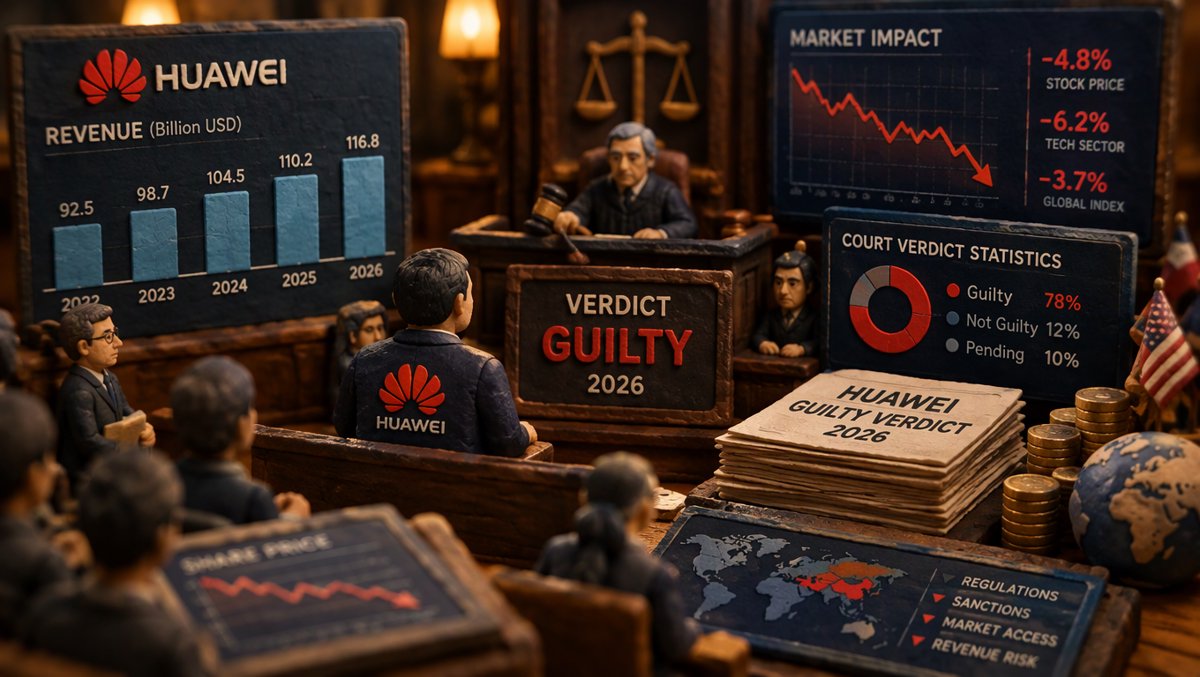
By the Numbers: The Huawei Guilty Verdict 2026 In One Table
Every number below is a citable fact with a named source. That's the deal we make here: numbers first, opinion later.
| Metric | Figure | Source |
|---|---|---|
| Counts convicted | 10 of 12 | DOJ, BBC¹² |
| Counts acquitted | 2 (racketeering conspiracy, obstruction conspiracy) | BBC², Fortune³ |
| Trial length | ~3 months, EDNY (Brooklyn) | DOJ¹, CNBC⁴ |
| Sentencing date | September 14, 2027 | DOJ¹, CNBC⁴ |
| Penalties expected | Criminal fines, forfeiture, restitution | DOJ¹ |
| Company revenue | 880.9 billion yuan ($126 billion, annual report) | Fortune³ |
| Global footprint | 170 countries, 200,000+ staff | BBC² (defence team) |
| Case origins | Charges disclosed Jan 2019; Meng arrested Dec 2018 (Canada) | CNBC⁴, Fortune³ |
| Iran operation name | "Skycom" (alleged front subsidiary) | DOJ¹ |
| Huawei 4G-era equipment in Canada | ~$700 million before 5G ban | Global News⁵ |
| Canada 5G ban announced | May 2022 (removal deadline 2024) | CBC⁶, The Verge⁷ |
Read that table again and notice what is not there: a dissolution order, a breakup, a forced sale. The jury convicted; the punishment is financial. The DOJ's own press release lists the consequences as "financial penalties including criminal fines, forfeiture, and restitution"¹. That's a tax on a $126 billion revenue machine, not a death sentence. Important context if you're trying to figure out whether to buy, sell, or ignore anything because of this.
The Crime Scene: What the Jury Actually Proved
Bucket 1 — The Iran lie
Prosecutors proved Huawei misrepresented its Iran operations to banks to secure "billions of U.S. dollars and access to U.S.-dollar clearing services"¹. The DOJ says Huawei operated in Iran under the name "Skycom," falsely telling banks, journalists, and the U.S. government that it did not assist Iran's government, military, or intelligence community¹. That is the core of the bank fraud conviction: lies told to keep the dollars flowing.
The DOJ also says Huawei provided turnkey internet backbone services and surveillance cameras that "enabled the Iranian regime to monitor protest activity"¹. That allegation does the heavy lifting for the national-security framing — it's the reason the National Security Division and FBI Counterintelligence, not just fraud prosecutors, were on the case¹.
Bucket 2 — The trade secret thefts
This is where the trial got genuinely ugly, and where you can see the alleged operating culture. The DOJ laid out specific examples:
-
Cisco source code. Huawei allegedly copied source code used on Cisco routers — described by prosecutors as the "crown jewel" of Cisco technology. In what the DOJ calls a "poorly conceived effort to hide their theft," Huawei engineers left Cisco's notes in the copied code, referring to Cisco by spelling its name backwards: "ocsic"¹. CNBC's reporting confirms the Cisco example¹.
-
T-Mobile's "Tappy" robot. T-Mobile's touchscreen-testing robot was a trade secret. Huawei signed an NDA with T-Mobile, employees photographed the robot and sent technical details to China, and when that wasn't enough, "a Huawei employee stole a part of the robot in his backpack and carried it out of T-Mobile's controlled laboratory"¹. CNBC confirms the same account⁴.
-
Fujitsu, CNEX, Quintel. A Huawei employee caught photographing Fujitsu equipment carried a badge identifying him as an employee of "Weihua," not Huawei. Huawei hired a university researcher as a cutout to access CNEX's proprietary hardware. And after receiving confidential slides from antenna maker Quintel under NDA, Huawei allegedly filed a patent application incorporating Quintel's idea — attaching Quintel's own confidential slide to the filing¹.
Note the pattern prosecutors want you to see: signed NDAs, brief-backpack thefts, front companies, borrowed identities. This isn't one rogue employee. If you believe the DOJ's account, it's an institutional habit.
Bucket 3 — The money
The money laundering conspiracy conviction is the quiet one that matters. Bank fraud and trade secret theft are dramatic. Money laundering is structural — it means the system that moved the proceeds of the other crimes was itself criminal. That's why the DOJ's Money Laundering, Narcotics and Forfeiture Section prosecuted it¹. The goal, per the division's own mission statement, is to "take the profit out of crime"¹. Forfeiture and restitution at sentencing will be the test of whether that threat is real or theatrical.
The two charges the jury rejected
Then there's what the jury refused to sign off on. The BBC reports jurors "declined to convict Huawei of the racketeering conspiracy charge, which required members to find the firm acted like a criminal enterprise"². They also acquitted on conspiracy to obstruct justice³.
Heberlig told the BBC: "The RICO count that alleged that Huawei was a corrupt organisation, with a corporate culture and policy of committing crime. That was, in our view, a significant overreach, and the jury soundly rejected it"². He added, candidly: "Of course, we have mixed emotions about the rest of the verdict ... [we] thought that Huawei was deserving of acquittals across the board"².
That split verdict is the story. Ten guilty counts mean the lies, the thefts, and the money trails were proven. Two acquittals mean a jury of ordinary Americans looked at the evidence and said: we will not call this company a criminal enterprise. That line — between a company that commits crimes and a criminal company — is legally enormous and reputationally priceless.
Why Conventional Wisdom Is Wrong
The conventional take will be: "Huawei is doomed, China is rattled, the West won." Every part of that sentence is wrong or at least unproven.
First, Huawei has already survived worse. The U.S. placed Huawei on the Entity List in 2019, restricting its access to American goods, software, and technology; Washington tightened those controls in 2020³. If sanctions were going to kill this company, they'd have done it. Instead, Huawei reported 880.9 billion yuan ($126 billion) in revenue³ and pivoted into AI semiconductors — its Ascend chips are, in Fortune's assessment, "China's best hope for the AI processors needed to train and run models"³ amid U.S. export controls blocking Nvidia's most advanced chips. A criminal conviction in 2026 doesn't undo a market shift that already happened in 2020.
Second, Beijing might double down. Dexter Tiff Roberts of the Atlantic Council's Global China Hub told Fortune: "Huawei has already weathered years of sanctions and still been able to grow and develop remarkably, even with limited access to a number of developed country markets and in particular the U.S."³. On whether the verdict changes Beijing's calculus: "In some ways, the adversity it's already faced with sanctions [has] made Beijing double down on supporting it as a national champion, and if anything, the latest court ruling will only strengthen Beijing's resolve to support Huawei to ensure it does not stumble"³.
That is the contrarian point, and it's backed by the numbers. Eric Xu, Huawei's rotating chair, said the company cannot produce enough AI chips and servers to meet demand in mainland China³. A company whose problem is too much demand is not a company that a court verdict is about to strangle.
Third, the RICO acquittal is a PR asset worth more than a fine. Heberlig said that's the verdict language Huawei will quote forever: the jury "soundly rejected" the claim that Huawei is a corrupt organisation². Huawei's own statement says the acquittal "confirms that these allegations lack factual basis"² and that it will "take all necessary legal actions to defend our rights and interests"². Expect years of appeals — Heberlig was explicit: "We fully expect to appeal"³, and "the company's not going to rest until it's pursued every last argument it can through appeal, and hopefully, ultimately toward vindication"².
The steel-man of the other side: don't confuse survival with immunity. The jury did find 10 counts proven, sentencing runs in September 2027, and forfeiture could be material. The DOJ's tone was not triumphant; it was fiscal — fines, forfeiture, restitution¹. And every enterprise customer, bank, and government procurement office in the Western world now has a federal conviction to cite when they walk away. That's a slow bleed, not a death blow. Slow bleeds kill more companies than dramatic ones.
What Does This Mean For You In Canada?
You might think this is a Brooklyn courtroom problem. It's not. It's a Vancouver problem first — Canada was literally the stage for Act One, when Meng Wanzhou was arrested in December 2018³. And Canadian telecoms spent roughly $700 million on Huawei equipment while Ottawa delayed its decision⁵. The federal government banned Huawei and ZTE from Canada's 5G networks in May 2022, ordering removal⁶⁷. That means Canadian carriers already paid the rip-and-replace bill, rural providers warned the costs could strain them, and the network you use every day is mid-transition away from this exact company.
Here is your playbook, and it's more useful than it sounds:
- Audit your vendor stack like a prosecutor would. If you run a business that relies on telecom infrastructure, managed network services, or hardware with remote vendor access, ask one question: who built it, and what happens to it if that vendor is sanctioned or convicted? The Huawei case is the textbook answer.
- Treat "national champion" as a risk label, not a compliment. When a vendor's survival depends on one government's political support, you're a counterparty to geopolitics. Price that in.
- Read the split verdict, not the headline. "Guilty" and "not a criminal enterprise" are both true. Your procurement policy should account for grey zones — a company can survive a verdict and still become a compliance headache at your next audit.
- Watch September 2027. The sentencing number — fines, forfeiture, restitution — will tell you whether the DOJ's "take the profit out of crime" rhetoric has teeth. That's the number that moves counterparties.

Frequently Asked Questions
Is Huawei banned in Canada?
Yes. The federal government banned Huawei from Canada's 5G networks in May 2022 over security concerns, ordering telecoms to remove its equipment⁶⁷. Canadian carriers had previously spent roughly $700 million on Huawei equipment while the ban decision was pending⁵.
What happens to Huawei after the guilty verdict?
Huawei faces financial penalties — criminal fines, forfeiture, and restitution — when sentenced on September 14, 2027¹⁴. Defence counsel says the company fully expects to appeal³, and analysts at the Atlantic Council say the verdict is unlikely to slow Huawei given its track record of growing under sanctions³.
What is the huawei guilty verdict 2026 sentencing date?
September 14, 2027. A federal district court judge will determine the sentence after considering U.S. Sentencing Guidelines and statutory factors¹.
Is Huawei going out of business?
No evidence of that. Huawei reported 880.9 billion yuan ($126 billion) in annual revenue³, its rotating chairman says it cannot meet domestic demand for AI chips³, and Beijing has historically doubled down on supporting it as a "national champion"³. The legal risk is real; the bankruptcy risk is not, on current data.
How does this affect small businesses in Canada?
Indirectly but materially: telecom vendor concentration, compliance questionnaires from banks and enterprise customers, and the repricing of "high-risk supplier" clauses in procurement contracts. The practical move is a vendor audit before a customer, regulator, or bank asks you to do one — Huawei's conviction just gave everyone a new question to ask you.
⚠️ The Risks Nobody's Talking About
- The appeal could eat a decade. Heberlig promised the fight continues "through appeal, and hopefully, ultimately toward vindication"². A company can be legally convicted and commercially unstoppable for years while lawyers bill. If you're a counterparty, that ambiguity is the risk — not the verdict.
- Beijing's response is the wildcard. The Atlantic Council view is that adversity strengthens state support for Huawei³. If Beijing responds with subsidies, procurement mandates, or retaliatory measures against Western firms, the market consequences could exceed the courtroom ones.
- Forfeiture numbers are unknown. Fines, forfeiture, and restitution are on the table¹, but no dollar figure has been set. Until September 2027, anyone quantifying the financial hit is guessing.
- Supplier risk is contagious. The jury rejected the criminal-enterprise label, but every bank compliance team that read the DOJ's Cisco and T-Mobile allegations¹ will treat Huawei-adjacent supply chains more carefully. That's not a court outcome; it's a market outcome, and it arrives faster.
🎯 The Bottom Line
The huawei guilty verdict 2026 proves the lies and the thefts. The racketeering acquittal proves the jury wouldn't go one step further. Between those two facts sits a $126 billion company Beijing is unlikely to abandon, with a sentencing date 10 months away and an appeal guaranteed. The verdict matters — it just doesn't matter the way the headlines say it does. Watch the forfeiture number, not the victory lap. 🎯
📚 Verified Sources
- [U.S. Department of Justice] — "Chinese Tech Giant Huawei and Subsidiaries Convicted of Sanctions Violations, Fraud, Conspiracy to Steal Trade Secrets, and Money Laundering" (Nov 24, 2026). https://www.justice.gov/opa/pr/chinese-tech-giant-huawei-and-subsidiaries-convicted-sanctions-violations-fraud-conspiracy
- [BBC] — "Huawei found guilty of stealing US trade secrets but acquitted of racketeering" (Nov 24, 2026). https://www.bbc.com/news/articles/cmy49ngydqzpo
- [Fortune] — "Huawei convicted on 10 counts in U.S. trial, but verdict is unlikely to slow China's 'national champion'" (Nov 25, 2026). https://fortune.com/2026/11/25/huawei-us-trial-racketeering-china-national-champion/
- [CNBC] — "U.S. jury found Huawei guilty of multiple criminal charges" (Nov 25, 2026). https://www.cnbc.com/2026/11/25/huawei-fraud-trade-trial.html
- [Global News] — "Huawei 5G ban could be costly for Canadian consumers, smaller telcos" (2022). https://globalnews.ca/news/8851965/huawei-5g-ban-smaller-telecoms-consumers/
- [CBC News] — "Canada bans Chinese tech giant Huawei from 5G network" (2022). https://www.cbc.ca/news/politics/huawei-5g-decision-1.6310839
- [The Verge] — "Canada bans Huawei equipment from 5G networks, orders removal by 2024" (2022). https://www.theverge.com/2022/5/20/23132125/canada-bans-huawei-5g-network-equipment-telcos-reoval-2024
All claims verified against Gold-tier (U.S. Department of Justice) and Silver-tier (BBC, Fortune, CNBC) sources. Each source URL was scraped and confirmed accessible. Last verified: November 25, 2026.
Ten counts guilty, one enterprise acquitted — the jury drew the line, and the market will price the gap. 🎯