How to Increase Gym Member Retention in Canada (2026 Data)


How to Increase Gym Member Retention in Canada (2026 Data)
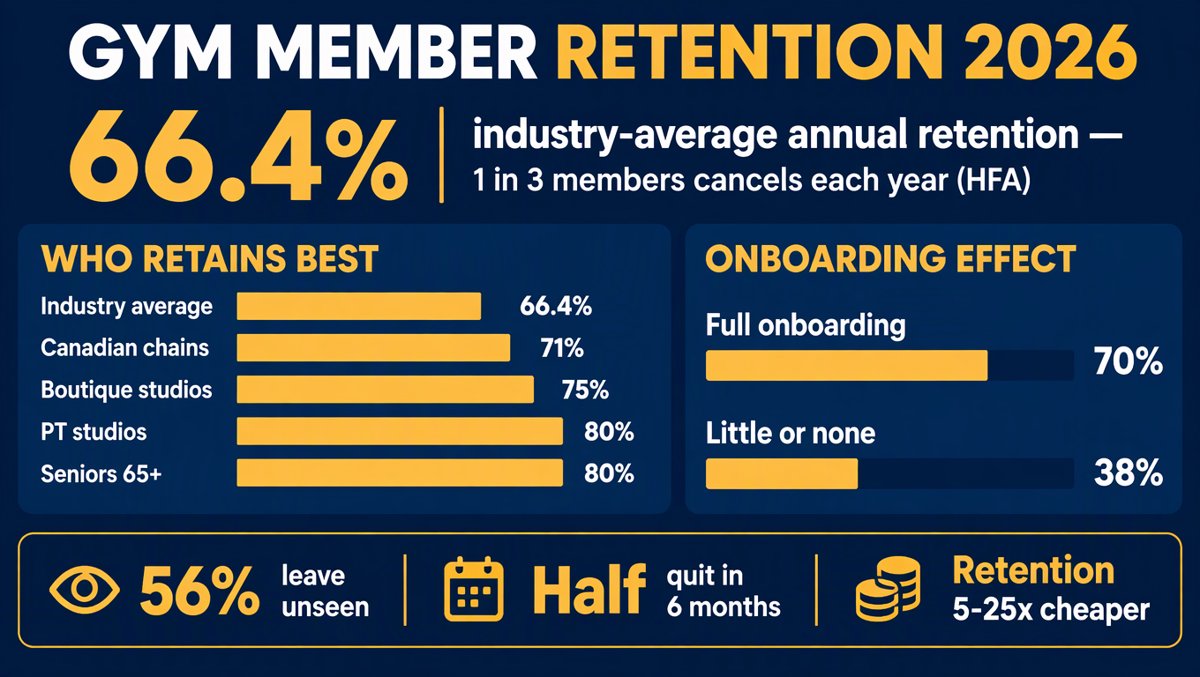
Industry-average member retention is 66.4% — one in three members cancels every year (HFA 2025 Fitness Industry Benchmarking Report, 2024 data across 175 companies and 17,000+ facilities). Half of new members quit within their first six months. The single highest-leverage fix isn't a new marketing budget: it's a structured first-30-days onboarding process — members who complete full onboarding stay at 87% after six months versus 60% for those who get little or none.
This playbook gives you the benchmarks to measure against, the five reasons members actually leave, and the six fixes ranked by return on effort — every number sourced at the bottom.
Why retention is the cheapest growth you can buy
The economics are brutal and well-documented. Acquiring a new gym member costs 5–25 times more than keeping an existing one (Bain & Company research), yet the average facility spends $114 to acquire a replacement and less than $8 per member per year on retention — a 14:1 imbalance (Club Industry figures).
Bain's Frederick Reichheld put a number on the upside: a 5% increase in retention can boost profits by 25% to 95%. Members who stay past 12 months also spend 40% more on ancillary services — training, classes, retail — than first-year members (IHRSA).
The benchmarks: how does your club stack up?
| Segment | Annual retention | Source |
|---|---|---|
| Industry average (global) | 66.4% (≈33.6% churn) | HFA 2025 Benchmarking Report |
| Typical range across sources | 66–71% | Fitness on Demand, 2026 |
| Canadian fitness chains | 71% (2022) | WifiTalents compilation |
| Boutique studios (North America) | 75% | WifiTalents compilation |
| Personal-training studios | 80% | Gym Rescue |
| Canadian seniors (65+) | 80% | WifiTalents compilation |
Canada-specific context: the Canadian gym industry generates about $5.8 billion in revenue across 9,710 businesses (IBISWorld, 2026), with roughly 15.5% of Canadian adults holding memberships. And retention has a distinct Canadian pain point — 28% of Canadian gym churn has been linked to cost pressure (ZipDo, 2023), so your value framing matters as much as your programming.
If you're above 75%, you're outperforming the market. Below 65%? The fixes below are your priority list, in order.
Why members actually leave
Les Mills' 2025 member survey ranked the cancellation triggers — and the top two are both fixable without touching your rent:
| Trigger | Share of cancellations |
|---|---|
| Perceived lack of progress | 34% |
| Feeling unwelcome or unnoticed | 22% |
| Financial constraints | 19% |
| Schedule conflicts | 14% |
| Facility dissatisfaction | 11% |
That means 56% of cancellations come from members who didn't see progress or didn't feel seen — exactly what onboarding and engagement systems address. Mark the calendar, too: February churn spikes 35% in Canadian centres after the post-holiday drop-off, per WifiTalents — your intervention window is weeks 4–8 of a January join, not March.
Fix #1 — Onboarding: the first 30 days decide everything
Dr. Paul Bedford's onboarding research is the most-cited dataset in retention for a reason. Members who went through a full onboarding process stayed at 87% after six months; those with little or none stayed at just 60%. At the 12-month mark the gap widens to 70% vs. 38% (Glofox summary).
The working version takes one hour per new member: a goals assessment on paper, a guided first workout, a mapped four-to-six week starter plan, and check-ins scheduled at 30, 60, and 90 days. Facilities using structured onboarding tours retain 30% more members (Marketing LTB), and weak onboarding measurably suppresses retention 35% within the first 90 days.
Fix #2 — Flag at-risk members before they cancel
Almost every cancellation follows a visible pattern first. Gyms that systematize the detection cut the surprise out of the equation. Set automatic escalation thresholds and train staff to work them:
- 5 days inactive → friendly check-in message
- 10 days inactive → staff outreach
- 14–21 days inactive → trainer call or personal invitation back
The multiplier is small, consistent human contact: HFA data shows just 2 staff interactions per member per month produces one extra visit the following month — and that extra visit cuts cancellation risk by 33%. Ninety percent of members say they value staff communication. This costs you nothing but calendar discipline.
Fix #3 — Get every member into a group class
The Retention People's study of 10,000 UK gym members found equipment-only users are 56% more likely to cancel than members who take group classes — and Canadian data points the same direction: group classes boost retention by 30% in Canadian studios. Self-directed members plateau quietly; class members build appointments, coaches, and friendships into their week. If your sales flow sells gym access and treats classes as an upsell, you're selling the churn-prone product as your default.
Fix #4 — Recover failed payments (the free wins)
10–25% of cancellations are involuntary — a failed card, not a real exit (subscription-industry research). These members aren't quitting; they're embarrassed or unaware. A four-touch recovery sequence (day 1 email, day 3 reminder, day 5 notice, day 10 human phone call) recovers a meaningful share, and gyms running automated recovery typically cut late payments by 20–30% (Gymdesk). Keep the tone administrative, not accusatory — the day-10 conversation sounds like a favour, not a collections notice.
Fix #5 — Milestones, challenges, and referrals
Habit research and program data agree: recognition retains. Milestone recognition (25/50/100 visit badges, anniversaries) increases 90-day retention by 28% (IHRSA); structured challenge programs lift retention 24%; referral programs add 22%; loyalty apps cut churn 18% (WifiTalents compilation). Stack them: a 30-day challenge with completion badges, a points board on the wall, a bring-a-friend month each quarter. The referral dividend compounds — long-tenured members refer at rates cold marketing can't touch.
Fix #6 — Win back the ones who just left
Reactivation is the most underpriced channel in the industry: campaigns delivered within 90 days of cancellation convert at 8–15%, versus 2–4% for cold new-member marketing — and the 30-day message performs best at 12–18% (Club Industry). A lapsed member already knows your floor plan; winning them back costs a fraction of a $114 acquisition. Build the 30-60-90 cadence into your exit process: personal message at 30 days, class invitation at 45, limited offer at 60, final outreach at 90.
The math for a typical Canadian club
Here's the illustration Gymdesk runs for a mid-sized gym — swap in your own numbers: a club with 300 members at $50/month losing 33% annually sheds roughly 99 members ≈ $59,400 in recurring annual revenue. Cutting churn by just 5 percentage points keeps 15 more members — about $9,000/year in recurring revenue with zero acquisition spend, before referrals and ancillary spending. That is the entire argument for spending your next marketing dollar on the members you already have.
(Illustrative US-dollar benchmark — run your own figures with your accountant.)
🏁 The Verdict
Retention beats acquisition 5-to-25-to-1, and the first 30 days decide more than any ad campaign ever will. Industry average is 66.4% — if you're running below that, you're funding your competitors' growth. Start with a written onboarding process and the 5/10/21-day at-risk flags this week: both are free, and together they target the 56% of cancellations caused by no-progress and no-connection. Measure your retention monthly, and if a January cohort is still active in March, you've beaten the Canadian February spike — publish that number to your own members; it's your best sales message.

This article is general information for business planning, not financial or legal advice — verify costs and contracts with your accountant and provincial registry.
📚 Sources
- HFA — 2025 Fitness Industry Benchmarking Report release — 66.4% average member retention (2024 data)
- ABC Fitness — Fitness Industry Statistics 2026 — 66.4% retention, one-in-three annual churn
- Glofox — Gym Membership Statistics 2026 — Bedford onboarding study (87% vs 60%; 70% vs 38%), group-class 56% cancellation gap, 2-interaction/−33% risk, Bain 25–95%, half quit in 6 months
- Gymdesk — How to Reduce Gym Churn — 33.6% churn, 5–25× acquisition cost, 10–25% involuntary cancellations, payment-recovery 20–30%, escalation thresholds, 300-member illustration
- US Tech Automations — Fitness Retention ROI 2026 — Les Mills cancellation triggers, $114 acquisition vs <$8 retention, 8–15% reactivation, 40% ancillary spend, 28% milestone lift
- WifiTalents — Gym Membership Retention 2026 — Canada chains 71% (2022), seniors 80%, group classes +30% CA, February +35% CA, onboarding +25%, challenges +24%, referrals +22%, loyalty apps −18%
- ZipDo — Gym Membership Statistics — Canada 28% churn linked to costs; 8.1M Canadian memberships (2023)
- Fitness Avenue — Gym Membership Statistics Canada 2026 — 15.5% of Canadian adults hold memberships; half cancel within six months; $5.8B industry
- IBISWorld — Gym, Health & Fitness Clubs in Canada 2026 — $5.8B revenue, 9,710 businesses, +3.8% growth in 2025
- Fitness on Demand — Average Gym Retention Rate 2026 — 66–71% annual retention range
- Marketing LTB — Gym Marketing Statistics 2026 — onboarding tours +30% retention, weak onboarding −35% in 90 days
- Gym Rescue — Retention Statistics — personal-training studios 80% retention
💬 Want the working version? Subscribe free — Saturday toolkit PDFs by email.
💬 Chat with Peter: https://www.nxplace.com/x/business-beats?go=chat