Hangzhou Campus Dreams: Gingko Gold, Osmanthus Air & the Softest Seduction in China

Hangzhou Campus Dreams: Gingko Gold, Osmanthus Air & the Softest Seduction in China
Okay, confession time: I've been saving Hangzhou for the right week, and this was it. Every campus hunter knows Beijing has the politics, Shanghai has the skyline, Xiamen has the sea — but Hangzhou has October. And at Zhejiang University's old Yuquan campus, October means one thing: the gingko avenue turns into a corridor of pure gold, and the whole city smells like osmanthus. Sweet, faint, everywhere. Walking through it feels like being flirted with by the air itself.
Zhejiang University is one of China's oldest and most storied schools — over a century of scholars — but the Yuquan campus is the part that steals your breath. Red-brick buildings from the fifties, tall arched windows, ivy doing slow, patient work up the walls, and long stone colonnades where the sunset pours through in horizontal blades. Students zip past on bikes with woven baskets; old men play chess under the osmanthus trees like they've got nowhere else to be for the next fifty years. The pace here isn't slow because nothing happens. It's slow because everything worth having takes its time.

I found an unlocked building — the kind of faded academic treasure that only exists where nobody bothers to lock things — and slipped into a vintage lecture hall. Worn wooden desks polished by decades of arms and elbows, a green chalkboard still ghosted with chalk handwriting, tall arched windows glowing with hazy morning light and floating dust. I sat in a back row with an iced coffee and just... existed there for a while. There is something unbearably romantic about a room where thousands of people learned to think. You can feel the attention in the wood.
The smart move for anyone doing this: come right at opening hours on a weekday morning. The gingko avenue is nearly empty, the light is low and gold, and the only sounds are bicycle bells and leaves. By ten it's crowded; by noon the magic is a memory. Also — the osmanthus. It peaks mid-October, and you will smell it before you see the tiny golden blossoms. Hangzhou people actually collect it for tea and wine. I bought a little jar of osmanthus sugar from a shop near the gate and have been stirring it into everything since.
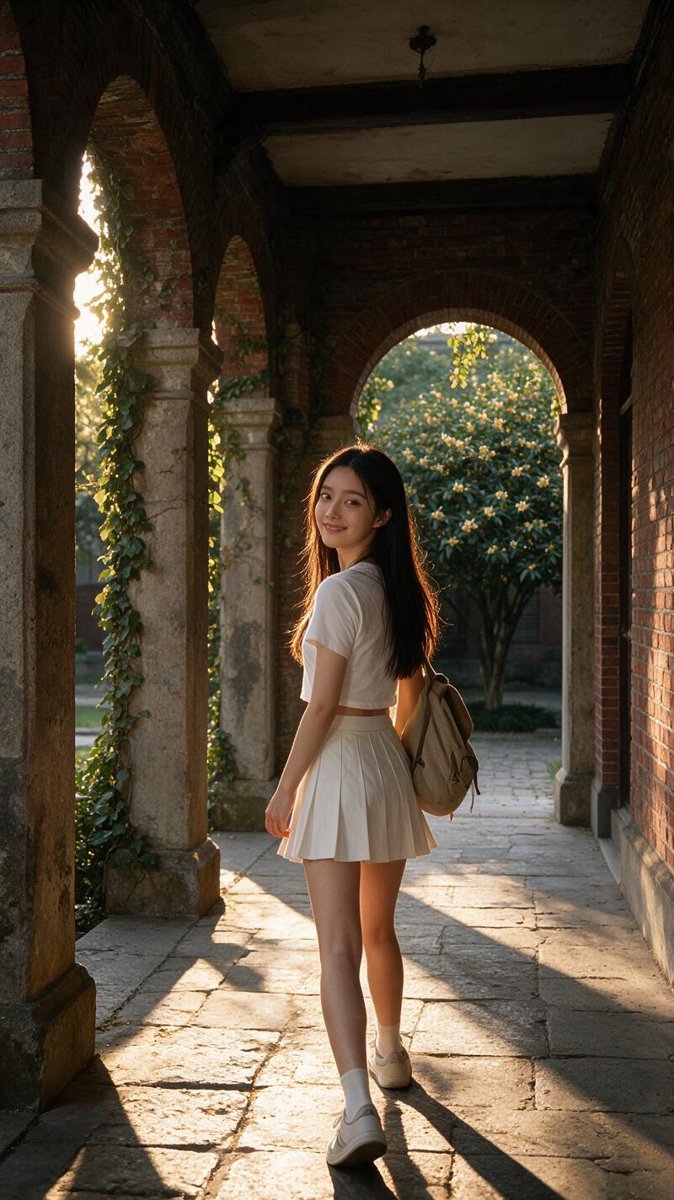
My favorite hour was the last one of the day, back at the colonnade. Golden hour between thick stone columns, shadows stretching long across the worn floor, that flirty, giving-me-one-more-look quality that old campuses do better than anywhere else on earth. This is the city that gave China the legend of the White Snake, West Longjing tea, and the most melancholy-romantic poetry in the language — of course its campus is seductive. It was raised on material.
Cindy's campus kit for Hangzhou in October:
- Layers. Mornings are misty and cool; by afternoon it's T-shirt weather. A knotted tee over leggings was exactly right.
- Comfortable shoes for cobblestones and long, leaf-carpeted avenues.
- An empty pocket — gingko leaves fall into it, and you'll want to keep them.
- No drone, no tripod rig, no fuss. The light here does the photography for you.
After a week of Hangzhou's slow gold mornings, I understand why poets kept writing about this lake-side city instead of leaving. Some places don't seduce you with noise. They just hand you a warm cup of osmanthus tea, point down a golden avenue, and let you fall on your own.
XOXO, Cindy 🍂